
Lecture
A dielectric placed in an electric field can lose its properties as an insulating material if the field strength exceeds a certain critical value. The phenomenon of the formation of a conducting channel in a dielectric under the action of an electric field is called breakdown.
The minimum voltage applied to a dielectric that causes its breakdown is called the breakdown voltage Ubd.
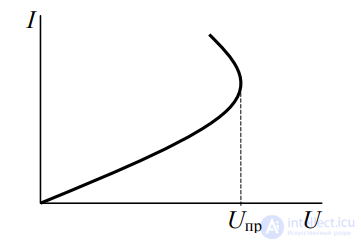
The pre-breakdown state of a dielectric is characterized by a sharp increase in current, a departure from Ohm's law toward increasing conductivity. Formally, the breakdown voltage is taken to be the voltage at which dI/dU→∞, i.e., the differential conductivity becomes infinitely large (Fig. 4.4). The value of the breakdown voltage depends on the thickness of the dielectric h and on the shape of the electric field, determined by the configuration of the electrodes and of the dielectric itself. Therefore it characterizes not so much the properties of the material as the ability of a specific sample to withstand a strong electric field. For comparing the properties of different materials, a more convenient characteristic is the dielectric strength. The dielectric strength is the minimum field strength of a uniform electric field that causes breakdown of the dielectric: Ebd = Ubd /h.
If breakdown occurs in a gaseous dielectric, then, owing to the high mobility of the molecules, the punctured region restores its electrical properties once the voltage is removed. In contrast, breakdown of solid dielectrics results in destruction of the insulation. However, material destruction can be prevented by limiting the rise of current during breakdown to an allowable level.
 I
I
Fig. 4.4. Current-voltage characteristic of a dielectric
Breakdown of dielectrics can arise as a result of purely electrical, thermal, and in some cases electrochemical processes caused by the action of the electric field.
Breakdown of solid dielectrics. Three main breakdown mechanisms can be observed in solid dielectrics: 1) electrical;
Each of these mechanisms can occur in the same material depending on the nature of the electric field it is subjected to – direct or alternating, pulsed, low or high frequency; the duration of voltage exposure; the presence of defects in the dielectric, in particular closed pores; the thickness of the material; the cooling conditions, and so on.
Electrical breakdown of solid dielectrics is characterized by very rapid development. It proceeds within a time of no more than 10–7 … 10–8 s, is not caused by thermal energy, although the dielectric strength under electrical breakdown depends to some extent on temperature, and is accompanied in its initial stage by destruction of the dielectric in a very narrow channel.
Electrical breakdown is by its nature a purely electronic process, in which an electron avalanche is created in the solid from a small number of initial electrons. The development of avalanches is accompanied by photoionization (as in gases), which accelerates the formation of the conducting channel. Electrons accelerated by the field transfer their energy to lattice sites upon collision and heat it up to the point of melting. Significant pressure builds up in the discharge channel, which can lead to the appearance of cracks or complete destruction of the insulator.
A purely electrical breakdown occurs when the influence of electrical conductivity and dielectric losses, which cause heating of the material, is excluded, and when ionization of gas inclusions is absent.
In the case of a uniform field and complete homogeneity of the material's structure, the breakdown field strengths under electrical breakdown can serve as a measure of the dielectric strength of the substance. Such conditions can be observed in single crystals of many oxides, alkali halide compounds, and some organic polymers. In this case Ebd reaches more than 1000 MV/m. Electrical breakdown is observed in most dielectrics under short-duration (pulsed) voltage exposure.
Thin films can have a substantially higher dielectric strength than bulk samples. This property is known as electrical strengthening of materials. Its use makes it possible to increase the reliability of thin-film insulation in microelectronic elements and devices, since the operating field strengths in thin films (~108 V/m) are close to the breakdown values for bulk samples.
Thermal breakdown occurs when the amount of thermal energy released in the dielectric due to dielectric losses exceeds the amount of energy that can be dissipated under the given conditions; in this case thermal equilibrium is disrupted, and the process takes on an avalanche-like character.
The phenomenon of thermal breakdown amounts to heating of the material in the electric field to temperatures corresponding to melting, charring, and so on. The dielectric strength under thermal breakdown is a characteristic not only of the material but also of the article made from it, whereas the dielectric strength under electrical breakdown serves as a characteristic of the material itself. The breakdown voltage caused by heating of the dielectric is related to the frequency of the voltage, the cooling conditions, the ambient temperature, and other factors. In addition, the electrothermal breakdown voltage depends on the heat resistance of the material; organic dielectrics (for example, polystyrene) have lower electrothermal breakdown voltages than inorganic ones (quartz, ceramics), other conditions being equal, owing to their lower heat resistance.
Typical signs of thermal breakdown are an exponential decrease of the breakdown voltage with increasing ambient temperature, as well as a decrease in dielectric strength with increasing exposure time of the dielectric in the electric field (at relatively small values of t).
The thermal breakdown mechanism is most likely at elevated temperatures, when losses due to through conductivity can be expected to dominate. For the dissipated power the following expression is known:
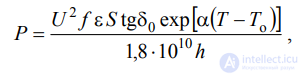
where U – is the applied voltage; f – is the frequency; ε – is the relative permittivity (assumed independent of temperature);
tgδ0 – is the loss tangent of the dielectric at ambient temperature; α – is the temperature coefficient of the dielectric loss tangent; Т – is the temperature of the material heated by dielectric losses; То – is the ambient temperature; S – is the electrode area; h – is the thickness of the dielectric.
The temperature Т throughout the volume of material located in the field between the electrodes (neglecting edge effects) is uniform, provided the dielectric is not too thick and its thermal conductivity is not too poor (a sufficiently valid assumption).
Since the thermal conductivity of the electrode metal, with rare exceptions, is two to three orders of magnitude greater than that of the dielectric, we will assume that heat is removed from the heating volume into the surrounding medium through the electrodes (neglecting heat removal through the end surface of the dielectric). The power removed from the dielectric is expressed by Newton's formula:
PT = 2αS(T −T0),
where α – is the overall heat transfer coefficient from the dielectric to the surrounding medium.
The breakdown voltage under thermal breakdown is calculated by the formula:
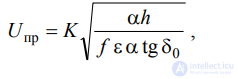
where K – is a numerical coefficient equal to 1.15 – 105, if all quantities having dimensions are expressed in SI units.
The resulting expression shows that the thermal breakdown voltage will be higher if the heat removal conditions are better (α is larger) and the dielectric is thicker; it will be lower at high frequencies, large values of the dielectric loss coefficient εtgδ, and a large temperature coefficient of the loss tangent α.
In real conditions the phenomenon of thermal breakdown proceeds in a more complex way than considered above. Along the thickness of the dielectric a temperature gradient develops, the middle layer turns out to be heated more than the layers adjacent to the electrodes, its resistance drops sharply, which leads to distortion of the electric field and increased voltage gradients in the surface layers. The thermal conductivity of the electrode material is also significant. All this contributes to breakdown of samples at lower voltages than those obtained from the approximate calculation.
A variety of thermal breakdown can be considered to be ionization breakdown. It is characteristic of solid porous dielectrics and is caused by ionization of gas in the pores. Due to ionization losses, the surface of closed pores heats up, local temperature differences arise in the dielectric, along with associated thermomechanical stresses. Such processes are especially dangerous in brittle materials, since the thermomechanical stresses can exceed the material's strength limit and cause the dielectric to crack.
Electrochemical breakdown. Electrochemical breakdown of electrical engineering materials is significant at elevated temperatures and high air humidity. This type of breakdown is observed under direct and low-frequency alternating voltage, when processes develop in the material that cause an irreversible decrease in insulation resistance (electrochemical aging). In addition, electrochemical breakdown can occur at high frequencies if ionization of gas takes place in closed pores of the material, accompanied by a thermal effect and reduction, for example in ceramics, of oxides of metals with variable valence.
The development of electrochemical breakdown requires a long time, since it is associated with the phenomenon of electrical conductivity. In ceramics containing oxides of metals with variable valence (for example, TiO2), electrochemical breakdown occurs considerably more often than in ceramics composed of oxides of aluminum, silicon, magnesium, and barium. Electrochemical breakdown is also observed in many organic materials; it depends significantly on the electrode material.
Surface breakdown. During testing and operation of solid dielectrics with high dielectric strength, the phenomenon of surface breakdown may be observed, meaning the breakdown of gas or liquid near the surface of a solid dielectric. Essentially, in the case of surface breakdown the dielectric strength of the solid dielectric itself is not violated, however the formation of a conducting channel on the surface substantially limits the operating voltages of the insulator.
The value of the surface breakdown voltage is largely determined by the configuration of the electrodes, the overall dimensions, and the shape of the solid dielectric. If the insulator is operated in air, the surface breakdown voltage depends on the pressure, temperature, relative humidity of the air, and the frequency of the electric field. In some designs the surface breakdown voltage can even be lower than the breakdown voltage of the gas under the same conditions. One of the causes of this effect is the distortion of the uniformity of the electric field caused by the redistribution of charges in the adsorbed moisture film.
As a result of the displacement of ions along the surface of the solid dielectric, the field strength near the electrodes increases sharply.
The more pronounced the hydrophilic properties of the dielectric, the more strongly the surface breakdown voltage drops under conditions of increased humidity. However, the influence of air humidity on this breakdown voltage is weak in the radio-frequency range, when the surface of the dielectric is dried out owing to increased dielectric losses in the adsorbed moisture film.
To prevent surface breakdown, it is necessary to increase, as much as possible, the length of the discharge path along the surface of the solid dielectric. This is facilitated by creating a ribbed surface on insulators, machining various types of grooves, and manufacturing designs with «recessed» electrodes. An increase in operating voltages is also achieved by smoothing out inhomogeneities of the electric field through changes in electrode shape or optimization of the insulator design. A similar effect can be obtained by applying semiconducting coatings or dielectric films with increased permittivity to the surface of the insulator.
An effective measure against surface breakdown is to replace air with a liquid dielectric, for example transformer oil. As is known, many liquids have a higher dielectric strength. In addition, the permittivity of liquids, which is higher than that of air, helps to reduce the field strength at the surface of the solid dielectric. Therefore, by immersing the insulator in a liquid dielectric, one can achieve higher permissible operating voltages.

Comments