
Lecture
Conductor — a substance, medium, or material that conducts electric current well.
A conductor contains a large number of free charge carriers, that is, charged particles that can move freely within the volume of the conductor and, under the action of an electric voltage applied to the conductor, create a conduction current . Owing to the large number of free charge carriers and their high mobility, the value of the electrical conductivity of conductors is large.
From the standpoint of electrodynamics, a conductor is a medium with a large value, at the frequency under consideration, of the dielectric loss tangent (tgδ >> 1) ; in such a medium the conduction current is much greater than the displacement current. Here an ideal conductor (superconductor) is understood as a medium with an infinitely large value of tgδ, while other conductors are called real conductors or conductors with losses.
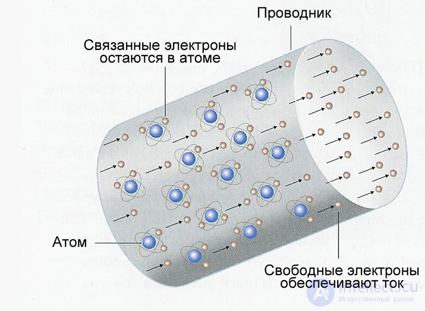
Conductors is also the name given to parts of electrical circuits — connecting wires , metal busbars, and so on.
Among the most common solid conductors are metals, semimetals, and carbon (in the form of coal and graphite). An example of conducting liquids under normal conditions is mercury and electrolytes, and at high temperatures, molten metals. An example of conducting gases is ionized gas (plasma). Some substances that are insulators under normal conditions can pass into a conducting state under external influences; in particular, the conductivity of semiconductors can vary strongly with changes in temperature, illumination, doping, and so on.
The microscopic description of conductors is connected with the electron theory of metals. The simplest model describing conductivity has been known since the beginning of the last century and was developed by Drude.
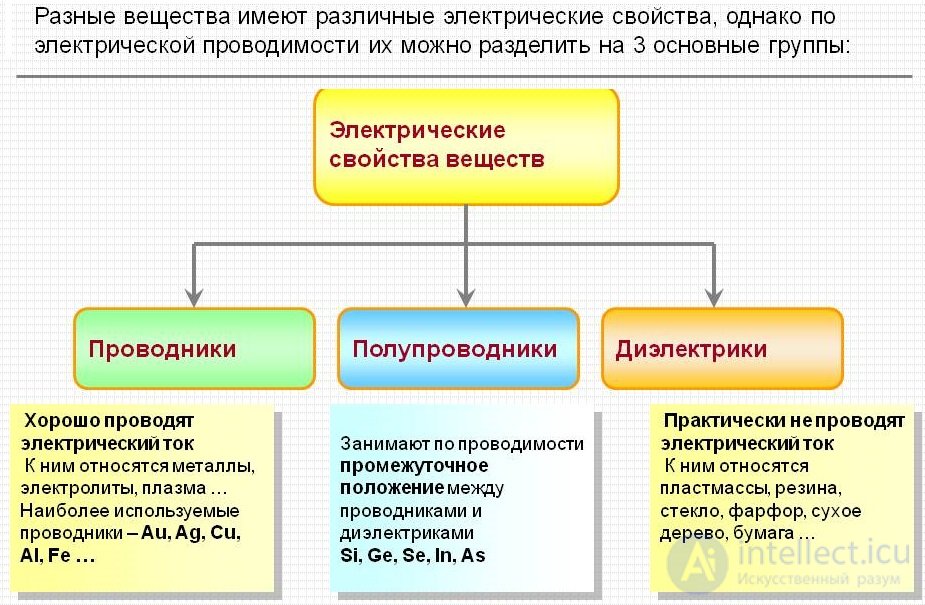
Conductors are divided into:
Solids, liquids, and gases can all serve as conductors of electric current.
Solid conductors are metals, metal alloys, and certain modifications of carbon.
Liquid conductors include molten metals and various electrolytes.
The mechanism of current flow through metals in the solid and liquid states is due to the motion of free electrons, which is why they are called conductors with electronic conductivity, or conductors of the first kind.
Electrolytes, or conductors of the second kind, are solutions (mainly aqueous) of acids, bases, and salts, as well as melts of ionic compounds. The passage of current through such conductors is associated with the transport of ions, as a result of which the composition of the electrolyte gradually changes, and electrolysis products are released at the electrodes.
All gases and vapors, including those of metals, are not conductors at low electric field strengths. If the electric field strength exceeds a certain value that enables the onset of impact ionization, the gas can become a conductor possessing both electronic and ionic conductivity. A strongly ionized gas is called plasma.
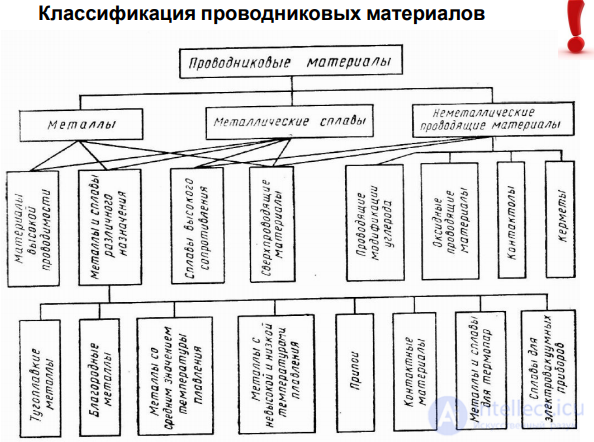
Fig. Classification of conductor materials
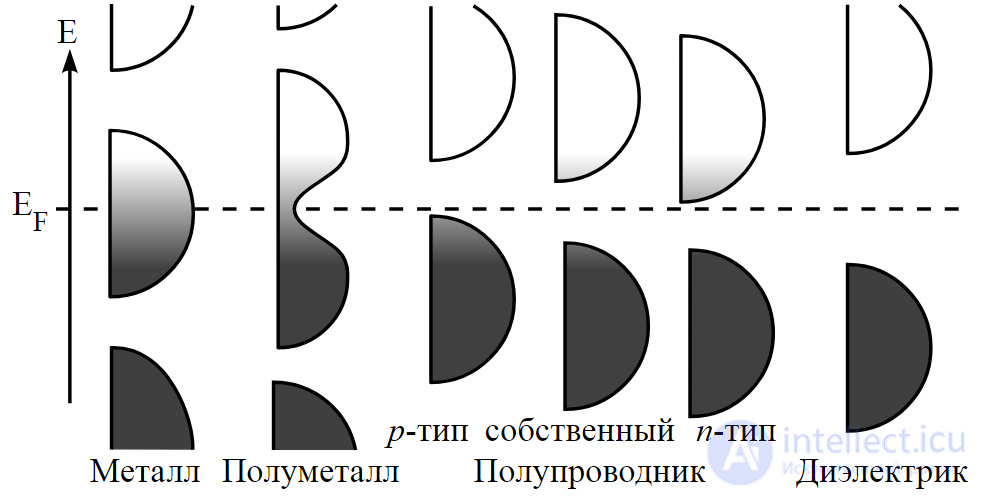
Diagram of the filling of electronic energy levels in various types of materials in an equilibrium state. In the figure, energy is conventionally shown by the height, and the width of the shapes represents the density of states for a given energy in the material in question.
The shading corresponds to the Fermi–Dirac distribution (black — all states occupied, white — state empty).
Semimetals
In metals and semimetals, the Fermi level  lies inside at least one allowed band. In dielectrics and semiconductors, the Fermi level lies inside the band gap, but in semiconductors the bands lie close enough to the Fermi level to be filled with electrons or holes as a result of thermal motion of the particles.]] Semimetals — in solid-state physics, this term denotes various substances that, in terms of their electrical properties, occupy an intermediate position between metals and semiconductors. Unlike semiconductors, semimetals possess electrical conductivity near absolute zero temperature, whereas semiconductors (and even more so, dielectrics) are insulators under these conditions.
A characteristic feature of semimetals is a small overlap of the valence band and the conduction band, which, on the one hand, means that semimetals remain conductors of electric current all the way down to absolute zero temperature, while, on the other hand, as the temperature rises the number of charge carriers (electrons and holes) increases, yet still remains small, reaching a concentration of up to 1018—1020 cm−3, or up to 10−3 per atom.
Charge carriers in semimetals are distinguished by high mobility and small effective mass. This is why semimetals are convenient materials for observing size effects , semimetal–dielectric phase transitions in strong magnetic fields, and a number of other phenomena in solids.
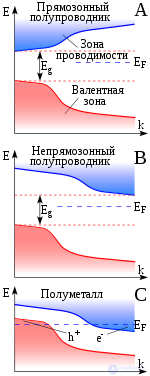
Band diagram of a direct-gap (A) semiconductor, an indirect-gap (B) semiconductor, and a semimetal (C).
 – energy;
 – wave number;
 – band-gap width;
– Fermi level;
 – holes in the valence band;
 – electrons in the conduction band.
According to physics, all substances consist of atoms, and atoms consist of a positive nucleus and electrons rotating around it in various orbits. Electrons rotating in the outer orbit are called valence electrons and form bonds between neighboring atoms. A distinction is made between a valence bond, in which an electron rotates around its own orbit, and a covalent bond, in which valence electrons rotate along a common orbit between two neighboring atoms. Electrons that have left their orbit and move freely within the substance are called free electrons and take part in the conduction of electric current.
With respect to electric current, all substances are divided into:
In a solid crystalline body consisting of many atoms, the electric and magnetic fields of individual atoms influence one another, forming energy levels.
To explain the distinguishing features of insulators, conductors, and semiconductors, band theory is used, according to which electrons, rotating around their nucleus in different orbits, possess different energies.
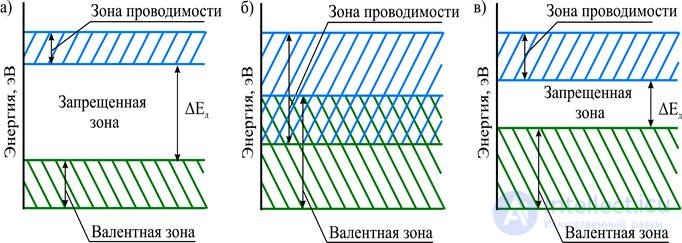
Fig. 1.1 – Energy bands of an insulator (a), a conductor (b), and a semiconductor (c).
According to band theory, the difference between these substances is as follows:
The energy levels occupied by valence electrons form the valence band. The energy levels occupied by free electrons that take part in conduction form the conduction band. The valence band and the conduction band are separated by the band gap.
Band-gap width:
The electrical conductivity of substances is determined by the content of free electrons. In metals, 1 cm3 contains about 1022e/cm3, while in semiconductors it is 109÷1010e/cm3.
To create a current of I=1A, it is necessary to pass approximately ne≈1018 per second.

Comments