
Lecture
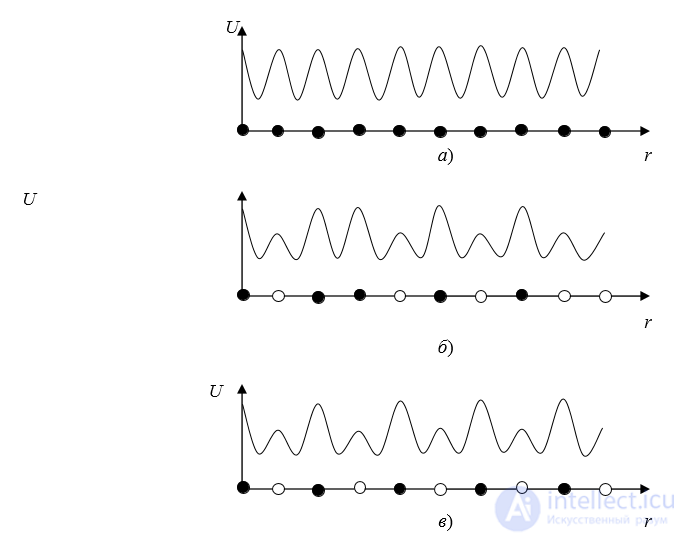
An ideal metal lattice has a strictly periodic potential (Fig. 2.2, a).
If part of the copper atoms are randomly replaced by atoms of another element, then the field near the impurity atoms is not the same as near the host atoms. The lattice potential becomes non-periodic (Fig. 2.2, b). It is disturbed by randomly distributed impurities, which leads to carrier scattering and additional electrical resistance.
r
Fig. 2.2. Electrical conductivity of alloys:
a – strictly periodic potential of an ideal metal lattice; b – disturbance of the periodicity of the lattice potential by non-uniformly
distributed impurity atoms; c – periodic distribution of the potential with a uniform distribution of impurity
In alloys, impurities cause a stronger disturbance of the periodicity of the lattice potential than thermal vibrations do. Therefore the resistivity of an alloy ρalloy is significantly greater than the resistivity ρ of pure metals and is determined mainly by carrier scattering on impurities.
As Nordheim showed, the mobility for binary alloys, caused by scattering on disturbances of the periodicity of the lattice potential, is given by the following approximate relation:
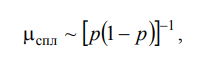
where p and 1−p are the relative fractions of the metals forming the alloy.
Substituting the expression for the mobility of the alloy into σ = qnµ, and taking into account that ρ =  , we obtain the expression for the resistivity of a binary (two-component) alloy:
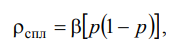
where β is a proportionality coefficient.
The function p(1−p) has a maximum at p = 1/2, i.e., when both components are present in the alloy in equal amounts. If
the metals being alloyed, at a certain ratio of components, form a compound with an ordered internal structure, then the periodicity of the lattice is restored (Fig. 2.2, c) and the resistance due to scattering on impurities practically disappears entirely.
This fact confirms the quantum theory of electrical conductivity, according to which the cause of the electrical resistance of solid materials is not the collision of free electrons with lattice atoms, but their scattering on lattice defects that disturb the periodicity of the potential.
An ideally regular, defect-free lattice, having a strictly periodic potential, is unable to scatter free charge carriers and should therefore have zero resistance. This is not the phenomenon of superconductivity, but the natural behavior of all absolutely pure metals at extremely low temperatures, following from the quantum nature of their electrical resistance.
The resistance determined by scattering on impurities does not depend on temperature and persists at absolute zero. It is therefore called the residual resistance ρres.
At a temperature other than absolute zero, the resistance ρt, caused by scattering on thermal vibrations of the lattice, is added to the residual resistance ρres, and the total resistance of the conductor is
ρ = ρres + ρt .
Since for alloys ρres is usually much greater than ρt, their resistivity, up to high temperatures, changes with temperature considerably more weakly than that of pure metals, and the temperature coefficient of resistance of alloys is, as a rule, significantly lower than the temperature coefficient of resistance of pure metals.

Comments