
Lecture
The classical electron theory of metals, developed by Drude and Lorentz, is based on the concept of an electron gas consisting of free (collectivized) electrons. The electron gas is attributed the properties of an ideal gas, i.e., the motion of the electrons obeys the laws of classical statistics.
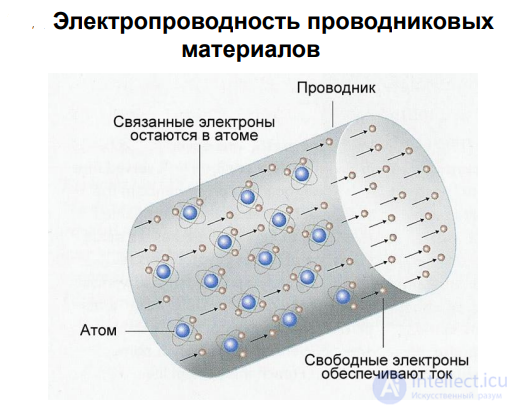
If it is assumed that the atoms in the metal are singly ionized, the concentration of free electrons will equal the concentration of atoms and can be calculated using the formula
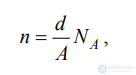
where d is the density of the material; A is the atomic mass; NA is Avogadro's number. The current density in a conductor is determined by the expression
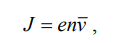
where v is the average velocity of the directed motion of the charge carriers.
In a copper conductor, a current density of 106 A/m2 corresponds to an electron drift velocity on the order of 10–4 m/s. The average thermal velocity u at a temperature of 300 K is on the order of 105 m/s. Thus, it can be considered that under real conditions the inequality v << u holds.
The main shortcoming of the classical theory is not only the assumption of the existence of free electrons, but, more importantly, the application to them of the laws of classical Maxwell–Boltzmann statistics, according to which the distribution of electrons over energy states is described by an exponential function
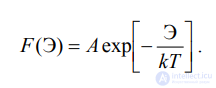
In this case, any number of electrons can occupy each energy state, which contradicts the Pauli principle, according to which only two electrons with opposite spins can occupy each state.
In quantum theory, the probability of an energy state being occupied by electrons is determined by the Fermi function:
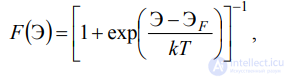
where E is the energy of the level whose occupation probability is being determined; EF is the energy of the characteristic level about which the probability curve is symmetric (the Fermi energy). At T = 0 K, F(E) = 1, if E ≤ EF.
Thus, the value EF determines the maximum energy that an electron in a metal can have at a temperature of absolute zero. The corresponding potential φF = EF /e is called the electrochemical potential.
The distribution of electrons over energies is determined by the occupation probability of the levels and the density of quantum states in the band:
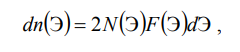
where dn is the number of electrons per energy interval from E to E + dE; N(E) is the density of allowed states in the band.
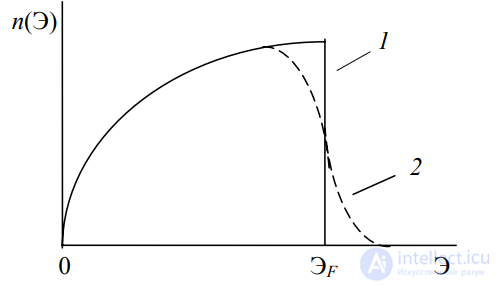
Fig. 2.1. Distribution of electrons over energies in a metal: 1 – T = 0 K; 2 – T ≠ 0 K
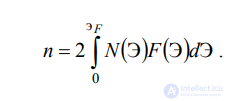
The total electron concentration in the metal is found by integrating over all occupied states (fig.
Systems of microparticles whose behavior is described by Fermi–Dirac statistics are called degenerate.
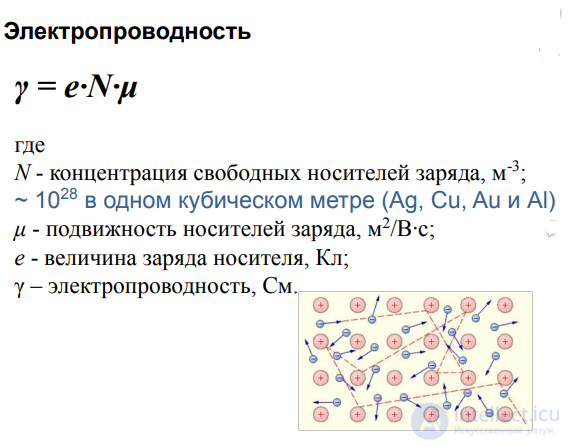
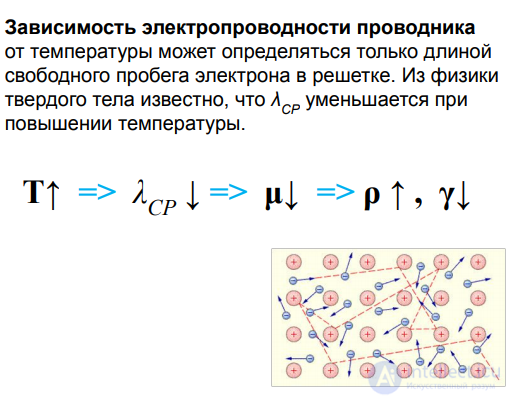
Fig. electrical conductivity
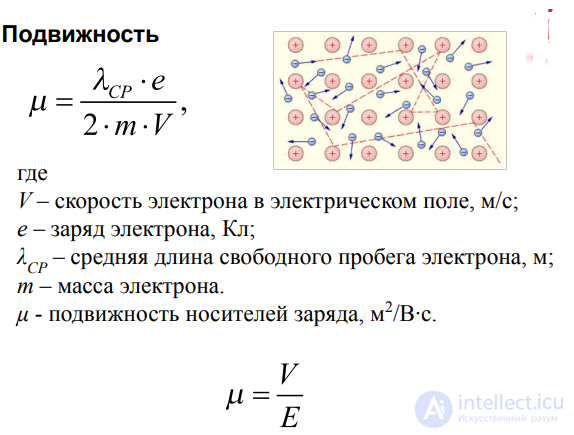
Fig. mobility
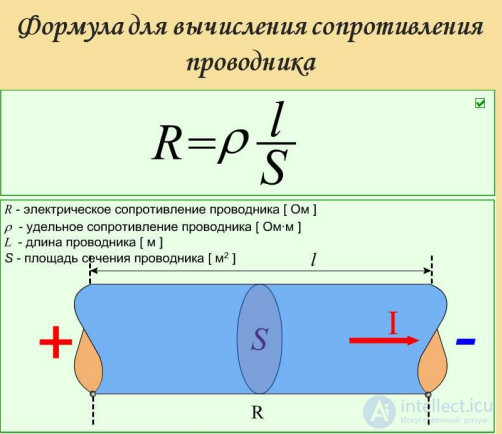
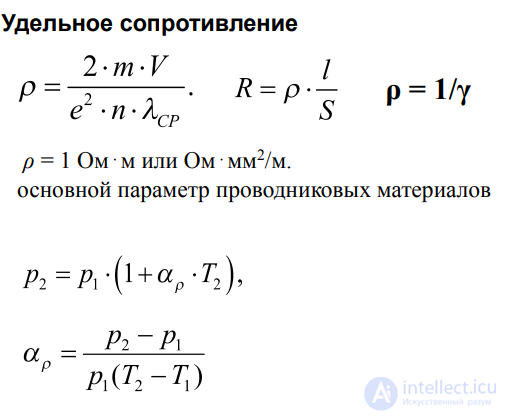
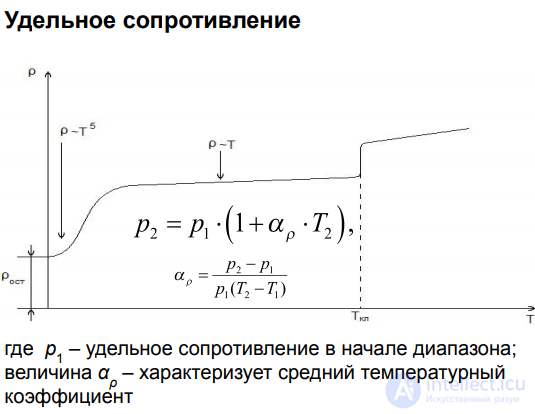
Resistivity, temperature dependence of resistance

Comments