
Lecture
Glass-ceramics (sitalls) are glass-crystalline materials obtained through almost complete stimulated crystallization of specially formulated glasses. They occupy an intermediate position between ordinary glasses and ceramics. A drawback of glasses is considered to be the process of local crystallization – devitrification, which leads to the appearance of inhomogeneity and deterioration of the properties of glass articles. If one or more additives that provide crystallization nuclei are introduced into the composition of glasses prone to crystallization, it becomes possible to stimulate the crystallization process of the glass throughout the entire volume of the article and obtain a material with a homogeneous microcrystalline structure.
The technology for producing glass-ceramics consists of several operations. First, an article is made from the glass melt using the same methods as for ordinary glass. It is then most often subjected to a two-stage heat treatment at temperatures of 500 … 700°C and 900 … 1100°C. In the first stage, crystallization nuclei form; in the second, crystalline phases develop. The content of crystalline phases by the end of the process reaches about 95%, and the sizes of the optimally developed crystals are 0.05 … 1 µm. The change in dimensions of the articles during crystallization does not exceed 1 … 2%.
Thus, glass-ceramics differ from glasses in that they mainly have a crystalline structure, and from ceramics – in the significantly smaller size of the crystalline grains.
Crystallization of glass may be due to photochemical or catalytic processes. In the first case, the crystallization centers are the finest particles of metals (silver, gold, copper, aluminum, etc.), released from the corresponding oxides that are part of the glass composition, under the influence of irradiation followed by heat treatment to develop the image. Ultraviolet radiation is usually used to initiate the photochemical reaction. During heat treatment, crystallites form and grow around the metal particles. At the same time, during development, the material acquires a certain color. Glass-crystalline materials obtained by this method are called photo-sensitive glass-ceramics. If not the entire surface of the article is irradiated, but only certain areas, local crystallization can be induced in a specified volume.
Crystallized areas dissolve considerably more easily in hydrofluoric acid than the adjacent glassy regions. This makes it possible to obtain holes, recesses, etc. in the articles by etching.
The technology for manufacturing glass-ceramics is simplified if compounds that are of limited solubility in the glass melt or that crystallize readily from the melt are used as crystallization catalysts. Such compounds include TiO2, FeS, B2O3, Cr2O3, V2O5, and fluorides and phosphates of alkali and alkaline-earth metals. With catalytic crystallization, the need for preliminary irradiation is eliminated. The glass-crystalline materials obtained in this way are called thermal glass-ceramics.
In appearance, glass-ceramics are dense materials, white and ranging from light beige to brown in color. They are distinguished by increased mechanical strength, may have either a very small or a large coefficient of linear expansion, high thermal conductivity, and satisfactory electrical characteristics.
Many glass-ceramics have high chemical resistance to strong acids (except HF) and alkalis. The availability of raw materials and the simple technology ensure a low cost of the articles.
By technical purpose, glass-ceramics can be divided into structural and capacitor grades. Structural glass-ceramics are widely used as substrates for hybrid integrated circuits and discrete passive elements (e.g., thin-film resistors), parts for microwave devices, and certain types of electron tubes. The advantage of glass-ceramic capacitors is their increased dielectric strength compared to ceramic capacitors.
To increase the strength of glass, its crystallization, which leads to structural inhomogeneity of the material, is generally avoided. However, if such crystallization proceeds under controlled conditions and the final structure of the material consists of microcrystalline particles uniformly distributed in a glassy matrix, the material acquires a set of new properties.
Materials obtained by controlled crystallization of inorganic glass are called glass-crystalline materials or glass-ceramics. The glass crystallization process in glass-ceramics is carried out to completion, so that the residual content of the non-crystalline phase is no more than a few percent. The crystal size in glass-ceramics is 1…2 µm, and the thickness of the non-crystalline interlayers is a few tenths of a micrometer. The same components used for glasses are used to manufacture glass-ceramics, along with additives – catalysts (nucleating agents). The basis of glass-ceramics consists of oxides (Li2O, Al2O3, SiO2, MgO, CaO, and others), and salts of photosensitive metals (Au, Ag, Cu) are used as nucleating agents, which act as colloidal dyes and are present in the glass in the form of the finest colloidally dispersed particles, as well as fluoride and phosphate compounds, TiO2, and others, which represent crystallization centers distributed in the glass as poorly soluble particles.
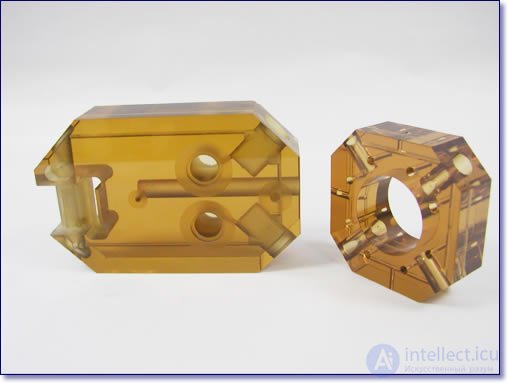
After melting the batch for glass-ceramics and articles produced by conventional technology, it is reheated to the glass transition temperature (400…600 °C). At this temperature, crystals form, nucleating at the crystallization centers. The holding time of the article at the glass transition temperature is chosen so as to obtain the maximum volume of the crystalline phase. The degree of crystallization in glass-ceramics reaches up to 95%. Depending on the starting raw material, three types of glass-ceramics are distinguished – photo-sensitive glass-ceramics, thermal glass-ceramics, and slag-based glass-ceramics. The structure of glass-ceramics is multiphase and consists of grains of one or more crystalline phases bonded together by a glassy interlayer. The content of the crystalline phase ranges from 30 to 95%. The crystal size usually does not exceed 1…2 µm. In appearance, glass-ceramics can be opaque or transparent (the amount of glass phase in them reaches up to 40%).
Slag-based glass-ceramics are obtained from blast-furnace slag and catalysts (sulfates, iron powders, and others); fluorine compounds are introduced into them to enhance ceramization.
Unlike ordinary glass, whose properties are determined mainly by its chemical composition, the properties of glass-ceramics are decisively determined by their structure and phase composition. The reason for the valuable properties of glass-ceramics is their exceptional fine grain size and nearly ideal polycrystalline structure. The properties of glass-ceramics are isotropic. They are completely free of any porosity. Shrinkage of the material during processing is negligible. The high abrasion resistance of glass-ceramics makes them insensitive to surface defects.
The density of glass-ceramics is 2,400…2,950 kg/m3, the flexural strength σfl = 70…350 MPa (and even up to 560 MPa), the tensile strength — σt = 112…161 MPa, the compressive strength — σc = 700…2000 MPa, and the modulus of elasticity — 84…141 GPa. The strength of glass-ceramics depends on temperature. Up to a temperature of 700…780 °C its strength decreases only slightly, while at higher temperatures it drops rapidly. The heat resistance of glass-ceramics under load is 800…1,200 °C. The maximum softening temperature tsof = 1,250…1,350 °C. The impact toughness of glass-ceramics is higher than that of glass (4.6…10.5 kJ/m2), but they too belong to brittle materials, and their hardness approaches that of hardened steel (microhardness is 7,000…10,500 MPa). At the same time, they are very wear-resistant (ffr = 0.07…0.19). The coefficient of linear expansion of glass-ceramics is (7…300)·10-7 s-1. Due to their increased density, glass-ceramics exceed glasses in thermal conductivity (λ = 2…7 W/m·K), and their thermal shock resistance is high (Δt = 500…900 °C).
Glass-crystalline materials have high chemical resistance to acids and alkalis and do not oxidize even at high temperatures. These materials are gas-impermeable and have zero water absorption; they are good dielectrics.
The application of glass-ceramics is determined by their properties. Bearings, parts for internal combustion engines, pipes for the chemical industry, parts for chemical pumps, plungers, envelopes for vacuum electron devices, and radio-electronic components are made from glass-ceramics. Glass-ceramics are used as heat-resistant coatings to protect metals from the effects of high temperatures. Glass-ceramics are used to manufacture wear-resistant parts for textile machinery, abrasives for grinding, and spinnerets for drawing synthetic fibers. Blades for air compressors and nozzles for jet engines can be made from glass-ceramics. Glass-ceramics are used to manufacture precision gauges and bases for metal-cutting machine tools.

Comments