
Lecture
Electrically insulating plastics — polyethylene, polyvinyl chloride, polystyrene — are characterized by a low dielectric constant, high dielectric strength, and high volume and surface resistivity. They are used to insulate wires and electrical equipment in electrical engineering.
Polyethylene is a thermoplastic polymer of ethylene, belonging to the class of polyolefins. It is an organic compound. It is a white mass (thin sheets are transparent and colorless). It is chemically and frost resistant, a dielectric, insensitive to impact (a shock absorber); it softens on heating (80–120°C), and its adhesion (stickiness) is extremely low. It is sometimes popularly identified with cellophane. It is the most widespread plastic in
the world.
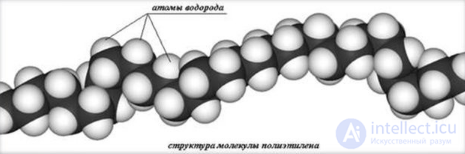
Polyethylene film (especially packaging film, such as bubble wrap or adhesive tape); packaging (bottles, jars, boxes, canisters, watering cans, seedling pots); polymer pipes for sewage, drainage, water and gas supply; electrically insulating material.
Polyethylene powder is used as a hot-melt adhesive. Armor (armor panels in bulletproof vests). Housings for boats, all-terrain vehicles, parts of technical equipment,
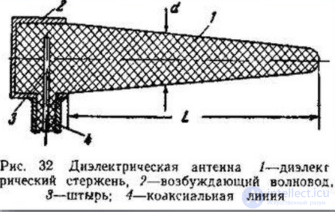
dielectric antennas, household items, etc.
Foamed polyethylene (expanded polyethylene) is used as a thermal insulator. Low-pressure polyethylene (LDPE—actually high-density, HDPE),
is used in the construction of waste-processing landfills and reservoirs for liquid and solid substances capable of polluting soil and groundwater.
Low-pressure polyethylene is widely used in landscaping around buildings and in playgrounds, pushing plywood and wood into the
background, since the service life of HDPE roofing sheets is more than 15 years, while "wooden equivalents" last only 10 years, and after 3–5
years the wood loses its marketable appearance.
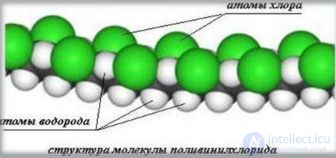
Polyvinyl chloride is a colorless, transparent plastic, a thermoplastic polymer of vinyl chloride. It is distinguished by its chemical resistance to alkalis, mineral
oils, many acids, and solvents. It does not burn in air and has low frost resistance (−15 °C). Heat resistance: +65 °C.
It is used for the electrical insulation of wires and cables, for the production of sheets, pipes (mainly chlorinated polyvinyl chloride), films, films
for stretch ceilings, artificial leather, polyvinyl chloride fiber, expanded PVC, linoleum, dirt-trapping mats, footwear
compounds, furniture edging, etc. It is also used to produce phonograph records (i.e. vinyl records) and profiles for
making windows and doors.
Polyvinyl chloride is also often used in clothing and accessories to create a leather-like material distinguished by smoothness and shine.
Polyvinyl chloride is used as a gasket in household refrigerators, replacing relatively complex mechanical latches. This has made it possible to
use magnetic latches in the form of magnetized elastic inserts placed inside the gasket balloon.
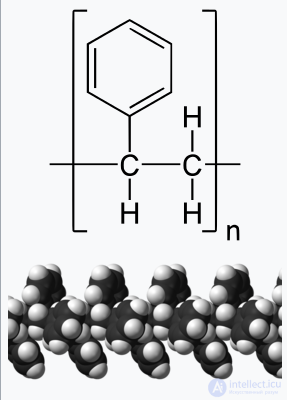
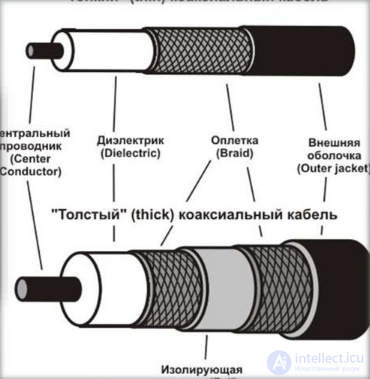
Polystyrene Polystyrene is the product of the polymerization of styrene. Polystyrenes are used to manufacture an extremely wide range of products, which are primarily used in everyday human life. The high electrical performance of polystyrene at ultra-high frequencies allows it to be used in the production of: dielectric antennas and coaxial cable supports.
Compound — a thermosetting or thermoplastic polymer resin (curing under natural conditions) and elastomeric materials, with or without fillers and/or additives, after hardening It is used as an electrically insulating material and as a means of explosion protection. The term "compound" is also applied to the material used to fill cables and stays in suspension and cable-stayed bridges, to protect the cable (stay) material from aggressive environmental effects. In the food industry, "compounds" refers to stabilizing systems (including emulsifiers, stabilizers, thickeners) used to simplify processing and reduce production costs, for example in mayonnaises and sauces.
Polymer compounds are also used to eliminate resonant vibrations of electronic assemblies; however, this sharply worsens thermal conditions and repairability . The latter is sometimes done deliberately: to prevent reverse engineering (repair), or to encourage sales of spare parts as well as of the finished product.
Compounds are mixtures of various insulating substances (resins, bitumens, esters, cellulose, etc.) that are converted to a liquid state, most often by heating to a sufficiently high temperature; hardening occurs on cooling of the molten compound. Such compounds are often called thermal compounds.
For electronic equipment consisting of components sensitive to elevated temperature, compounds that cure at room temperature or at a somewhat higher temperature, as a result of polymerization proceeding thanks to special hardeners introduced into their composition, have become very important.
By purpose, two main groups of compounds are distinguished: impregnating and casting compounds. The latter are used to fill relatively large cavities, gaps between various parts, to protect insulation from moisture, to increase breakdown voltage, to improve heat dissipation, to increase mechanical strength, and so on.
By properties, compounds are divided into thermoplastic and thermosetting. Thermoplastic compounds soften on heating (for impregnation or casting) and harden on cooling. These include bituminous compounds. Bitumens are a group of amorphous thermoplastic petroleum materials that are complex mixtures of hydrocarbons.
Thermosetting compounds cure irreversibly as a result of chemical reactions occurring in the liquid state. They generally have higher heat resistance than thermoplastic compounds, since they no longer soften on heating. However, casting with a thermosetting compound practically rules out the possibility of repairing a part or device if it is damaged. Thermosetting compounds include those based on polyester, silicone, and epoxy resins. The most widely used in electronics are epoxy compounds, distinguished by high mechanical strength, high heat resistance, and good electrical properties. These compounds are compositions based on epoxy resins and hardeners (various chemical compounds that react with the functional groups of the epoxy resins or act as curing catalysts). Besides resin and hardener, compounds may contain plasticizers, fillers, diluents, and so on. Depending on composition, there are compounds that cure at room temperature or on heating.
Epoxy resins are products of the polycondensation of chlorinated glycerols with dihydric phenols in an alkaline medium.
Epoxy resin as such does not possess technically useful properties and is therefore of no interest for practical use. Under the influence of hardeners, whether at low temperature or on heating, epoxy resins undergo a chemical change that makes them valuable for practical application.
Epoxy compounds have low shrinkage on hardening, exceptional strength, and very high moisture-protective properties.
Compounds are widely used for impregnating and casting individual units of electrical and radio equipment: transformers, chokes, capacitors. They are also used for encapsulating and molding discrete semiconductor devices and integrated circuits. Some types of epoxy compounds have high optical homogeneity and transparency to radiation in the visible and near-infrared regions of the spectrum.
Because of these properties, they find application as optical matching (immersion) media for extracting light from LEDs.

Comments