
Lecture
Это окончание невероятной информации про сталь.
...
chromium steel grades are: 12X12, 20X13, 30X13, 40X13, 08X13 and others.
Grades 12X13 and 20X13 deform and weld well. Grades 30X13 and 40X13 have limited weldability, since the medium carbon mass fraction and high chromium content promote crack formation during welding in the heat-affected zone of the base metal. These steels forge and stamp well in the hot state, since they are ductile at high temperature.
Grades 20X13, 30X13, 40X13 belong to the martensitic class, while grade 12X13 belongs to the ferritic class.
These steels are widely used as a structural and corrosion-resistant material. They are used to manufacture blades for various turbines and compressors, valves, fittings for petroleum installations and apparatus, while grades 30X13 and 40X13 are used for cutting and measuring tools, springs, carburetor parts and other parts operating at temperatures up to 400 °C.
Parts made from these steels undergo quenching and low, medium or high tempering depending on the grade and required properties.
Grade 40X13 steel is widely used for making surgical and household instruments.
Chromium-nickel steels are produced in the following classes depending on chemical composition and the mass fractions of chromium and nickel: austenitic, austenitic-ferritic and austenitic-martensitic. Steels with a content of 18% chromium and 9…10% nickel form an austenitic structure. These steels have corrosion resistance at high temperatures in various working environments, including acid solutions, and possess high formability by pressure working and weldability. Austenitic steels have found the widest application in the chemical industry and construction.
The drawbacks of the austenitic class of steels include poor machinability by cutting and poor casting properties, so they are widely used as a structural material in welded structures and products obtained by pressure working.
The most widely used austenitic-class steels are grades O4X18H10, O8X18H10, O8X18H10T and many others, about 30 grades in total. Titanium is introduced into the steel to eliminate intergranular corrosion. Austenitic steels are quenched at a temperature of 1,050…1,100 °C. Parts are cooled in oil. After quenching, the tensile strength is σв = 500…600 MPa (individual grades reach a strength of 1,000…1,200 MPa), and the elongation is δ = 35…40%.
Austenitic-ferritic class steels, besides chromium and nickel, also contain titanium and silicon. They have higher anti-corrosion properties in active environments, as well as high technological properties. The most widely used austenitic-ferritic steel grades are 12X21H5T, OX22H5T, X28AH and others, about 10 grades in total.
These steels are quenched at a temperature of 950…1,000 °C, with cooling in oil. After quenching, an aging operation is carried out at a temperature of 500 °C. The tensile strength of these steels is σв = 950…1,200 MPa, elongation δ = 4…12%.
Austenitic-martensitic class steels, besides chromium, contain aluminum and manganese in their composition and a reduced nickel mass fraction (1…9%). Steels of this class are used as a corrosion-resistant structural material for operation in active, oxidizing working environments and have higher mechanical and chemical properties compared to the steels discussed earlier. Tensile strength, depending on chemical composition, is 1,200…1,900 MPa, elongation — 3…10%.
Grades of austenitic-martensitic class steels: 2Х13Н4Г9, Х15Н9Ю, ОХ17Н7Ю, ОХ17Н7Ю1, 09Х15Н8Ю, 2X17H2 and others.
These steels are quenched at a temperature of 975 °C, with cooling in oil. After quenching, mandatory cold treatment operations, aging, and strengthening by cold rolling are carried out.
Heat-resistant (scale-resistant) steels and alloys. It is known that scale forms on a metal surface under the action of temperature and oxygen from the working environment. The higher the temperature of the working environment, the more actively the scale-formation process proceeds. Meanwhile, the scale that has formed can itself impede further oxidation of the metal. This can be achieved when the oxide film is dense, without cracks or pores.
Practice shows that the oxide film of iron, tungsten and other elements has poor protective properties. Oxygen easily diffuses through the films of these metals, and scale forms to a great depth; the scale cracks, becomes porous, and the metal burns away.
Chromium, aluminum, nickel and silicon have a dense oxide film, and, moreover, the films of these metals do not crack under the action of temperature. Once oxidized, the surface of the part, under the action of temperature and oxygen during the initial heating period, becomes heat-resistant. The oxide film formed on the surface protects the metal from further destruction.
A maximum chromium mass fraction (10%) at a temperature of 800…900 °C provides stable scale resistance. At a chromium mass fraction of 20…25%, the operating temperature can reach 1,000…1,100 °C.
Scale resistance is provided not by the structure of the steel, but only by its chemical composition. The following grades of heat-resistant steels have found practical application: 4X9C2, 1Х12СЮ, 4X10C2M, 3X13H7C2, X20HMC2, 4X18H25C2, OX18H10T and others, about 60 grades in total.
Heat-resistant steels are used for manufacturing parts that operate in active working environments and at high temperatures with light mechanical loading: valves for automobile and tractor engines and diesels; heat exchangers, grates, tubes, spark plug electrodes, furnace conveyors, carburizing boxes, muffles, retorts, exhaust systems and other parts and structures in chemical, petrochemical and gas production.
Creep-resistant steels and alloys. The creep resistance of steels is always accompanied by their heat resistance (scale resistance), i.e. all creep-resistant steels must, above all, be heat-resistant.
When considering the creep resistance of a structural material, one should know that the strength characteristic of any structural material decreases with increasing temperature, including for ordinary structural carbon steel. Consequently, creep resistance is characterized by two indicators: temperature and time. Here, if the time indicator is taken as the fundamental factor, creep resistance should be characterized by long-term strength. When determining long-term strength at high temperature, creep of the test specimen is observed, and this creep affects the creep resistance. The creep resistance of structural materials is influenced by their structure and alloying elements. The structural classes of these steels are pearlitic, austenitic and martensitic. As alloying elements in chromium-nickel steels, silicon, manganese, molybdenum, tungsten, vanadium and niobium are used in various mass fractions depending on the purpose of the steel.
By purpose, creep-resistant alloy steels are divided into valve steels, boiler steels, boiler-turbine steels, and steels for jet technology. These steels are used to make various parts and structures, such as valves for machine engines, steam and gas pipeline tubes, ultra-high-pressure apparatus and boilers, blades for steam and gas turbines, nozzle liners, fastening parts and others.
Spring steel. Spring steel (GOST 14959—79*) is produced in the form of hot-rolled or forged stock (with a diameter or thickness of up to 250 mm), as well as in the form of calibrated bars of round, square and profiled cross-section, coils and strips with special surface finishing.
Spring steel is produced as commercial-quality and high-quality, and also as carbon steel (65, 70, 80, 85, 60Г, 65Г, 70Г) and alloy steel (55C2, 55C2A, 60C2, 70C3A, 60С2Г, 50ХГ, 50ХГА and others).
The digits in the marking of carbon steels indicate the average mass fraction of carbon in hundredths of a percent; the letter Г, placed to the right after the digits, indicates an increased manganese content (0.7…1.2%). In the designation of alloy steels, the digits placed at the front of the grade indicate the mass fraction of carbon in hundredths of a percent.
As an example, let us consider the chemical composition of grade 60C2H2A steel. The mass fraction of carbon is 0.56…0.64%, of silicon — 2%, of nickel — 2%. The letter А at the end of the grade indicates that the steel is high-quality, i.e. it has a reduced mass fraction of harmful impurities — sulfur and phosphorus (their combined mass fraction is 0.05%).
Spring steels are supplied according to strictly specified regulated characteristics. The regulated characteristics are chemical composition, mechanical properties and intended use.
By regulated characteristics, these steels are divided into categories: 1, 1A, 1Б, 2, 2A, 2Б, 3, 3A, 3B, 3Г, 4, 4A, 4Б.
Steel of categories 1, 1A, 1Б, 4, 4A and 4Б is divided into subgroups depending on the type of subsequent processing:
Spring steels have high mechanical properties both in the as-received and in the heat-treated condition. Carbon and manganese steels have tensile strengths σв = 1,000…1,130 MPa (100…115 kgf/mm2), elongation δ = 7…9%, hardness 230…250 HB. Silicon, silicon-chromium and silicon-nickel steels have higher mechanical properties compared to carbon and manganese steels. For example, grade 60C2H2A steel has a tensile strength σв = 1,500 MPa (150 kgf/mm2), hardness 420…475 HB, elongation δ = 19%.
Spring steel has high forgeability, limited weldability, high hardenability and no temper brittleness.
In regulatory-technical documentation and on drawings, spring steel is designated as follows:
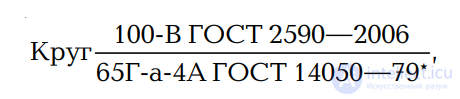
which means — hot-rolled round steel, diameter 100 mm, normal rolling precision per GOST 2590—2006, grade 65Г, for hot working subgroup a, category 4A.
Other types of rolled products of these steels are designated similarly.
Spring steel is used to manufacture leaf springs, general-purpose springs, automobile valve springs, shock absorber springs, lock washers, clutch discs, eccentrics, bands, brake drums and bands, friction discs, spring washers, torsion shafts and other parts requiring high resilience and wear resistance, including heavily loaded springs for heavy-duty trucks, tractors and railway cars.
Bearing steel. Under GOST 801—78, bearing steel is produced hot-rolled, cold-rolled, calibrated, and with special surface finishing, in the form of round bar, strip, square bar, tube, band, and wire (ШХ4, ШХ6, ШХ9, ШХ15, ШХ15СГ).
The following designations are used in the marking of these steels:
The marking of individual steels indicates the melting method:
Depending on further processing, bearing steel is divided into the following groups:
Bearing steels have high mechanical properties (especially after hardening): hardness, strength, impact toughness, wear resistance, and heat resistance.
For example, steel grade ШХ15СГ in the as-supplied condition has the following properties:
Bearing steel has high technological properties: forgeability, machinability, grindability, hardenability, and low susceptibility to temper brittleness; weldability is limited. This steel is used to make balls, rollers, rings, bushings, plungers, delivery valves, atomizer bodies, and other parts that require high hardness, wear resistance, and contact strength.
Bearing steel alloyed with silicon and manganese is used for making bearings that operate at elevated temperatures.
Free-cutting structural steel of enhanced and high machinability (free-machining). Under GOST 1414—75, the following groups of structural steels of enhanced and high machinability are produced:
The following designations are used in the marking of this group of steels:
The digits following the letters indicate the mass fraction of lead. The other designations are the same as for alloyed structural steels.
Structural steel of enhanced and high machinability is supplied as hot-rolled round, square, and hexagonal bar, as rolled and calibrated stock, either heat-treated (Т) or without heat treatment, and also work-hardened (Н). Depending on its intended use, this steel is divided into groups:
Depending on the chemical composition, structural steel of enhanced and high machinability has the following ranges of mechanical properties: tensile strength σв = 580 … 800 MPa (58 … 80 kgf/mm2) (for some steel grades σв = 1 000 … 1 200 MPa); Brinell hardness 187 … 241 HB; elongation δ = 8 … 12 % (for some steel grades σ = 20 %).
Free-machining steels have high technological properties: forgeability, weldability, and especially machinability. The latter property is achieved through special metallurgical processes involving the addition of sulfur, lead, and selenium to the structural steel. During machining, these additives create a kind of internal lubrication that reduces friction at the point of contact between the tool and the workpiece; as a result, the cutting process proceeds smoothly, and conditions are created for chip breakup. The harmful effect of sulfur in these steels is neutralized by an increased manganese content.
Structural steels of enhanced and high machinability have increased toughness, ductility, and fatigue behavior, which limits their range of applications.
Carbon-sulfur steels are used for lightly loaded fastening parts that require high dimensional accuracy and surface finish. Other groups of free-machining steels are used for parts operating under higher stresses and loads. For example, steel grades A12, A20, A30, and А40Г are used to make axles, shafts, gears, pinions, pins, screws, bolts, bushings, rings, lead screws, and other complex-shaped parts produced on automatic lathes and requiring high surface quality. The first two of these grades undergo carburizing, while the later grades are improved by hardening and tempering.
Cast steel. Depending on their intended use, mechanical properties, and chemical composition, castings are divided into three groups:
Castings are made from steels of the following grades (GOST 977—88): 15Л, 20Л, 30Л, 35Л, 40Л, 50, 55Л, 20ГЛ, 20Г1ФЛ, 10ФЛ, 30ХГСФЛ, 45ФЛ, 32Х06Л, 40ХЛ, 35ХМЛ, 35ХГСЛ, 35ХГМЛ, 20ДХЛ, 20ХГСНДМЛ, 08ГДНФЛ, 13ХНДФТЛ, 12ДН2ФЛ, 12ДН1МФЛ, 23ХГС2МФЛ, 25Х2Г2ФЛ.
The principle of marking cast steels is similar to the marking of carbon and alloyed quality structural steels, but the letter Л (cast steel) is placed at the end of the designation.
In technical documentation and on drawings, cast steels are designated as follows: casting 12ДХН1МФЛ GOST 977—88, which means: a casting made of steel grade 12ДХН1МФЛ of the especially high-quality group, GOST 977—88.
Other steel grades are designated similarly. The chemical composition of steels is determined by the corresponding grades. The mechanical and technological properties of castings depend on the grades of steel chosen for the purpose.
Low-alloy structural steel. Under GOST 19281—89*, low-alloy structural steel is produced in the following groups and grades:
The marking of low-alloy structural steels follows the same principle as for alloyed structural steels.
Low-alloy steel is supplied as heavy-plate and wide-strip rolled stock in coils, strip, and sheet, used for welded structural steel structures (in machine building — for non-welded structures) without heat treatment: pipelines, tanks for storing and transporting liquids, and so on.
The tensile strength of this steel σв = 440 … 600 MPa, elongation δ = 20 … 23 %, impact toughness is 30 … 44 J/cm2.
The following designation is adopted in technical documentation:
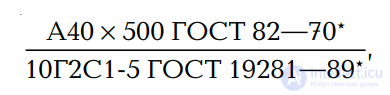
which means: universal wide-strip steel, 40 mm thick, 500 mm wide (GOST 82—70*), with edge camber of class A, grade 10Г2С1 (GOST 19281—89*), category 5.
Low-alloy structural steel is used for making trusses, railcar framing, elements of welded structural steel structures, sheet structures, vessel bottoms, and also reinforcement for reinforced-concrete products. Depending on the chemical composition of the steel grades, structural components can operate at temperatures of 40 … 70 °C, and some grades even at subzero temperatures and under pressure.
Часть 1 6. Steels and Alloys for Special Purposes
Часть 2 7. Carbon and alloy steels for special purposes - 6.

Comments