
Lecture
Scientific research as the activity of a researcher whose goal is to obtain a new theoretical result constitutes a series of interrelated actions — from choosing a topic to introducing the results obtained into scientific communication. These actions comprise three stages: preparatory, main, and final. Let us examine each of them.
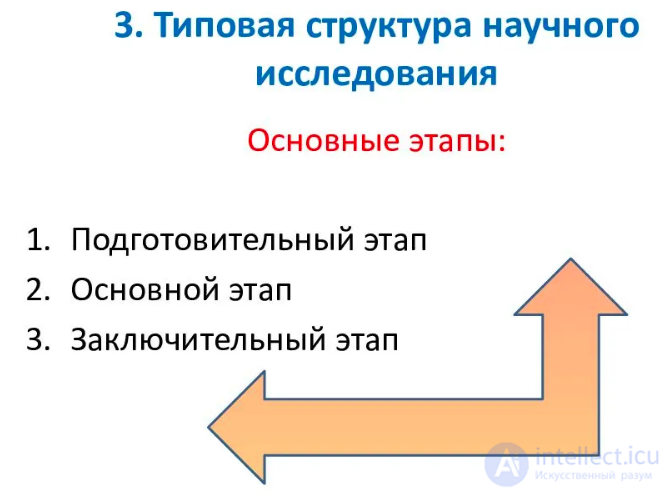
1) Preparatory stage
2) Main stage
3) Final stage
The tasks of the preparatory stage are choosing the research topic, determining the work plan, and accumulating scientific information and factual material on the topic. A trial study is then conducted and its results are analyzed. The preliminary stage is considered complete when the researcher has become convinced of the legitimacy of the chosen topic, has formulated an initial hypothesis, and has determined and tested the research methodology on a limited body of material.
In choosing a research topic, one is guided above all
by its relevance (from Latin actualis — active, effective). A topic is relevant if research into it is called for by scholarship or by social practice.
Every science, at one or another period of its development, has a «bank» of unsolved problems and dead-end situations, work on which would advance scientific knowledge as a system or, more often, particular strands within it. However, not every problem that currently exists requires a solution at any given moment in the development of a science. Problems that correspond to the current directions of a science require solving. Thus, in contemporary philological studies, one of the current directions is one associated
with overcoming its dehumanization, with the study of homo loquens in
its manifold manifestations. It follows that the problems that fit into this scholarly context are the relevant ones.
A research topic may also be significant from the standpoint of the needs of human and societal development. Among such topics in our country are those connected with studying the contradictions and complexities of the communicative-speech situation, the practice of teaching the languages of the peoples of Russia, and the practice of teaching Russian to foreigners.
Of course, the optimal situation is one in which all aspects of a topic's relevance are in agreement, and the topic itself corresponds
to the researcher's own interests.
There are a number of techniques for choosing a topic. These are:
1) consultations with leading scholars, with practitioners (of schools, institutions and organizations, companies and firms, media editorial offices
and so on);
2) applying the principle of research at the boundaries of disciplines, in an interdisciplinary field (linguistics and literary studies, poetics and rhetoric, the history of literature and the history of culture, and so on);
3) applying the principle of reinterpreting facts already known to scholarship in light of new ideas (new interpretations of the Russian classics);
4) applying the principle of a more effective solution to practical problems (studying the reading competence of various segments of the population), and
so on.
The gathering of literature on the research topic begins with the preparation of a bibliographic list. Familiarization with the literature traditionally begins with the study of general works: encyclopedic publications, academic works, monographs, and searching for materials on the Internet. One then proceeds to reading articles published in periodicals and scholarly collections. The study of the scholarly literature is accompanied by excerpting the main points, by summarizing or quoting them. Excerpts and quotations are formatted in accordance with the requirements of the applicable state standard (GOST). (On working with sources, see the excerpts from U. Eco's book
given below among the reading materials.)
The collection of factual material is carried out by the method of observation. In order to obtain precise and objective conclusions, factual material is gathered in the volume necessary
to prove the hypothesis.
At the main stage, the research method is applied to the material. The solution of the problem proceeds through the further development of the hypothesis and its transformation into theoretical knowledge.
The main stage comprises two phases:
1) work with the factual material;
2) explanation aimed at revealing the essential characteristics of the phenomenon under study (classification, modeling, and other methods predominate here).
The main stage is complete when a theoretical result has been obtained. The final stage grows directly out of the main one — out of that part of it which consists in formulating
new knowledge. At this stage the researcher again turns to the object of research: an attempt is made to fit the result obtained into the theoretical picture of the object. If the attempt succeeds, the research is complete; if not, this serves as a signal to the researcher that it is necessary to return to some
earlier stages of the research.
Further, at the final stage the meaning of the result obtained is disclosed, along with its significance for scholarship and practice. Finally,
the most important task of this stage is to present the results obtained in scientific communication in the form of a scholarly report
(presentation) or a publication. (See the excerpts from V.I. Karasik's book given below among the reading materials.)
And finally, a separate word should be said about student research.
The competency-based model of the contemporary philologist presupposes his or her readiness for research activity. This
requirement for a philologist applies regardless of the chosen field of specialization. The choice of specialization may determine the type of scientific research mastered in the course of university study — theoretical or applied. Whereas theoretical research is aimed at finding a new theoretical result on a topic that has a recognized tradition of consideration in the contemporary humanities, applied research is aimed at understanding facts and processes
occurring in the practice of language use, in the literary process, in the functioning of texts in communication, and in the activity of
the speaker and the listener, and so on.
In accordance with these requirements, study at a classical university includes work on a student research paper
(a term paper, a final qualifying
work, a report, a presentation at a special seminar, at practical sessions, and so on). The types of work listed are carried out in
accordance with the requirements approved at the institution.
Their difference from ordinary scholarly research lies above all in the fact that they are carried out under the supervision of an instructor
— a professor, a lecturer, or a practicing specialist.
A student research paper is prepared in a single copy (copied if necessary).
Interesting advice for the student is given by U. Eco in his book «How to Write a Thesis» (Moscow, 2001).
Reading materials
V.I. Karasik. The Language Circle: Personality, Concepts, Discourse
Scientific discourse has traditionally attracted the attention of linguists. The participants in scientific discourse are researchers
as representatives of the scholarly community, while a characteristic feature of this discourse is the fundamental equality of all participants in scholarly communication, in the sense that none of the researchers possesses a monopoly on truth, and the infinity of knowledge compels every scholar to take a critical stance toward both others' and his or her own investigations. In the scholarly community it is customary to use the respectful form of address «colleague», which neutralizes all status markers. At the same time, scholars are distinguished by their tendency to erect various barriers against outsiders, by degrees of scholarly qualification, academic titles, and membership in prestigious scholarly communities. The dyad «agent — client», convenient for describing the participants of other kinds of institutional discourse, requires modification in scientific discourse. The point is that the task of a scholar is not only to obtain knowledge, evaluate it, and communicate it to the public, but also to
train new scholars. Scholars therefore appear in several capacities, displaying in doing so various status-role characteristics: the scholar-researcher, the scholar-teacher, the scholar-expert,
the scholar-popularizer. The clients of scientific discourse are clearly delineated only at its periphery: on the one hand, the broad public that reads
popular-science journals and watches the corresponding television programs, and, on the other, novice researchers who are
trained in departments and laboratories. The chronotope of scientific discourse is the setting typical of scholarly dialogue. This dialogue may be oral or written,
so that for oral discourse the appropriate settings are the conference hall, the laboratory, the department, the scholar's office, while for written discourse the prototypical setting is the library.
<...>
The values of scientific discourse are concentrated in its key concepts (truth, knowledge, research) and reduce to recognizing the knowability of the world, to the necessity of increasing knowledge and proving its objectivity, to respect for facts, to impartiality in the search for truth («Plato is my friend, but truth is dearer»), and to a high valuation of precision in formulation and clarity of thought. These values are formulated in the sayings of thinkers but are not set down in special codes; they arise from the etiquette accepted in the scholarly milieu and can be formulated as certain evaluative judgments:
It is necessary, interesting, and useful to study the world; One should strive to uncover the secrets of nature; One should systematize knowledge; One should record the results of research (a negative result
is also important); One should subject everything to doubt; The interests of scholarship should be placed above personal interests; One should take all facts into account; One should take into account the achievements of one's predecessors
(«We stand on the shoulders of giants»), and so on.
The evaluative potential of the key concept of scientific discourse, «truth», comes down to the following points: truth requires disclosure, it is not obvious, the path to truth is difficult, mistakes and delusions are possible along the way to truth, the deliberate distortion of truth is subject to condemnation, the disclosure of truth requires persistence and great effort but may also come as a flash of insight, and truth is independent of any individual person. Truth
is compared to light, a metaphor for the absolute good. Truth is one, but the paths to it are many. Falsehood and the appearance of truth are opposed to truth. In the Russian language, the conception of truth is fixed in the dyad «pravda — istina» (see: Logical Analysis of Language. Truth and Truthfulness in Culture and Language. Moscow, 1995). The systemic context for the concept of «truth» is a set of opposed concepts
— «truth (pravda)», «error», «falsehood», «fantasy», «lying» [Gak, 1995:24]. What is relevant for scientific discourse is proof of deviation from the truth, i.e., proof of error. The means of such
proof have been developed in detail within logic.
The strategies of scientific discourse are determined by its particular aims:
1) to determine the problem situation and delimit the subject of study,
2) to analyze the history of the question,
3) to formulate a hypothesis and the aim of the research,
4) to justify the choice of methods and material of the research,
5) to construct a theoretical model of the subject of study,
6) to set out the results of observations and experiment,
7) to comment on and discuss the results of the research,
8) to give an expert assessment of the research conducted,
9) to determine the field of practical application of the results obtained,
10) to set out the results obtained in a form acceptable to specialists and non-specialists (students and the general public).
These strategies can be grouped into the following classes: execution, expert evaluation, and implementation of research into practice.
The strategies of scientific discourse are realized in its genres (the scholarly article, the monograph, the dissertation, the scholarly report, a conference
presentation, the poster presentation, the scientific-technical report, the review, the abstract, the annotation, the theses). The written genres of scientific discourse are fairly clearly opposed on the basis of primacy/secondarity (article — theses); there is debate as to what should be considered the prototypical genre of scientific discourse — the article or the monograph; the question of whether the university textbook belongs to scientific discourse is likewise debatable; the oral genres of this discourse are more diffuse. A conference presentation varies in tone depending on the circumstances (a plenary report, a session presentation, a comment, a remark at a
round-table meeting, and so on). L.V. Krasilnikova [1999] examines the genre of the scholarly review and identifies the most important functions of this genre — the representation of a scholarly work and its critical evaluation. The relative weight of these functions in the text of a particular review is largely determined by the addressee factor: for a reader unfamiliar with the reviewed text, it is important to gain an idea of that text,
and therefore such a review should include elements of a summary survey, whereas for specialists in a given field of scholarship (and for the author whose work is being reviewed) an assessment of the work performed is needed. A substantial change to the genre system of scientific discourse is being introduced by computer-mediated communication, which blurs the boundaries between formal and informal discourse in online discussion forums. It should be noted that discursive strategies serve as guidelines for the formation of text types, but speech genres crystallize not only within deductively identified communicative institutional strategies but also in accordance with established tradition. Purely traditional, for example, is the genre of the dissertation,
since to determine the level of an author's scholarly qualification it would in fact be quite sufficient to discuss the totality of his or her publications.
But as a ritual fixing the initiation of a new member of the scholarly community, the defense of a dissertation in its present form is tacitly
recognized as necessary. Ritual, as is well known, is an important means of stabilizing relations within a social institution.
The subject matter of scientific discourse covers a very broad range of problems; what is fundamentally important in this regard is the distinction between
the natural sciences and the humanities. The humanities are less formalized and display a strong dependence of
the object of knowledge on the knowing subject (this is evidenced by the tendency of philosophers to contrast scientific and philosophical knowledge).
Scientific discourse is characterized by a pronounced high degree of intertextuality, and therefore reliance on precedent texts and their
concepts [Slyshkin, 2000] is one of the system-forming features of the discourse in question. Intertextual connections
in the text of a scholarly article are represented in the form of quotations and references and perform referential, evaluative, etiquette, and decorative functions [Mikhailova, 1999: 3]. Precedent texts for scientific discourse are the works of the classics of a discipline, quotations known to many, the titles of monographs and articles; illustrations too become precedent, for example, linguists are well familiar with the phrases
«Colourless green ideas sleep furiously» and «Flying planes can be dangerous»,
used in works on generative grammar.
Discursive formulas are understood as characteristic turns of speech proper to communication within the corresponding social
institution. These formulas unite all representatives of the scholarly community; at the same time, there are clear markers that allow one, for example, in many cases to distinguish a literary-critical
study from a linguistic one. Compare: «Thus, against a specific historical-cultural background, Yeats freely finds symbols for
his poetic imagination. Like an architect, he built a new Byzantium out of his own images, conveyed within the conventional framework of symbolism» and «In a literary text, signs at various levels (from sound to text) acquire additional meanings not
necessarily present in their «pre-textual» semantics». The striving for maximum precision in scholarly text sometimes leads
authors to excessive semantic (terminological) and syntactic complexity of the text. At the same time it should be noted
that scholarly communication presupposes calm, unhurried conversation
and thoughtful reading, and therefore a complex text in scientific discourse optimally performs the basic discursive functions: it
discloses the content of a problem at the most precise level, renders that content inaccessible to insufficiently prepared
readers (protection of the text), and establishes a pace of speech adequate for discussing
the given problem. Discursive formulas become concretized in clichés, for example, in the genre of reviews: «The comments made
do not, of course, call into question the high evaluation of the work performed».
Do not be alarmed by the title of this section. I do not mean your moral character. I mean your approach to sources and to taking notes on them.
You saw, from the example of the note cards, that I, being then still an immature philologist, made fun of some researcher and dispatched him in short order.
To this day I remain convinced that I acted correctly on that occasion, and in any case we are even, because he too dispatched a substantial topic in short order. But such a case is, first, fairly atypical, and second, I nonetheless took notes on this scholar too and, it would seem, heeded his judgment — and not only out of the consideration that everything said on our narrow topic must be taken into account, but also because the best ideas do not always come from the greatest experts on a question.
Here, for instance, is a case from my own practice: the Abbé Vallet.
To tell it in order, I must acquaint you with certain aspects of that old work of mine. For a year my
thesis was stalled because of one difficulty. The fact is that today's aesthetics considers the perception of the beautiful to be intuitive. But for Saint Thomas the category of the intuitive did not exist. In our century, many researchers have tried to prove that Thomas, in certain statements, implied intuitiveness, but they were forcing the material.
At the same time, the perception of objects in general was, for Thomas, a moment so instantaneous and fleeting that it is unclear how one could enjoy aesthetic qualities that are extremely complex: the play of proportions, the relationship between the essence of things and the way in which that essence organizes matter, and so
on.
The way out of the contradiction lay hidden (I found it for myself a month before defending my thesis) in the discovery that aesthetic contemplation rested on
a far more complex act — judgment. But Thomas does not say this in so many words. And nevertheless he speaks of aesthetic
contemplation in such a way that it is impossible not to arrive at precisely this conclusion. The aim of interpretation often amounts to the process of fishing
out of the author the answer to a question that has not yet been put to him, but which, if put, he could not have answered in any other way. In other words: by comparing various statements, one must demonstrate how the sole conceivable answer follows of itself from the logic of the thought under examination.
Authors sometimes do not state things directly simply because the meaning seems to them too obvious. Or, in the case of Saint Thomas,
it is otherwise: for him it was unnatural to reflect on aesthetic subjects; he touched on these questions only in passing, taking their unambiguity for granted.
Because of this I was at an impasse. And none of the critics and philosophers I was reading helped me find a way out. At the same time, the single truly original aspect of my research was precisely this problem — together, of course, with the solution that remained to be found. In my fruitless search for illumination, I came across, at some flea market in Paris, a pamphlet that charmed me, at first, by its handsome binding. Opening the little book, I saw that its author was a certain Abbé Vallet, and it was called «The Idea of the Beautiful in the Philosophy of Thomas Aquinas», Louvain, 1887. It appeared in no bibliography whatsoever. The author was an obscure nineteenth-century researcher. Naturally, I bought the pamphlet (it cost little). Reading it, I found that I regretted even that small sum spent on the Abbé Vallet, since he repeats commonplaces and adds nothing of his own. Nevertheless I decided to read it to the end. (Out of scholarly humility, though at the time I did not know it was called that; I learned scholarly humility precisely from this episode.) The Abbé Vallet changed my life — imagine that, what a twist of fate.
In short, I read on out of sheer stubbornness. And at one point, in some parenthetical remark, more in passing than anything, this abbé, utterly unaware of the scale of his discovery, says something about the theory of judgment as applied to the concept of beauty. Eureka! That was what I had been looking for so long. And where did I find it? In this insignificant abbé! He died a hundred years ago; for a hundred years no one remembered him, and yet from beyond the grave he illuminated the mind of one of his descendants who was willing to read him closely.
There you have an example of scholarly humility. Something useful can be learned from anywhere. Often we are not talented enough to be able to learn something useful
from those less gifted than ourselves. Or from those who only seem less gifted, while in fact one must learn to recognize their gift. What seems worthless to one person may seem the opposite to another. One must learn to listen with respect. Fewer value judgments. All the more so when someone's style of thought differs from ours, or their ideology differs. Even from a sworn opponent one can take brilliant ideas. It all depends on one's mood, the weather, the degree of tiredness. Perhaps, had I come across the Abbé Vallet a year earlier, I would not have recognized his discovery. But from this case I learned not to disdain any possibility, however
insignificant.
By calling this scholarly humility, we may perhaps be thought hypocritical: self-abasement can be a form of pride. Let us do without moral labels!
Self-abasement, then, be it so; pride, then, be it so — apply this in practice as often as you can.
M. Epstein. The Sign of the Blank:
On the Future of the Humanities
On Scholarship. The Mass of Knowledge, the Energy of Thought
* * *
Knowledge is reified, «past» thought, just as factories, machines, and other means of production are, in economic terms, past labor. There is always a danger that in scientific-educational, academic institutions professionally engaged in producing and disseminating knowledge, the stock of past thought will begin to predominate over the energy of living, «not-yet-knowing» thought. The basic task of scholarly and academic work is usually defined as research: «careful, systematic, patient study and investigation in some field of knowledge, undertaken with the aim of discovering or establishing facts or principles»1.
Research is an important part of scholarly work, but far from the only one. Any particle of knowledge is the result of thought and the premise for further mental acts, which lead from the cognition of what exists to the creation of something unprecedented. As already noted, thought
takes the form of knowledge when it adapts itself to a given subject. But by its next act, thought de-objectifies this
knowledge, frees its elements from fixed connections, brings them into a state of free play, of the potential combinability of everything with everything, and thereby
constructs a series of possible, virtual objects. Some of them, thanks to art, technology, and socio-political
practice, become objects of the surrounding environment, which thought thus adapts to itself.
Turning to the specific content of a scholarly work, one should judge its merit both by the measure of the knowledge it covers and by the measure of
its transformation into thought, or more precisely by the ratio of these two measures. Must a scholarly work contain references to all available sources?
In principle, more references are better than fewer. But it is better to have conceptual coverage of a larger body of material than of a smaller one. And when one
covers a large body of material, there turn out to be fewer references to its specific sections. A scholar's life is short, while the possibilities of scholarship
are boundless, and so one has to balance the elaboration of details against the breadth of the design. What Faulkner said of the writer Thomas Wolfe:
that he is the greatest of us because he suffered the most magnificent of failures — can be applied to a scholar as well2. Is Einstein's attempt to create, by force of thought, a unified field theory, for which he — and indeed science itself — did not and does not have sufficient knowledge, not itself a failure?
Such a great failure is worth many small victories. Scholarship is made not by know-it-alls but by people who keenly feel the lack of knowledge, the limitations of their own understanding of things. Pure erudites, who know their subject inside and out, rather rarely make a creative contribution to scholarship, largely confining themselves to publishing, commentary, archival, and bibliographic activity (undoubtedly useful and necessary).
First, because they know everything there is to know about their subject, they have nothing further to add to it;
second, one can know everything only about some limited subject, whereas great scholarship requires the conjunction of different subjects and fields. One can, for example, know everything about the life and work of A. Pushkin or F. Dostoevsky, B. Pasternak or M. Bulgakov. But one cannot know everything about Pasternak's style, vision, and world outlook, about his place in Russian and world literature — these are problem areas requiring conceptual, constructive thought. The trouble with many pure erudites is that they do not sense a problem; they stand firmly on the ground of their knowledge and do not see, close by, the abyss that can be crossed only by the footbridge of concepts, of intellectual constructs. Scholarship begins where knowledge ends and the unknown, the problematic, begins. Such a view of scholarship goes back to Aristotle. «For it is owing to their wonder that men both now begin and at first began to philosophize, and he who is perplexed and wonders believes himself to be ignorant» («Metaphysics», Book 1, Ch. 2). Ideally a scholar should acquire as much knowledge as possible, but not so much as to lose the capacity for wonder.
In scholarship there are various layers and levels of work:
(1) observation and the gathering of facts,
(2) analysis, classification, systematization,
(3) interpretation of facts and observations, the search for meanings, regularities, conclusions,
(4) generalization and typology, the creation of a synthesizing concept or characterization (for example, of a given writer, era, set of tendencies, national or world literature, and so on),
(5) methodology, the study of various methods of analysis, interpretation, generalization,
(6) paradigmatic thinking — awareness of the premises, cognitive schemas, and «prejudices» on which a given discipline or its individual methods rest, and an attempt to change them, to establish a new vision of things (that of which T. Kuhn writes in «The Structure of Scientific
Revolutions»).
It would be ideal if scholarship moved at all these levels
synchronously and in parallel: found new facts — gave a new interpretation — created a new paradigm. But the point is precisely that scientific revolutions occur otherwise. Many known facts simply begin to be ignored, because they interfere with the understanding of other, previously
unnoticed facts, the very perception of which becomes possible
only thanks to a new paradigm. And this in turn already changes
the perception even of previously known facts — or even changes the facts themselves!
Thus, in the words of T. Kuhn, «chemists could not simply accept Dalton's [atomistic] theory as evident, for many facts at the time spoke very much against it. Moreover, even after the theory's acceptance,
they had to struggle with nature, trying to reconcile it with
the theory. When this happened, even the percentage composition of well-known compounds turned out to be different. The data themselves changed»1.
If this happens in the most exact sciences, what then can be said of
the humanities, where paradigms are far more diffuse and do not organize
the professional community as rigidly: new visions flare up among different authors without leading to scientific revolutions, while scientific
revolutions do not prevent the persistent survival of the most traditional
branches of «normal» scholarship (archival, bibliographic research...).
The history of science shows that many ideas that renewed the scientific picture of the world arose not in agreement with the facts known at the time,
but in sharp collision with them. This is why the philosopher and methodologist of science Paul Feyerabend formulates the rule of counterinduction, «which recommends that we introduce and develop hypotheses that are incompatible with well-established theories and facts»2. Unfortunately,
scholars in the humanities know this rule of counterinduction even less well than
natural scientists do, even though it is precisely the humanities that are capable
of more localized paradigmatic breakthroughs, defamiliarizations, and insights, owing to the instability and diffuseness of their own paradigms. And
further Feyerabend insists: the «counter-rule», recommending the development of hypotheses incompatible with observations, facts, and experimental results, needs no special defense, since there exists not a single more or less interesting theory that
agrees with all the known facts»1. Such a discrepancy
between facts and concepts energizes the field of scholarship, allowing new facts to be discovered and old ones reconsidered.
Thus, to confine scholarly or academic activity
to the sphere of cognition, i.e., to the accumulation and multiplication of knowledge (facts, regularities, observations, and generalizations), is to lose sight of the whole
of which knowledge is a part. It would be more correct to define the task of scholarly and academic institutions not as research but
as thought-knowledge, intellectual activity in the form of cognition and thinking, i.e.
(1) the establishment of existing facts and principles, and
(2) the production of new concepts and ideas that can be productively used in the development of civilization.
Knowledge is information about the existing facts and connections of the universe; thought is the transformation of these connections, the creation of new ideas and conceptions, which in turn can be embodied in objects, properties, and possibilities of the surrounding world. Thought reworks known facts, turns them into fictions, so that some of these fictions may become new facts.

Comments