
Lecture 33 min.
A logical error is usually understood as an unintentional violation of the rules of logic in the course of reasoning, caused by logical carelessness or ignorance. Logical errors concern not thoughts as such, but the way one thought is connected with another, the relations between different thoughts. Errors connected with the untruth of thoughts, that is, with a distortion in thought of the relations between objects and phenomena of surrounding reality, are called factual errors. An error in proof is quite a common thing. When carrying out proofs, we rely on our logical intuition, on a spontaneously acquired knowledge of the laws of logic. As a rule, it does not let us down. But in certain and especially in complex cases it may prove unreliable.
Let us consider the rules and errors with respect to each element of a proof or refutation.
Experiments conducted by psychologists show that nearly every fourth inference we make does not rest on the laws of logic and is therefore incorrect. Logic is rarely studied specially. The skills of logical thinking, that is, consistent and well-grounded thinking, are formed and perfected in the practice of reasoning. But, as the English philosopher F. Bacon observed, exercises not enlightened by theory reinforce the correct and the erroneous with equal success.
Our logical instinct and our skills of proof are not as flawless as they often seem. It is therefore useful not to miss an opportunity to improve them.
A clear boundary can be drawn only when it is known not only what it encompasses but also what remains outside it. A clear understanding of proof presupposes, among other things, a certain idea of reasoning that has the form of proof but in fact is not one. Such "failed proofs" are the result of errors made, unintentionally or deliberately, in the course of a proof. Familiarity with the most typical of them helps to improve practical skills of proof and allows us to understand better what an "error-free" proof is.
A proof is a logical, deductive connection between accepted arguments and the thesis derived from them. Logical errors in proof can be divided into those relating to the thesis, to the arguments, and to their connection.
A formal error occurs when an inference does not rest on a logical law and the conclusion does not follow from the accepted premises. Sometimes this error is simply called, for short, "non sequitur" ("does not follow").
Suppose someone reasons as follows: "If I visit my uncle, he will give me a camera; when my uncle gives me a camera, I will sell it and buy a bicycle; so if I visit my uncle, I will sell him and buy a bicycle."
Clearly, this is an unsound argument. Its conclusion about "selling the uncle" is absurd. But the premises are harmless and may well be true, so the source of the trouble is not in them. The cause of the error lies in the deduction itself, in deriving from the accepted statements something that was not implied in them at all.
A deduction from true premises always yields a true conclusion. In this case the conclusion is false. So the inference does not rest on a law of logic and is incorrect. The error is simple. The pronoun "it" (in the Russian original, "him") can refer to different objects. In the sentence "I will sell it and buy a bicycle" it must refer to the camera. But it turns out that it actually refers to the uncle.
To refute this incorrect reasoning, one must show that there is no logical connection between the accepted premises and the conclusion drawn from them.
The German physicist W. Nernst, who discovered the third law of thermodynamics (on the unattainability of absolute zero temperature), "proved" the completion of the development of the fundamental laws of this branch of physics as follows: "The first law had three authors: Mayer, Joule and Helmholtz; the second had two: Carnot and Clausius; and the third had only one: Nernst. Consequently, the number of authors of the fourth law of thermodynamics must equal zero, that is, there simply cannot be such a law."
This joking proof nicely illustrates a situation in which there is clearly no logical connection between the arguments and the thesis. The illusion of a peculiar "logicality" of the reasoning is created by an enumeration that is purely external to the substance of the matter.
Wire was found in the tomb of the Egyptian pharaohs. On this basis one "Egyptologist" suggested that the telegraph was known in Ancient Egypt. Hearing this, another "researcher" concluded that, since no wire had been found in the tombs of the Assyrian kings, wireless telegraphy was already known in Ancient Assyria.
The "Egyptologist's" supposition, if it is not a joke, is an obvious absurdity. The "Assyriologist's" conclusion is an even greater piece of nonsense, again if it is not a joke. And, of course, there is no logical connection between these "suppositions" and the "conclusions" allegedly made on their basis.
Fortunately, chaotic, amorphous reasoning is encountered quite rarely. Outwardly it has the form of proofs and even claims to be regarded as such. It contains the words "thus," "consequently," "hence" and the like, meant to indicate a logical connection between the arguments and the proposition being proved. But such reasoning is not in fact proof, since logical connections are replaced in it by psychological associations.
Here, for example, is a piece of reasoning that outwardly resembles a proof: "A perpetual motion machine is recognized as impossible because it contradicts the law of conservation of energy, or the first law of thermodynamics. When the second law of thermodynamics was discovered, people began to speak of the impossibility of a perpetual motion machine of the second kind. The same can be said of a perpetual motion machine of the third kind, which is forbidden by the third law of thermodynamics. But there is no fourth law of thermodynamics! Consequently, nothing prevents us from building a perpetual motion machine of the fourth kind. And all the more a perpetual motion machine of the fifth kind and so on!"
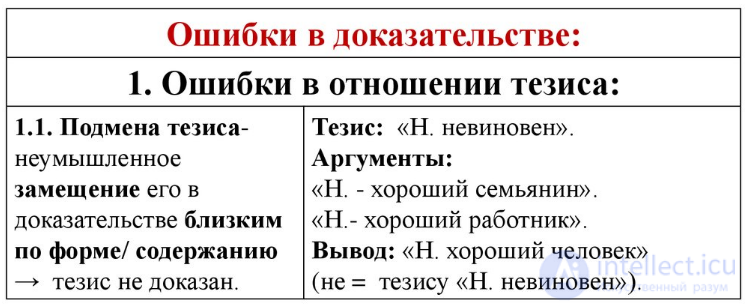
A characteristic error concerning the thesis is substitution of the thesis, the unconscious or deliberate replacement of it in the course of a proof by some other statement. Substitution of the thesis leads to proving not what was required to be proved.
The thesis may be narrowed, in which case it remains unproved. For example, to prove that the sum of the angles of a triangle equals two right angles, it is not enough to prove that this sum is not greater than 180°. To justify the claim that a person should be honest, it is not enough to prove that a reasonable person should not lie.
The thesis may also be broadened. In this case additional grounds are needed. And it may turn out that they entail not only the original thesis but also some other, already unacceptable statement. "He who proves too much proves nothing" - this old Latin proverb has precisely such a danger in mind.
Sometimes a complete substitution of the thesis occurs, and it is not as rare as it may seem. Usually it is obscured by some circumstances connected with the specific situation, and thanks to this it escapes attention. Widely known is the case of the ancient Greek philosopher Diogenes, who was once even beaten for substituting the thesis of a dispute. One philosopher was arguing that in the world as it presents itself to our thinking there is no motion, there are not many things, but only one single thing, motionless and round. By way of objection, Diogenes stood up and began to walk unhurriedly in front of the disputants. For this, if some old sources are to be believed, he was beaten with a stick.
The point at issue was that for our mind the world is motionless. Diogenes, by his walking, tried to confirm a different idea: in the world perceived by the senses there is motion. But this was not disputed. The author of the view that there is no motion held that the senses, which tell of the multiplicity of things and their motion, simply deceive us.
Of course, the view that there is no motion is mistaken, just as the idea that the senses do not give us a correct picture of the world is mistaken. But since such a view was under discussion, one had to speak about it, and not about something else, even if that were true.
This is how A. S. Pushkin describes this dispute:
"There is no motion," said the bearded sage, The other kept silent and began to walk before him. He could not have objected more strongly; All praised the ingenious answer. But, gentlemen, this amusing incident Brings to my mind another example: Every day the sun walks before us, Yet the stubborn Galileo is right.
1. The thesis must be logically definite, clear and precise.
This rule protects us from vagueness and ambiguity in the expression of the main idea in a proof. Connected with this rule is the procedure of clarifying the thesis. For this it is enough to answer the following questions:
On this depends which means we may use in proving the thesis: deduction, induction or analogy.
Sometimes it is necessary to specify the time referred to in the proposition, for example, to make clear whether it is asserted that a certain property belongs to an object always or only sometimes.
The requirement of definiteness, of clearly bringing out the meaning of the propositions put forward, applies equally to the presentation of one's own thesis and to the presentation of the position being criticized. In the ancient Indian theory of debate there was a sensible rule: if you intend to criticize someone's position, you should restate the thesis being criticized and obtain the opponent's agreement that his idea has been stated correctly. Only after this may the critical analysis begin. Observing this rule makes criticism objective, precise and unbiased.
2. The thesis must remain identical, that is, one and the same throughout the whole proof or refutation. This means: a tacit change of the thesis, a shift to a new proposition or concept, is forbidden. One must firmly keep the interlocutor's attention on the preservation of the thesis of the reasoning. This requirement is a special case of the law of identity as applied to proof and refutation. If in the course of a dispute the thesis has changed or been refined, then the subject of the dispute must become the new thesis and not the old one, but this must be declared openly.
3. The thesis must not contain a logical contradiction, that is, it must not use concepts that stand in a relation of incompatibility. For example: "This is a terribly beautiful girl."
If the rules concerning the thesis are not observed for some reason, the following errors are possible.
Many words of our language have "blurred" extensions, or are even used in different senses altogether. Imagine you turn on the television and immediately flinch at the announcer's words: "A national catastrophe has occurred!" You are in a panic and already think the country has perished, when suddenly it turns out that this is a sports program and the announcer meant the defeat of the national football team.
Many difficulties in argumentation are connected with an unclear formulation of the thesis.
Such a device was used in the polemic against Claude Pepper, a senator from the state of Florida, as a result of which he lost the next election. His opponent declared: "...all of the FBI and every member of Congress know that Claude Pepper is a shameless extrovert, moreover, there are grounds to believe that he practices nepotism with regard to his sister-in-law, his sister was a thespian in sinful New York. Finally, though it is hard to believe, it is well known that before his marriage Pepper practiced celibacy."
If an opponent has used such a trick, one must either explain the unfamiliar expressions, or ask the person who put forward the thesis to do so, or say that a trick has been used against you. It is worth revealing the meaning of these words, which not everyone knows. It is clear that the trick of "unclear formulation of the thesis" was used, because: any senator, as a statesman, must be sociable and not a reserved person (the word "extrovert" says precisely that he is a sociable person; but the adjective "shameless" makes it possible to interpret this differently); further, the word "nepotism" means merely favoritism toward relatives, but with regard to a person who was clearly not a relative (a sister-in-law is the wife's sister), it sounds somewhat ambiguous; the sister was a "thespian" - something incomprehensible - and moreover in "sinful New York" - the family is clearly not respectable - do we need such a senator? (this is the subtext), although the word "thespian" simply means a lover of dramatic art: a person who simply likes to go to the theater, and to serious productions at that; before his marriage the senator was merely an unmarried man, like any other ("celibacy" means the unmarried state). Once the meaning of the words is revealed, it is clear that there was nothing "criminal" in the life of Senator Claude Pepper.
Another violation is also possible - an excessive demand for clarification of the thesis - it consists in insistently asking for an explanation even of clear expressions.
For example, someone says that he considers a certain statement true. He is asked: "What is truth?" Suppose he answers that "truth is a statement that corresponds to reality." And then he may be asked again what he understands by "reality," by "correspondence," and so on. How should one act in such a situation? One can suggest asking questions at the end of the talk, or ask the audience "who else is so slow on the uptake?", or say directly and openly that such-and-such a trick is being used.
The most frequent error is an attempt to justify the thesis with the help of false arguments.
Tigers, as is well known, do not fly. But the reasoning "Only birds fly; tigers are not birds; therefore, tigers do not fly" is, of course, not a proof of this fact. The reasoning uses the false premise that only birds are able to fly: many insects fly, and mammals too (for example, bats), and airplanes, and so on. With the premise "Only birds fly" one can derive not only a true but also a false conclusion, say, that cockchafers, since they are not birds, do not fly.
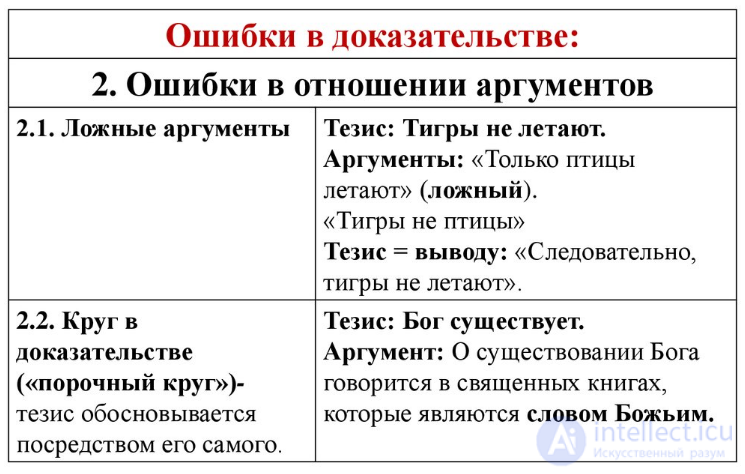
A fairly common error is circular reasoning (begging the question) in proof: the validity of the proposition being proved is justified by means of that same proposition, perhaps stated in a somewhat different form. If what still needs to be proved is taken as the basis of the proof, the thought to be justified is derived from itself, and the result is not a proof but an empty walk in a circle.
Why do we see through glass? The usual answer: it is transparent. But to call a substance transparent means to say that one can see through it.
In the article "What Then Must We Do?" L. N. Tolstoy sharply accuses political economy of an obvious vicious circle. "The question of economic science," writes Tolstoy, "is as follows: what is the cause of the fact that some people, who have land and capital, can enslave those people who have no land and capital?
The answer that suggests itself to common sense is that this comes from money, which has the property of enslaving people. But science denies this and says: it comes not from a property of money, but from the fact that some have land and capital and others do not have them. We ask: why do people who have land and capital enslave those who own nothing? We are answered: because they have land and capital.
But we are simply asking that very thing. Deprivation of land and of the tools of labor is itself enslavement. This is like the answer: it puts one to sleep because it possesses a soporific power."
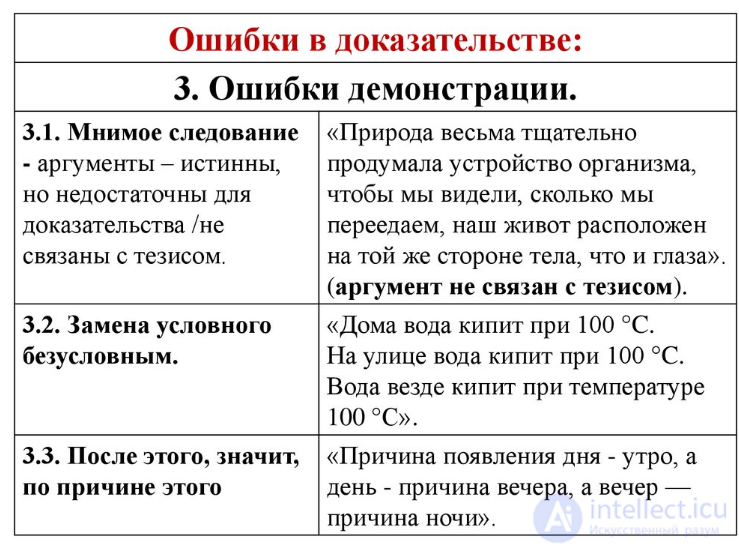
Demonstration is subject to the same rules as the inferences by which it is represented. We already know that demonstration most often takes the form of a simple (categorical), conditional-categorical, or disjunctive-categorical syllogism, or of complete induction. However, in some cases it may be expressed by incomplete induction and analogy. The rules of all these inferences were considered in Chapter 3. They are the rules of demonstration.
Without returning to them, let us recall the main errors that arise when they are violated: the fallacy of four terms, the undistributed middle term in both premises, illicit major term, two negative premises, two particular premises (in the simple syllogism); change of the basis of division, incomplete division, non-strict disjunction, jump in division (in the disjunctive-categorical syllogism); affirming the consequent and denying the antecedent (in the conditional-categorical syllogism); hasty generalization, causal connection in place of temporal sequence (post hoc ergo propter hoc), substitution of the conditional for the unconditional (in incomplete induction); absence of a necessary, law-governed connection between the transferred attribute and the similar attributes (in analogy). These errors in the demonstration of a proof are, as a rule, united under the common name "apparent following" (non sequitur): their presence in any inference that expresses a demonstration results in the thesis not following from the arguments, despite their truth. For example, to prove the thesis: The laws of the state should not be obeyed the following arguments are used:
1. All moral commandments should be obeyed;
2. The laws of the state are not moral commandments.
The demonstration takes the form of a simple (categorical) syllogism:
All moral commandments should be obeyed.
The laws of the state are not moral commandments.
The laws of the state should not be obeyed.
This syllogism commits an error - illicit major term - as a result of which, despite the outward correctness and persuasiveness of the proof, the thesis does not follow from the arguments.
Let us consider one more example. To support the thesis: Not in every sentence must the first word be capitalized the following arguments are adduced:
1. If a word is a proper name, it must be capitalized;
2. Not every sentence begins with a proper name. Here the demonstration is expressed by a conditional-categorical syllogism:
If a word is a proper name, it must be capitalized.
Not every sentence begins with a proper name.
Not in every sentence must the first word be capitalized.
This syllogism commits an error - denying the antecedent - as a result of which the thesis does not follow from the arguments, although the reasoning seems, at first glance, correct and persuasive.
Demonstration, as a way of connecting the arguments with the thesis, is built in the form of inferences (deductive, inductive, by analogy) with the corresponding set of normative requirements. A demonstration is sound and logically impeccable only when all the rules of inference for each type of inference are strictly observed in it.
Accordingly, violation of these rules entails errors in demonstration. For all the variety of possible errors, they can be reduced to typical ones:
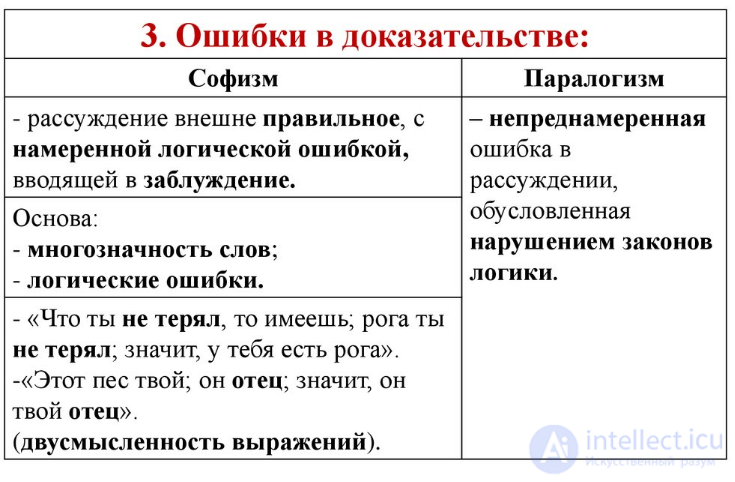
Logical errors made unintentionally in proof, in reasoning, are called paralogisms (from the Greek paralogismos - incorrect reasoning). A paralogism is a violation of the laws of logic committed involuntarily, through poor knowledge of the subject under discussion or a low logical culture of thinking. In its logical essence a paralogism does not differ from a sophism. Its only difference is in motive. However, we know that in legal relations "ignorance of the law is no excuse." The price of violating the laws of logic in this case turns out to be truth, and the situation is all the sadder because a person who commits a paralogism may quite sincerely strive for truth.
A sophism is logically incorrect reasoning passed off as correct. Translated from the Greek, sophysma - is a trick, a contrivance, deliberately incorrect reasoning. A sophism is a deception, but a subtle and camouflaged one, so that it is not immediately, and not by everyone, that it can be exposed.
Sophisms exploit the peculiarities of our everyday language. Many ordinary words and expressions are ambiguous. For example, the Russian word for "earth" has eight meanings, among them: dry land, soil, actual reality, country, territory, and so on. Language also has homonyms: words that sound the same but differ in meaning (in Russian, the same word means a braid of hair, a scythe as a farm tool, and a narrow spit of land jutting into the water). These features of language can undermine the unambiguous expression of thought and lead to confusion between the meanings of words, which creates fertile ground for sophisms.
Speaking of the apparent persuasiveness of sophisms, the ancient Roman philosopher Seneca compared them to the art of conjurers. To deal successfully with the sophisms encountered in the course of argumentation, one must know the subject under discussion well and possess certain skills of logical analysis, and be able to detect the logical errors made by an opponent.
Many sophisms raised the problem of the fluidity and changeability of the world around us and, in their own peculiar way, pointed to the difficulties of cognition.
Consider, for example, the well-known sophism "The Horned One": "What you have not lost, you still have. Have you lost your horns? Then you have them." It uses the ambiguity of the words "to acquire, to have": whether you had what you ought to have, or what you do not necessarily have to have. The sophisms "The Veiled One", "The Sitting One", "Euathlus" and others have also come down to us.
The Greek word from which the word "paradox" is derived (from the Greek para — against and doxa — opinion) literally means "unusual, strange, incredible, remarkable". The term is applied to reasoning in which both the truth of some statement and the truth of its negation are proved to an equal degree. The cause of a paradox is that in theories containing paradoxes the fundamental concepts, including logical ones, have not been sufficiently clarified.
Reflection on paradoxes is, without doubt, one of the best tests of our logical abilities and one of the most effective means of training them.
Becoming acquainted with paradoxes and getting to the heart of the problems behind them is no easy matter. It requires maximum concentration and intense thought about seemingly simple statements.
A paradox is understood in a narrow and a broad sense.
A paradox in the broad sense — is a statement that sharply diverges from generally accepted, established opinions, a denial of what appears to be "unquestionably correct".
A paradox in the narrow sense — is a pair of opposite statements, each of which is supported by convincing arguments.
The most categorical form of paradox is the antinomy (from the Greek anti — against and nomos — law): a contradiction in a law or a contradiction of a law with itself. In other words, it is a situation in which mutually contradictory statements about the same object have logically equal justification, and their truth or falsity cannot be demonstrated within the accepted paradigm.
Aphorisms that are paradoxical in the broad sense include "People are cruel, but man is kind" and "Admit that all are equal, and great men will immediately appear."
Paradoxicality is a characteristic feature of the scientific understanding of the world. Science has at all times been in a certain conflict with what has already become established and habitual. Constantly expanding knowledge has periodically come into contradiction with old dogmas. At times this contradiction reached such sharpness that it could be called a paradox. Newton's law of universal gravitation, for example, was paradoxical: it united such different kinds of motion as the fall of an apple and the motion of planets in their orbits. The wave theory of light also had an undeniable touch of paradox, asserting that at the center of the shadow cast by an opaque object there must be a bright spot.
Science constantly generates paradoxes. But under conditions of relatively slow development of scientific knowledge they were not very numerous and did not sound so sharp. Moreover, scientific discoveries and their practical applications were usually separated by long intervals of time, so paradoxes existed mainly in the theoretical sphere and could await their resolution for decades.
At present, the rapid growth of scientific knowledge is combined with the accelerated introduction of the latest achievements into practice. Under these conditions, contradictions between scientific theories and experience immediately take on a sharp and urgent character. Identifying such paradoxes and resolving them has become a routine matter for modern science.
That is why the topic of paradox has become popular in studies devoted to the development and growth of scientific knowledge.
Paradoxes are especially well known in the most rigorous and exact sciences, mathematics and logic. And this is no accident.
Logic is an abstract science. It has no experiments, not even facts in the usual sense of the word. In building its systems, logic proceeds from an analysis of real thinking. A divergence of logical theory from the practice of actual thinking is often revealed in the form of a more or less acute logical paradox. This explains the significance attached to paradoxes in logic.
Take, for example, the paradox "The Missionary": a missionary fell into the hands of cannibals and arrived just in time for dinner. They allowed him to choose in what form he would be eaten. To do so, he had to make a statement, on the condition that if the statement turned out to be true, he would be boiled, and if it turned out to be false, he would be fried. What must the missionary say in order to stay alive? He must say: "Fry me." If they fry him, it turns out that he spoke the truth and, therefore, according to the conditions, he must be boiled. If they boil him, the statement will be false and he ought to be fried. The cannibals will have no way out: "fry" implies "boil" and vice versa. This episode with the missionary is one of the paraphrases of the dispute between Protagoras and Euathlus. As is well known, the sophists, among whom Protagoras is one of the most famous, were the first to charge fees for teaching. Their fees were quite large, so large that another well-known sophist, Gorgias, set up a golden statue of himself in the temple at Delphi. It is not surprising that some students were unable to pay for their instruction immediately. Protagoras took them to the temple, where they swore an oath that they would pay, and testified that they were being charged a fair price. A certain Euathlus promised to pay his teacher for the instruction after the first lawsuit he won. Time passed, and Euathlus was in no hurry to take part in legal proceedings. When Protagoras's patience ran out, he threatened his student that he would sue him. He reasoned roughly as follows: "Euathlus will pay me anyway. If he wins the case, he will pay me as agreed, and if he loses, he will pay by the court's decision." But the student had not only learned his teacher's lessons well, he had surpassed him in logical casuistry. He replied that he would not pay in any case.
If the court decides that Euathlus does not have to pay, he will comply with the court's decision. And if the court orders him to pay, he will not do so under the agreement, since the case has not been won.
The paradox "The Crocodile and the Mother": a crocodile snatched her child from an Egyptian woman standing on the riverbank. When the mother begged him to return the child, the crocodile, shedding a tear, answered: your misfortune has touched me, and I will give you a chance to get your child back. Guess: will I give him back to you or not? If you answer correctly, I will return the child. If you guess wrongly, I will not give him back. Whatever the mother says, the crocodile will not give the child back.
The paradox "The Village Barber": the council of a certain village defined the duties of the village barber as follows: to shave all the men of the village who do not shave themselves, and only those men. Should he shave himself? If yes, then he will belong to those who shave themselves, and those who shave themselves he, as a barber, must not shave. If no, then he will belong to those who do not shave themselves and, therefore, he will have to shave himself. We thus come to the conclusion that this barber shaves himself if and only if he does not shave himself. Can such a barber exist?
Is there a taxi driver who drives all those and only those who do not drive a car themselves?
The paradox "The Catalogue". A certain library decided to compile a bibliographic catalogue that would include all those and only those bibliographic catalogues that do not contain a reference to themselves. Should such a catalogue include a reference to itself?
Sometimes a paradox turns out to be a peculiar way of posing a problem, about which it is hard even to decide what exactly that problem consists in. Reflection on such problems usually does not lead to any definite result, but it is undoubtedly useful as logical training.

Comments