
Lecture
All deductive inferences are called syllogisms (from the Greek sillogismos – counting up, summing up, drawing a consequence). There are several kinds of syllogisms. The first of them is called simple (categorical), because all the judgments contained in it (the two premises and the conclusion) are simple, or categorical. These are the already familiar judgments of types A, I, E, O.
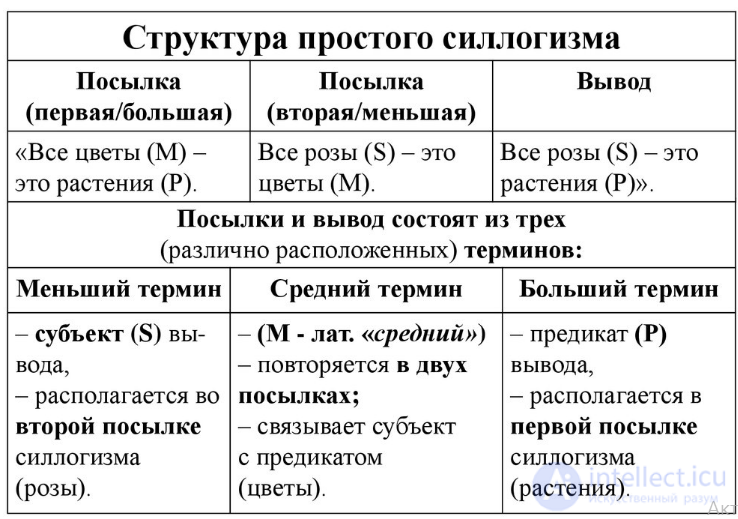
Let us consider an example of a simple syllogism:
All flowers (M) – are plants (P).
All roses (S) – are flowers (M).
All roses (S) – are plants (P). Both premises and the conclusion in this syllogism are simple judgments (moreover, both the premises and the conclusion are judgments of type A(universal affirmative)). Let us pay attention to the conclusion, expressed by the judgment: «All roses are plants». In this conclusion the subject is the term «roses», and the predicate is the term «plants». The subject of the conclusion is present in the second premise of the syllogism, and the predicate of the conclusion – in the first. Also, the term «flowers» is repeated in both premises, which, as is easy to see, serves as the connecting term: it is precisely thanks to it that the terms «plants» and «roses», which are unconnected and disjoined in the premises, can be linked together in the conclusion. Thus, the structure of a syllogism includes two premises and one conclusion, which consist of three terms (arranged in various ways):
1. The subject of the conclusion is located in the second premise of the syllogism and is called the minor term of the syllogism (the second premise is also called the minor premise).
2. The predicate of the conclusion is located in the first premise of the syllogism and is called the major term of the syllogism (the first premise is also called the major premise). The predicate of the conclusion, as a rule, is a broader concept in extension than the subject of the conclusion (in the example given, the concepts «roses» and «plants» stand in a genus–species relation), which is why the predicate of the conclusion is called the major term, and the subject of the conclusion – the minor term.
3. The term that is repeated in the two premises and links the subject with the predicate (the minor and major terms) is called the middle term of the syllogism and is denoted by the Latin letter M, because «middle» in Latin is medium.
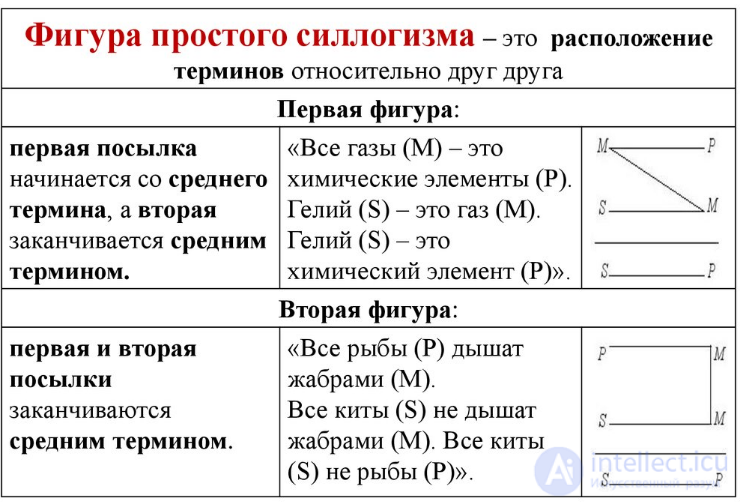
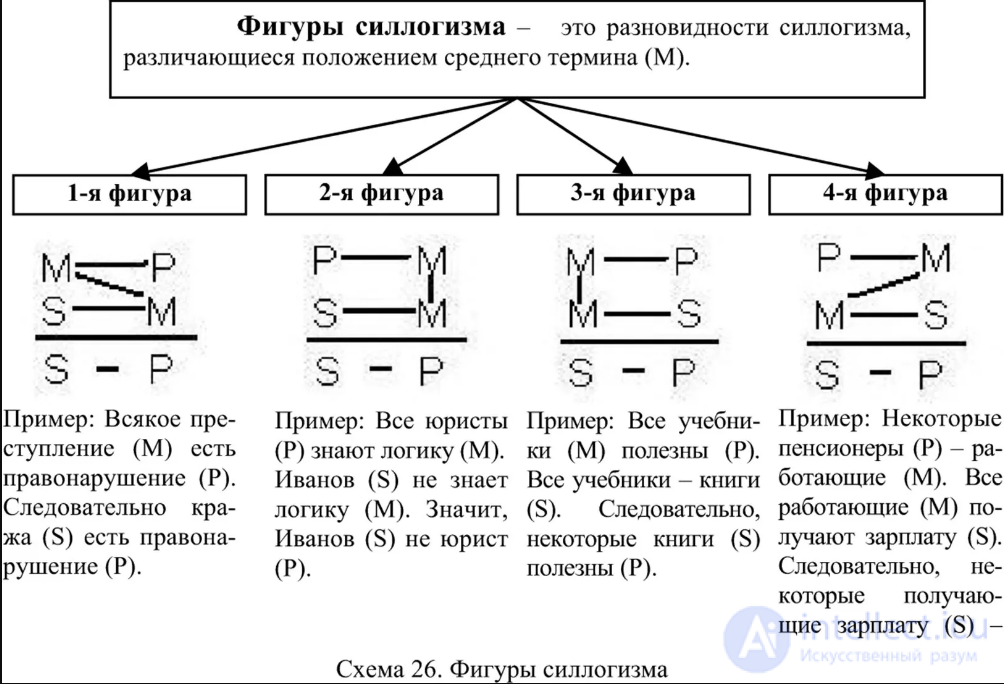
The three terms of a syllogism can be arranged within it in different ways. The mutual arrangement of the terms relative to one another is called the figure of the simple syllogism. There are four such figures, i.e. all the possible variants of the mutual arrangement of terms in a syllogism are exhausted by four combinations. Let us examine them.
The first figure of the syllogism – is such an arrangement of its terms in which the first premise begins with the middle term, and the second ends with the middle term. For example:
All gases (M) – are chemical elements (P).
Helium (S) – is a gas (M).
Helium (S) – is a chemical element (P). Given that in the first premise the middle term is linked with the predicate, in the second the subject is linked with the middle term, and in the conclusion the subject is linked with the predicate, let us draw up a diagram of the arrangement and connection of the terms in the example given (fig. 34):
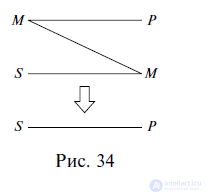
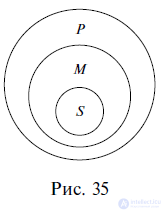
The straight lines in the diagram (except for the one that separates the premises from the conclusion) show the connection of the terms in the premises and in the conclusion. Since the role of the middle term is to link the major and minor terms of the syllogism, in the diagram the middle term in the first premise is joined by a line to the middle term in the second premise. The diagram shows exactly how the middle term links the other terms of the syllogism together in its first figure. In addition, the relations between the three terms can be depicted using Euler circles. In this case the following diagram is obtained (fig. 35):
The second figure of the syllogism – is such an arrangement of its terms in which both the first and the second premises end with the middle term. For example:
All fish (P) breathe with gills (M).
All whales (S) do not breathe with gills (M). All whales (S) are not fish (P).
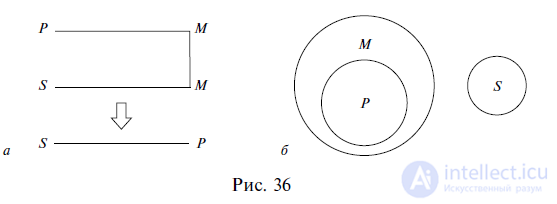
The diagrams of the mutual arrangement of the terms and the relations between them in the second figure of the syllogism look like this (fig. 36):
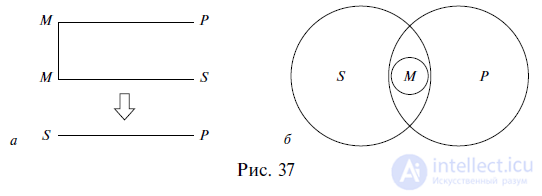
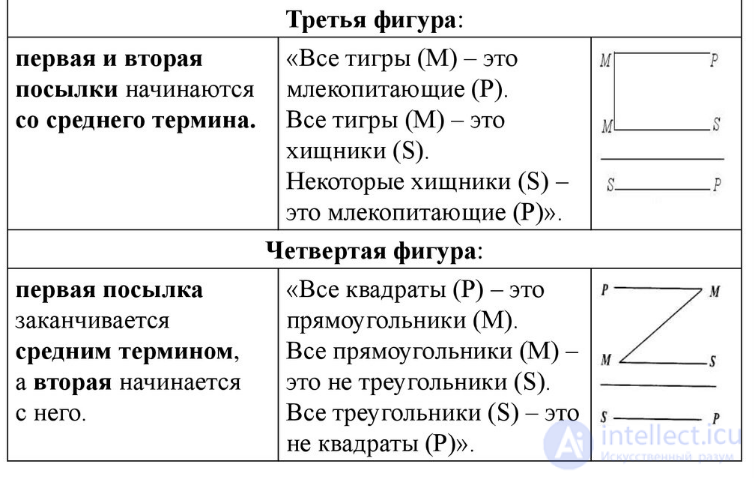
The third figure of the syllogism – is such an arrangement of its terms in which both the first and the second premises begin with the middle term. For example:
All tigers (M) – are mammals (P).
All tigers (M) – are predators (S).
Some predators (S) – are mammals (P). The diagrams of the mutual arrangement of the terms and the relations between them in the third figure of the syllogism (fig. 37):
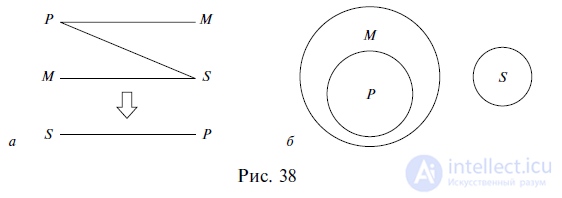
The fourth figure of the syllogism – is such an arrangement of its terms in which the first premise ends with the middle term, and the second begins with it. For example:
All squares (P) – are rectangles (M).
All rectangles (M) – are not triangles (S).
All triangles (S) – are not squares (P). The diagrams of the mutual arrangement of the terms and the relations between them in the fourth figure of the syllogism (fig. 38):
Let us note that the relations between the terms of a syllogism in all the figures can also be different.
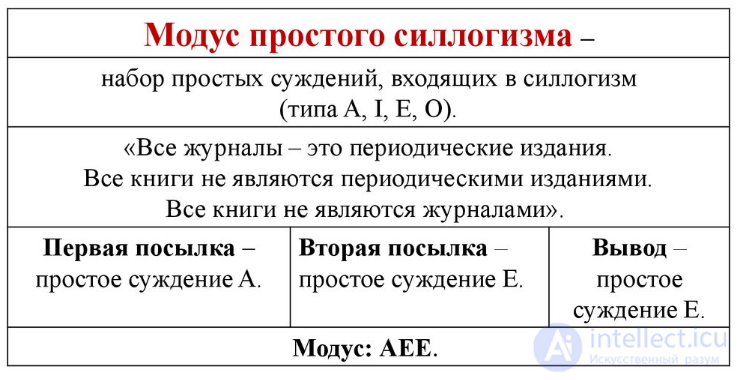
Any simple syllogism consists of three judgments (two premises and a conclusion). Each of them is simple and belongs to one of the four types (A, I, E, O). The set of simple judgments comprising a syllogism is called the mode of the simple syllogism.
For example:
All celestial bodies move. All planets are celestial bodies. All planets move.
In the syllogism, the first premise is a simple judgment of type A (universal affirmative), the second premise is also a simple judgment of type A, and the conclusion in this case is a simple judgment of type A. Therefore, the syllogism examined has the mode AAA.
In the second example: All magazines are periodicals. All books are not periodicals. All books are not magazines. The syllogism has the mode AEE. In the third example: All carbons are simple substances. All carbons are electrically conductive. Some electrical conductors are simple substances.
The syllogism has the mode AAI. In total there are 256 modes across all four figures, i.e. possible combinations of simple judgments in a syllogism. Each figure has 64 modes. However, of these 256 modes only 19 yield reliable conclusions, while the rest lead to probabilistic conclusions. If we take into account that one of the main features of deduction (and hence of the syllogism) is the reliability of its conclusions, then it becomes clear why these 19 modes are called correct (valid), and the rest – incorrect (invalid).
Our task is to be able to determine the figure and mode of any simple syllogism. For example, it is required to establish the figure and mode of the syllogism:
All substances consist of atoms. All liquids are substances. All liquids consist of atoms.
First of all, one must find the subject and predicate of the conclusion, i.e. the minor and major terms of the syllogism. Next, one should establish the location of the minor term in the second premise and of the major term in the first. After that, one can determine the middle term and schematically depict the arrangement of all the terms in the syllogism (fig. 39):
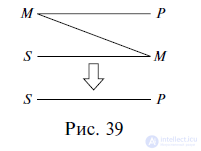
All substances (M) consist of atoms (P).
All liquids (S) – are substances (M).
All liquids (S) consist of atoms (P). As we can see, the syllogism under consideration is constructed according to the first figure. Now we must find its mode. To do this, we should determine which type of simple judgment the first and second premises and the conclusion belong to. In our example, both premises and the conclusion are judgments of type A (universal affirmative), i.e. the mode of this syllogism is AAA. So, the proposed syllogism has the first figure and the mode AAA.
1. What is a syllogism?
2. What is the structure of a simple syllogism?
3. What is the figure of a simple syllogism? Think about why only four figures of the syllogism are possible. How does one determine the figure of a given syllogism? Give two examples for each figure of the syllogism, accompanying them with diagrams of the mutual arrangement of the terms and the relations between them.
4. What is the mode of a simple syllogism? How does one determine the mode of a given syllogism? How many modes exist across all four figures of the syllogism? What are correct and incorrect modes? How many correct modes exist? Give, choosing them yourself, one example each of syllogisms having the modes AAA, AEE, AAI.
5. Determine the figure and mode of the following syllogisms:
1) All grass snakes are reptiles. All reptiles are not invertebrates. All invertebrates are not grass snakes.
2) All pines are conifers. No birch is a conifer. No birch is a pine.
3) All bees are insects. All bees are flying creatures. Some flying creatures are insects.
4) No elementary particle is a molecule. All electrons are elementary particles. No electron is a molecule.
5) All majors are military personnel. Some Russians are majors. Some Russians are military personnel.

Comments