
Lecture 25 min.
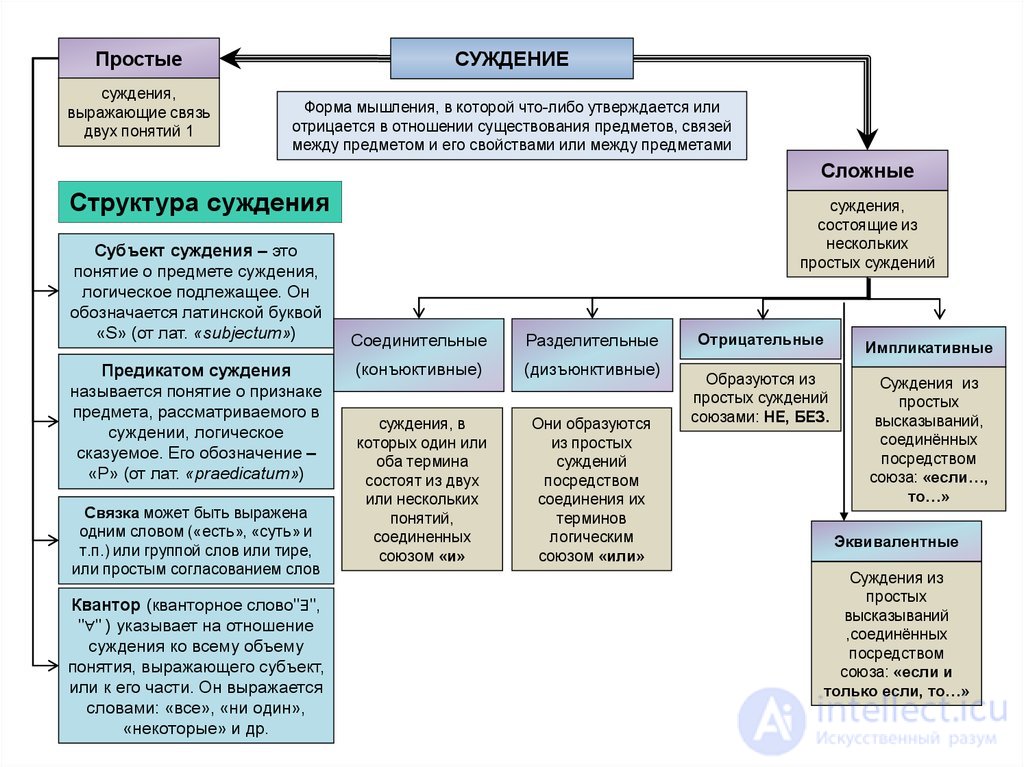
1) By degree of complexity, all propositions are divided into two broad groups (two types) – simple and compound.
Simple propositions are propositions in which no proper part can be singled out that is itself an independent proposition.
Compound propositions are propositions consisting of two or more simple propositions.
Since a proposition is the meaning of a statement, everything said about the division of statements into groups also applies to the classification of propositions. First of all, they can be divided into simple and compound propositions. The former do not contain other propositions as their parts; in compound propositions, some of their parts are themselves propositions. Among simple propositions, a special role is played by the so-called categorical propositions, formed with the help of the logical connectives "All ... are", "All ... are not", "Some ... are ..." and "Some ... are not ...".
Categorical propositions do not exhaust the whole class of simple propositions. Also simple are propositions about relations, such as "A equals B", "A is less than B".
"A is farther than B", "A is earlier than B", etc. These propositions cannot be reduced to propositions with the copula "is". If we use only a language that includes categorical propositions alone, we will not be able to express most of mathematics, physics and other sciences.
Simple propositions disclose an unconditional connection between objects of thought (which is why they are also called categorical). In terms of function, they reflect one single connection of the objective world.
Simple propositions are divided into kinds on the following grounds:
by the nature of the copula;
by the nature of the subject;
by the nature of the predicate;
by the relation between the subject and the predicate.
Kinds of propositions by quality and quantity
The quality of a proposition is the characterization of a proposition, by its logical form, as affirmative or negative. It is determined by the nature of the copula ("is" or "is not").
An affirmative proposition is a proposition that discloses the presence of some connection between the subject and the predicate.
The general formula of an affirmative proposition is "S is P".
A negative proposition is a proposition that discloses the absence of some connection between the subject and the predicate.
The general formula of a negative proposition is "S is not P".
In turn, a negative proposition can be: a) with a positive predicate ("Petrov is not a patriot"), b) with a negative predicate ("Petrov is not a non-patriot").
The quantity of a proposition is the characterization of a proposition by the logical extension of its subject as universal, particular or singular.
A universal proposition is a proposition in which something is asserted about a whole group of objects in the distributive sense ("all", "any", "every" in affirmative propositions and, correspondingly, "no", "nobody", "none" in negative propositions).
In turn, universal propositions can be exclusive and non-exclusive.
An exclusive proposition says something only about the given group ("only", "solely", for example, "Only a court administers justice").
Non-exclusive propositions presuppose that the assertion they contain may also be true of other groups (for example, the proposition "All advocates are lawyers" does not deny that, besides advocates, prosecutors, investigators, etc. are also lawyers).
Particular propositions are propositions in which something is stated about a part of some group of objects ("some", "not all", "most", "part", "certain", etc.). These are propositions of the form "Some S are (are not) P".
Particular propositions are divided into definite and indefinite.
Definite particular propositions are propositions in which what is asserted about a part of some group of objects cannot be extended to the whole group of objects. The word "some" here implies "only some" (for example, "some people are beautiful", "some books are not interesting").
Indefinite particular propositions are propositions in which what is stated about a part of the objects of a group may also be applied to the whole group. The word "some" here implies "at least some, and perhaps all".
Singular propositions are propositions in which something is stated about a single object of thought ("this"). The formula is "This S is (is not) P" ("The Sun is the source of life on Earth", "The Moon is not a planet").
Singular propositions include propositions about an individual object and propositions about a collection of objects regarded as a single whole and expressed by collective concepts.
An intermediate position between universal and particular propositions is occupied by exceptive propositions, in which a single statement contains both the quantifier "all" and a limitation "except" (or "with the exception of", "as a rule", etc.). For example: "All students, with the exception of two, came to the lecture".
The combined classification of propositions by their quantity and quality:
Universal affirmative propositions are propositions that are universal in quantity (by the nature of the subject) and affirmative in quality (by the nature of the copula).
(for example, "All advocates are lawyers")
Particular affirmative propositions are propositions that are particular in quantity (by the nature of the subject) and affirmative in quality (by the nature of the copula).
(for example, "Some witnesses give reliable testimony")
Universal negative propositions are propositions that are universal in quantity (by the nature of the subject) and negative in quality (by the nature of the copula).
(for example, "No accused person is acquitted")
Particular negative propositions are propositions that are particular in quantity (by the nature of the subject) and negative in quality (by the nature of the copula).
(for example, "Some witnesses do not give truthful testimony")
For the formulaic notation of these kinds of propositions, logic uses the vowels of the Latin words "affirmo" ("I affirm") and "nego" ("I deny"):
A – universal affirmative;
I – particular affirmative;
E – universal negative;
O – particular negative.
To operate correctly with propositions, one must know the distribution of the terms in them – the subject and the predicate.
A term is considered distributed if it is thought of in its entire extension, and undistributed if it is not thought of in its entire extension.
In universal affirmative propositions (A): "All S are P" – the subject is distributed and the predicate is undistributed (the shading in the diagram shows the degree of their distribution).
The only exceptions are cases where the proposition is universal and exclusive. For example, "Only humans are rational beings on Earth". In these, not only the subject but also the predicate is distributed.

In particular affirmative propositions (I): "Some S are P" – the subject and the predicate are undistributed.

The only exceptions are cases where the subject is wider in extension than the predicate. For example: "Some mortal beings are humans", "Some lawyers are advocates". In these, the subject is undistributed and the predicate is distributed.
 In universal negative propositions (E): "No S is P" – the subject and the predicate are distributed.

+In particular negative propositions (O): "Some S are not P" – the subject is undistributed and the predicate is distributed.
Thus, the following regularity can be observed:
a) the subject is distributed in universal propositions and undistributed in particular ones;
b) the predicate is distributed in negative propositions and undistributed in affirmative ones.
Attributive propositions (from Latin attributum – property, attribute), or propositions about the properties of something, disclose the presence or absence of certain properties (or attributes) in an object of thought.
(for example, "All the republics of the former USSR declared their independence")
In terms of content, this is a proposition about whether an object of thought does or does not possess some set of properties (in which case the predicate is expressed by a concrete concept, for example, "Copper is a metal") or a single property (in which case the predicate is expressed by an abstract concept, for example, "Copper is conductive").
In terms of extension, attributive propositions are propositions about whether an object of thought is or is not included in a given class of objects – "propositions of inclusion (or non-inclusion) in a class of objects". In symbolic logic they are expressed by the formulas: S  P (read: the extension of S is included in the extension of P) and S
  P (read: S belongs to P).
Relational propositions (from Latin relatio – relation), or propositions about the relations of something to something, disclose the presence or absence in an object of thought of a certain relation to another object (or several objects).
They are usually expressed by the formula x R y, where x and y are objects of thought, and R (from relatio) is the relation between them.
(for example: "Russia is not equal to the USSR", "Moscow is larger than Saint Petersburg")
Varieties of relational propositions:
propositions about relations between two objects;
propositions about relations between three or more objects (the predicate in this case is "many-place" ("Ryazan lies between Moscow and Tambov").
In modern logic there is a tendency to reduce relational propositions to attributive ones. For example, the proposition "Ryazan is smaller than Moscow" (relational) can be represented as the proposition "Ryazan belongs to the cities that are smaller than Moscow" (attributive).
Existential propositions (from Latin exsistentia – existence), or propositions about the existence of something, are those that disclose the presence or absence of the object of thought itself.
The predicate is expressed by the words "exists" ("does not exist"), "there is" ("there is not"), "was" ("was not"), "will be" ("will not be"), etc.
The kinds of propositions by the nature of the predicate have important cognitive significance. Attributive propositions embody knowledge about the ever newly discovered properties of various objects of thought. Relational propositions reflect the infinite wealth of relations between objects of thought: spatial and temporal, natural and social (political, moral, religious, family, legal, etc.). Existential propositions allow us to formulate our thoughts on the most important problems of the existence (or absence) of certain objects and phenomena: whether there is life on other planets, whether the "biofield", "telepathy" or "poltergeist" exists, or, for example, whether the event of a crime took place.
The modality of a proposition (from Latin modus – manner, mode) is the characterization of a proposition according to its degree of possibility, necessity, obligation, etc.
This is information about the objective character (or mode) of the connection between the subject and the predicate disclosed in the proposition, about a person's subjective attitude to it, about the character and degree of reliability of the knowledge contained in the proposition, and so on. In language, the modality of a proposition is expressed by many words. For example, such as "possibly", "permitted", "valuable", as well as their negations ("impossible", "not permitted", etc.
Alethic, or truth, modality (from Greek aleteja – truth) expresses the character of the connection between the objects thought of, and hence between the subject and the predicate of a proposition. The modal operator is "necessarily" or "possibly".
From the standpoint of alethic modality, the following kinds of propositions are distinguished:
a) assertoric propositions, or propositions about the fact, the actuality of something. In such propositions modality is not expressed, and only the bare fact of something is stated (for example: "Russia is moving to a market economy");
b) problematic propositions, or propositions about the possibility of something (for example: "Russia may move to a market economy");
c) apodictic propositions, or propositions about the necessity of something (for example: "Russia will of necessity move to a market economy").
Deontic, or normative, modality (from Greek deon – what is needed, what is due) is the characterization of propositions about human activity from the standpoint of relations of obligation (through the operators "obligatory", "permitted", "forbidden" and the like).
The main varieties of deontic modality:
a) propositions about the presence or absence of some right. They are formulated with the words "permitted", "forbidden", "entitled", etc. (for example: "Everyone has the right to life", or "Forced labor is prohibited");
b) propositions about the presence (or absence) of some obligation. They are formulated with the words "obliged", "must", "it is necessary", etc.
Epistemic, or cognitive, modality (from Greek episteme – knowledge) is the characterization of propositions from the standpoint of the degree of reliability of knowledge. The logical operators are "provable", "unprovable", "refutable", etc.
The main varieties of epistemic modality:
a) propositions based on belief, whether religious or not. For example: "I believe that God exists", "I believe that a better life will come";
b) propositions based on knowledge, whether problematic or not (reliable). For example: "There are apparently other intelligent beings in the Universe", "Telepathy probably exists", "It is certain that there is no life on Mars".
Axiological, or value, modality (from Greek axios – valuable) expresses a person's evaluative attitude to an object of thought. The operators are "good", "bad", "indifferent", etc. For example: "It is bad to live without friends", "It is good to have a little house in the country".

Compound propositions are formed from simple propositions with the help of logical connectives: conjunction, disjunction, implication, equivalence and negation.
The truth or falsity of compound propositions depends, first of all, on the truth or falsity of the simple or other propositions that make them up.
In language, compound propositions are expressed by compound sentences, complex sentences, and sometimes also by simple expanded sentences (in the latter case we are dealing with a peculiar contraction of compound sentences; for example, instead of the compound sentence "Aristotle was a great logician, and Hegel was also a great logician" one can say: "Aristotle and Hegel were great logicians").
1. Conjunctive (or copulative) propositions (from Latin conjunctio – connection, joining). They are formed from the original propositions by means of the logical connective of conjunction "and" (symbolically " "). The most general scheme: A
 B (read: "A and B"), where A and B are the original propositions, and the sign
 is the symbol of their conjunction. For example: "No one is forgotten, and nothing is forgotten".
Besides the conjunction "and", in language conjunction can be rendered by other grammatical conjunctions ("while", "but", "yet", "although", "as well as").
If a conjunction is expressed by a simple expanded sentence, it can have three initial structures:
a) one subject and two predicates – "S is (is not) P1 and P2". For example: "All are equal before the law and the court" (the original propositions: "All are equal before the law" and "All are equal before the court");
b) two subjects and one predicate – "S1 and S2 are (are not) P". For example: "State pensions and social benefits are established by law" (here too there are two original propositions);
c) two subjects and two predicates – "S1 and S2 are (are not) P1 and P2". For example: "The fundamental human rights and freedoms are inalienable and belong to everyone from birth" (here there are already four simple propositions).
More complex constructions are also possible.
There are four possible ways of combining two original propositions "A" and "B", depending on their truth ("t") and falsity ("f"). The conjunction of such propositions is true if each of them is true taken separately.
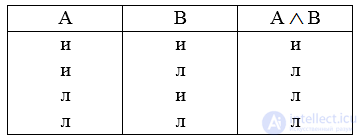
The logical connective "and" can also join more than two original propositions, by the formula: A B
B C. In such cases it is important that the original propositions have the property of associativity (combinability), i.e. that their truth or falsity does not change with the way they are grouped: (A
 B)
B) C or A
 (B
(B C), etc.
2. Disjunctive (dividing) propositions (from Latin disunctio – separation, isolation).
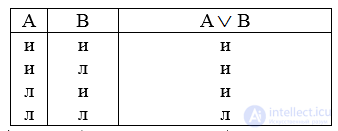
Weak (non-strict) disjunction is formed by the logical connective "or" (symbol  ). It is characterized by the fact that the combined propositions do not exclude each other. The general formula is: A
 B (read "A or B"). The linguistic means of expressing weak disjunction are the grammatical conjunctions "or", "either" and others in their dividing-and-connecting sense. For example: "Law can promote economic development or hinder it".
A weak disjunction is true when at least one of its component propositions is true (or both together), and false when both propositions are false:
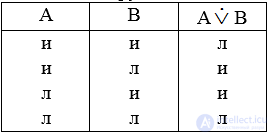
Strong (strict) disjunction is formed by the logical connective "either... or" (symbol  ). Its components exclude each other. The general formula is "A
  B" (read "either A or B"). It is expressed by the same grammatical means as the weak one ("or", "either"), but now in the dividing-and-excluding sense. For example: "A law that establishes or aggravates liability has no retroactive effect".
A strict disjunction is true only when one of its component propositions is true and the other is false:
A disjunctive proposition may include three or more original propositions. The formula is A B
B  C...
C...
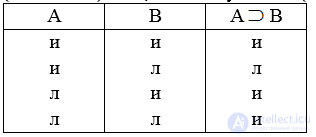
3. Implicative (or conditional) propositions (from Latin implicatio – entanglement, close connection).
They combine propositions on the basis of the logical connective "if... then" (denoted by →). The formula is A→B (read: "If A, then B"). Conditional propositions reflect dependencies between objects and phenomena – causal, spatio-temporal, functional, etc. In classical logic, implication is denoted by the sign  (A
(A B) and is called material implication.
An implication is true in all cases except one: when the antecedent (ground) holds and the consequent (consequence) does not.
4. Equivalent (equipollent) propositions (from Latin aequivalens – of equal value, equivalent).
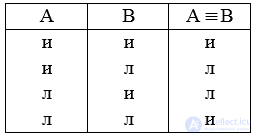
They combine propositions with a mutual (direct and converse) conditional dependence. They are also called double implication. They are formed by the logical connective "if and only if... then" (symbol 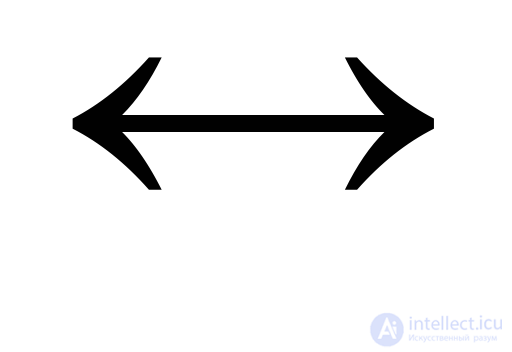 ). The formula of equivalence is A
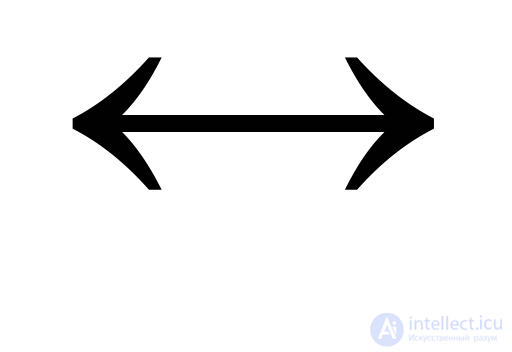 B (read: "if and only if A, then B"). Example: "If and only if a person has reached retirement age, then he has the right to an old-age pension".
To denote a generalized equivalence, independent of the specific content of the propositions forming it, the sign " " is also used.
An equivalent proposition is true in two cases: when both of its component propositions are true and when both are false.
5. Negation of propositions.
The logical connective "it is not true that" or simply "not" (the negation sign  or
or  ). Unlike the binary connectives, it applies to a single proposition. Adding it to a proposition means forming a new proposition. For example, the original proposition: "All judges are incorruptible". Its negation: "It is not true that all judges are incorruptible" or "Not all judges are incorruptible".
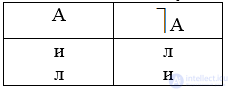
A negation is true if the original proposition is false, and vice versa:
The factor of logical influence is the acceptance of a proposition as true or false by virtue of its justification by other propositions, from which the accepted proposition follows logically as a consequence. A distinctive feature of rationally oriented cognition is that it accepts only those propositions that rest on a reliably established empirical or theoretical foundation of verified propositions. Such justified propositions acquire the epistemic status of knowledge: K(p), where K is a modal operator denoting "knowledge".
By degree of justification, two non-overlapping classes of propositions are distinguished among items of knowledge:
1) certain and
2) problematic.
1) Certain propositions are sufficiently justified true or false propositions. Their truth or falsity is established either by direct verification or indirectly, when the proposition is confirmed by empirical or theoretical statements.
The modality of such propositions can be expressed with the help of the operators of provenness (verifiedness) — V and of refutedness (falsifiedness) — F. A proposition p is proven if it is sufficiently justified: Vp. If the negation of the proposition, i.e. not-p, is sufficiently justified, then that proposition is also considered proven: V˥p. For example, the proposition "It is not true that N. took direct part in committing the crime" is proven if an alibi has been established, i.e. the fact that N. was in another place at the time the crime was committed.
Thus, any reliably established proposition can be spoken of as proven, or verified, i.e. 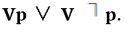 .
.
Certain propositions can be expressed with the help of the refutedness operator: Fp ∨ F˥p.
The operators of provenness and refutedness can be expressed through each other. Thus, the provenness of p is equivalent to the refutation of not-p, and the provenness of not-p is equivalent to the refutation of p. This equivalence can be represented as follows:
Vp ≡ F˥p;
V˥p ≡ Fp.
Certainty is a modal characteristic of a proposition that, like the concepts of truth and falsity, does not vary by degrees. Of two statements one cannot say that one of them is "more certain" than the other. If a proposition is sufficiently justified, it is considered proven, and thereby certain, i.e. true or false without variation by degrees.
It should be noted that, in psychological terms, certain knowledge is characterized by the absence of doubt about the truth of the corresponding proposition. However, the absence of doubt by itself does not yet indicate the certainty of a proposition, which is recognized as such only when there are appropriate grounds, whether logical or empirical.
2) Problematic propositions are propositions that are insufficiently justified. The truth or falsity of such propositions has not been established precisely, which is why they are called problematic, plausible, or probable.
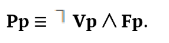
In natural language, the indicators of a proposition's problematic character are usually parenthetical words: "apparently", "probably", "it seems", "possibly", "one may suppose", etc. The accepted expression for problematic propositions is: "S is probably P". The problematic character of a proposition (p) can be expressed by the operator P; the expression Pp is read: "Probably, p".
The problematic character of a proposition p can be expressed in terms of provenness and refutedness:
In judicial inquiry, versions (hypotheses) about the circumstances of the cases under investigation are constructed in the form of problematic propositions. They direct the investigation along the right course and help to establish certain results.
The requirement of proof is imposed on all propositions in legal proceedings. A guilty verdict in a criminal case and a court decision in a civil case must rest on reliably established circumstances of each particular case. Only in that case is the court's decision considered just.
The justification of problematic propositions can be represented in terms of probability theory. The logical probability of a proposition means the degree of its justification. If we denote probability by the symbol P, then for any proposition p its probability takes a value 0 ≤ P(p) ≤ 1. 0 and 1 serve as the limits of justification, expressing a certain value. Thus, P(p) = 0 means that p is falsified, or refuted (p is false). Since the probability of a problematic proposition takes a numerical value in the interval between 0 and 1, i.e. 0 < P(p) < 1, it is usually expressed as a fraction, for example, P(p) = 1/3 or P(p) = 0.2. If P(p) = 1, this means that p is verified, or proven (p is true).
In the simplest cases, when one is dealing with grounds of the same type and equal logical strength, the degree of probability of a proposition is determined by the ratio of the number of favorable grounds (m) to their total number (n): P(p) = m/n. Thus, if for a proposition p out of 10 grounds (n) 8 turned out to be favorable (m), then its degree of justification, or logical probability, will be expressed by the fraction 8/10 = 4/5, i.e. P(p) = 4/5.
If all 10 possible grounds are favorable, the probability will be expressed by the ratio P(p) = 10/10 = 1. This means that the statement p is considered certain. If all 10 grounds turn out to be unfavorable, the probability of p will be equal to 0: P(p) = 0/10 = 0. This means that p is assessed as false.
In most cases the grounds are statements of different types and different evidential strength. They are usually assessed on their merits, taking into account the different "weight" of each. In ordinary reasoning the following approximate gradation of probabilities is often used:
1) P(p) = 1/3 — "p" is improbable;
2) P(p) = 1/2 — "p" is equally probable and improbable;
3) P(p) > 1/2 — "p" is more likely than not;
4) P(p) > 2/3 — "p" is highly probable.
Practically and theoretically grounded evaluative standards make it possible to determine objectively, in probabilistic form, the actual logical value of problematic propositions.
Justification as an objective logical characteristic of a proposition should be distinguished from the concept of confidence, which expresses a person's subjective psychological attitude toward a statement, his readiness to accept or reject the corresponding proposition. When people say, for example, "I am sure that X committed the crime"; "I am convinced that the witness is mistaken"; "I believe that the accused describes the circumstances of the crime incorrectly", they are, as a rule, expressing a subjective attitude to the content of the statements — an inclination to accept or reject the information expressed in them.
When a researcher is impartial and sets himself the task of finding objective truth, his feeling of confidence is determined by rational, logical grounds and depends primarily on the degree of justification of the proposition.
If the probabilistic assessment of a proposition directly affects the degree of confidence, the reverse is not always the case. A high degree of confidence does not mean that it arose as a result of the proposition's justification. Besides logical grounds, a feeling of confidence may arise under the influence of other, extra-logical factors, which are not always clearly recognized and not always controlled. These include various kinds of interests, utilitarian considerations, subjective inclinations, habits, and the like. In this case the desired may unintentionally be passed off as the actual.
That is precisely why, when analyzing a proposition of practical importance, one should distinguish between such logically verifiable modal characteristics as the degree of justification and the subjective feeling of confidence in the truth of that proposition. In scientific research and in the work of a lawyer, the justification of a proposition, expressed in the corresponding reasoning, must be the leading factor determining the formation of subjective confidence, without which the discovery of truth is also impossible.

Comments