
Lecture
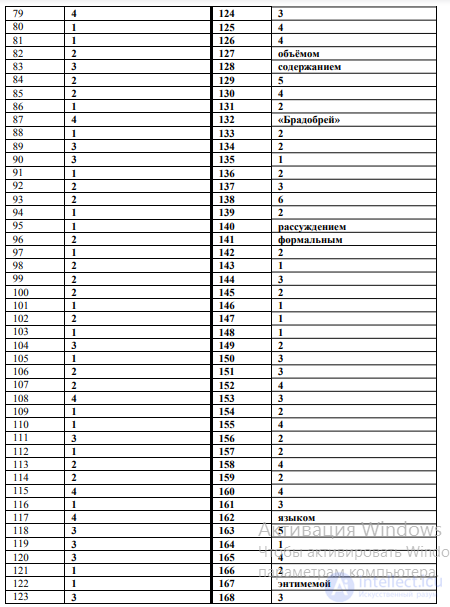
The answers are at the bottom of the article, or better yet, work them out yourself without peeking at the answers
70. Logic must be studied in order to:
answer 2
71. Logical culture – is:
answer 4
72. A logical constant – is:
answer 2
73. A logical error – is:
answer 2
74. The logical scheme of reasoning – is:
answer 1
75. The laws of logic:
answer 1
76. Logical paradoxes:
answer 3
77. A logical argument used when the issue at hand is not the thesis, but the personal characteristics of the person stating it:
answer 2
78. The law of logic violated in the following dialogue:«Teacher: I hope, Tom, that I won't see you copying from someone else's notebook.Tom: I hope so too» -
answer 1
79. The law of logic violated in the passage below:
«One of the scholars complained to a well-known doctor that he had arthritis.
- Did your mother have arthritis? – the doctor asked.
- No.
- And your father?
- He didn't have it either.
- You don't have arthritis, - the doctor declared, and having bid the patient farewell, left without further explanation» -
answer 4
80. The law of logic violated in the passage below:
«One day a padishah asked Birbal:
- Tell me, Birbal, how much will remain if you take four away from twelve?
- Nothing will remain, - answered Birbal.
- What do you mean, nothing? – the padishah was surprised.
- Just so, - answered Birbal, - if you subtract the four seasons from the twelve months, what will remain? Nothing!» -
answer 1
81. The law of logic violated in the passage below: «The defense counsel became acquainted with the case materials, and a petition was submitted from him: to release him from custody» -
answer 1
82. L. Feuerbach said that:
answer 2
83. Any concept has:
answer 3
84. Any simple syllogism has:
answer 2
85. The method for investigating causal relations applied in the following case: «While studying conditioned reflexes, academician I.P.Pavlov established that if the occipital lobe of a dog's brain is removed, the visual reflex disappears. New experiments gave the same results – the dogs practically went blind. The scientist concluded that the occipital lobe of the brain is the center for the formation of the visual reflex» -
answer 2
86. The mnemonic diagram that helps understand the relations between propositions:
answer 1
87. The thinker who believed that logic is the science of the methods of "proof and refutation":
answer 4
88. The most significant function of logic for a person:
answer 1
89. Unintentional logical errors are most often called:
answer 3
90. One of the conditions for a correct discussion is the presentation of sufficient facts and arguments. This condition is called:
answer 3
91. Relying on the law of excluded middle, determine whether the truth of a third proposition is possible:Some first-year students passed the logic exam.Not a single first-year student passed the logic exam early.
answer 1
92. Relying on the law of contradiction, determine whether both propositions can be true at the same time:All students of group 1 prepared for the logic exam.Some students of group 1 did not prepare for the logic exam.
answer 2
93. The definition «Philosophers are people who engage in philosophy» is:
answer 2
94. Determine the type of inductive inference:«10 students prepared to present papers at the institute-wide student scientific conference. Two of them spoke at the plenary session, and the rest – at the social sciences section. Thus, all the students who prepared papers presented at the conference».
answer 1
95. Determine the type of inductive inference: «It is known that all students of groups 1, 3 and 8 of the first year showed up for the exam session. Therefore, all first-year students showed up for the exam session».
answer 1
96. Determine the type of inductive inference: «N. went to the police and stated that after eight in the evening four unknown persons met her son, an 11th-grade student, beat him, took his phone and disappeared. Later the unknown persons were detained based on their description. They turned out to be students of a vocational school».
answer 2
97. Determine the type of inductive inference: «Volodya was late for a meeting with the president yesterday, and today he was late again. It appears that Volodya is always and everywhere late».
answer 1
98. determine the type of the following concept - «a philosophical work by Socrates»:
answer 2
99. Determine whether the conclusion «All tickets for the show were sold out» can be obtained by means of complete induction:
answer 2
100. Determine whether the conclusion «All servicemen take the oath» can be obtained by means of complete induction:
answer 2
101. Determine whether the conclusion «All pupils of the school were vaccinated» can be obtained by means of complete induction:
answer 1
102. Determine whether the conclusion «Hot weather lasted all week» can be obtained by means of complete induction:
answer 2
103. Determine whether the conclusion «A cold May – a fruitful year» can be obtained by means of complete induction:
answer 1
104. Determine the figure of the syllogism: All doctors have a higher education. Some doctors work at a clinic. Therefore, some of those working at the clinic have a higher education.
answer 3
105. Determine the figure of the syllogism: All bodies with a lower density than water float on water. All wooden bodies have a lower density than water. Therefore, all wooden bodies float on water.
answer 1
106. Determine the figure of the syllogism: No flowering plant reproduces by spores. Ferns reproduce by spores. Ferns are not flowering plants.
answer 2
107. Determine the figure of the syllogism: Ostriches cannot fly. Ostriches are birds. Therefore, some birds cannot fly.
answer 2
108. Determine the type of law of logic: «Any thought can be recognized as true if and only if it has a sufficient basis; every thought must be substantiated».
answer 4
109. Determine the type of the concept «inspector»:
answer 1
110. Determine the type of the concept «the Sun»:
answer 1
111. Determine the type of proposition: «Some countries have a one-party system».
answer 3
112. Determine the type of proposition: «Nothing exists without a cause».
answer 1
113. Determine the type of proposition: «North of the islands of Novaya Zemlya lie the islands bearing the name Franz Josef Land».
answer 2
114. Determine the type of proposition according to the square: «A healthy mind in a healthy body».
answer 2
115. Determine the type of proposition according to the combined classification and its symbolic designation on the logical square: «Not all outstanding musicians had perfect pitch».
answer 4
116. Determine the type of proposition according to the combined classification and its symbolic designation on the logical square: «70% of the world's total freight turnover is transported by sea».
answer 1
117. The main goal of any argument or discussion:
answer 4
118. The primary subject of logic is:
answer 3
119. Indicate what the propositions from which another proposition follows are called in the structure of an inference:
answer 3
120. The relation on the logical square reflecting the given statement:«Two propositions can be true at the same time, but cannot be false at the same time -
answer 3
121. The relation on the logical square reflecting the given statement: «Of two propositions, one must be true and the other – false» -
A=B=C
answer 1
122. The relation on the logical square reflecting the given statement:«From the truth of universal propositions follows the truth of particular ones, but from the truth of
particular propositions the truth of universal ones is not necessary» -
answer 1
123. The relation on the logical square reflecting the given statement: «Both propositions cannot be true at the same time, but can be false» -
answer 3
124. Relations between concepts are depicted by:
answer 3
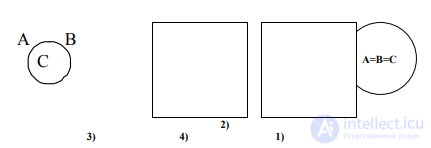
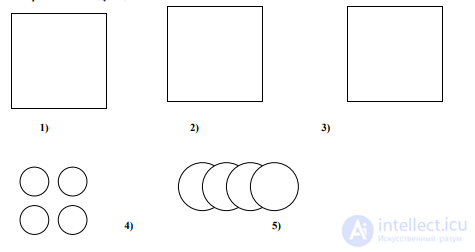
125. The relations between the concepts:
A daughter
B granddaughter
C woman (a person of female sex)
- are depicted by the following diagram:
answer 4
126. The relations between the concepts «point», «line», «plane», «space» are depicted by the following diagram:
answer 4
127. The set (class) of objects reflected in our consciousness, each of which has the features fixed in the concept under study, is called its ……..
Write the answer:
answer extension
128. The totality of properties, features and relations of objects reflected in our consciousness, the core of which is formed by the distinctive essential properties, features and relations, is called the …….. of a concept.
Write the answer:
answer content
129. The «father» of logic as a science is considered to be…
answer 5
130. The error committed in the inference:A. Matter is eternal.B. Fabric is matter.Conclusion: Fabric is eternal -
answer 4
131. Errors most often encountered in a discussion:
answer 2
132. The paradox: «A barber shaves only those residents of his village who do not shave themselves; should he shave himself?» - is called ………
Think it over and write the answer:
Answer - The Barber
133. By logical form is meant:
answer 2
134. A concept that is greater in extension is called:
answer 2
135. The concept with the greatest extension: «lawyer», «lawyer Ivanov», «prosecutor», «jurist» -
answer 1
136. A concept – is:
answer 2
137. A concept – is:
answer 3
138. The concepts «star» and «constellation» are in the relation of:
answer 6
139. Concepts whose extensions fully or partially coincide are called:
answer 2
140. A sequence of thoughts connected according to definite rules, by means of which we generate new thoughts or substantiate ones already known, is called ……..
Write the answer:
answer reasoning
141. A sequence of mental actions according to predetermined rules is called …….. thinking
Write the answer:
answer formal
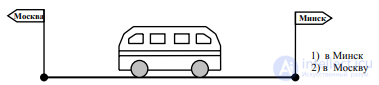
142. An intercity bus is traveling along the highway (see figure). Determine where it is heading:
answer 2
143. The rules of the syllogism violated by the mode AIA:
answer 1
144. The rules of the syllogism violated by the mode OEI:
answer 3
145. The correctness of an inference depends above all on:
answer 2
146. Law – is the domain of:
answer 1
147. A law-governed society – is a society in which the following is most widely spread:
answer 1
148. The sentence «Farewell, free element!»:
answer 1
149. The sentence «What is a slain gladiator to the raging crowd?»:
answer 2

Comments