
Lecture
In everyday and scientific thinking, syllogisms are rarely used in their pure form. For example, we often use a simple categorical syllogism in the form of an enthymeme or epicheirema. A sequence of syllogisms joined into a logically connected chain of reasoning is called a polysyllogism, or complex syllogism. Aristotle did not use the term «polysyllogism». In his «Analytics», the concept of «complex syllogism» is used to denote a chain of syllogisms. In this sense, polysyllogisms were used in ancient Chinese logic (the Mohist school) and Indian logic (Dharmakirti). A description of polysyllogisms is found in Ibn Sina (Avicenna) in his «Danish Nameh».
A polysyllogism is the combination of several syllogisms into a single inference. A polysyllogism consists of a prosyllogism and an episyllogism. The syllogism that precedes in the polysyllogism is called the prosyllogism, and the one that follows is called the episyllogism.
For example:
14.1.1. In a democratic state (P), a one-party system (M) cannot be established.
In a totalitarian state (R), a one-party system (M) is established.
No totalitarian state (R) is democratic (P).
This state (S) is totalitarian (R).
This state (S) is not democratic (P)
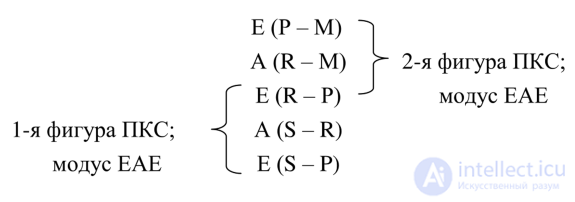
In speech practice, a polysyllogism usually takes the form of a sorites or an epicheirema. The prosyllogism has the formal structure of the 2nd figure of the syllogism. Mode: EAE (Cesare). The episyllogism has the formal structure of the 1st figure of the syllogism. Mode: EAE (Celarent). Let us make one further clarification. The prosyllogism is the ground, while the episyllogism is the consequence in the polysyllogism. Overall, the result is a single inference.
In syllogistics, two types of classical polysyllogism are distinguished:
1) progressive polysyllogism,
2) regressive polysyllogism.
In a progressive polysyllogism, the conclusion of the prosyllogism becomes the major premise of the episyllogism. In a regressive polysyllogism, the conclusion of the prosyllogism becomes the minor premise of the episyllogism. In particular, example 14.1.1 is a variant of a progressive polysyllogism. Next, we will examine two types of polysyllogisms - the sorites and the epicheirema.
Sorites (from Greek, sōros - heap) is a combination of abbreviated syllogisms in which either the major or the minor premise is omitted.
Two types of sorites are distinguished:
1) a sorites in which, starting from the second syllogism, the minor premise is omitted;
2) a sorites in which, starting from the second syllogism, the major premise is omitted.
In short: the first concept is connected with the last.
Sorites is «a heap-like inference with omitted premises» (A.N. Chudinov).
For example:
14.2.1. Every republic (A) is a form of government in which power belongs to elected bodies (B).
Any republican form of government (B) can be presidential, parliamentary, or mixed (C).
All the listed forms of republican government (C) in the modern world can have three forms of state structure (D).
Any republican form of state structure (D) is a unitary state, a federative state, or a confederative state (E).
Every republic (A) is a unitary state, a federative state, or a confederative state (E) .
This is precisely the sorites - a complex syllogism in which premises are omitted. In general form, the formal structure of a sorites is expressed by the formula
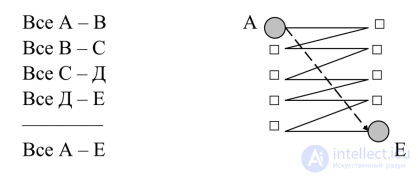
In a sorites, each concept (= term of the syllogism) enters into the premises twice: the first time as the predicate of the 1st premise, the second time as the subject of the 2nd premise, and so on (see example 14.2.1). The exception is the first and last concept, i.e., the subject and predicate of the conclusion (see example 14.2.1 and the formula of the sorites given above).
A regressive sorites begins with the premise containing the subject of the conclusion and ends with the premise containing the predicate of the conclusion. A progressive sorites begins with the premise containing the predicate of the conclusion and ends with the premise containing the subject of the conclusion. In conclusion, let us note: a sorites is used when it is necessary to construct an entire chain of syllogistic inferences, in which the initial thought would successively move from the first to the second, from the second to the third, and so on, and would ultimately close on the last (S - P) in the conclusion. In this case, all the middle terms-concepts occurring within the sorites are omitted in the conclusion.
Epicheirema (from Greek epiheirema - attack) is a complex syllogism in which both premises are enthymemes.
It is precisely on this basis that in many logic textbooks the epicheirema is not classified as a complex syllogism.
At the same time, as will be shown further with an example, each premise of the epicheirema is an abbreviated syllogistic inference, i.e., an enthymeme. On this basis alone, the epicheirema can be classified as a complex syllogism.
14.3.1. A lie causes distrust, since it is a statement that does not correspond to the truth.
Flattery is a lie, since it is a deliberate distortion of the truth.
Flattery causes distrust.
In example 14.3.1, the premises of the epicheirema are presented in the form of enthymemes. Let us decode them:
1) Every statement that does not correspond to the truth (M) causes distrust (P),
A lie (S) is a statement that does not correspond to the truth (M).
A lie (S) causes distrust (P).
The syllogism is constructed according to the rules of the 1st figure. Mode: AAA (Barbara).
2) Every deliberate distortion of the truth (M) is a lie (P).
Flattery (S) is a deliberate distortion of the truth (M).
Flattery (S) is a lie (P).
The syllogism is constructed according to the rules of the 1st figure. Mode: AAA (Barbara).
In the third inference, the epicheirema looks as follows:
3) A lie (M) causes distrust (P).
Flattery (S) is a lie (M).
Flattery (S) causes distrust (P).
The subject of the conclusion of the 2nd enthymeme is connected with the predicate of the conclusion of the 1st enthymeme. The conclusion in an enthymeme comes first - before the logical connective «since».
Let us give one more example of an epicheirema. Causing death by negligence is punishable, since it is a crime. The act of the accused N. is regarded as causing death by negligence, since he committed a crime against M. through recklessness or negligence. Therefore, N.'s actions are punishable (under Art. 109 of the Criminal Code of the Russian Federation). This is roughly how an indictment against criminals is drawn up in the form of syllogistic inferences.
Classical syllogistics includes demonstrative deductive inferences in which the conclusion follows necessarily from true premises. The premises in the classical theory of the syllogism are simple attributive judgments (S - P). In demonstrative syllogistic conclusions, the inference is made on the basis of knowledge about the relation of S to P («All people are mortal», «Socrates is a person», «All law students study the theory of state and law»). The theory of the syllogism that relies only on knowledge about the relation of S to P in simple attributive judgments is called the narrow (classical) theory of the syllogism.
Table 4.1. Classification of Polysyllogisms
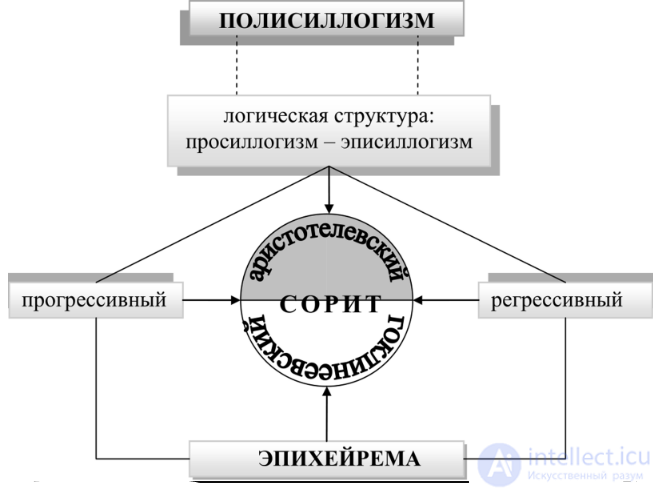
The extended theory of the syllogism is based not only on knowledge about the relation of S to P, but also on knowledge about the relation of P to S. The extended theory of the syllogism also includes exclusive (exceptive) judgments. Such inferences are often encountered in the practice of thinking.
Example 14.4.1
Thus, from a legal point of view, according to Art. 209 of the Criminal Code of the Russian Federation, the qualifying characteristic of a gang is the presence of two or more persons in its composition.
Example 14.4.2
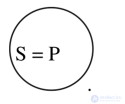
The conclusion follows necessarily, although, according to the rules of the 1st figure, the minor premise should be an affirmative judgment.
In the non-classical theory of the syllogism, the number of correct modes increases. In the general theory there are 19 of them, by which a reliable conclusion can be obtained. The extended theory of the syllogism proceeds from the fact that in universal affirmative judgments (A), not only the subject is distributed, but the predicate may also be distributed. In universal negative judgments (E), both the subject and the predicate are distributed. In particular affirmative judgments (I), the subject is not distributed, but the predicate may be distributed. In particular negative judgments (O), the subject is not distributed, but the predicate is distributed.
Information about the relation of P to S is formed on the basis of introducing an additional premise or introducing an exclusive judgment into the inference («All S, and only this S, is P»). Thus, for example, knowledge about the relation of P to S in a universal affirmative statement can be obtained through the additional introduction of knowledge: «All S is P, and no non-S is P» or «All S is P and all P is S».
Let us consider the method for completing an exercise in which the rules of the non-classical theory of the syllogism are applied. In particular, the major premise in this syllogism is an exclusive judgment (S, and only S, is P).
Example 14.4.3
Only he who thinks independently is free. This person is not free, since he does not think independently.
By the logical connective «since» we determine the conclusion: This person (S) is not free (P). For convenience of analysis of the syllogism, we will place the major premise in 1st place, the minor premise in 2nd place, and the conclusion in 3rd place:
The inference has the formal structure of the 2nd figure of the syllogism:
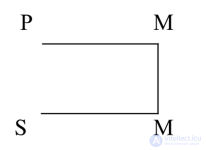
The minor term is the concept «this person», occupying the place of the subject in the conclusion, and located in the minor premise in the inference. The major term is the concept «free», occupying the place of the predicate in the conclusion, and located in the major premise in the inference. The term occurring in both premises but absent from the conclusion, «thinks independently», is the middle term.
The rules of the second figure are observed: the major premise is an exclusive judgment (conventionally regarded in syllogistics as universal), the minor premise is negative. Mode AEE (Camestres) corresponds to the correct modes of the 2nd figure of the syllogism. The rules of terms S - M - P are observed: 1) this syllogism has 3 terms; 2) the middle term «thinks independently» is distributed in both premises: in the major premise as the predicate of a universal affirmative (A) exclusive judgment, in the minor as the predicate of a universal negative (E) judgment (a singular judgment is regarded as universal); 3) the major term «only he who is free» is distributed in the major premise as the subject of a universal affirmative exclusive judgment, i.e., S and P are equal in extension; 4) the minor term «this person» is distributed in the minor premise as the subject of a universal negative judgment. The conclusion is a universal negative judgment (a singular judgment is regarded as universal), in which both the subject and the predicate are distributed. The premises are true statements. Thus, the syllogism is correct in form and true in content. The conclusion follows necessarily.
Inferences based on the properties of complex judgments are traditionally included in the theory of demonstrative (probative) conclusions. The conclusion in them necessarily follows from the premises when the corresponding rules of inferential knowledge are observed. At the same time, in inferences that use the properties of complex judgments (conjunction, disjunction, implication, equivalence), there are both correct and incorrect modes, i.e., the conclusion does not always follow necessarily in them. Finally, their logical structure differs from syllogistic inferences (there is no S - M - P in it, most importantly no middle term and relation of the two extremes). We will call these logical conclusions inferences from complex judgments, rather than syllogisms, as is customary in the educational literature.
WORKSHOP
Determine the type of inference, give its scheme and mode
1) Exclusive judgments reflect the fact that the attribute expressed by the predicate belongs (or does not belong) only to the given subject and to no other. Exclusive judgments can be singular, particular, and universal

Comments