
Lecture
Disjunctive syllogism – a syllogism in which at least one of the premises is a disjunctive proposition
Conditional-disjunctive (lemmatic) syllogism – a syllogism in which the first premises are conditional, and the last is a disjunctive proposition
Rules of the conditional-disjunctive syllogism
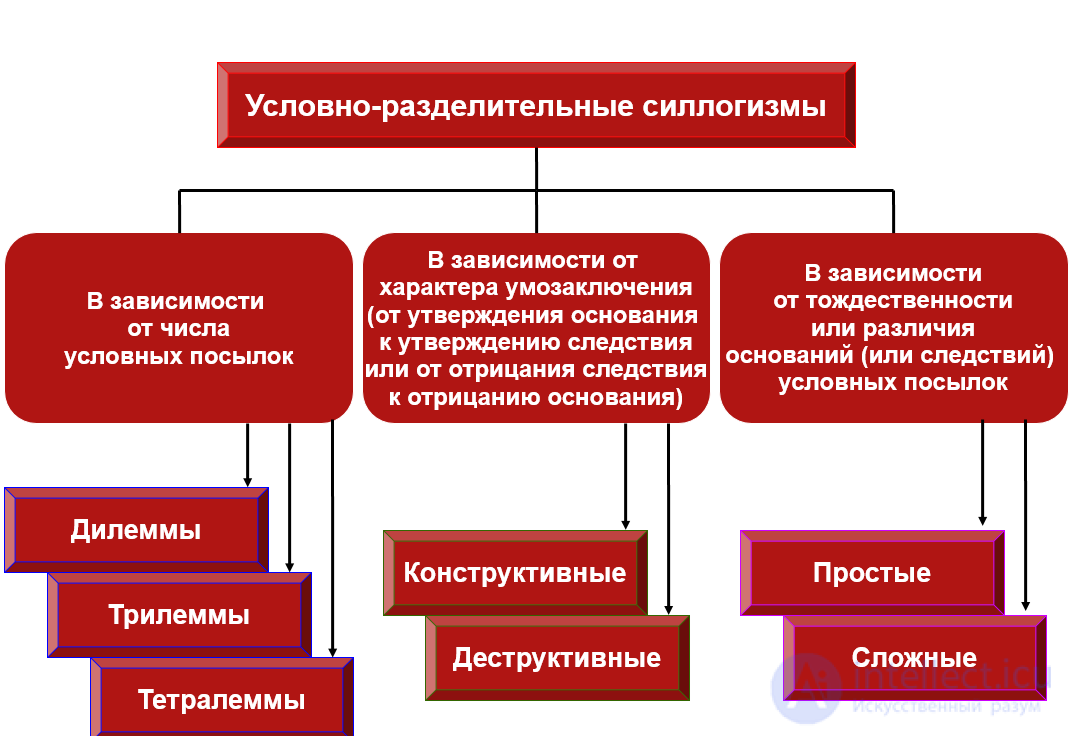
Fig. Types of Dilemma, Trilemma, Tetralemma
The first premise of a conditional-disjunctive syllogism is a conditional (implicative) proposition, and the second premise is a disjunctive one. It is important to note that a conditional (implicative) proposition may contain not just one antecedent and one consequent (as in the examples we have considered so far), but several antecedents or consequents. For example, in the proposition: «If one is to enter Moscow State University, one must study a great deal, or else one must have a great deal of money», – two consequents follow from a single antecedent, which can be represented using conditional notation as the formula: (a → b) ∧ (a → c). In the proposition: «If one is to enter Moscow State University, one must study a great deal, and if one is to enter MGIMO, one must also study a great deal», – one consequent follows from two antecedents: (a → b) ∧ (c → b). In the proposition: «If a wise man rules a country, it flourishes, and if a rogue rules it, it suffers», – two consequents follow from two antecedents: (a → b) ∧ (c → d). In the proposition: «If I stand up against the injustice around me, I will remain human, though I will suffer cruelly; if I walk past it indifferently, I will lose my self-respect, though I will remain safe and unharmed; and if I actively assist it in every way, I will turn into an animal, though I will achieve material and career success», – three consequents follow from three antecedents: (a → b) ∧ (c → d) ∧ (e → f).
If the first premise of a conditional-disjunctive syllogism contains two antecedents or consequents, such a syllogism is called a dilemma; if there are three antecedents or consequents, it is called a trilemma; and if the first premise includes more than three antecedents or consequents, the syllogism is a polylemma. The dilemma is the form most often encountered in thought and speech, and it is on the example of the dilemma that we will examine the conditional-disjunctive syllogism (also often called the conditional-disjunctive inference).
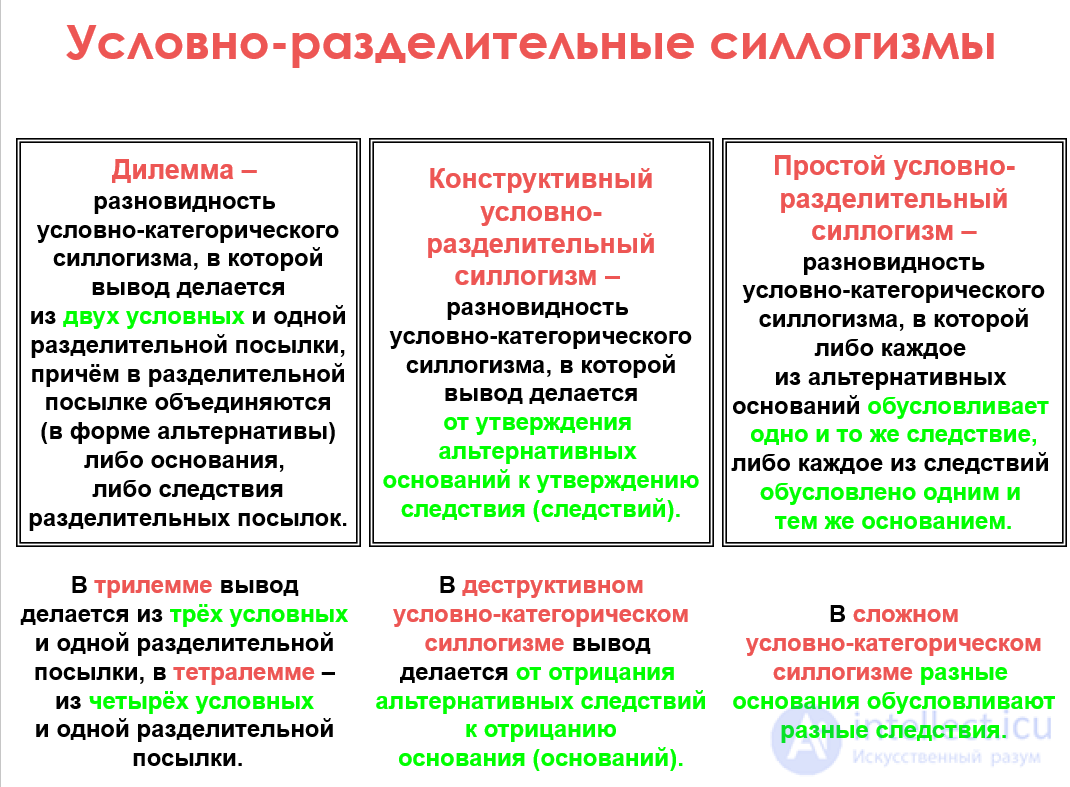
A dilemma can be constructive (affirming) or destructive (denying). Each of these types of dilemma, in turn, is divided into two varieties: both the constructive and the destructive dilemma can be simple or complex.
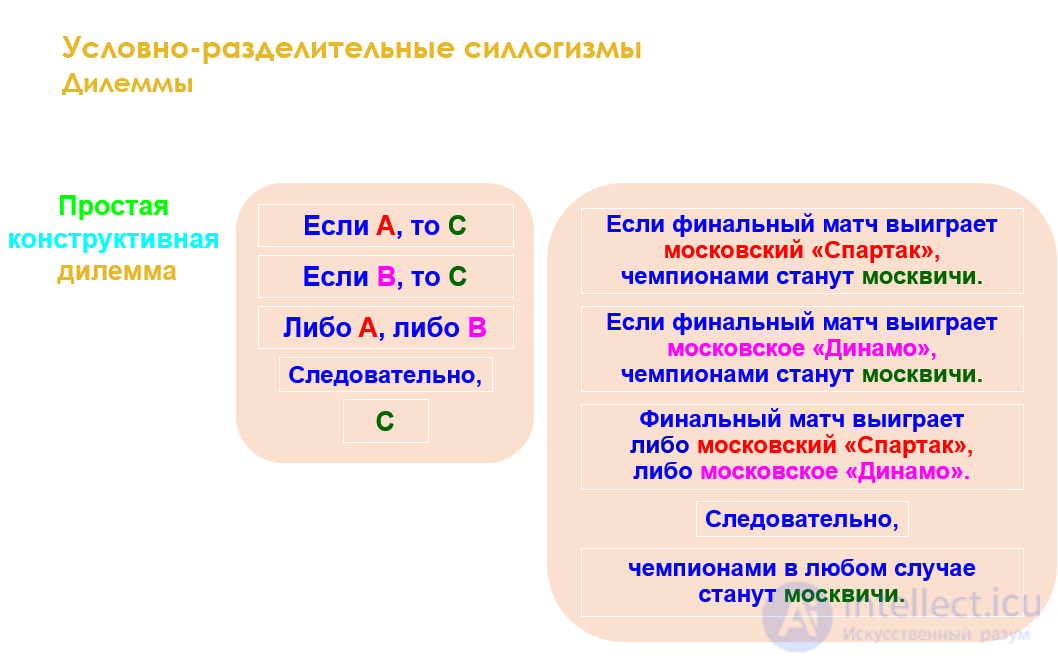
In a simple constructive dilemma, one consequent follows from two antecedents, the second premise is a disjunction of the antecedents, and the conclusion affirms this one consequent as a simple proposition. For example:
If one is to enter Moscow State University, one must study a great deal, and if one is to enter MGIMO, one must also study a great deal.
One can enter either Moscow State University or MGIMO.
One must study a great deal.
The modal form of this dilemma:
(((a → b) ∧ (c → b)) ∧ (a c)) → b.
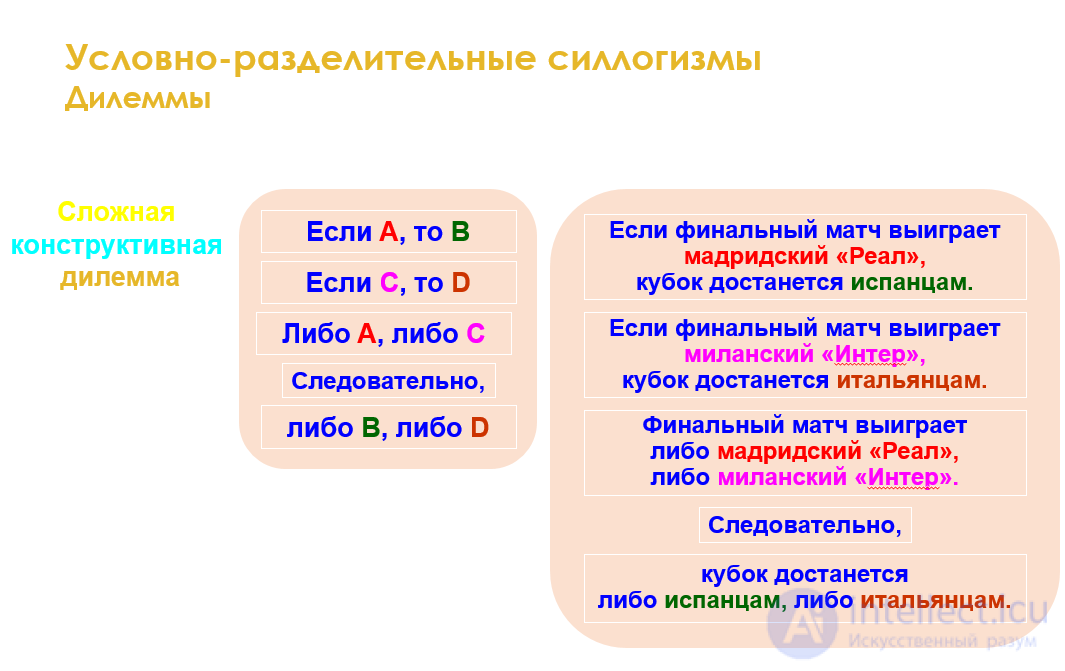
In the first premise of a complex constructive dilemma, two consequents follow from two antecedents, the second premise is a disjunction of the antecedents, and the conclusion is a complex proposition in the form of a disjunction of the consequents. For example:
If a wise man rules a country, it flourishes, and if a rogue rules it, it suffers.
A country can be ruled by either a wise man or a rogue.
A country can either flourish or suffer.
The modal form of this dilemma:
(((a → b) ∧ (c → d)) ∧ (ac)) → (bd).
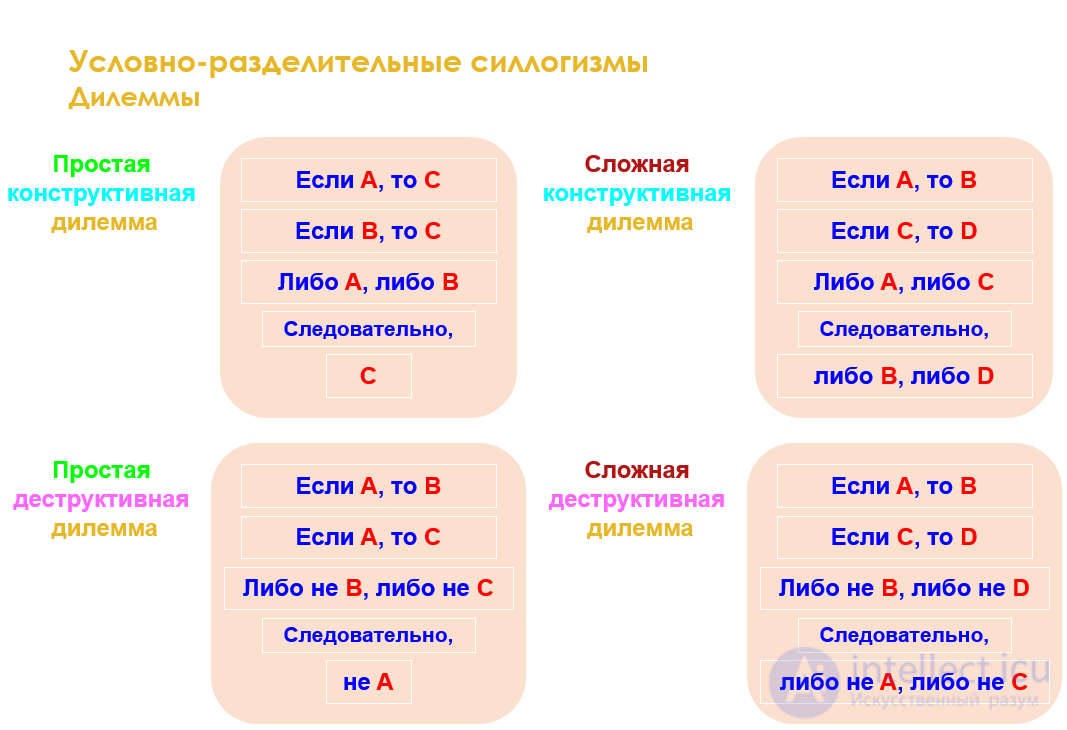
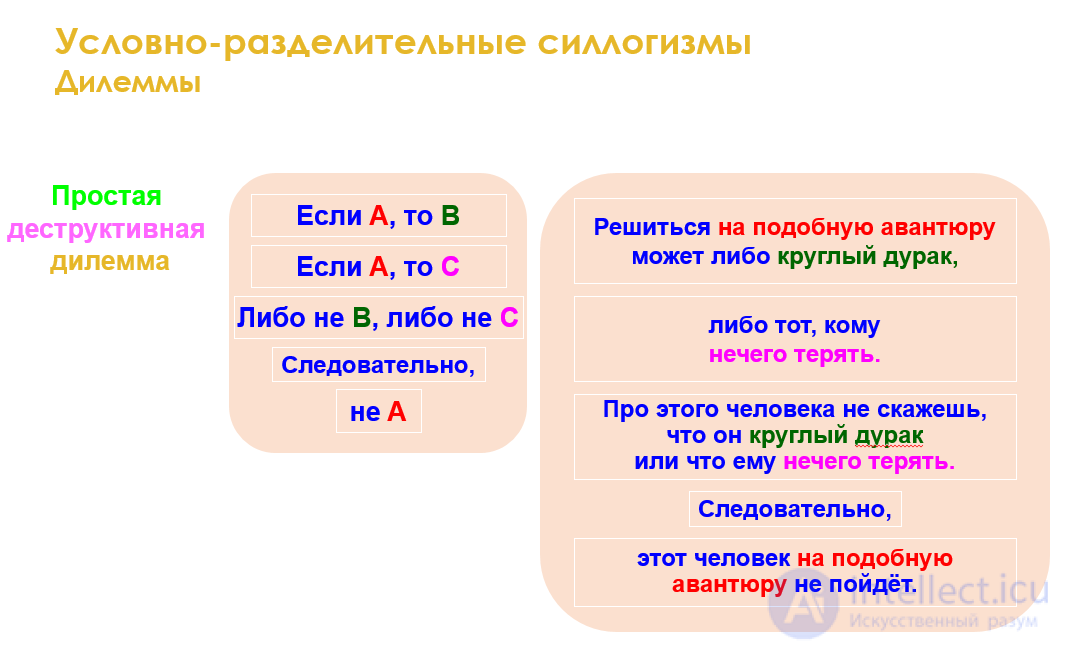
In the first premise of a simple destructive dilemma, two consequents follow from one antecedent, the second premise is a disjunction of the negations of the consequents, and the conclusion negates the antecedent (a negation of a simple proposition occurs). For example:
If one is to enter Moscow State University, one must study a great deal, or else one must have a great deal of money.
I do not want to study a great deal, or to spend a great deal of money.
I will not enter Moscow State University.
The modal form of this dilemma:
(((a → b) ∧ (a → c)) ∧ (¬ b ∨ ¬ c)) → ¬ a.
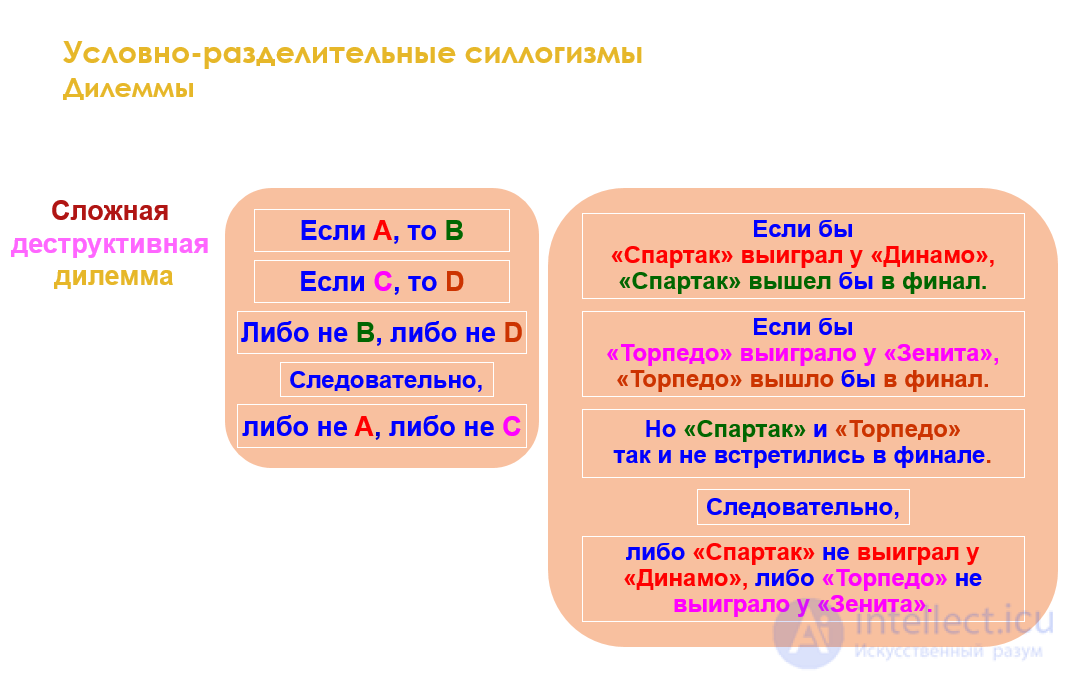
In the first premise of a complex destructive dilemma, two consequents follow from two antecedents, the second premise is a disjunction of the negations of the consequents, and the conclusion is a complex proposition in the form of a disjunction of the negations of the antecedents. For example:
If a philosopher considers matter to be the first principle of the world, he is a materialist, and if he considers consciousness to be the first principle of the world, he is an idealist.
This philosopher is not a materialist, or not an idealist.
This philosopher does not consider matter to be the first principle of the world, or he does not consider consciousness to be the first principle of the world.
The modal form of this dilemma:
(((a → b) ∧ (c → d)) ∧ (¬ b¬ d)) → (¬ a¬ c).
Since the first premise of a conditional-disjunctive syllogism is an implication, and the second is a disjunction, its rules are the same as the rules of the conditional-categorical and disjunctive-categorical syllogisms discussed above.
1. What is a conditional-disjunctive syllogism?
2. On what basis are such varieties of the conditional-disjunctive syllogism as the dilemma, trilemma, and polylemma distinguished?
3. How does a constructive dilemma differ from a destructive one?
What is the difference between a simple constructive dilemma and a complex one? Come up with one example each for a simple and a complex constructive dilemma and express their form using conventional logical notation.
4. How does a simple destructive dilemma differ from a complex one?
Come up with one example each for a simple and a complex destructive dilemma and express their form using conventional logical notation.
5. What are the rules of the conditional-disjunctive syllogism?

Comments