
Lecture 8 min.
Logical necessity is one of the modal characteristics of a statement (along with "possibility", "contingency" and "independence"); a statement is necessary if its negation is logically impossible.
In philosophy, metaphysical necessity, sometimes called broad logical necessity , is one of several different kinds of necessity, which lies between logical necessity and nomological (or physical) necessity, in the sense that logical necessity entails metaphysical necessity but not vice versa, and metaphysical necessity entails physical necessity but not vice versa. A proposition is considered necessaryif it could not have been otherwise. Nomological necessity is necessity according to the laws of physics, and logical necessity is necessity according to the laws of logic, while metaphysical necessities are necessary in the sense that the world could not have been otherwise. Which facts are metaphysically necessary, and on what grounds we may regard certain facts as metaphysically but not logically necessary, are subjects of substantial debate in contemporary philosophy.
The concept of a metaphysically necessary being plays an important role in some arguments for the existence of God , especially in the ontological argument , but metaphysical necessity is also one of the central concepts of late 20th-century analytic philosophy . Metaphysical necessity has proved to be a controversial concept and has been criticized by David Hume , Immanuel Kant , J. L. Mackie and Richard Swinburne , among others.
Let us briefly consider logical and physical modalities, as well as modalities related to values.
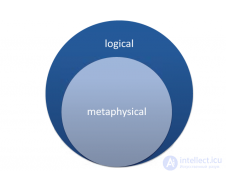
Logical modal conceptsinclude "(logically) necessary", "(logically) possible", "(logically) impossible" and "(logically) contingent".
Logical necessity isa characteristic of a statement whose negation is a logical contradiction.
Logically necessary statements include, in particular, the statement "It is not true that neon is an inert gas and at the same time not an inert gas", since the negation of this statement ("Neon is an inert gas and neon is not an inert gas") is internally contradictory (it is a negation of the law of non-contradiction). The statement "Grass is green or it is not green" is logically necessary, since its negation ("It is not true that grass is green or it is not green") is contradictory (a negation of the law of excluded middle). The statement "All bachelors are unmarried" is also logically necessary, since its negation ("There are bachelors who are married") is contradictory.
The truth of a logically necessary statement can be established independently of experience, on the basis of a simple analysis of the meanings of the words that make up the statement. For example, the statement "Snow is white" is factually true; empirical observation is required to confirm its truth. But the statements "Snow is snow", "White is white", "Every bachelor is unmarried" and the like are necessarily true: to establish their truth one need not appeal to experience; it is enough to know the meanings of the words they contain.
The concept of logical necessity is connected with the concept of a logical law: the laws of logic and everything that follows from them are logically necessary.
Logical possibility is a characteristic of an internally consistent statement.
For example, the statement "The efficiency of a steam engine is 100%" is obviously false, but it is internally consistent and therefore logically possible. But the statement "The efficiency of such an engine is higher than 100%" is contradictory, and therefore logically impossible.
Logical possibility can be explained through the concept of a logical law: any statement that does not contradict the laws of logic is logically possible. For instance, the statement "Viruses are living organisms" is compatible with the laws of logic and, consequently, is logically possible. But the statement "It is not true that if a person is a lawyer, then he is a lawyer" contradicts the logical law of identity and is therefore impossible.
Logical contingency is "two-sided possibility", or the logical possibility of both the statement and its negation.
What is contingent is what may be but may also not be. From the point of view of logic it is contingent, for example, that all multicellular beings are mortal: neither the assertion of this fact nor its negation contains an internal (logical) contradiction.
Logical impossibility is the internal inconsistency of a statement. Logically impossible statements are, for example: "Plants breathe and plants do not breathe", "It is not true that if the Universe is infinite, then it is infinite", "Some wives are not married", and the like.
Logical modalities can be defined through one another.
"Statement A is logically necessary" means "The negation of A is not logically possible".
For example, "It is necessary that cold is cold" means "It is impossible for cold not to be cold".
"A is logically possible" means "The negation of A is not logically necessary".
For example, "It is possible that cadmium is a metal" means "It is not true that it is necessary that cadmium is not a metal".
Metaphysical necessity is contrasted with other types of necessity. For example, the philosophers of religion John Hick and William L. Rowe distinguished the following three:
Hume's dictum is a thesis about necessary connections between distinct entities. Its original formulation can be found in David Hume's "Treatise of Human Nature": "There is no object which implies the existence of any other if we consider these objects in themselves." The intuition of Hume that motivates this thesis is that, although experience gives us certain ideas about various objects, it could also have given us very different ideas. Thus, when I see a bird in a tree, I could just as well perceive the bird without the tree or the tree without the bird. This is because their essence does not depend on the other. David Lewis follows this line of thought in formulating his principle of recombination : "anything can coexist with anything else, at least provided they occupy distinct spatiotemporal positions. Likewise, anything can fail to coexist with anything else."
Hume's dictum has been used in various arguments of contemporary metaphysics . It can be used, for example, as an argument against nomological necessity, the view that the laws of nature are necessary, i.e. the same in all possible worlds. To see how this might work, consider the case where salt is thrown into a cup of water and then dissolves. This can be described as a series of two events, the event of throwing and the event of dissolving. Proponents of necessity hold that all possible worlds with the throwing event also contain the subsequent dissolving event. But these two events are distinct entities, so, according to Hume's dictum, one event is possible without the other. An even broader application is to use Hume's dictum as an axiom of modality for determining which propositions or worlds are possible on the basis of the notion of recombination. [10]
In Naming and Necessity , [11] Saul Kripke argued that there were a posteriori truths, such as "Hesperus is Phosphorus" or "water is H 2 O", which were nevertheless metaphysically necessary.
While many theologians (for example, Anselm of Canterbury , René Descartes and Gottfried Leibniz ) considered God a logically or metaphysically necessary being, Richard Swinburne argued for factual necessity, and Alvin Plantinga argues that God is a being with causal necessity. Since a factually or causally necessary being does not exist by logical necessity, it does not exist in all logically possible worlds. [12] Thus Swinburne used the term "absolute brute fact" to denote the existence of God. [13]

Comments