Definition, or determination, is a logical operation: 1) revealing the content (meaning) of a name by describing the essential and distinguishing features of the objects or phenomena denoted by that name (the name’s denotatum); 2) explicating the meaning of a linguistic term, or of a concept.
Definition (formed from the Latin word: definitio — limit, boundary).
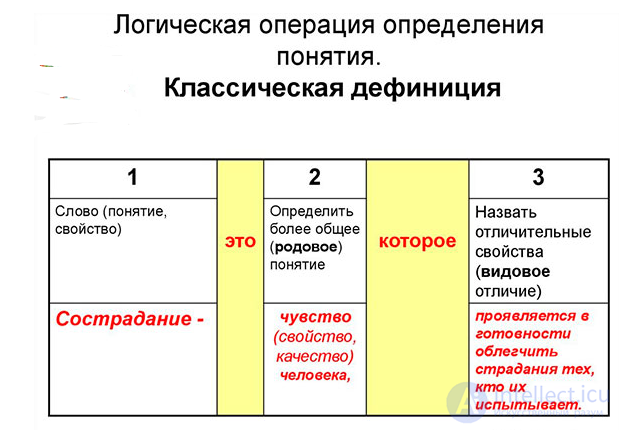
To define a term means to establish the boundaries of its application. A strict definition consists of two parts: the definiendum (dfd) — the name being defined, and the definiens (dfn) — the defining expression that reveals the meaning of the defined name or establishes the meaning of the term. The definiendum and the definiens must stand in a relation of identity, that is, have one and the same denotatum, and be mutually interchangeable.
Definitions are divided on different grounds, in particular by the way they reveal content — into explicit (in which the features inherent in the object or phenomenon are indicated) and implicit (in which the relations in which the defined object or phenomenon stands to other objects and phenomena are revealed).
Infinition is a concept of postphilosophical discourse denoting a deferred definition, one that defines a certain concept while at the same time demonstrating its indefinability.
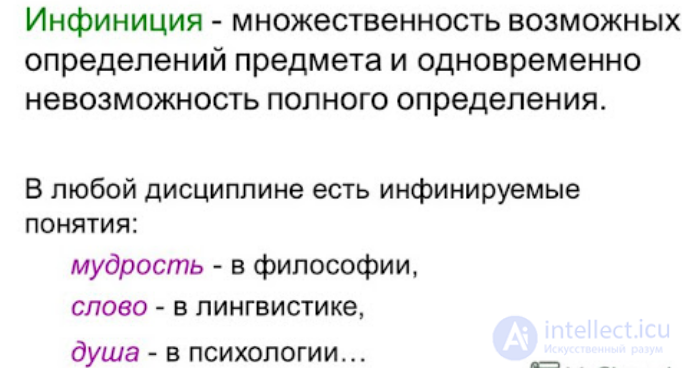
Infinitions abound in the writings of Lao Tzu, Chuang Tzu and other Taoist thinkers; in works on apophatic theology, in particular the treatises of Pseudo-Dionysius the Areopagite; and in the works of Jacques Derrida and other followers of deconstruction. To infine — «to unbound», to remove the limit, to defer the definition, to extend it into infinity. For example, such concepts as «Tao», «différance», «deconstruction»… are usually infined (rather than defined).
Examples of the aforementioned infinitions:
«The Tao produces fullness and emptiness, but is itself neither fullness nor emptiness; it produces decay and decline, but is itself neither decay nor decline. It produces roots and branches, but is itself neither root nor branch»
[…] Not-Beginning said: The Tao cannot be heard: what can be heard is not It. The Tao cannot be seen: what can be seen is not It. The Tao cannot be expressed in words: what can be expressed in words is not It. Do we know the Formless, which gives form to form? In the same way the Tao does not allow itself to be named».
Chuang Tzu.
Explicit definitions can be represented in the form of an equality in which the defined part is equivalent in scope to the defining part. They are given by a linguistic construction of the form: A ↔ B. Every such construction contains four parts: A is called the defined part, B — the defining part, the sign «↔» indicates that expression A means the same thing as expression B. In the case of specific explicit definitions, instead of the sign «↔» either the sign «Df» is written (read as: «equals by definition»), or the sign «≡ Df» (read as: «equivalent by definition»). The first sign is used when the defined part A is a nominal construction, and the second when A is a propositional construction. In the defined part A, which may be a complex expression, there is always present a certain term that is the goal of the definition. This term is called the defined term. In explicit definitions the defined term is that minimal part of the defined expression A which does not occur in the defining part.
Explicit definitions are divided on different grounds into several kinds. Depending on which linguistic category the defined term belongs to, the following kinds are distinguished:
Attributive-relational definitions, in which the nearest generic difference and the specific feature belonging only to the given species are indicated (for example, «a square is a rhombus with right angles»).
Genetic definitions, in which the origin or manner of construction of the object denoted by the defined name is indicated (for example, «a sphere is a spatial surface described by a semicircle when it is rotated around its diameter»).
Purposive (functional) definitions, in which it is indicated how the defined object is used, what functions it performs, and for the achievement of what purposes it is applied.
Qualifying definitions, in which what the defined object represents is fixed, that is, some of its structural features, attributes, and features of its external appearance are fixed.
Enumerative definitions, in which the objects that fall under the defined term are simply listed.
Operational definitions, in which the specific characteristic of the objects is an indication of a certain operation by means of which these objects can be detected and their difference from other objects designated (for example, «an acid is a substance that turns litmus red»).
Explicit definitions possess one important property — the defined and defining parts can be substituted for one another in any context, that is, for them the rule of replacement by definition holds true.
Implicit definitions do not have a clearly expressed structure, as a result of which there is no way to eliminate the definiendum from a given context (for example, the matrix definition of logical operations in propositional calculus, and others). They are given by a linguistic construction of the form: A is that which satisfies the conditions: B1, B2, … Bn.
Rules of definition
- The rule against circularity — the definiens must not contain the definiendum. In other words: it is forbidden to explain the meaning of a term through itself.
Logic is the science of logical thinking. Physical laws are laws that exist in physics.
Such definitions do not clarify the situation. We understand the original term no better than before.
- The rule of proportionality — the defined must be equal to the defining. A term must not be interpreted too narrowly or too broadly.
Example of an overly broad definition: «Compote is a liquid».
There are thousands of kinds of liquids, and this definition does not allow one to understand how compote differs from them.
Or, conversely, too narrow: «An artist is a person who paints still lifes».
But an artist can also create portraits or landscapes.
- Clarity — the meaning must be revealed by means of words and expressions understandable to those around. Every definition is aimed at its own audience. Here we explain to a small child what a black hole is. This definition will differ from the one we would read out as part of a report at a conference of astrophysicists.
Sometimes you read something and understand nothing: «A singularity is a point in spacetime through which the geodesic line entering it cannot be smoothly continued».
What is this geodesic line, and how can it be «smoothly continued»? If a complex term is revealed by means of even more convoluted expressions, the principle of clarity is violated.
- Inadmissibility of metaphors and idioms. A definition must clearly state what the object is, without jokes, witticisms or abstract reasoning.
The statements «a lion is the king of beasts», «bread is the head of everything» do not conform to the rules.
- A definition must not be negative. Negating the characteristics of an object does not allow one to form a full-fledged idea of it.
Water is not considered a solid substance, and a theorem is not a hypothesis.
Here it is clear what the object is not, but it is still unclear what it actually is.
Types of definitions
- Intensional. They single out the desired object from a certain set. Such a definition may contain the distinguishing features of the object, rules for singling it out from the set, or a reference to objects close to it in meaning.
- Extensional. These represent an enumeration of all the objects that fall under the concept in question.
For example, the expression «world religions» is defined by a list of the major religious teachings.
These definitions are used if the set of objects is finite and not too large. Try explaining what an «animal» is by enumerating all species of animals — it would take weeks.
- Genetic. The object is described by indicating the way it is created: «Water is a substance formed as a result of the combustion of hydrogen in oxygen».
- Axiomatic. They explain the meaning of a word through a set of axioms (what is this?) in which it occurs. In Euclidean geometry the concepts of «point», «lines», and «parallelism» are revealed through a system of postulates.
- Prescriptive. They establish how certain terms should correctly be used and interpreted.
The Criminal Code of the Russian Federation states that fraud should be understood as causing property damage by deception or abuse of trust.
This is a requirement that the entire judicial and law-enforcement system must follow.
- Object-based and semantic. Object-based definitions describe the objects themselves and their features.
A rectangle is a quadrilateral in which all sides are equal.
Semantic definitions explain the meanings of verbal expressions as a totality of signs.
By the term «rectangle» we shall understand a quadrilateral with equal sides.
Implicit definitions include the following:
Axiomatic definitions. By means of axiomatic definitions a certain term is defined by indicating the set of axioms in which it is contained. From this point of view the axioms of any system are synthetic definitions of the terms that occur in them. Thus, in scientific inquiry, by means of axiomatic definitions the meaning of the initial (primitive) terms of a scientific theory is set by introducing a system of postulates that contain these terms and formulate the conditions that the objects denoted by the terms must satisfy. In mathematical logic an example of an axiomatic definition is the definition of a formula in propositional calculus.
Inductive definitions. An example of an inductive definition is the definition of a natural number in mathematics:
- 0 is a natural number;
- if n is a natural number, then n′ is a natural number;
- nothing else is a natural number.
The essence of such definitions is as follows. If it is required to define a class of objects falling under a certain term, then we directly declare certain objects to be elements of this class. This part of the definition is called the basis of induction. After that, all the remaining objects belonging to the class are generated by means of certain procedures. This part of the definition is called the inductive step. The third part of the definition restricts the class of natural numbers to only those objects given by the first two parts. In the general case, the part that sets the basis of induction may indicate not one object but many objects, and even an infinite number of them. On the other hand, the parts that set the inductive steps may use not one generating operation, as is the case in the example given, but several operations. This is precisely the situation in the inductive definition of the formulas of propositional logic. Here, in the basis of induction, any propositional variable, of which there are infinitely many, is declared a formula. The generating procedures in this case are the procedures of applying the logical constants ¬, &, ∨, ⊃ to previously constructed formulas.
Recursive definitions. They are similar to inductive definitions, but are used to define not classes of objects but certain functions. An example of a recursive definition is the definition of the mathematical series of Fibonacci numbers by means of a recursive (recurrent) function, in which each subsequent number equals the sum of the two preceding numbers: 1, 1, 2, 3, 5, 8 and so on. Another example is the following definition of addition: 1) x + 0 = x; 2) x + y′ = (x + y)′. The essence of this definition is as follows. Understanding a certain function consists in knowing its values for certain values of the arguments. It is precisely this that makes it possible to establish the recursive definition of addition. Indeed, the first part, called the basis of recursion, says that the value of the function x + y equals x if y = 0. The second part, called the recursion, says that if we want to compute the value of x + y′, where y′ is the number following y, then we must compute for this y what x + y equals, and take the number following x + y.
Contextual definitions, which make it possible, for example, to ascertain the content of a concept without resorting to an explanatory dictionary, but through the proposed context. In this case one speaks of a certain contextual dependence of the defined term. The defined term is placed in a certain linguistic context, and it is equated in meaning to another context that does not contain the given term. Here the term «contextual dependence» itself is understood in two different senses. On the one hand, it refers to obtaining some implicit knowledge about the term of interest to us from consideration of a certain specific context in which it occurs. In this case, understanding the meaning of the context allows one to suggest the possible meaning of the corresponding term. On the other hand, it refers to defining the term by defining all the contexts in which it occurs. To set out these contexts, a corresponding metalanguage is used. In the first case one speaks of a definition through context; in the second — of a contextual definition.
For all implicit definitions the following features hold:
The conditions B1, B2, … Bn are sentences.
The defined term is that minimal expression which occurs in each defining condition B1, B2, … Bn, which nevertheless does not entail the tautological character of the definitions, since in definitions of this sort the defining part (the conditions B1, B2, … Bn) is not equated to the expression A.
For the reasons stated, the rule of replacement by definition does not hold for implicit definitions.
Depending on the function they perform, definitions are divided into:
1. Real definitions, which define objects and phenomena. A definition is considered real if the value of the defined term consists of really (materially) existing objects or their characteristics (properties and relations). A real definition solves the task of forming a concept of the objects falling within the scope of the defined term, that is, the task of identifying the common and distinguishing features of these objects.
2. Nominal definitions, which introduce new linguistic forms — terms. A definition is considered nominal (formed from the Latin word: nomen — name, denomination) if the value of the defined term consists of objects that do not really (materially) exist, as well as their characteristics. It is used in situations where a term is introduced into a linguistic context as an abbreviated name for objects of a certain type, or where there exist several semantic interpretations of the defined term and it is necessary to agree which of them is adopted in the given context.
Depending on the purpose of the procedure performed, definitions are divided into:
1 Registering definitions, which fix (state) the known meaning of a certain term without changes.
2 Clarifying definitions, which correct (regulate) the meaning of a term by prescribing a meaning.
3 Postulating definitions, by means of which new scientific terms are introduced, or newly discovered phenomena, created objects, and so on, are designated.
Almost all definitions belong to the genus-species type, that is, to definitions through an indication of genus and specific difference, since in their formal notation almost any definition contains certain variables ranging over some universe. The latter is precisely the genus within which the defined objects are singled out by means of a specific difference. However, among definitions there are also those that cannot be classed as genus-species definitions. These are the so-called fundamental inductive definitions. The point is that characterizing a certain definition as genus-species presupposes that the genus already exists and it only remains to single out, by means of a specific difference within this genus, the class of defined objects. Fundamental inductive definitions, however, do not presuppose any universe given in advance; on the contrary, they themselves construct the universe of discourse. An example of a fundamental definition is the definition of a natural number considered above.
Various kinds of requirements are placed on definitions, compliance with which guarantees the correctness of this logical operation. A definition, as a logical operation, must conform to four basic rules:
1 The rule of proportionality and consistency. In a correct definition the scopes of the defined and defining names must coincide, that is, the equality must hold: dfd ↔ dfn. When this rule is violated, three kinds of errors are possible: a) the error of «too broad a definition» in the case where the scope of the defined name is smaller than the scope of the defining name: dfd ← dfn; b) the error of «too narrow a definition» in the case where the scope of the defined name is larger than the scope of the defining name: dfd → dfn; c) the error of «too broad and too narrow a definition» in the case where the scope of the defined name turns out to be both smaller and larger than the scope of the defining name at the same time. Thus, for all explicit definitions, when formally written in a language such as, for example, predicate calculus, the following consistency requirements must also be satisfied:
- the free variables occurring in A and B must be the same;
- the types of these variables must coincide (for example, identical predicate variables must also be of identical arity);
- the type of expression A must coincide with the type of expression B, that is, if A is a name, then B must also be a name; if A is a propositional form, then B must also be a propositional form, and so on.
2 The rule prohibiting circularity. A definition must not contain a circle within itself. When this rule is violated, two kinds of the error «circle in a definition» are possible: a) a «vicious circle» (mediated circle), when the defined name is defined through the defining name, and the defining name can only be defined through the defined name; b) tautology (direct circle), when the defined and defining names are expressed by identical terms.
3 The rule of non-negativity. A definition, where possible, should not contain negative features in the defining expression. However, this requirement is not always feasible, so in some cases exceptions are permissible.
4 The rule of clarity and precision. A definition must be clear, that is, the names used in the defining expression must have a clear meaning, and among them there must be no metaphors, comparisons or other figurative expressions. When this rule is violated, the error of «an unclear definition» arises. A definition must reveal content by means of clearly conceived features. When this rule is violated, the error of «defining the unknown through the unknown» arises.
In everyday conversational practice the vocabulary of a language is usually used at an intuitive level. Such a situation, owing to people having different intuitions, often leads to mutual misunderstanding and even to misconceptions. Therefore there is a pressing need to clarify the meanings of terms. It is precisely this function that is performed by definitions, by means of which terms acquire a certain unambiguous, standard interpretation.
The significance of clear and unambiguous terminology is especially great in scientific research, where the question of definitions receives close attention. Definitions are an indispensable element of scientific theories, since they make it possible to form a clear conceptual and terminological framework for these systems of knowledge. They are widely used in the process of constructing proofs of theoretical propositions, in establishing relations between different theories, and so on. At the same time, for the solution of various scientific problems the same term may be assigned different meanings. Thus, in everyday practice the semantic interpretations of the terms used by interlocutors are often rigidly fixed only for the duration of the [argumentative] conversation and no more, since it is precisely in argumentative processes that the consistency of the «fields of argumentation» of the opponents is extremely important, and above all — the semantic interpretations of the terms they use. And even in the sphere of science, where an attempt is made to give terms stable, fixed meanings, situations often arise that require clarification or redefinition of terms already previously defined. The latter is a consequence of the constant development and refinement of scientific knowledge, in accordance with which the definitions of scientific terms are also transformed.
Every definition, regardless of the purposes and methods of its introduction, represents a statement of the presence of a correspondence between a linguistic expression and its meaning. Statements of this kind are always conventions (agreements) about the use of a certain term. Therefore definitions are not sentences, and one cannot ascribe to them the properties of «being true» or «being false». One can only speak of whether a given definition performs its function, whether it achieves or does not achieve the goals set for it.
See also
- term
- [[b8996]]
- meaning
- [[b8998]]
- [[b8790]]
See also


Comments