Logic tests by topic for self-check
The test tasks are designed to highlight the main points of each topic, to aid understanding of logical norms, to repeat and reinforce the course material, to check logical knowledge, and to monitor residual knowledge. The test tasks may be used when preparing for classroom sessions, tests, or the exam. The tests are compiled for all topics of the course syllabus «Logic» and include from 10 to 30 questions with 4 answers each. Only 1 of the 4 proposed answers can be correct.
Test on Topic 1. “The Subject of Logic”
1. What does the word “logos” mean?
- A) Thought and word.
- B) Law, thought and word.
- C) Law and doctrine.
- D) Law, thought, word and doctrine.
2. What does logic study?
- A) Abstract thinking.
- B) The forms and laws of thinking.
- C) The laws, forms and methods of thinking.
- D) Linguistic texts.
3. What is thinking?
- A) It is a subjective image of the objective world.
- B) It is a holistic reproduction of an object that directly affects the sense organs.
- C) It is a sensory image of a previously perceived object.
- D) It is a purposeful, mediated and generalized reproduction of the connections and relations of an object.
4. Name the basic forms of abstract thinking.
- A) Concept, judgment and inference.
- B) Laws, forms and methods of thinking.
- C) Proof, refutation and dispute.
- D) Question, hypothesis and theory.
5. Who is the founder of inductive logic?
- A) Aristotle.
- B) F. Bacon.
- C) G. Hegel.
- D) G. Leibniz.
6. Who is the founder of syllogistics?
- A) Aristotle.
- B) J. Boole.
- C) J. Mill.
- D) L.V. Rutkovsky.
7. Which logic did G. Leibniz found?
- A) Deductive.
- B) Inductive.
- C) Traductive.
- D) Symbolic.
8. What contribution did Russian thinkers of the late 19th century make to traditional logic?
- A) They founded mathematical logic.
- B) They founded traductive logic.
- C) They founded non-classical logic.
- D) They founded deductive logic.
9. When was mathematical logic formed?
- A) In the 5th century BC.
- B) In the early 18th century.
- C) In the second half of the 19th century.
- D) In the early 20th century.
10. What is the general task of logic as a science?
- A) To investigate the rules and errors in thinking.
- B) To discover the methods of thinking.
- C) To study the forms of thinking.
- D) To create artificial intelligence.
Test on Topic 2. The Basic Laws of Logic
1. Which logical law expresses the requirement of clarity of thought?
- A) The law of identity.
- B) The law of non-contradiction.
- C) The law of excluded middle.
- D) The law of sufficient reason.
2. What is the most important requirement of logical thinking expressed by the law of sufficient reason?
- A) Non-contradiction.
- B) Validity.
- C) Definiteness.
- D) Consistency.
3. Exclude the extra word:
- A) Incompleteness of grounds.
- B) Extra argument.
- C) Contradictory argument.
- D) Self-destructive argument.
4. Are the requirements of the logical laws violated in the text “Two corpses were removed from the scene of the incident. No other physical evidence was found”?
- A) This is a logical text.
- B) The requirement of the law of identity is violated.
- C) The requirement of the law of non-contradiction is violated.
- D) The requirement of the law of sufficient reason is violated.
5. Which logical law's formulation is expressed by the statement “If a statement is true, then it is true”?
- A) The law of identity.
- B) The law of non-contradiction.
- C) The law of excluded middle.
- D) The law of sufficient reason.
6. Which logical law is violated by a police officer who calls a citizen a bandit, explaining this by saying “he has that kind of face”?
- A) The law of identity.
- B) The law of non-contradiction.
- C) The law of excluded middle.
- D) The law of sufficient reason.
7. In which of the statements is the law of excluded middle formulated?
- A) Every true statement has sufficient grounds in other true statements.
- B) Two contradictory judgments cannot both be false at the same time; one of them is necessarily true, and the other necessarily false.
- C) Two opposite statements about the same object cannot both be true at the same time in the same respect.
- D) Every thought must be identical to itself.
8. Which logical law's formulation is expressed by the statement “A statement and its negation cannot both be true”?
- A) The law of identity.
- B) The law of non-contradiction.
- C) The law of excluded middle.
- D) The law of sufficient reason.
9. What is unintentional incorrect thinking called?
- A) A casus.
- B) A paradox.
- C) A paralogism.
- D) A sophism.
10. Which law of logic's requirements are violated in the following reasoning: “This thief is a professor of his trade, and all professors teach at universities. Therefore, this thief teaches at a university”?
- A) The law of identity.
- B) The law of non-contradiction.
- C) The law of excluded middle.
- D) The law of sufficient reason.
Test on Topic 3. Fundamentals of the Theory of Concepts
1. What is a thought about a distinguishing feature of a class of objects called?
- A) A law.
- B) A concept.
- C) A judgment.
- D) An inference.
2. Which concepts are called empty (null)?
- A) These are concepts whose extension includes two or more homogeneous objects.
- B) These are concepts in whose extension the number of conceivable objects cannot be really counted.
- C) These are concepts whose extension is represented by a single object.
- D) These are concepts whose extension does not include a single object.
3. What are concepts called in which the reference is to features absent from the object?
- A) Abstract.
- B) Concrete.
- C) Negative.
- D) Positive.
4. In which case is the logical characterization of the concept given incorrectly?
- A) Yalutorovsk is a singular, concrete and positive concept.
- B) Newton's discovery is a general, concrete and positive concept.
- C) Terrorism is a general, concrete and positive concept.
- D) An unmanageable collective is a singular, abstract and negative concept.
5. What are concepts called that have something in common in extension or content?
- A) Comparable.
- B) Compatible.
- C) Identical.
- D) Overlapping.
6. What is the relation between the concepts “lawyer” and “defender”?
- A) Identical.
- B) Overlapping.
- C) Subordinate.
- D) Coordinate.
answer - b)
7. Which of the following concepts is generic for the concept “crime”?
- A) Robbery.
- B) Criminal offense.
- C) Act.
- D) Misdemeanor.
8. What is the relation between the concepts “criminal code” and “civil code”?
- A) Coordinate.
- B) Contradictory.
- C) Overlapping.
- D) Contrary.
9. What are concepts called that have something in common only in content?
- A) Incomparable.
- B) Incompatible.
- C) Coordinate.
- D) Comparable.
10. In which case is the type of relation between the concepts incorrectly determined?
- A) Afghan and terrorist - overlapping.
- B) Bandit and criminal - subordination.
- C) Theft and robbery - coordination.
- D) The law of identity and the law of non-contradiction - comparable.
11. What is the transition from a species concept to a generic one called?
- A) Division.
- B) Generalization.
- C) Limitation.
- D) Definition.
12. In which case is a concept incorrectly limited?
- A) Country - border - sea border.
- B) Novel - Russian novel - L.N. Tolstoy's novel “Anna Karenina”.
- C) Parallelogram - rectangle - square.
- D) Musician - violinist - great violinist.
13. In which case is the generalization of a concept done correctly?
- A) Resident of Amenis - resident of a city.
- B) President - head of state.
- C) Processor - computer.
- D) Rest - sleep.
14. Which of the following concepts directly generalizes the concepts “poplar” and “birch”?
- A) Plant.
- B) Tree.
- C) Deciduous tree.
- D) Living matter.
15. In which logical operations is the “species and genus” relation used?
- A) Only in generalization and limitation.
- B) Only in generalization and definition.
- C) Only in generalization and division.
- D) In generalization, limitation, division and definition.
16. Which logical operation must be performed to reveal the content of a concept?
-
- A) Generalization.
- B) Limitation.
- C) Definition.
- D) Division.
17. How does classification differ from division?
- A) Classification is the opposite of division.
- B) In it, objects are distributed into groups on the basis of their essential features.
- C) Classification is a multi-stage division.
- D) In classification, objects are distributed into classes.
18. In which case is the assessment of the definition “Gas canisters are an individual means of protection” given correctly?
- A) A proportionate definition.
- b) A definition that is too broad.
- C) A definition that is too narrow.
- D) Tautology
19. In which case is the assessment of the division “Universities may be state, private, or international” given correctly?
- A) A proportionate division.
- B) An incomplete division.
- C) A division with extra members.
- D) A jump in division.
20. What is tautology in a definition?
- A) This is defining the unknown through the unknown.
- B) This is a variety of circularity in definition.
- C) This is a negative definition.
- D) This is when the extension of the concept being defined coincides with the extension of the defining concept.
Test on Topic 4. Fundamentals of the Theory of Judgment
1. What is the quality and quantity of the judgment “There is no smoke without fire”?
- A) Universal affirmative.
- B) Universal negative.
- C) Particular affirmative.
- D) Particular negative.
2. Find the subject and predicate in the judgment “Every person has the right to education”?
- A) S - “every person”, P - “the right to education”.
- B) S - “the right to education”, P - “person”.
- c) S - “person”, P - “education”.
- D) S - “person”, P - “the right to education”.
3. What is the distribution of terms in the judgment “Some lawyers have a higher education”?
- A) S and P - distributed.
- B) S and P - not distributed.
- C) S - distributed, P - not distributed.
- D) S - not distributed, P - distributed.
4. Which of the listed judgments is universal negative?
- A) No politician lies.
- B) Many lawyers are narrow specialists.
- C) Some cultural figures do not tell the truth.
- D) He does not believe in God.
5. What symbols denote the judgments “All students like to solve logic problems” and “Some students do not like to solve logic problems”?
A) A and E. B) A and O. C) E and J. D) E and O.
6. Which of the following formulas corresponds to the judgment “Many students smoke”?
- A) All S are P.
- B) Some S are P.
- C) No S is P.
- D) Some S are not P.
7 Which of the following judgments is subaltern to the judgment “Some enterprises are not profitable”?
- A) Some enterprises are profitable.
- B) All enterprises are profitable.
- C) Some profitable institutions are enterprises.
- D) No enterprise is profitable.
8 What is the relation between the judgments “Every state is a political organization” and “Some states are political organizations”?
- A) Contradiction.
- B) Subalternation.
- C) Contrariety.
- D) Subcontrariety.
9. In which case is a pair of contrary judgments named?
- A) Some states are federal. Some states are not federal.
- B) All birds have wings. Everything that has wings is a bird.
- C) No man is his own enemy. Every man is his own enemy.
- D) Some plants do not contain chlorophyll. Some creatures that do not contain chlorophyll are plants.
10. Which relation between judgments is characterized in the following statement: “If the universal judgment is true, then the particular judgment is also true; if the particular judgment is false, then the universal judgment is also false”?
- A) Contrariety.
- B) Subcontrariety.
- C) Contradiction.
- D) Subordination.
11. What type does the judgment “It is every citizen's duty to protect nature and safeguard its wealth” belong to?
- A) Conjunctive.
- B) Strictly disjunctive.
- C) Weakly disjunctive.
- D) Conditional.
12. Which of the following judgments is disjunctive?
- A) If it were not for God's will, Moscow would not have been surrendered.
- B) Cognition is the interaction of subject and object.
- C) If there is no one wishing to speak, then the debate on the report is closed.
- D) The criminal act could have been committed in a state of physiological or pathological affect.
13. Which law of truth is expressed by the formulation “A compound judgment is true when at least one of its constituent simple judgments is true”?
- A) The law of conjunction.
- B) The law of strict disjunction.
- C) The law of weak disjunction.
- D) The law of implication.
14. Which of the following statements expresses the law of conjunction?
- A) A compound judgment is true when one of its constituent simple judgments is true and the other is false.
- B) A compound judgment is false when at least one of its constituent simple judgments is false.
- C) A compound judgment is true when at least one of its constituent simple judgments is true.
- D) A compound judgment is false when all of its constituent simple judgments are false.
15. Which of the following judgments is the negation of the judgment “Some investigators know logic”?
- A) Some investigators do not know logic.
- B) No investigator knows logic.
- C) All investigators know logic.
- D) Some people who know logic are investigators.
16. Which of the following judgments is conditional?
- A) An investigator has the right to conduct an investigative experiment if it is necessary to clarify the facts of the case.
- B) Science, above all, is not a private, closet matter but a public, social one.
- C) Our declaration will either gain a majority, or get a minority, or the votes will be split evenly.
- D) Give me the book, and I will pass the logic exam.
17. Which of the following judgments corresponds to the formula 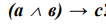 ?
?
- A) One only has to mention business - and the lazy man's head starts to ache.
- B) If a cadet knows the answers to the main questions of the logic course and can solve logic problems, then he will pass the logic exam.
- C) How terrifying reason can be, if it does not serve man.
- D) When an inspection of seized items is carried out, witnesses are invited.
answer The judgment corresponding to the formula is «b».
18. In which of the following judgments is an alethic modal word used?
- A) It does not matter how the canary behaves.
- B) As a rule, the past appears before us earlier than the future.
- C) I may not be able to come to the conference.
- D) Everything that is permitted is not forbidden.
19. Which modal logic do the words “obligatory” and “permitted” belong to?
- A) Axiological.
- B) Alethic.
- C) Deontic.
- D) Epistemic.
20. Which group of modalities do the words “beautiful” and “wonderful” belong to?
- A) Alethic.
- B) Axiological.
- C) Deontic
- D) Epistemic.
Test on Topic 5. Fundamentals of the Theory of Inference
1. Find the conclusion in the following reasoning: «Ivanov is not a lawyer, since all advocates are lawyers, and Ivanov is not an advocate»
- A) Here the conclusion is the judgment «Ivanov is not a lawyer».
- B) The conclusion is «All advocates are lawyers».
- C) The conclusion is «Ivanov is not an advocate».
- D) There is no conclusion here at all.
2. Find the major premise in the following syllogism: «Some medicines are poisons. Hence, some poisons are used to fight disease, because all medicines are used to fight disease».
- A) Here the major premise is the judgment «Some medicines are poisons».
- B) The major premise is «Some poisons are used to fight disease».
- C) The major premise is «All medicines are used to fight disease».
- D) There is no major premise here at all.
3. What kind of reasoning is called a syllogism?
- A) These are arguments that lead from the general to the particular.
- B) These are arguments that necessarily lead from true premises to a true conclusion.
- C) These are arguments that lead from true premises to conclusions that may be either true or false.
- D) These are arguments that lead from the particular to the general.
4. Find the terms in the syllogism: «An eagle is a bird, and since an eagle eats meat, then all birds eat meat».
- A) «Eagle» is the minor term, «bird» is the major, and «meat-eaters» is the middle term.
- B) «Eagle» is the minor term, «bird» is the middle, and «meat-eaters» is the major term.
- C) «Eagle» is the middle term, «bird» is the minor, and «meat-eaters» is the major term.
- D) «Eagle» is the major term, «bird» is the minor, and «meat-eaters» is the middle term.
5. In which figure of the categorical syllogism does the middle term follow both the predicate and the subject?
A) 1. B) 2. C) 3. D) 4.
6. What correct conclusion can be drawn from the following premises: «All soldiers wear belts» and «All soldiers are brave»?
- A) Some who wear belts are brave.
- B) All brave people wear belts.
- C) Some brave people wear belts.
- D) No correct conclusion can be drawn from these premises.
7. Which of the following judgments is the conversion of the judgment «Some criminals are repeat offenders»?
- A) Some criminals are not repeat offenders.
- b) Some repeat offenders are criminals.
- C) Some criminals are not non-repeat-offenders.
- D) All repeat offenders are criminals.
8. What is the figure and mode of the following syllogism «All students in our group are lawyers. All students in our group are familiar with Povarnin's book «The Art of Argument». Therefore, some lawyers are familiar with Povarnin's book «The Art of Argument».
- A) This syllogism is built according to figure 1, and has mode 1AA.
- B) According to figure 2, mode AAO.
- C) According to figure 3, mode AA1.
- D) According to figure 4, mode AA1.
9. Which figure of the categorical syllogism does the mode Barbara belong to?
10. Which of the following judgments is the obversion of the judgment «Some educational institutions are not legal ones»?
- A) Some educational institutions are legal.
- B) All educational institutions are legal.
- C) Some educational institutions are non-legal.
- D) No educational institution is legal.
11. What kind is the following syllogism: «Intentional crimes are committed with either direct or indirect intent. There was no direct intent in this crime. Therefore, there was indirect intent in this crime»?
- A) Conditional-categorical syllogism.
- B) Disjunctive-categorical syllogism.
- C) Conditional-disjunctive syllogism.
- D) Simple categorical syllogism.
12. Which of the following inferences is a lemmatic one?
- A) Human needs are usually divided into vital and spiritual, and attending classical music concerts is not a vital need.
- B) If I refuse to run away from home with friends, I will be considered a coward and a traitor, and if I run away from home, I will upset my parents. Therefore, I may be considered a coward and a traitor, or I will upset my parents.
- C) This person quickly multiplies six-digit numbers in his head, therefore he has a phenomenal memory.
- D) Every law is a normative act. Therefore, no non-normative act is a law.
13. What is the variety of conditional-categorical syllogism called in which the course of reasoning proceeds from affirming the antecedent to affirming the consequent?
- A) Affirming mode.
- B) Affirming-denying mode.
- C) Denying mode.
- D) Denying-affirming mode.
14. What kind of reasoning is: «If an official did not take bribes, he is not afraid of the police. This official did not take bribes, therefore, he is not afraid of the police»?
- A) Disjunctive-categorical syllogism.
- B) Conditional-categorical syllogism.
- C) Conditional-disjunctive syllogism.
- D) Purely conditional syllogism.
15. What kind is the following inference: «If a dense fir forest grows in the woods, then the number of insects in that forest will decrease; if the number of insects in the forest decreases, then the number of songbirds living in that forest will decrease; therefore, if a dense fir forest grows in the woods, then the number of songbirds in that forest will decrease»?
- A) Purely conditional syllogism.
- B) Conditional-categorical syllogism.
- C) Purely disjunctive syllogism.
- D) Lemmatic syllogism.
16. What is a conditional-categorical syllogism?
- A) This is a syllogism in which the premises are conditional judgments and the conclusion is categorical.
- B) This is a syllogism in which one premise is a conditional judgment, while the other and the conclusion are categorical judgments.
- C) This is a syllogism in which the premises and the conclusion are conditional judgments.
- D) This is a syllogism in which one premise consists of two or more conditional judgments, while the other is a disjunctive judgment.
17. What is the mode of the following syllogism: «Crimes are committed either through negligence or intentionally. This crime was not intentional. Therefore, it was committed through negligence»?
- A) Denying-affirming mode.
- B) Affirming-denying mode.
- C) Denying mode.
- D) Affirming mode.
18. How is an inference made using the affirming-denying mode?
- A) Affirmation by means of negation.
- B) Division by means of exclusion.
- C) Exclusion by means of division.
- D) Negation by means of affirmation.
19. Which of the following arguments is an enthymeme without the major premise?
- A) It is necessary that all citizens come to the elections and fulfill their civic duty.
- B) Any authoritarian leader is power-hungry, and all power-hungry people are ruthless.
- C) Syllogisms of this type are not valid, since the rules of the figures are not observed in them.
- D) Since all electrons are particles with a negative charge, it is obvious that some elementary particles have a negative charge.
20. What kind of reasoning is «Sasha is a big businessman, and this explains his interest in economics»?
- A) This is an enthymeme without the major premise.
- B) An enthymeme without the minor premise.
- C) An enthymeme without the conclusion.
- D) This is a polysyllogism.
21. What is an inference called in which the conclusion is drawn from a single premise?
- A) Deductive.
- B) Immediate inference.
- C) Inductive
- D) Categorical syllogism.
22. What kind of reasoning is called plausible?
- A) These are arguments that lead from the general to the particular.
- B) These are arguments that lead from true premises to conclusions that may be either true or false.
- c) These are arguments that lead from the particular to the general.
- D) These are arguments that lead from true premises to a true conclusion.
23. What kind is the teacher's reasoning: «Five cadets in the group are not ready for the lesson today, therefore the whole group is not ready for the lesson today»?
- A) Complete induction.
- b) Incomplete induction.
- C) Popular induction.
- D) Scientific induction.
24. Which method of scientific induction was applied to obtain the conclusion in the reasoning: «Ivanov, Kozlov, Petrov and Sidorov did the apartment renovation. The renovation is complete: the linoleum is laid, the ceilings are whitewashed, the plumbing is replaced, and the wallpaper is glued. Ivanov laid the linoleum, Kozlov whitewashed the ceilings, Petrov replaced the plumbing. Therefore, Sidorov glued the wallpaper»?
- A) The method of sole agreement.
- B) The method of sole difference.
- C) The method of residues.
- D) The method of concomitant variations.
25. What kind is L.N. Tolstoy's reasoning: «A person is like a fraction: the numerator is what he actually is, and the denominator is what he thinks of himself. The larger the denominator, the smaller the fraction. It is the same with the magnitude of a person as with the magnitude of a fraction»?
- A) Deduction.
- B) Induction.
- C) Analogy.
- D) There is no inference.
26. Which of the following arguments is an inference by analogy?
- A) If God exists, then the soul is immortal. God exists, therefore the soul is immortal.
- B) April was rainy this year, and so were March and May. Therefore, all spring months this year were rainy.
- C) A model of a ship capsized during trials in a pond. Therefore, the ship itself has poor seaworthiness and may capsize at sea.
- D) All advocates are lawyers, therefore some lawyers are advocates.
27. Which inductive method is applied in the following reasoning: «When conditions A, B and C combine, event a occurs; when conditions B and C combine, event a does not occur; therefore, condition A is connected with event a»?
- A) The method of sole agreement.
- B) The method of sole difference.
- C) The method of concomitant variations.
- D) The method of residues.
28. Who first substantiated the relationship between inductive and deductive methods?
- A) F. Bacon.
- B) J. Mill.
- C) K. Popper.
- D) H. Reichenbach.
29. What kind of inference does the error «after this, therefore because of this» belong to?
- A) To inference by analogy.
- B) To inductive inference.
- C) To deductive inference.
- D) It is not an error in inference.
30. Which method of scientific induction is applied in the following reasoning: «The appearance of a rainbow was observed in the sky during rain, in the spray of a waterfall, in drops of dew. It was concluded that the cause of the appearance of a rainbow is the passage of sunlight through drops of water»?
- A) The method of sole agreement.
- B) The method of sole difference.
- C) The method of concomitant variations.
- D) The method of residues.
Test on Topic 6. Fundamentals of the Theory of Argumentation
1. What proof is called indirect?
- A) This is a true judgment by means of which the thesis is substantiated.
- B) This is a proof in which the truth of the advanced thesis is directly substantiated by arguments.
- C) This is a logical device by which the falsity or unproven nature of an advanced statement is established.
- D) This is a proof in which the truth of the advanced thesis is substantiated by proving the falsity of the antithesis.
2. What are the thesis and arguments in the following reasoning: «Every lawyer must know logic (a). Cadet Sidorov is receiving a logical education (b), since he is studying at the law faculty (c)»?
- A) a is the thesis, b and c are the arguments.
- B) b is the thesis, a and c are the arguments.
-
- C) c is the thesis, a and b are the arguments.
- D) There is no argumentation here.
3. What kind of argumentation is: «You say that this person is guilty. This person is not guilty, since whoever committed the crime must have been at the scene of the crime at the time it was committed, and he was in another city»?
- A) Direct proof.
- B) Indirect proof.
-
- C) Direct refutation.
- D) Indirect refutation.
4. How can one avoid the error of «circular reasoning»?
- A) Put forward the simplest thesis, which is easy to prove.
- B) Do not substantiate the thesis with an argument for whose substantiation the statement serving as the thesis would itself act as an argument.
- C) Present the fewest possible number of arguments.
- D) Do not repeat the same arguments in the proof.
5. Which of the following statements is a rule of the thesis?
- A) The thesis must be formulated in the language of logic.
- B) The thesis must be a substantiated statement.
- C) The thesis must be a clear statement.
- D) The thesis must be a provable statement.
6. What trick in argumentation is called «excessive demand for clarification of the thesis»?
- A) This is a demand to explain every argument.
- B) This is a demand to explain the reasons for advancing the thesis.
- C) This is a demand to explain the origin of the thesis.
- D) This is a demand to explain even clear expressions.
7. Who is most often the arguer at a court session?
- A) Witnesses and the accused.
- B) Relatives of the accused.
- C) The prosecutor and the defense attorney.
- D) The prosecutor and the judge.
8. What is a demonstration?
- A) A system of inferences showing the logical following of the thesis from the arguments.
- B) A system of arguments.
- C) The rhetorical persuasiveness of the arguers.
- D) The recipient's acknowledgment of the truth of the thesis.
9. What is the logical act of destroying a proof called?
- A) Criticism of the thesis.
- B) Criticism of the arguments.
- C) Criticism of the demonstration.
- D) Refutation.
10. What is a thesis?
- A) This is a judgment whose truth is being proved.
- B) This is a judgment whose truth must be proved because it is useful for society.
- C) This is a judgment whose truth is accepted in the argumentation.
- D) This is a judgment whose truth was proved earlier.
Test on Topic 7. Fundamentals of Eristics
1. What is the art of conducting a dispute called?
- A) Rhetoric.
- B) Heuristics.
- C) Eristics.
- D) Erotematics.
2. What changes only in a dialectical dispute?
- A) The composition of the participants changes.
- B) The theses of the parties change.
- C) The methods of demonstrating the arguments change.
- D) The arguments change.
3. When can a discussion arise in a classroom session?
- A) When the session begins.
- B) When the teacher gives new information.
- C) When interest in the topic arises.
- D) When one of the students disagrees with the teacher's thesis.
4. What is a dispute called that is aimed at reaching the truth and in which the participants use only correct methods?
- A) Dialectical.
- B) Rhetorical.
- C) Sophistical.
- D) Eclectic.
5. The famous Russian advocate Plevako once defended in court an old woman who had stolen a cheap teapot. The prosecutor decided, in his indictment speech, to list in advance all the possible arguments Plevako might use: the poor old woman, bitter need, the insignificant theft, the defendant deserving not compassion but pity. But - private property is sacred, and if we allow it to be shaken, the country will perish. Plevako rose: «Russia has had to endure many misfortunes, many trials. The Pechenegs tormented her, as did the Polovtsians, the Tatars, the Poles. Moscow was surrendered. Russia endured everything, overcame everything. But now an old woman has stolen a teapot worth thirty kopecks. This, of course, Russia surely cannot withstand - this will be her ruin». What trick did Plevako use?
- A) Argument to pity.
- B) Argument to ignorance.
- C) Argument to the public.
- D) Argument to the person.
6. What is a clash of positions called, in the course of which each side argumentatively defends its own understanding of the problem under discussion and seeks to refute the arguments of the other side?
- A) Demonstration.
- B) Proof.
- C) Refutation.
- D) Dispute.
7. What kind of trick is used in the following speech at a meeting: «The management of our institution will agree with my opinion, which may be wrong, but I will listen carefully to all objections»?
- A) Argument to authority.
- B) Argument to pity.
- C) Argument to ignorance.
- D) Argument to the person.
8. Who is the primary recipient (listener) when defending a thesis (diploma) work?
- A) The opponent.
- B) The reviewer.
- C) Fellow students.
- D) Members of the committee.
9. What is a dispute called whose goal is to achieve victory over the opposing side?
- A) Dialogue.
- B) Discussion.
- C) Debate.
- D) Polemic.
10. What is the trick in a dispute called when, instead of arguing the thesis, one praises the opponent in the hope that he, touched by the compliments, will agree to accept the thesis?
- A) Argument to ignorance.
- B) Argument to vanity.
- C) Argument to authority.
- D) Appeal to the opponent's own argument.
Test on Topic 8. Fundamentals of Heuristics
1. What is a question?
- A) This is a demand to eliminate cognitive uncertainty.
- B) A form of transmitting information.
- C) The absence of initial knowledge in a judgment.
- D) This is a difficult situation for logically unprepared people.
2. Which of the following questions is simple and closed?
- A) What does the word «philistine» mean?
- B) In which cases does a cadet not salute?
- C) Is it true that the size of a material point is one millimeter?
- D) I am a single woman - am I a family, will I receive a separate apartment?
3. Which of the following answers is a weak and incomplete answer to the question: «Which logicians made the greatest contribution to the development of the inductive method»?
- A) F. Bacon and J. Mill.
- B) F. Bacon, J. Mill and K. Popper.
- C) Two Englishmen and an Austrian.
- D) A certain thinker of the 16th century.
4. Which of the following assessments of the question «What forms are effective for acquiring knowledge?» is correct?
- A) This is a correct question.
- B) This is a trivially incorrect question.
- C) This is a non-trivially incorrect question.
- D) It is not a question at all.
5. What kind of answer is: «Some Englishman» to the question: «Who was the first to systematize the methods of scientific induction?»?
- A) Strong.
- B) Incomplete.
- C) Weak.
- D) Irrelevant.
6. What is a substantiated assumption about the causes of the origin and interconnections of individual objects of reality called?
- A) A general hypothesis.
- B) A particular hypothesis.
- C) A singular hypothesis.
- D) A working hypothesis.
7. Into what types are hypotheses divided?
- A) Into general and particular.
- B) Into general and singular.
- C) Into general, particular and singular.
- D) Into particular and singular.
8. What are hypotheses put forward in the course of investigative or judicial activity called?
- A) Diagnoses.
- B) Versions.
- C) Forecasts.
- D) Working hypotheses.
9. What is an assumption put forward at the beginning of a study called?
- A) A guess.
- B) A conjecture.
- C) A working hypothesis.
- D) A consideration.
10. What is the process of confirming a hypothesis called?
- A) Verification.
- B) Checking.
- C) Falsification.
- D) Justification.
See also
- [[b5646]]
- [[b9563]]
- [[b9796]]
- [[b9797]]
- [[b9798]]
- [[b5645]]
- [[b5643]]
- [[b5647]]
- [[b834]]
- [[b835]]
- [[b836]]
See also


Comments