
Lecture
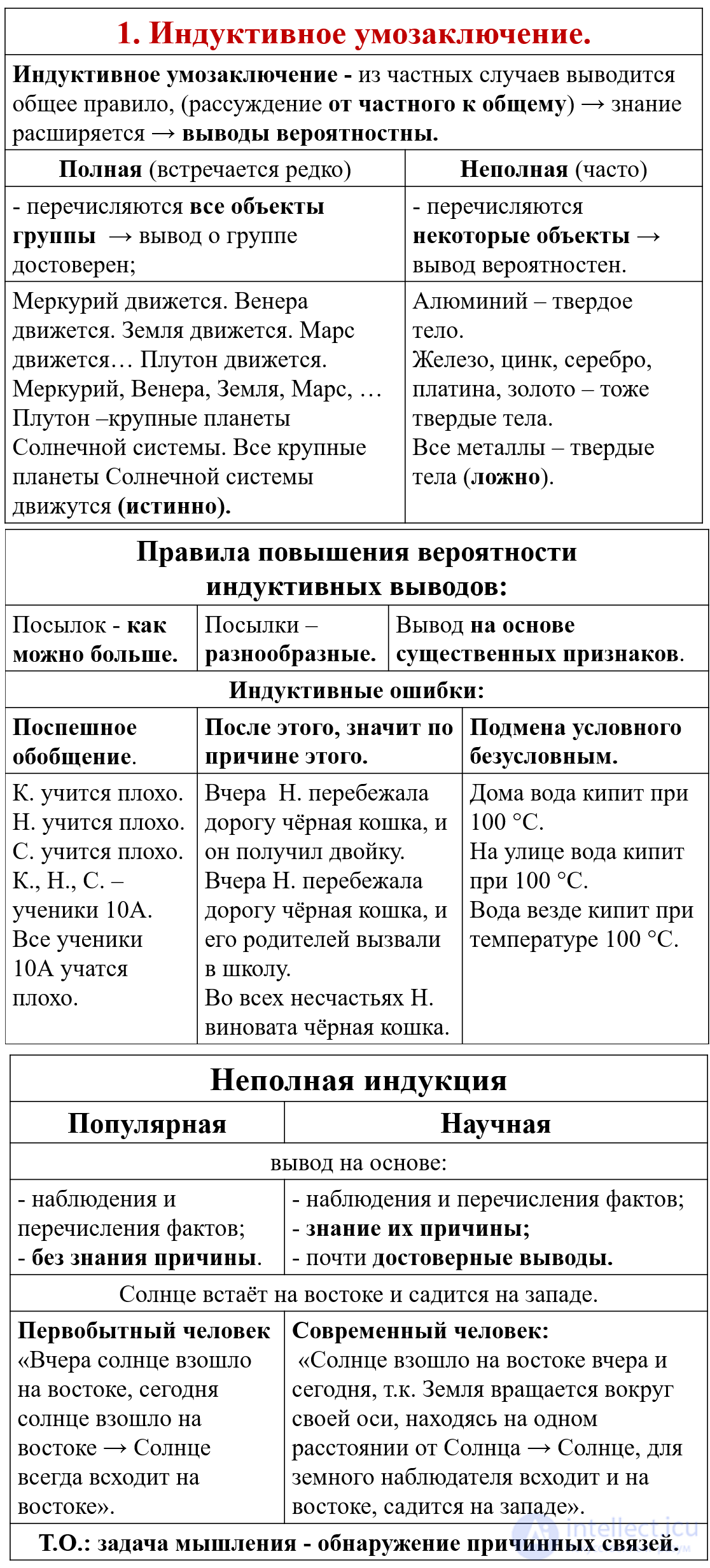
Inductive reasoning is when a general rule is derived from particular cases (reasoning from the particular to the general) → knowledge expands → conclusions are probabilistic.
In induction, a general rule is derived from several particular cases; the reasoning proceeds from the particular to the general, from the lesser to the greater, and knowledge expands, which is why inductive conclusions are, as a rule, probabilistic.
|
Complete (rare) |
Incomplete (common) |
|
- all objects of the group are listed → the conclusion about the group is certain;
|
- some objects are listed → the conclusion is probabilistic.
|
|
Mercury moves. Venus moves. Earth moves. Mars moves… Pluto moves. Mercury, Venus, Earth, Mars, … Pluto –are the major planets of the Solar System. All the major planets of the Solar System move (true). |
Aluminum – is a solid body. |
Induction can be complete or incomplete. In complete induction, all objects from a given group are listed and a conclusion is drawn about the entire group. For example, if the premises of an inductive argument list all nine major planets of the Solar System, then such induction is complete:
Mercury moves. Venus moves. Earth moves. Mars moves… Pluto moves.
Mercury, Venus, Earth, Mars, … Pluto – are the major planets of the Solar System.
All the major planets of the Solar System move.
In incomplete induction, some objects from a given group are listed and a conclusion is drawn about the entire group. For example, if the premises of an inductive argument list not all nine major planets of the Solar System, but only three of them, then such induction is incomplete:
Mercury moves. Venus moves. Earth moves. Mercury, Venus, Earth – are the major planets of the Solar System. All the major planets of the Solar System move.
It is clear that the conclusions of complete induction are certain, while those of incomplete induction are probabilistic; however, complete induction is rare, and therefore inductive reasoning is usually taken to mean incomplete induction.
To increase the degree of probability of the conclusions of incomplete induction, the following important rules should be observed:
1. As many initial premises as possible should be gathered. As an example, let us consider the following situation. It is necessary to check the level of academic performance of students in a certain school. Suppose that the school has a total enrollment (counting all grades and parallel classes) of 1,000 people. Using the method of complete induction, one would need to test every one of these thousand students for academic performance. Since this is rather difficult to do, one can use the method of incomplete induction: test some portion of the students and draw a general conclusion about the level of academic performance at this school. Various sociological surveys are likewise based on the application of incomplete induction. It is obvious that the greater the number of students tested, the more reliable the basis for the inductive generalization will be, and the more accurate the resulting conclusion. However, simply having a larger number of initial premises, as this rule requires, is not enough to increase the probability of an inductive generalization. Suppose a considerable number of students undergo testing, but, by chance, only underachievers happen to be among them. In this situation we would arrive at a false inductive conclusion that the level of academic performance at this school is very low. That is why the first rule is supplemented by a second.
2. Diverse premises must be selected. Returning to our example, let us note that the set of those tested should not simply be as large as possible, but should also be specially, systematically formed rather than randomly assembled, i.e., care must be taken to ensure it includes students (in roughly equal proportions) from different grades, parallel classes, and so on. And finally, the third rule of incomplete induction prescribes the following.
3. A conclusion should be drawn only on the basis of essential characteristics. If, say, testing reveals that a 10th-grade student does not know the entire periodic table of chemical elements by heart, then this fact (characteristic) is not essential for a conclusion about his academic performance. However, if testing shows that a 10th-grade student writes the particle «not» together with the verb (i.e., makes this spelling error), then this fact (characteristic) should be regarded as essential (important) for a conclusion about the level of his education and academic performance.
Such are the basic rules of incomplete induction. Let us now turn to its most common errors. When discussing deductive reasoning, we examined each error together with the rule whose violation gives rise to it. In this case, the rules of incomplete induction are presented first, and then, separately, its errors. This is because none of these errors is directly tied to any single one of the rules given above. Any inductive error can be regarded as the result of a simultaneous violation of all the rules, and at the same time the violation of each rule can be seen as a cause leading to any of the errors.
The first error, frequently encountered in incomplete induction, is called hasty generalization. Most likely, each of us is well acquainted with it. Everyone has heard statements such as: «All men are callous», «All women are frivolous».
These common stereotypical phrases are nothing other than hasty generalization in incomplete induction: if some objects from a given group possess a certain characteristic, this does not at all mean that this characteristic applies to the entire group without exception. A false conclusion can follow from the true premises of an inductive argument if hasty generalization is allowed. For example:
K. does poorly in school. N. does poorly in school. S. does poorly in school.
K., N., S. – are students of 10th grade «A».
All students of 10th grade «A» do poorly in school.
It is not surprising that hasty generalization underlies many unfounded assertions, rumors, and gossip.
The second error bears a long and, at first glance, strange name: after this, therefore because of this (from the Latin post hoc, ergo propter hoc). Here the point is that if one event occurs after another, this does not necessarily mean there is a cause-and-effect relationship between them. Two events may be connected merely by temporal sequence (one occurring earlier, the other later). When we say that one event must be the cause of another simply because it occurred earlier, we are committing a logical error. For example, in the following inductive argument the generalizing conclusion is false, despite the truth of the premises:
The day before yesterday a black cat crossed the path of the failing student N., and he got a failing grade. Yesterday a black cat crossed the path of the failing student N., and his parents were called to the school. Today a black cat crossed the path of the failing student N., and he was expelled from school.
The black cat is to blame for all the misfortunes of the failing student N.
The error of «after this, therefore because of this» gives rise to tall tales, superstitions, and mystifications.
The third error, widespread in incomplete induction, is called substituting the unconditional for the conditional. Let us consider an inductive argument in which a false conclusion follows from true premises:
At home, water boils at 100 °C. Outside, water boils at 100 °C. In the laboratory, water boils at 100 °C. Water boils at 100 °C everywhere.
We know that high in the mountains water boils at a lower temperature. What manifests itself under some conditions may not manifest itself under others. In the premises of the example considered, there is a conditional element (occurring under certain conditions), which in the conclusion is replaced by an unconditional one (occurring the same way under all conditions, independent of them). A good example of substituting the unconditional for the conditional is found in the tale familiar to us since childhood about tops and roots, in which a peasant and a bear plant turnips, agreeing to divide the harvest as follows: the peasant gets the roots, the bear gets the tops. Having received only the turnip greens, the bear realized that the peasant had cheated him, and committed the logical error of substituting the unconditional for the conditional: he decided that one should always take only the roots. The following year, when the peasant and the bear were dividing the wheat harvest, the bear himself proposed that he take the roots and the peasant the tops, and once again he was left with nothing.
Incomplete induction can be popular or scientific. In popular induction, the conclusion is drawn on the basis of observation and simple enumeration of facts, without knowledge of their cause, while in scientific induction the conclusion is drawn not only on the basis of observation and enumeration of facts, but also on the basis of knowledge of their cause. Therefore scientific induction, unlike popular induction, is characterized by much more accurate, almost certain conclusions. For example, primitive people see the sun rise in the east every day, move slowly across the sky during the day, and set in the west, but they do not know why this happens; the cause of this constantly observed phenomenon is unknown to them. It is clear that they can form a conclusion using only popular induction, reasoning roughly as follows: «The day before yesterday the sun rose in the east, yesterday the sun rose in the east, today the sun rose in the east, therefore the sun always rises in the east». We, like primitive people, observe the daily sunrise in the east, but, unlike them, we know the cause of this phenomenon: the Earth rotates on its axis in one and the same direction at a constant speed, which is why the sun appears every morning on the eastern side of the sky. Therefore, the conclusion that we draw represents scientific induction and looks something like this: «The day before yesterday the sun rose in the east, yesterday the sun rose in the east, today the sun rose in the east; and this happens because for several billion years the Earth has been rotating on its axis and will continue to rotate in the same way for many more billions of years, remaining at the same distance from the Sun, which was born before the Earth and will exist longer than it; therefore, for an earthly observer, the Sun has always risen and will always rise in the east».
The main difference between scientific induction and popular induction lies in the knowledge of the causes of the events taking place. Therefore, one of the important tasks not only of scientific but also of everyday thinking is to discover causal connections and dependencies in the world around us.
1. What is inductive reasoning? How does it differ from deductive reasoning?
2. What is the difference between complete and incomplete induction? Come up with one example for complete induction and one for incomplete induction.
Why is incomplete induction usually meant by the term induction?
3. What are the basic rules of incomplete induction? Give an example of some situation (other than the one discussed in this section) and use it to show how observing the basic rules of incomplete induction helps increase the probability of inductive generalizations.
4. What are the main errors widespread in incomplete induction? What negative phenomena in the spiritual life of a person and society can they lead to? Come up with one example for each error in incomplete induction.
5. How does popular induction differ from scientific induction? Give one example each (other than those presented in this section) of popular and scientific induction.

Comments