
Lecture
Inferences that contain disjunctive judgments are called disjunctive. In thought and speech the disjunctive-categorical syllogism is often used, in which, as the name suggests, the first premise is a disjunctive judgment and the second premise is a simple (categorical) one. For example:
An educational institution can be primary, or secondary, or higher. Moscow State University is a higher educational institution. Moscow State University is not a primary and not a secondary educational institution.
The disjunctive-categorical syllogism has two modes:
1. The affirmative-negative mode, in which the first premise is a strict disjunction of several alternatives of something, the second affirms one of them, and the conclusion denies all the rest (thus the reasoning moves from affirmation to negation). For example:
Forests are coniferous, or deciduous, or mixed. This forest is coniferous. This forest is neither deciduous nor mixed.
Using conventional notation for logical connectives, the form of this syllogism can be represented as follows:
 – this is the first premise in the form of a strict disjunction of three simple judgments;
a – this is the second premise in the form of an affirmation of one of them; 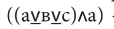 – these are the two premises of the syllogism joined by the conjunction sign; (¬ b ∧ ¬ c) – this is the conclusion of the syllogism in the form of a conjunction of the negations of the two remaining simple judgments that were part of the first premise; the implication sign «→» shows that the conclusion follows from the premises.
2. The negative-affirmative mode, in which the first premise is a strict disjunction of several alternatives of something, the second denies all these alternatives except one, and the conclusion affirms the one remaining alternative (thus the reasoning moves from negation to affirmation).
For example:
People are Caucasoid, or Mongoloid, or Negroid. This person is neither Mongoloid nor Negroid. This person is Caucasoid.
Using conventional notation for logical connectives, the form of this syllogism can be represented as follows:
 – this is the first premise in the form of a strict disjunction of three simple judgments;
(¬ b ∧¬ c) – this is the second premise in the form of a conjunction of the negations of two of them;
 – these are the two premises of the syllogism joined by the conjunction sign;
a – this is the conclusion of the syllogism in the form of an affirmation of the third simple judgment that was part of the first premise;
and finally, the implication joins the premises and the conclusion of the syllogism.
The first premise of a disjunctive-categorical syllogism is a strict disjunction, i.e., it represents the logical operation of division of a concept that is already familiar to us. It is therefore no surprise that the rules of this syllogism repeat the rules of division of a concept that we already know:
1. The division in the first premise must be carried out according to a single basis. For example:
Transport can be land, or underground, or water, or air, or public. Suburban electric trains are public transport. Suburban electric trains are not land, not underground, not water, and not air transport.
The syllogism is built according to the affirmative-negative mode: the first premise presents several alternatives, the second premise affirms one of them, and as a result the conclusion denies all the rest. However, a false conclusion follows from two true premises. Why does this happen? Because in the first premise the division was carried out according to two different bases: the natural environment in which the transport moves, and who owns it. Substituting the basis of division in the first premise of a disjunctive-categorical syllogism leads to a false conclusion.
2. The division in the first premise must be complete. For example:
Mathematical operations are addition, or subtraction, or multiplication, or division. Taking a logarithm is not addition, not subtraction, not multiplication, and not division. Taking a logarithm is not a mathematical operation.
In this syllogism, an incomplete division in the first premise leads to a false conclusion following from true premises.
3. The results of the division in the first premise must not overlap, or the disjunction must be strict. For example:
Countries of the world are northern, or southern, or western, or eastern. Canada is a northern country. Canada is not a southern, not a western, and not an eastern country.
In this syllogism the conclusion is false, since Canada is a northern country to the same extent that it is a western one. A false conclusion from true premises is explained in this case by the overlap of the division results in the first premise, or, what amounts to the same thing, by a non-strict disjunction. It should be noted that a non-strict disjunction in a disjunctive-categorical syllogism is admissible when the syllogism is built according to the negative-affirmative mode. For example:
He is either strong by nature or he constantly does sports. He is not strong by nature. He constantly does sports.
There is no error in this syllogism, despite the fact that the disjunction in the first premise was non-strict. Thus, the rule under consideration applies unconditionally only to the affirmative-negative mode of the disjunctive-categorical syllogism.
4. The division in the first premise must be consistent. For example:
Sentences are simple, or complex, or compound-complex.
This sentence is compound-complex. This sentence is neither simple nor complex.
In this syllogism a false conclusion follows from true premises because a jump in division was made in the first premise.
The disjunctive-categorical syllogism in logic is often simply called the disjunctive-categorical inference. Besides it, there is also the purely disjunctive syllogism (purely disjunctive inference), both premises and the conclusion of which are disjunctive judgments.
For example:
Mirrors are flat or spherical. Spherical mirrors are concave or convex. Mirrors are flat, or concave, or convex.
The form of the purely disjunctive syllogism given above can be represented as follows: – the first premise;
 – the second premise;
 – the conclusion.
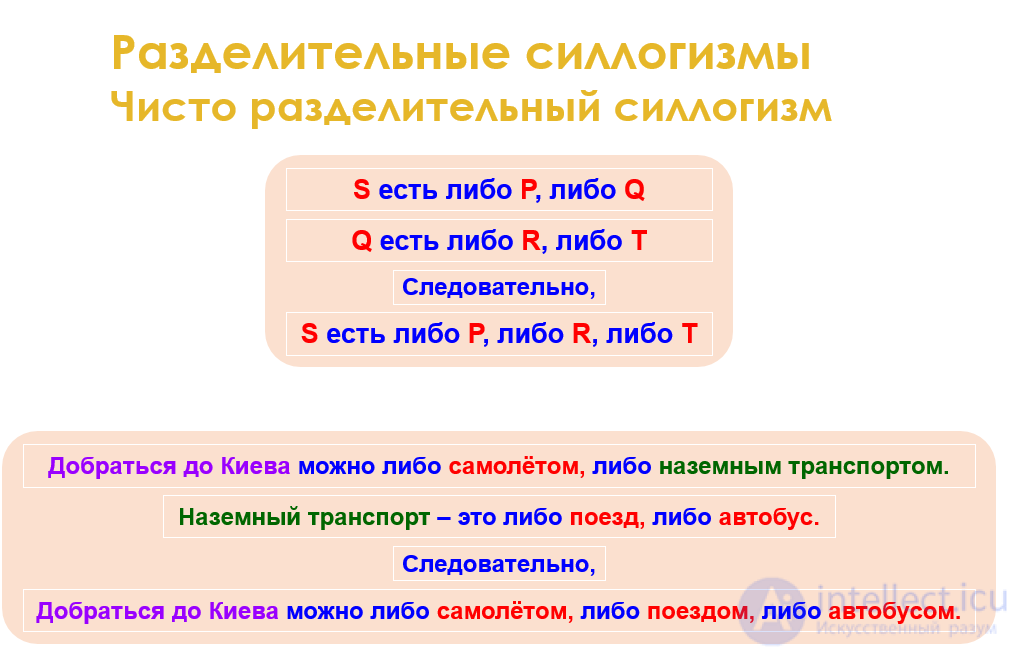
Purely disjunctive syllogism
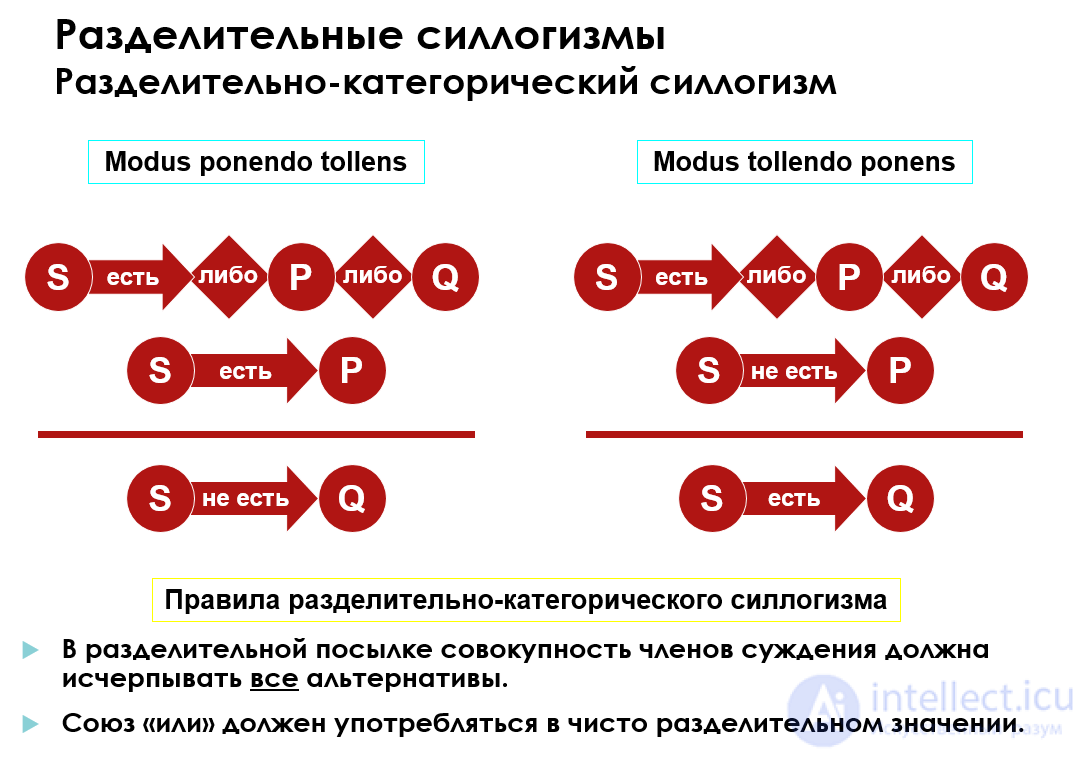
Fig. Disjunctive-categorical syllogism
1. What are disjunctive inferences?
2. What modes does the disjunctive-categorical syllogism have?
Give three examples for each mode, depicting their form using conventional logical notation.
3. What are the rules of the disjunctive-categorical syllogism?
What errors arise when they are violated? In what case can the disjunction in a disjunctive-categorical syllogism be non-strict? Come up with one example for each error that arises when the corresponding rule is violated.
4. How does the purely disjunctive syllogism differ from the disjunctive-categorical syllogism? Give two examples of a purely disjunctive syllogism.
5. Have errors been made (and which ones) in the following disjunctive-categorical syllogisms:
1. Quadrilaterals are squares, or rhombuses, or trapezoids. This figure is not a rhombus and not a trapezoid. This figure is a square.
2. Selection in nature can be artificial or natural. This selection is not artificial. This selection is natural.
3. People are talented, or untalented, or stubborn.
He is a stubborn person.
He is neither talented nor untalented.
4. Judgments are affirmative or negative.
This judgment is affirmative.
This judgment is not negative.
5. Students are either excellent students or failing students.
My friend is not an excellent student.
My friend is a failing student.

Comments