
Lecture
Deduction (from Latin deductio — derivation, also called deductive reasoning, syllogism) — is a method of thinking whose result is a logical conclusion, the truth of which is guaranteed by the truth of the premises. It can also be defined as a logico-methodological procedure by which the transition from the general to the particular is carried out in the process of reasoning.
The starting points (premises) of deduction are axioms or simply hypotheses that have the character of general statements («the general»), while the end point is the consequences of the premises, theorems («the particular»). If the premises of a deduction are true, then its consequences are also true. Deduction is the primary means of logical proof. It is the opposite of induction.
An example of the simplest deductive inference:

Inferences in which one premise is a conditional statement, and the second premise coincides with the antecedent or consequent of the conditional statement, or with the result of negating the antecedent or consequent of the conditional statement.
The truth of the antecedent entails the truth of the consequent, and the negation of the consequent entails the negation of the antecedent.
Forms of the valid modes (types) of conditional-categorical inferences:


Inferences in which one of the premises is a disjunctive statement, and the second coincides with one of the members of the disjunctive statement (1) or negates all but one (2). In the conclusion, accordingly, all members except the one indicated in the second premise are negated (1), or the omitted member is affirmed (2).
Forms of the valid modes of disjunctive-categorical inferences
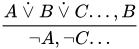 (here a strictly disjunctive statement is required). That is: the first premise: either A, or B, or C …, the second premise: B; the conclusion: therefore, not A, not C … .
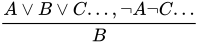 . That is: the first premise: A or B or C …, the second premise: not A, not C …; the conclusion: therefore, B.
Inferences whose premises and conclusions are conditional statements.
 . That is: premise: if A, then B; conclusion: therefore, if not B, then not A. For example, if an animal is a mammal, then it is a vertebrate. Therefore, if some animal is not a vertebrate, then it is not a mammal.
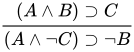 . That is: premise: if A and B, then C; conclusion: therefore, if A and not C, then not B.
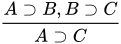 . That is: the first premise: if A, then B; the second premise: if B, then C; conclusion: therefore, if A, then C.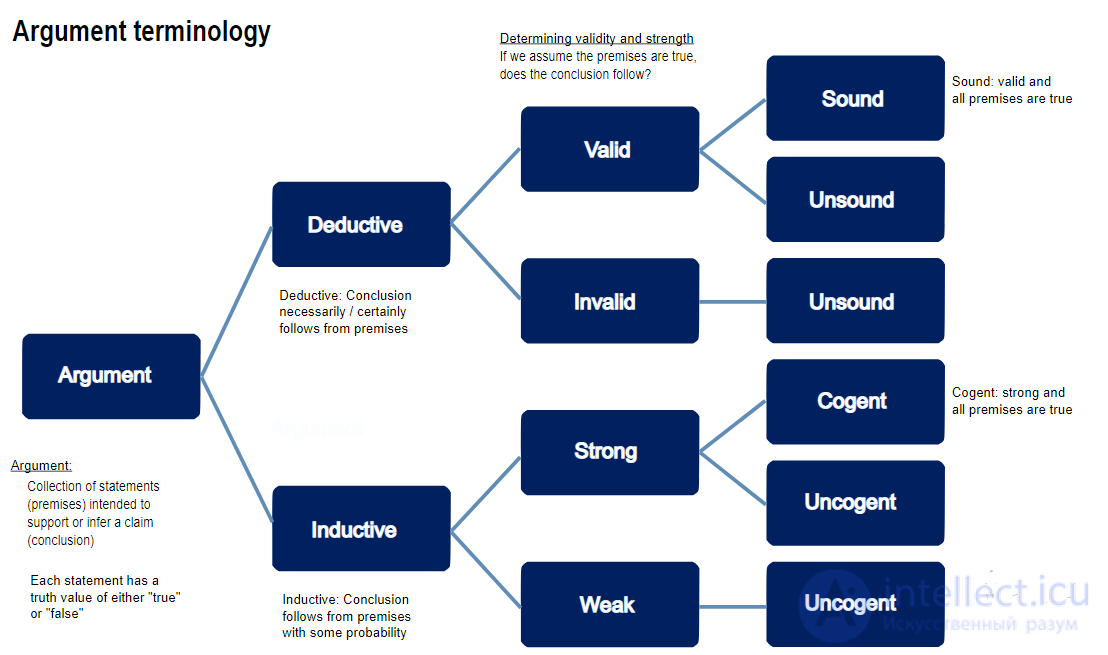
A diagram of the classical representation of the relationship between theory, empiricism, induction, and deduction.
A special type of inference made up of two conditional statements and one disjunctive statement.
Types of valid dilemmas:
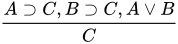
(that is: the first premise: if A, then C; the second premise: if B, then C; the third premise: A or B; conclusion: therefore, C);
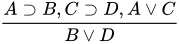 (complex)
(that is: the first premise: if A, then B; the second premise: if C, then D; the third premise: A or C; conclusion: therefore, B or D);
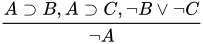
(that is: the first premise: if A, then B; the second premise: if A, then C; the third premise: not B or not C; conclusion: therefore, not A);
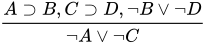 (complex)
(that is: the first premise: if A, then B; the second premise: if C, then D; the third premise: not B or not D; conclusion: therefore, not A or not C).
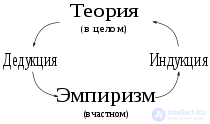
A diagram of the classical representation of the relationship between theory, empiricism, induction, and deduction.
The «deductive» method of Sherlock Holmes is based on typical abductive inferences

Comments