
Lecture
1. Check whether the given conditional-categorical inference is correct: «If an animal is a mammal, then it is a vertebrate. This reptile is not a mammal. Therefore, it is not a vertebrate»
Answer: no, incorrect
2. Check whether the given conditional-categorical inference is correct: «If this act is classified as theft, then it must be the secret misappropriation of another's property. It has been proven that this is indeed the secret misappropriation of another's property. Therefore, the classification of this act as theft is correct».
Answer: yes, correct
3. Check the following purely conditional inferences for correctness: «If it is cold outside, we will go to the cinema. And if we go to the cinema, we will eat ice cream there. Therefore, if it is cold outside, we will eat ice cream at the cinema». 2. «We will go to the cinema if it is cold outside. If we do not go to the cinema, we will not eat ice cream. Therefore, we will not eat ice cream if it is cold outside».
Answer: only the first is correct
4. Check the purely conditional inference for correctness: «I have read that if we are dealing with gold or platinum, they will not oxidize under normal conditions, and if the latter is true, they can be kept in damp and poorly ventilated rooms. That is why I am sure that, having precious metals on hand, one need not worry about dampness in the room or poor ventilation».
Answer: yes, correct
5. Check this disjunctive-categorical inference: «Elementary particles have either a negative electric charge, or a positive one, or a neutral one. Electrons have a negative electric charge. Therefore, electrons have neither a positive nor a neutral electric charge».
Answer: yes, correct
6. Check this disjunctive-categorical inference: «Sidorova may be either a complete slacker or completely untalented. But she is not a complete slacker, which means she is completely untalented».
Answer: yes, correct
7. Check the following dilemma: «If Peter goes to Novgorod, then Ivan will go to Tambov. If Peter goes to Arkhangelsk, then Olga will stay in Vyazma. It is certain that Peter will go to Arkhangelsk or to Novgorod. Therefore, Ivan will go to Tambov or Olga will stay in Vyazma».
Answer: yes, correct
8. Using the experience of solving the previous problem and your knowledge of the theory of disjunctive-categorical inferences, determine the correctness of the following reasoning. «If Peter goes to Novgorod, then Ivan will go to Tambov. If Peter goes to Arkhangelsk, then Olga will stay in Vyazma. It is certain that Peter will go to Arkhangelsk or to Novgorod, and Olga will not stay in Vyazma. Therefore, Ivan will go to Tambov.
Answer: yes, correct
9. Indicate the type of this immediate syllogistic inference. Some mushrooms are poisonous. – Therefore, some mushrooms are not non-poisonous.
Answer: obversion
10. Was the operation of conversion performed correctly in this syllogistic inference?Some mushrooms are poisonous. – Therefore, some mushrooms are not non-poisonous.
Answer: no, incorrect
11. Was the operation of contraposition of the predicate performed correctly in this syllogistic inference?To err is human. – It is not human nature to err.
Answer: no, incorrect
12. Was the operation of conversion performed correctly in this syllogistic inference? All students of law schools study labor law. – All those who study labor law are students of law schools.
Answer: no, incorrect
13. Indicate the type of this immediate syllogistic inference. Some students in our group are not honor students. – Therefore, some honor students are students in our group.
Answer: contraposition of the predicate
14. Was the operation of conversion performed correctly in this syllogistic inference? Some students in our group are not honor students. – Therefore, some honor students are students in our group.
Answer: no, incorrect
15. Check the conclusion based on the logical square: «It is true that some of Peter the Great's undertakings were progressive; hence it is also true that some of Peter the Great's undertakings were not progressive»
Answer: no, incorrect
16. Check the conclusion based on the logical square: «It is false that all roads lead to Rome. Hence, it is false that some roads lead to Rome».
Answer: no, incorrect
17. Check the conclusion based on the logical square: «It is false that some dolphins have gills. Therefore, it is false that all dolphins have gills».
Answer: yes, correct
18. Determine the figure of this syllogism: All students are learners, Some learners receive a scholarship, Therefore, some of those who receive a scholarship are students.
Answer: fourth figure of the syllogism
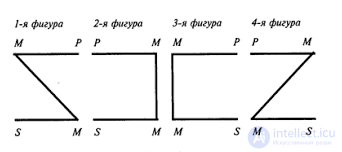
19. Determine the figure of this syllogism: All artists know Rembrandt's paintings.,Ivanov knows Rembrandt's paintings. Ivanov is an artist
Answer: second figure of the syllogism
20. Determine the figure of this syllogism: Every artist knows Rembrandt's paintings. Petrov is not an artist. Therefore, Petrov does not know Rembrandt's paintings.
Answer: first figure of the syllogism
21. Determine the figure of this syllogism Bribery is a criminal offense. Every criminal offense is punishable.Therefore, bribery is punishable.
Answer: first figure of the syllogism
22. Determine the mood of this syllogism: All students are learners.Some learners receive a scholarship. Therefore, some of those who receive a scholarship are students.
Answer: AII
23. Determine the mood of this syllogism All artists know Rembrandt's paintings. Ivanov knows Rembrandt's paintings. Ivanov is an artist.
Answer: AAA
24. Determine the mood of this syllogism. Every artist knows Rembrandt's paintings. Petrov is not an artist. Therefore, Petrov does not know Rembrandt's paintings.
Answer: AOO
25. Determine the mood of this syllogism Bribery is a criminal offense. Every criminal offense is punishable. Therefore, bribery is punishable.
Answer: AAA
26. Check this syllogism using the general rules:«Most textbooks are interesting. Some textbooks are well-illustrated books.Therefore, among well-illustrated books there are interesting ones».
Answer: no, invalid
27. Check this syllogism using the general rules: Some writers are women. All women love flowers,Therefore, among those who love flowers there are writers.
Answer: yes, valid
28. Check this syllogism using the general rules: B. Russell is a famous logician. B. Russell is a famous public figure. Therefore, among famous public figures there are famous logicians.
Answer: yes, valid
29. The rules of which figure should be applied to this syllogism? No medicine is pleasant. Candy is not a medicine. All candy is pleasant.
Answer: the first
30. Check the following syllogism using the rules of figures: Every correct syllogism has three terms. This syllogism also has three terms. Therefore, this syllogism is correct.
Answer: no, invalid
31. Check the following syllogism using the rules of figures: Some learners are athletes. All students are learners. Therefore, some students are athletes.
Answer: no, invalid
32. Check the following syllogism using the rules of figures: L. is a defendant.Every defendant has the right to a defense. Therefore, L. has the right to a defense.
Answer: yes, valid
33. Using circle diagrams, determine whether the syllogism is valid. «All people breathe with lungs. No fish breathes with lungs. No fish is a human being.
Answer: yes, valid
34. Using circle diagrams, determine whether the syllogism is valid. All gases are extremely solid bodies. Xenon is a gas.Therefore, xenon is an extremely solid body.
Answer: yes, valid
35. Determine the type of polysyllogism:
All crimes are socially dangerous
All misappropriations are crimes
All misappropriations are socially dangerous.
All misappropriations are socially dangerous.
All thefts are misappropriations.
All thefts are socially dangerous.
All thefts are socially dangerous.
All secret appropriations of books from the library are thefts.
All secret appropriations of books from the library are socially dangerous.
Answer: progressive polysyllogism
36. Determine the type of polysyllogism:
All resourceful people have logical abilities
All students are resourceful people
All students have logical abilities
Everyone who has logical abilities is a rational being
All students have logical abilities
All students are rational beings.
Answer: regressive polysyllogism
37. Determine the type of sorites:
Petrov is a human being.
To err is human.
He who is prone to error cannot be considered perfect.
He who cannot be considered perfect must be modest.
Therefore, Petrov must be modest.
Answer: Aristotelian sorites
38. Make sure that this is an enthymeme, restore it to the full form of a syllogism, and determine its correctness by any method. «Since every myth is a symbol, it is clear that the myth of Ariadne's thread is a symbol».
Answer: the enthymeme is correct
39. Make sure that this is an enthymeme, restore it to the full form of a syllogism, and determine its correctness by any method. The speaker violated the law of identity, since he substituted one concept for another.
Answer: the enthymeme is correct
40. Make sure that this is an enthymeme, restore it to the full form of a syllogism, and determine its correctness by any method.
Ivanov is a pacifist, since all of progressive humanity fights for a just social order.
Answer: this is not an enthymeme
41. Make sure that this is an epicheirema and check its correctness.Student Ivanov does not admire mathematics, since he did not study it.
Student Ivanov is also a pacifist, since he fights for peace. Therefore, it can be asserted that at least some pacifists do not admire mathematics.
Answer: the epicheirema is incorrect
42. Make sure that this is an epicheirema and check its correctness. A lie causes distrust, since it is a statement that does not correspond to the truth.Flattery is a lie, since it is a deliberate distortion of the truth. Thus, a lie causes distrust
Answer: the epicheirema is correct
43. Determine whether this reasoning is an example of complete or incomplete induction: «None of my floppy disks contains any known viruses, since I personally checked each one of them»
Answer: this is complete induction
44. Determine whether this reasoning is an example of complete or incomplete induction: «I passed math successfully because I kept an amulet in my pocket. I wouldn't have passed physics either if I hadn't had the amulet with me. And I also took the foreign language exam with the amulet, and I got an «excellent» for it. Now I will take all my exams with the amulet».
Answer: this is incomplete induction
45. Which method of establishing a causal connection is demonstrated in the following reasoning? «Numerous observations show that various plants exposed to sunlight have a green color. But if, under the same conditions, these plants are placed in darkness, the green color is lost. Conclusion: the cause of the green color is sunlight».
Answer: the joint method of agreement and difference
46. Does analogy belong to deductive or non-deductive reasoning?
Answer: non-deductive
47. In which case will the conclusion by analogy be more reliable? First case. During the robberies of enterprise cash offices in a certain region, the exposed criminals acted as follows. At night they attacked the watchman, tied him up, broke down the door of the cash office, and then used a crowbar and sledgehammer to pry open the safe door and steal the money. When, several years later, robberies of cash offices began occurring in the same city using the same method, it was assumed that the robberies had been committed by the same criminals (or one of them), who had escaped or been released from places of confinement. Second case. In the regional cities of another region, robberies of enterprise cash offices began to occur. Unidentified persons opened the doors of the cash offices and safes using lock picks and stole the money. The time of the crime was established only approximately, and there were practically no fingerprints. It was assumed that this series of robberies had been committed by the same criminals who had operated in the first region.
Answer: the first conclusion

Comments