
Lecture
Analogy (derived from the Greek word: ảναλογία — similarity, proportionality, proportion).
Analogy is a type of reasoning that expresses the similarity of objects or phenomena in certain properties, features, or relations.
In inferences by analogy, based on the similarity of objects in some features, a conclusion is drawn about their similarity in other features as well. The structure of an analogy can be represented by the following scheme:
Object A has features a, b, c, d.
Object B has features a, b, c.
Probably, object B has feature d.
Here, A and B – are the objects (entities) being compared or likened to one another; a, b, c – are the similar features; d – is the transferred feature.
Let us give an example of reasoning by analogy:
The works of the philosopher Sextus Empiricus, published by the «Mysl» publishing house in the «Philosophical Heritage» series, are provided with an introductory article, commentary, and a subject-name index.
The annotation to the new book – the works of the philosopher Francis Bacon – states that they were published by the «Mysl» publishing house in the «Philosophical Heritage» series, and are provided with an introductory article and commentary.
Most likely, the published works of Francis Bacon, just like the works of Sextus Empiricus, are provided with a subject-name index.
In this case, two objects are being compared: the previously published works of Sextus Empiricus and the forthcoming works of Francis Bacon. The similar features of these two books are that they are published by the same publishing house, in the same series, and are provided with introductory articles and commentary. Based on this, it can be asserted with a high degree of probability that if the works of Sextus Empiricus are provided with a subject-name index, then the works of Francis Bacon will be too. Thus, the presence of a subject-name index is the transferred feature in the example under consideration (see also paragraph 3.1, where the planets Earth and Mars serve as the objects being likened, and the transferred feature is the presence of life on the planet).
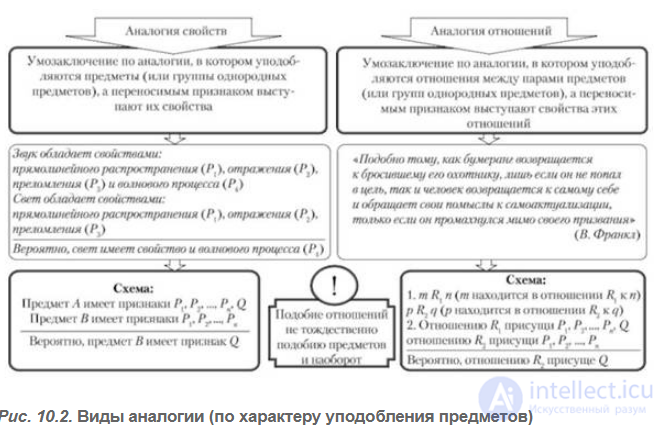
Inferences by analogy are divided into two types:
1. Analogy of properties, in which two objects are compared, and the transferred feature is some property of these objects.
The example given above is an analogy of properties.
2. Analogy of relations, in which two groups of objects are compared, and the transferred feature is some relation between the objects within these groups. An example of an analogy of relations:
In a mathematical fraction, the numerator and denominator are in an inverse relation: the larger the denominator, the smaller the numerator. A person can be compared to a mathematical fraction: its numerator is what he actually represents, while its denominator is what he thinks of himself, how he evaluates himself. It is likely that the higher a person rates himself, the worse he actually becomes.
As we can see, two groups of objects are compared. One is the numerator and denominator in a mathematical fraction, and the other is the real person and his self-assessment. Moreover, the inverse relationship between the objects is transferred from the first group to the second.
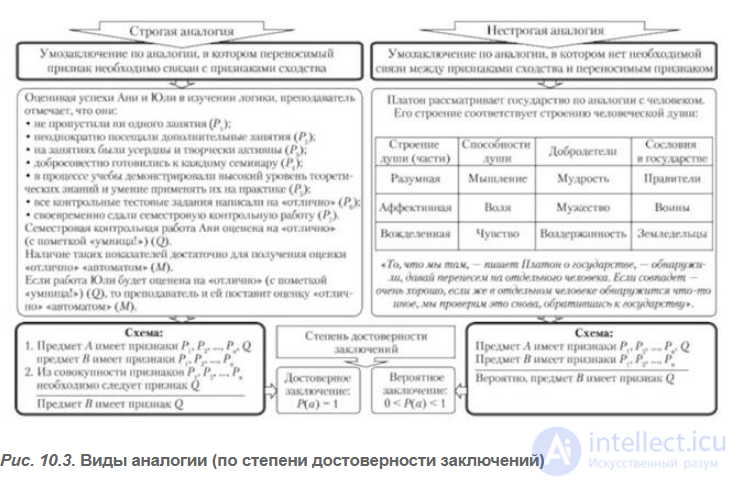
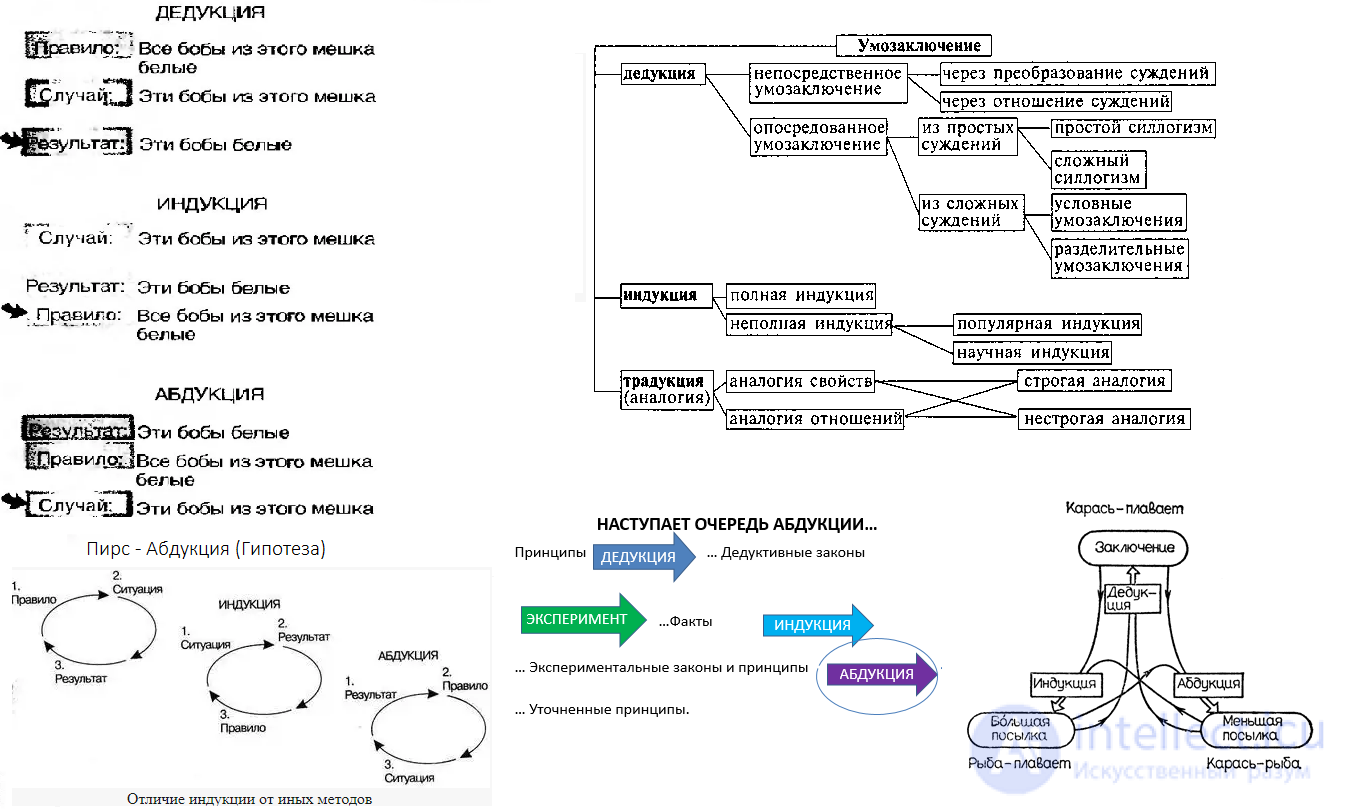
Due to the probabilistic nature of its conclusions, analogy is, of course, closer to induction than to deduction. It is therefore not surprising that the basic rules of analogy, observance of which increases the probability of its conclusions, largely resemble the rules of incomplete induction already known to us. First, a conclusion must be drawn on the basis of the greatest possible number of similar features in the objects being likened. Second, these features must be diverse. Third, the similar features must be essential for the objects being compared.
Fourth, there must be a necessary (regular) connection between the similar features and the transferred feature. The first three rules of analogy essentially repeat the rules of incomplete induction. Perhaps the most important is the fourth rule, concerning the connection between the similar features and the transferred feature. Let us return to the example of analogy considered at the beginning of this section. The transferred feature – the presence of a subject-name index in the book – is closely connected with the similar features – publishing house, series, introductory article, commentary (books of this genre are necessarily provided with a subject-name index). If the transferred feature (for example, the volume of the book) is not regularly connected with the similar features, then the conclusion of the inference by analogy may turn out to be false:
The works of the philosopher Sextus Empiricus, published by the «Mysl» publishing house in the «Philosophical Heritage» series, are provided with an introductory article, commentary, and have a volume of 590 pages.
The annotation to the new book – the works of the philosopher Francis Bacon – states that they were published by the «Mysl» publishing house in the «Philosophical Heritage» series, and are provided with an introductory article and commentary.
Most likely, the published works of Francis Bacon, just like the works of Sextus Empiricus, have a volume of 590 pages.
Despite the probabilistic nature of their conclusions, inferences by analogy have quite a few merits. Analogy is a good means of illustrating and explaining complex material, is a way of giving it artistic imagery, and often leads to scientific and technical discoveries.
1. What is the structure of inferences by analogy?
2. How does analogy of properties differ from analogy of relations?
Give one example (other than those considered in this section) for each of these two types of analogy.
3. What are the basic rules of inferences by analogy, observance of which increases the probability of its conclusions?
4. What are the merits and drawbacks of inferences by analogy?
5. Determine the type of analogy in the examples below:
1) Gills are to fish what lungs are to mammals.
2) Arthur Conan Doyle's novella «The Sign of Four», about the adventures of the detective Sherlock Holmes and notable for its dynamic plot, I liked very much. I have not read Arthur Conan Doyle's novella «The Hound of the Baskervilles», but I know that it is devoted to the adventures of the noble detective Sherlock Holmes and has a dynamic plot. Most likely, I will also like this novella very much.
3) The essence of Ernest Rutherford's planetary model of the atom is that negatively charged electrons move in different orbits around a positively charged nucleus; just as in the Solar System the planets move in different orbits around a single center – the Sun.

Comments