
Lecture
The simple syllogism is one of the most widespread kinds of inference. It is therefore often used in everyday and scientific thinking. However, when we use it, we usually do not observe its rigid logical structure. For example:
No fish are mammals; and all whales are mammals. Therefore, no whales are fish.
Instead, we are more likely to say: "No whales are fish, since they are mammals" – or: "No whales are fish, because fish are not mammals". It is easy to see that these two inferences are an abbreviated form of the simple syllogism given above.
Thus, thinking and speech usually employ not the simple syllogism, but its various abbreviated forms:
1. The enthymeme is a simple syllogism in which one of the premises or the conclusion is omitted.
An enthymeme (Greek ένθυμημα, from ένθυμέομαι, to have in mind) is an abbreviated (incomplete) syllogism in which one of the premises or the conclusion is not stated explicitly but is merely implied.
It is clear that three enthymemes can be derived from any syllogism. For example:
All metals conduct electricity. Iron is a metal. Iron conducts electricity.
Three enthymemes follow from this syllogism: "Iron conducts electricity, since it is a metal (the major premise is omitted)", "Iron conducts electricity, because all metals conduct electricity (the minor premise is omitted)", "All metals conduct electricity, and iron is a metal (the conclusion is omitted)".


Fig. Examples
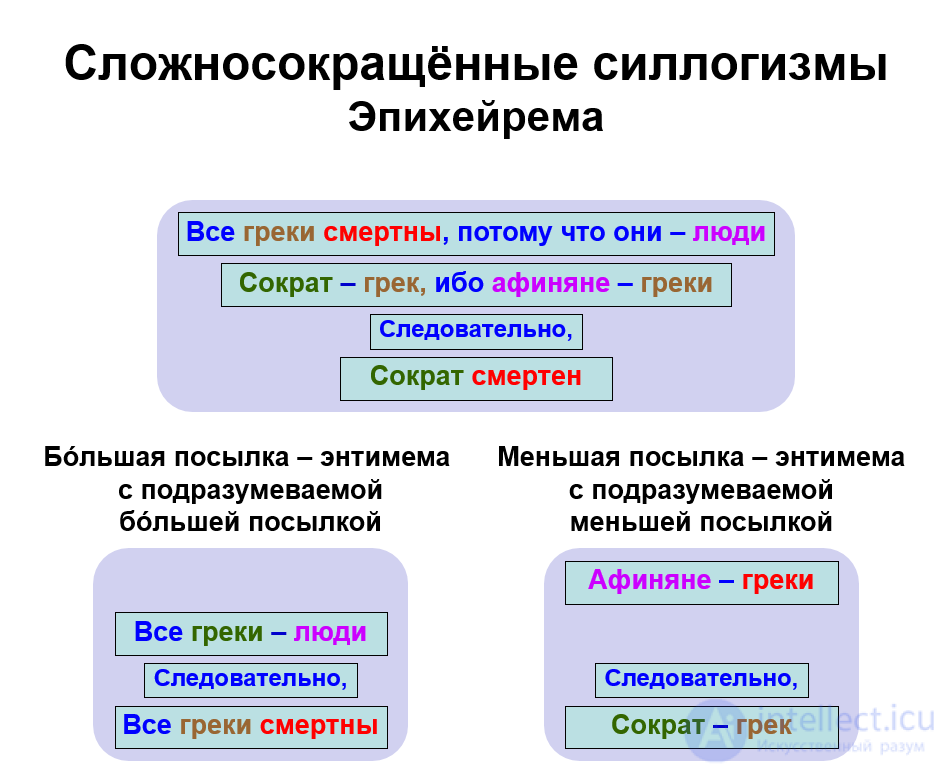
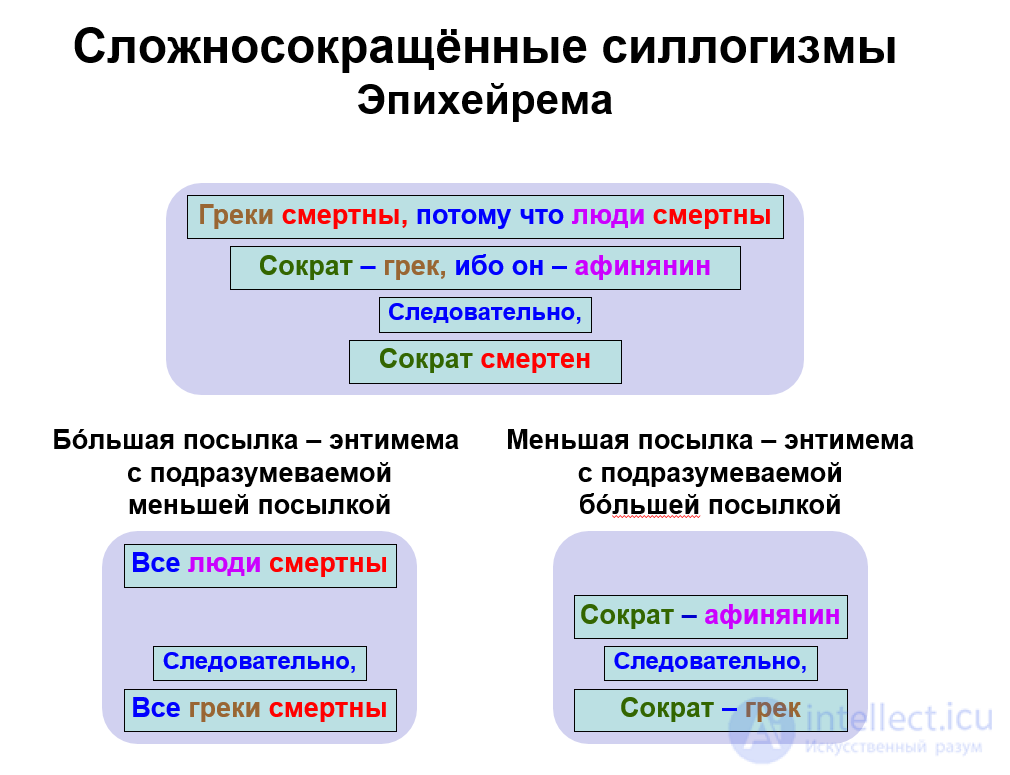
2. The epicheirema is a simple syllogism in which both premises are enthymemes. Let us take two syllogisms and derive enthymemes from them.
Syllogism 1:
Whatever brings a society to disaster is evil.
Social injustice brings a society to disaster.
Social injustice is evil.
Omitting the major premise in this syllogism, we obtain the enthymeme: "Social injustice is evil, since it brings a society to disaster".
Syllogism 2:
Whatever promotes the enrichment of some at the expense of the impoverishment of others – is social injustice. Private property promotes the enrichment of some at the expense of the impoverishment of others. Private property is social injustice.
Omitting the major premise in this syllogism, we obtain the enthymeme: "Private property is social injustice, since it promotes the enrichment of some at the expense of the impoverishment of others". If we place these two enthymemes one after the other, they become the premises of a new, third syllogism, which will be the epicheirema:
Social injustice is evil, since it brings a society to disaster. Private property is social injustice, since it promotes the enrichment of some at the expense of the impoverishment of others. Private property is evil.
As we can see, three syllogisms can be distinguished within an epicheirema: two of them are premise syllogisms, and one is constructed from the conclusions of the premise syllogisms. This last syllogism forms the basis for the final conclusion.

3. The polysyllogism (complex syllogism) is a set of two or more simple syllogisms connected in such a way that the conclusion of one of them is a premise of the next.
For example:
Whatever develops thinking is useful. All intellectual games develop thinking. All intellectual games are useful. Chess is an intellectual game. Chess is useful.
Brackets mark the two syllogisms combined into a polysyllogism. Note that the conclusion of the preceding syllogism has become the major premise of the following one. In this case the resulting polysyllogism is called progressive. If, however, the conclusion of the preceding syllogism becomes the minor premise of the following one, the polysyllogism is called regressive.
For example:
All stars are celestial bodies. The Sun is a star. The Sun is a celestial body. All celestial bodies take part in gravitational interactions. The Sun is a celestial body. The Sun takes part in gravitational interactions.
The conclusion of the preceding syllogism is the minor premise of the next. Note that in this case the two syllogisms cannot be joined graphically into a sequential chain, as they can in a progressive polysyllogism.
It was said above that a polysyllogism may consist of not just two but more simple syllogisms. Here is an example of a (progressive) polysyllogism consisting of three simple syllogisms:
Everything material has physical properties. All objects of the Universe are material. All objects of the Universe have physical properties. Quanta are objects of the Universe. Quanta have physical properties. Photons are quanta of the electromagnetic field. Photons have physical properties.


4. The sorites (abridged complex syllogism) is a polysyllogism in which a premise of a subsequent syllogism, which is the conclusion of the preceding one, is omitted. Let us return to the example of a progressive polysyllogism considered above and omit in it the major premise of the second syllogism, which is the conclusion of the first syllogism. The result is a progressive sorites:
Whatever develops thinking is useful. All intellectual games develop thinking. Chess is an intellectual game. Chess is useful.
Now let us turn to the example of a regressive polysyllogism considered above and omit in it the minor premise of the second syllogism, which is the conclusion of the first syllogism. The result is a regressive sorites:
All stars are celestial bodies.
The Sun is a star.
All celestial bodies take part in gravitational interactions.
The Sun takes part in gravitational interactions.


Fig. Goclenian and Aristotelian sorites
1. Why is the simple syllogism not entirely convenient for constant use in thinking and speech? What is it usually replaced with?
2. What is an enthymeme? Why can three enthymemes be derived from any syllogism? Make up an example of a simple syllogism and derive all its enthymemes.
3. What is an epicheirema? How many simple syllogisms are implicitly contained in any epicheirema? Try to make up an example of an epicheirema.
4. What is a polysyllogism? How does a progressive polysyllogism differ from a regressive one? Make up one example each of a progressive and a regressive polysyllogism.
5. What is a sorites? Which sorites is progressive, and which is regressive? Make up one example each of a progressive and a regressive sorites.

Comments