
Lecture
A counterexample is any exception to a generalization. In logic, a counterexample disproves a generalization, and it does so strictly in the fields of mathematics and philosophy. For example, the fact that «the student John Smith is not lazy» is a counterexample to the generalization «students are lazy», and at the same time is a counterexample and refutation of the universal quantification «all students are lazy».
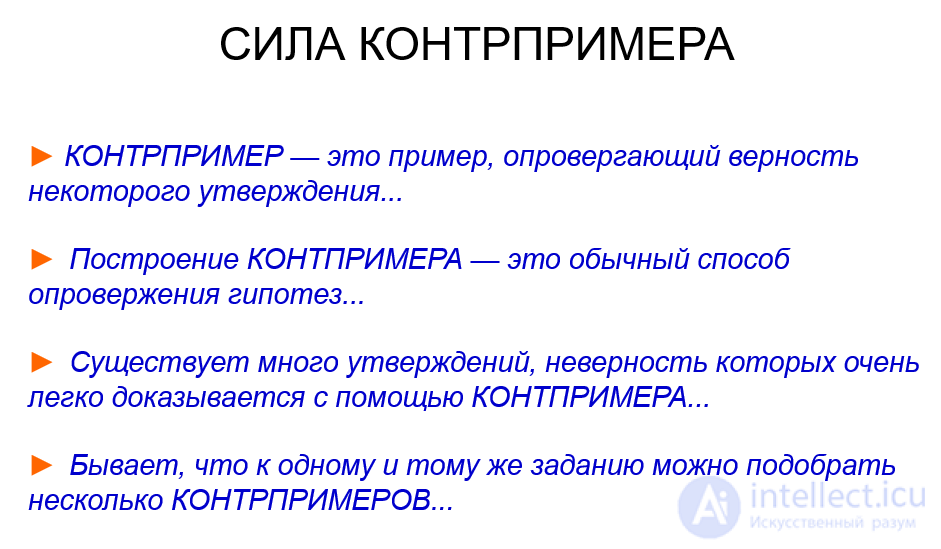
In mathematics, counterexamples are often used to prove the boundaries of possible theorems. By using counterexamples to demonstrate the falsity of certain hypotheses, mathematical researchers can avoid dead ends and learn to modify hypotheses in order to obtain provable theorems. It is sometimes said that mathematical development consists primarily of searching for (and proving) theorems and counterexamples.
Suppose a mathematician is studying geometry and shapes and wants to prove certain theorems about them. She hypothesizes that «All rectangles are squares», and she is interested in finding out whether this statement is true or false.
In this case, she can either try to prove the truth of the statement using deductive reasoning, or try to find a counterexample to the statement if she suspects that it is false. In the latter case, the counterexample would be a rectangle that is not a square, for example, a rectangle with two sides of length 5 and two sides of length 7. However, although she found rectangles that were not squares, all the rectangles she found had four sides. She then puts forward a new hypothesis, «All rectangles have four sides». This is logically weaker than her original hypothesis, since every square has four sides, but not every four-sided figure is a square.
The example above explained — in a simplified way — how a mathematician can weaken her hypothesis in the face of counterexamples, but counterexamples can also be used to demonstrate the necessity of certain assumptions and hypotheses. For example, suppose that after some time the mathematician mentioned above settled on a new hypothesis: «All figures that are rectangles and have four sides of equal length are squares». This hypothesis consists of two parts: the figure must be a «rectangle» and must have «four sides of equal length». The mathematician would then like to find out whether either of the assumptions can be removed while still preserving the truth of her hypothesis. This means she needs to check the truth of the following two statements:
A counterexample to (1) has already been given above, and a counterexample to (2) is a non-square rhombus. Thus, the mathematician now knows that each assumption alone is insufficient.
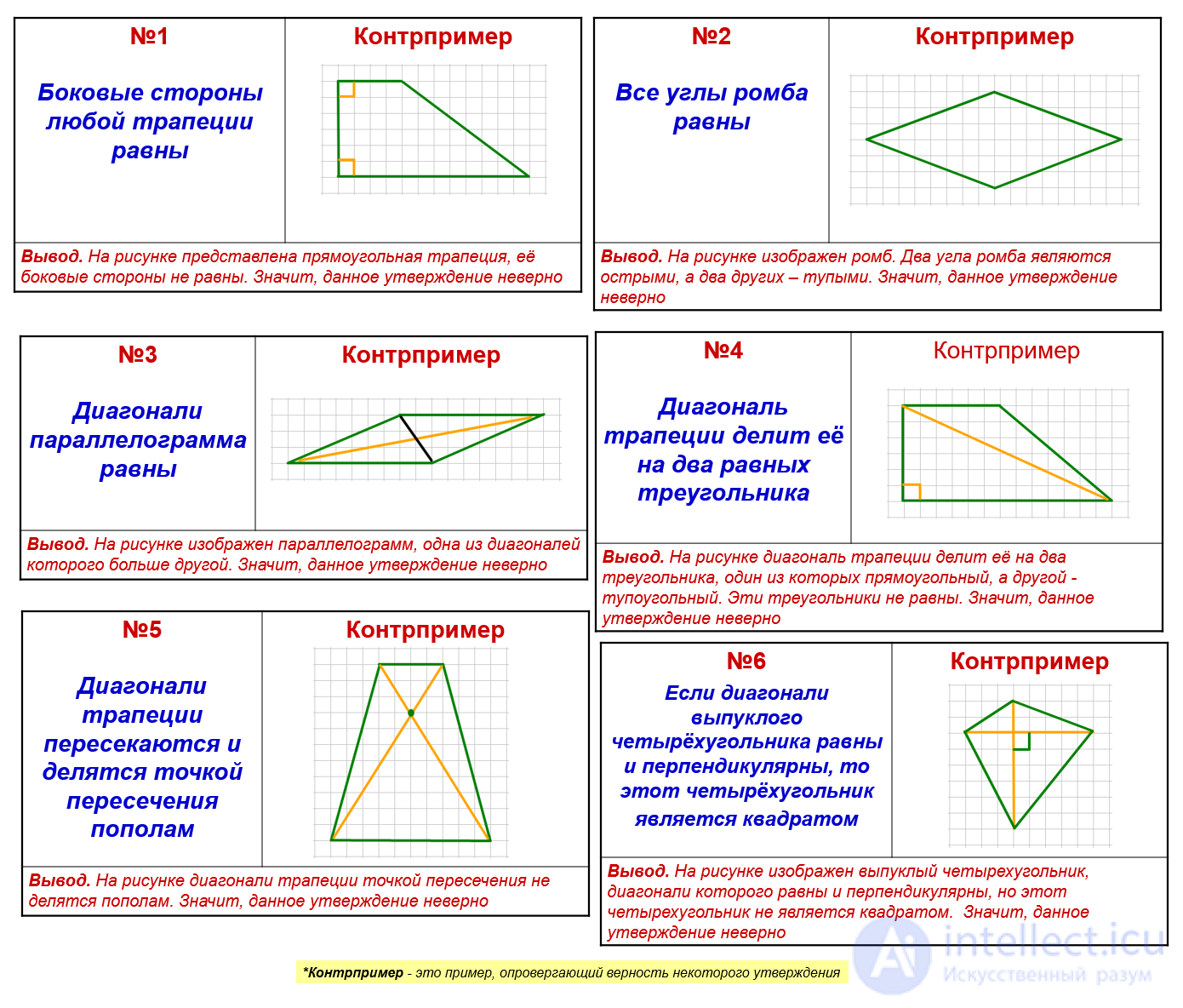
A counterexample to the statement «all prime numbers are odd numbers» is the number 2, since it is a prime number but is not an odd number. Neither 7 nor 10 is a counterexample, since neither of them is sufficient to contradict the statement. In this example, 2 is actually the only possible counterexample to the statement, although it alone is enough to contradict it. Similarly, the statement «All natural numbers are either prime or composite» has the number 1 as a counterexample, since 1 is neither prime nor composite.
Euler's sum of powers conjecture was disproved by a counterexample. It stated that in order to sum to another n-th power, at least n n-th powers are required. This conjecture was disproved in 1966 by a counterexample involving n = 5; other counterexamples for n = 5 are now known, as well as some counterexamples for n = 4.
The Witsenhausen counterexample shows that it is not always true (for control problems) that a quadratic loss function and a linear equation for the evolution of the state variable imply optimal control laws that are linear.
All isometries of the Euclidean plane are area-preserving mappings, but the converse is not true, as shown by counterexamples — the shear mapping and the squeeze mapping.
Other examples include refutations of the Seifert conjecture, the Pólya conjecture, the fourteenth problem of Hilbert conjecture, the Tait conjecture, and the Ganea conjecture.
In philosophy, counterexamples are usually used to prove that a certain philosophical position is incorrect by showing that it does not apply in certain cases. Alternatively, the original philosopher may modify their claim so that the counterexample no longer applies; this is analogous to how a mathematician modifies an assumption because of a counterexample.
For example, in Plato's «Gorgias», Callicles, trying to define what it means to say that some people are «better» than others, claims that those who are stronger are better. Socrates responds that, because of its numbers, the class of the common rabble is stronger than the wealthy nobility, even though the masses at first glance have a worse character. Thus, Socrates offered a counterexample to Callicles' claim by looking into an area that Callicles may not have expected — groups of people rather than individuals.
Callicles could challenge Socrates' counterexample by arguing that perhaps the common rabble really is better than the nobility, or that even in its numbers it is still not stronger. But if Callicles accepts the counterexample, then he must either withdraw his claim or modify it so that the counterexample no longer applies. For example, he could modify his claim so that it applies only to individual people, requiring him to think of common people as an aggregate of individuals rather than as a crowd. As it happens, he modifies his claim, saying «wiser» instead of «stronger», asserting that no numerical superiority can make people wiser.

Comments