
Lecture
The rules of the syllogism are divided into general and special.
General rules apply to all simple syllogisms, regardless of which figure they are constructed in.
Special rules hold only for each particular figure of the syllogism and are therefore often called the rules of the figures.
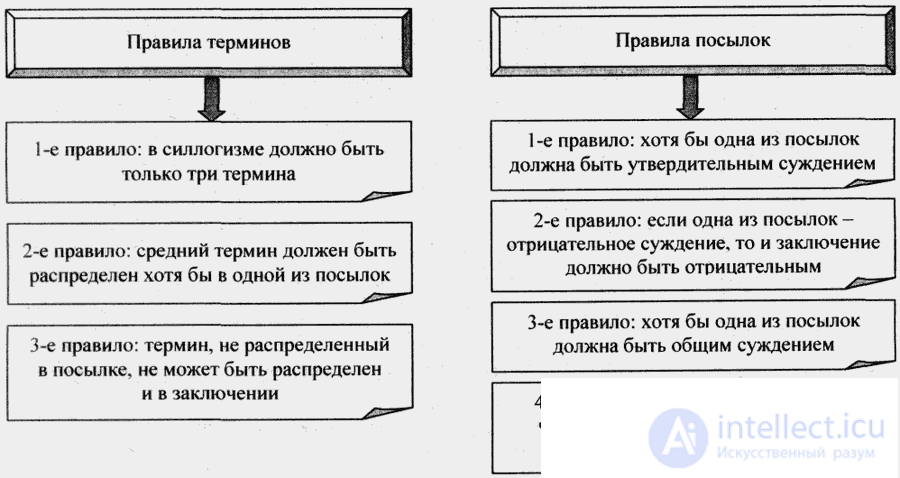
Let us consider the general rules of the syllogism:
1. A syllogism must have only three terms. Let us return to the previously mentioned example of a syllogism in which this rule is violated:
Motion is eternal. Going to school is motion. Going to school is eternal.
Both premises of this syllogism are true propositions, yet a false conclusion follows from them, because the rule under consideration has been violated. The word "motion" is used in the two premises in two different senses: motion as universal change in the world, and motion as the mechanical movement of a body from point to point. It turns out that the syllogism has three terms: motion, going to school, eternity, but four meanings (since one of the terms is used in two different senses), i.e. the extra meaning, as it were, implies an extra term. In other words, in the syllogism given there were not three but four terms (in meaning). The error that arises from violating the above rule is called the fallacy of four terms.
2. The middle term must be distributed in at least one of the premises. The distribution of terms in simple propositions was discussed in the previous chapter. Recall that the easiest way to establish the distribution of terms in simple propositions is by means of circle diagrams: one must depict the relations between the terms of the proposition with Euler circles, where a full circle on the diagram denotes a distributed term (+) and an incomplete one an undistributed term (–). Let us consider an example of a syllogism:
All cats (C) are living beings (L.b.). Socrates (S) is also a living being. Socrates is a cat.
A false conclusion follows from two true premises. Let us depict with Euler circles the relations between the terms in the premises of the syllogism and establish the distribution of these terms (Fig. 40):
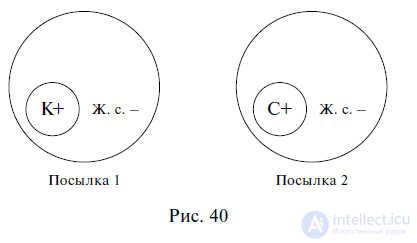
As we see, the middle term ("living beings") is in this case undistributed in both premises, whereas by the rule it must be distributed in at least one. The error that arises from violating the rule under consideration is called, quite simply, the undistributed middle term in each premise.
3. A term that was undistributed in a premise cannot be distributed in the conclusion. Let us turn to the following example:
All apples (A) are edible objects (E.o.). All pears (P) are not apples. All pears are inedible objects.
The premises of the syllogism are true propositions, and the conclusion is false. As in the previous case, let us depict with Euler circles the relations between the terms in the premises and in the conclusion of the syllogism and establish the distribution of these terms (Fig. 41):
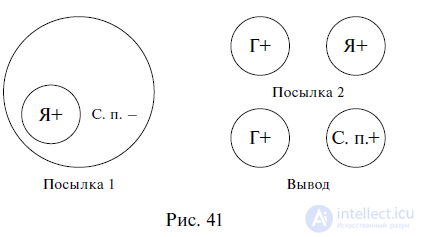
In this case the predicate of the conclusion, or the major term of the syllogism ("edible objects"), is undistributed (–) in the first premise but distributed (+) in the conclusion, which is forbidden by the rule under consideration. The error that arises from its violation is called the illicit major (illicit process of the major term). Recall that a term is distributed when all the objects included in it are spoken of, and undistributed when only some of the objects included in it are spoken of; this is precisely why the error is called an extension (illicit distribution) of the term.
4. A syllogism must not have two negative premises. At least one of the premises of a syllogism must be affirmative (both premises may be affirmative). If both premises in a syllogism are negative, then either no conclusion can be drawn from them at all, or, if one can be drawn, it will be false or, at the very least, unreliable and merely probable. For example:
Snipers cannot have poor eyesight. All my friends are not snipers. All my friends have poor eyesight.
Both premises in the syllogism are negative propositions, and, despite their truth, a false conclusion follows from them.
The error that arises in this case is called, quite simply, two negative premises.
5. A syllogism must not have two particular premises. At least one of the premises must be universal (both premises may be universal). If the two premises in a syllogism are particular propositions, no conclusion can be drawn from them. For example:
Some schoolchildren are first-graders. Some schoolchildren are tenth-graders.
No conclusion follows from these premises, because both of them are particular. The error that arises from violating this rule is called, quite simply, two particular premises.
6. If one of the premises is negative, the conclusion must also be negative. For example:
No metal is an insulator. Copper is a metal. Copper is not an insulator.
As we see, an affirmative conclusion cannot follow from the two premises of this syllogism. It can only be negative.
7. If one of the premises is particular, the conclusion must also be particular. For example:
All hydrocarbons are organic compounds. Some substances are hydrocarbons. Some substances are organic compounds.
In this syllogism a universal conclusion cannot follow from the two premises. It can only be particular, since the second premise is particular.
1. What are the general rules of the syllogism?
2. What are the general rules of the simple syllogism? Give two examples of each of the following errors: fallacy of four terms, undistributed middle term in the premises, illicit major, two negative premises.
3. Are any general rules (and which) violated in the following syllogisms:
1) All herbivores eat plant food. All tigers do not eat plant food. All tigers are not herbivores.
2) All straight-A students do not get failing grades. My friend is not a straight-A student. My friend gets failing grades.
3) All fish swim. All whales also swim. All whales are fish.
4) The bow is an ancient weapon for shooting. One of the vegetable crops is the onion. One of the vegetable crops is an ancient weapon for shooting.
5) Any metal is not an insulator. Water is not a metal. Water is an insulator.

Comments