
Lecture
Incomplete induction — is an inference in which, on the basis of a feature belonging to some elements or parts of a class, a conclusion is drawn about its belonging to the class as a whole.
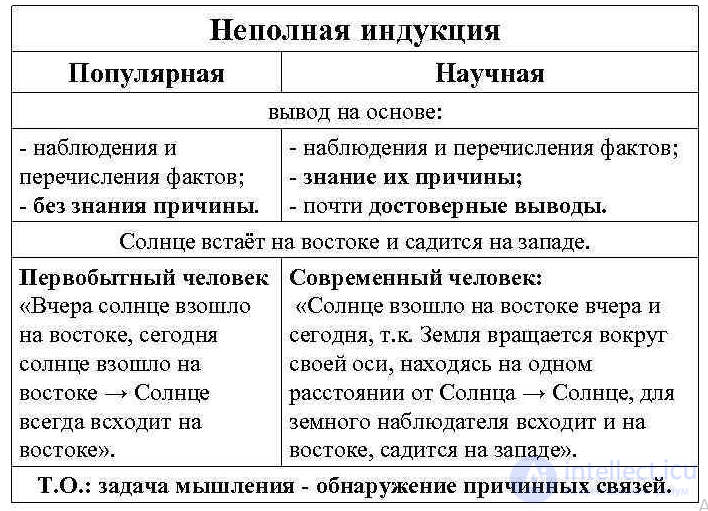
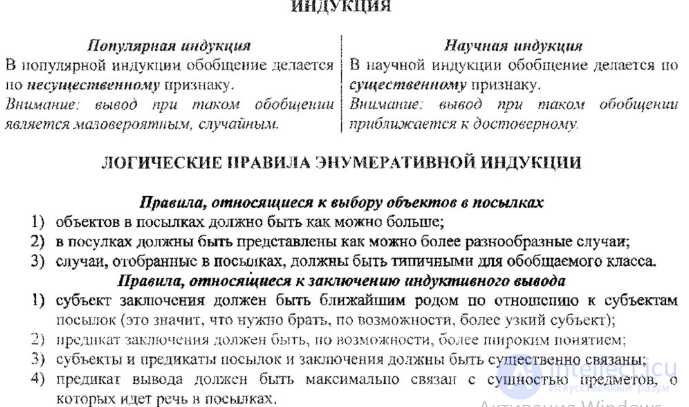
The incompleteness of an inductive generalization is expressed in the fact that not all, but only some elements or parts of a class are examined. The logical transition in incomplete induction from some to all elements or parts of a class is not arbitrary. It is justified by empirical grounds — the objective dependence between the universal nature of features and their stable recurrence in experience for a certain kind of phenomena. Hence the wide use of incomplete induction in practice. Thus, for example, during the sale of a certain product, conclusions are drawn about demand, market price and other characteristics of a large batch of this product on the basis of the first sample deliveries. In production conditions, sample specimens are used to draw conclusions about the quality of one or another mass product, for example, oil, sheet metal, wire, milk, groats, flour — in the food industry.
The inductive transition from some to all cannot claim logical necessity, since the recurrence of a feature may turn out to be the result of a simple coincidence.
Thus, incomplete induction is characterized by a weakened logical inference — true premises provide not a reliable but only a problematic conclusion. At the same time, the discovery of even one case contradicting the generalization makes the inductive conclusion untenable.
On this basis, incomplete induction is classified as plausible (non-demonstrative) inferences. In such conclusions, the conclusion follows from true premises with a certain degree of probability, which can range from improbable to highly plausible.
A significant influence on the nature of logical inference in the conclusions of incomplete induction is exerted by the method of selecting the source material, which manifests itself in the methodicalness or systematicity of forming the premises of the inductive inference. According to the method of selection, two types of incomplete induction are distinguished: (1) induction by enumeration, which has come to be called popular induction, and (2) induction by selection, which is called scientific induction.
Popular induction is the term for a generalization in which, by enumeration, the belonging of a feature to some objects or parts of a class is established, and on this basis it is problematically concluded that it belongs to the whole class.
In the course of centuries-long activity, people observe the stable recurrence of many phenomena. On this basis, generalizations arise that are used to explain past events and predict future events and phenomena. Generalizations of this kind are usually associated with observations of the weather, the influence of price on quality, and demand on supply. The logical mechanism of most such generalizations is popular induction. It is sometimes called induction through simple enumeration.
The recurrence of features in many cases does indeed reflect universal properties of phenomena. Generalizations built on this basis perform an important function as guiding principles in people's practical activity. Without such simple generalizations, no kind of labor activity is possible, whether it be the improvement of tools, the development of navigation, the successful conduct of agriculture, or contacts between people in the social environment.
Popular induction determines the first steps in the development of scientific knowledge as well. Any science begins with empirical research — observation of the relevant objects with the aim of describing, classifying, and identifying stable connections, relations and dependencies. The first generalizations in science owe their existence to the simplest inductive conclusions made by simply enumerating recurring features. They perform an important heuristic function as initial assumptions, conjectures and hypothetical explanations that need further verification and refinement.
A purely enumerative generalization already arises at the level of the adaptive-reflex reactions of animals, when recurring stimuli reinforce a conditioned reflex. At the level of human consciousness, a recurring feature in homogeneous phenomena does not simply give rise to a reflex or a psychological feeling of expectation, but suggests the idea that recurrence is not the result of a purely random coincidence of circumstances, but the manifestation of some undetected dependencies. The soundness of conclusions in popular induction is determined mainly by a quantitative indicator: the ratio of the studied subset of objects (the sample) to the whole class (the population). The closer the studied sample is to the whole class, the more well-founded, and hence the more probable, the inductive generalization will be.
Under conditions where only some representatives of a class are studied, the possibility of an erroneous generalization is not excluded. An example of this is the generalization “All swans are white,” obtained by means of popular induction and current in Europe for a long time. It was built on the basis of numerous observations in the absence of contradicting cases. After Europeans who landed in Australia in the 17th century discovered black swans, the generalization turned out to be refuted.
Erroneous conclusions in the results of popular induction can arise due to a failure to observe the requirement of taking into account contradicting cases, which render a generalization untenable.
Erroneous inductive conclusions can arise not only as a result of error, but also through dishonest, biased generalization, when contradicting cases are consciously ignored or concealed.
Incorrectly constructed inductive statements often lie at the basis of various kinds of superstitions, ignorant beliefs and omens such as the “evil eye,” “good” and “bad” dreams, a black cat crossing one's path, and so on.
Scientific Induction
Scientific induction is the term for an inference in which a generalization is constructed by selecting necessary circumstances and excluding accidental ones.
Depending on the methods of investigation, a distinction is made between: (1) induction by the method of selection and (2) induction by the method of exclusion (elimination).
Induction by the method of selection, or selective induction, — is an inference in which the conclusion about a feature's belonging to a class (set) is based on knowledge of a sample (subset) obtained by methodically selecting phenomena from various parts of that class.
The concept of diversity of conditions of observation turns out to be quite different for specific kinds of sets. In one case it takes the character of spatial diversity of type, in another — temporal, in a third — functional, in a fourth — mixed.
An example of induction by the method of selection can be the following line of reasoning about students' knowledge of logic. Thus, having chosen four students from the back rows out of 25 students, one can note that not one of them showed any knowledge. If a generalization is made on this basis that the whole group has no knowledge of logic at all, then it is obvious that such popular induction will yield an improbable conclusion.
It is another matter if the selection of the same number of students is made not from the back desks, but taking into account different seating locations and the presence of an intelligent face. If female students from the first and last desks, with glasses and without, are chosen, then it can be assumed with high probability that the whole group has extensive knowledge of such a fascinating subject as logic.
A reliable conclusion in this case is hardly likely to be well-founded, since the possibility of ignorance of the subject on the part of students who were not directly questioned is not excluded.
Induction by the Method of Exclusion
Induction by the method of exclusion, or eliminative induction, — is a system of inferences in which conclusions about the causes of the phenomena under study are constructed by discovering confirming circumstances and excluding circumstances that do not satisfy the properties of causal connection.
The cognitive role of eliminative induction is the analysis of causal connections. A connection between two phenomena is called causal when one of them — the cause — precedes and produces the other — the effect. The most important properties of a causal connection, which predetermine the methodical character of eliminative induction, are the following characteristics: (1) universality, (2) sequence in time, (3) necessity, and (4) unambiguity.
(1) The universality of a causal connection means that there are no uncaused phenomena in the world. Every phenomenon has its own cause, which may be discovered sooner or later in the process of research.
(2) Sequence in time means that the cause always precedes the effect. In some cases the effect follows the cause instantly, within fractions of a second. For example, a shot from a firearm occurs the instant the primer ignites in the cartridge. In other cases the cause produces the effect after a longer interval of time. For example, demand for a product may change its price after several hours, days, or months, depending on the volume of demand and the elasticity of supply. In the social sphere, causal connections may take effect over many months and years, and in geology — over centuries and millennia.
Since the cause always precedes the effect, out of many circumstances in the process of inductive research only those are selected which appeared earlier than the effect of interest to us, and those which arose simultaneously with it or appeared after it are excluded from consideration (eliminated).
Sequence in time is a necessary condition of causal connection, but by itself it is not sufficient for discovering the actual cause. Recognizing this condition as sufficient often leads to an error called “after this, therefore because of this”. The volume of production, for example, used to be regarded as the cause of the determination of price, because cost is perceived later than quantity, although these are events that occur simultaneously.
(3) Causal connection is distinguished by the property of necessity. This means that the effect can occur only in the presence of the cause; the absence of the cause necessarily leads to the absence of the effect.
(4) The unambiguous character of causal connection is manifested in the fact that each specific cause always produces a quite definite effect corresponding to it. The dependence between cause and effect is such that changes in the cause necessarily entail changes in the effect, and conversely, changes in the effect serve as an indicator of a change in the cause.
The noted properties of causal dependence perform the role of cognitive principles that rationally guide inductive research and form special methods of establishing causal connections.
The application of methods of eliminative induction is associated with a certain simplification of the real interconnections between phenomena, which is expressed in the following assumptions. Each of the circumstances is considered relatively independent and does not interact with the others. The identified circumstances are regarded as a complete list of them, and it is assumed that the researcher has not overlooked any other circumstances.
These assumptions, combined with the basic properties of causal connection, form the methodological basis for the conclusions of eliminative induction, determining the specific nature of logical inference when applying the methods of establishing causal connections.
A great contribution to the development of the methods of eliminative induction was made by natural scientists and philosophers: F. Bacon, J. Herschel, and J. S. Mill.
The Difference Between Scientific Induction and Popular Induction
The differences, at a minimum, are built on the principles of organization of the methods of these types of induction. Scientific induction is based on facts that exclude chance occurrences and any unverified data. Popular induction is a form of inference in which a conclusion is drawn about an entire phenomenon, class, or the nature of something on the basis of just one feature, occurrence, or nuance of that class. Put simply, having carried out a logical process consisting in arriving at a new judgment, a person following popular induction draws a conclusion about the entire system on the basis of one or two facts. This may not always be an objective and comprehensive conclusion and may not always reveal all the nuances, aspects and the full range of the given question. In principle, one can say that an erroneous opinion sometimes forms — a judgment that may be radically opposed to the truth. And yet scientific induction, too, does not claim to be the most infallible method. Rather, to arrive at the truth, one must use a set of methods and a many-sided study of the problem.
Methods of Scientific Induction
Modern logic describes five methods of establishing causal connections: (1) the method of agreement, (2) the method of difference, (3) the joint method of agreement and difference, (4) the method of concomitant variations, (5) the method of residues.
Let us examine the logical structure of these methods.
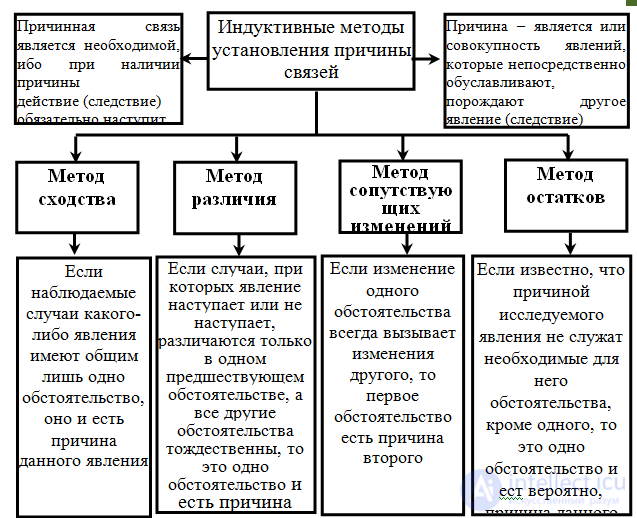
By the method of agreement, several cases are compared, in each of which the phenomenon under study occurs; at the same time all the cases are similar in only one respect and differ in all other circumstances.
The method of agreement is called the method of finding the common in the different, since all the cases are noticeably different from one another except for one circumstance.
The logical mechanism of inductive inference by the method of agreement presupposes a number of cognitive prerequisites.
(1) General knowledge of the possible causes of the phenomenon under study is required.
(2) From the antecedent circumstances, all circumstances that are not necessary for the effect under study must be excluded (eliminated), and thus fail to satisfy the basic property of causal connection.
(3) Among the multitude of antecedent circumstances, the similar and recurring one is singled out in each of the cases considered, which will be the probable cause of the phenomenon.
In general form, the logical mechanism of the inductive method of agreement takes the form of deductive reasoning according to the modus tollendo ponens of a disjunctive-categorical inference.
The soundness of the conclusion obtained with the help of the method of agreement depends on the number of cases considered and the diversity of the conditions of observation. The more cases studied and the more diverse the circumstances among which the similarity occurs, the more well-founded the inductive conclusion and the higher the degree of probability of the conclusion. The incompleteness of experience characteristic of incomplete induction is manifested in the fact that observation and experiment do not guarantee exact and complete knowledge of the antecedent circumstances among which the search for a possible cause takes place.
Despite the problematic nature of the conclusion, the method of agreement performs an important heuristic function in the process of cognition: it contributes to the construction of fruitful hypotheses, the testing of which leads to the discovery of new truths in science.
A reliable conclusion can be obtained by the method of agreement only if the researcher knows precisely all the antecedent circumstances, which constitute a closed set of possible causes, and also knows that each of the circumstances does not interact with the others. In this case inductive reasoning acquires demonstrative significance.
By the method of difference, two cases are compared, in one of which the phenomenon under study occurs, and in the other it does not; at the same time the second case differs from the first in only one circumstance, while all others are similar.
The method of difference is called the method of finding the different in the similar, for the cases being compared coincide with one another in many properties.
The method of difference is applied both in the process of observing phenomena under natural conditions and under conditions of laboratory or industrial experiment. In the history of economics, many laws were discovered by the method of difference (the law of diminishing marginal utility). In agricultural production, this method is used, for example, to test the effectiveness of fertilizers.
Reasoning by the method of difference also presupposes a number of prerequisites.
(1) General knowledge of the antecedent circumstances is required, each of which could be the cause of the phenomenon under study.
(2) From the members of the disjunction, circumstances that do not satisfy the condition of sufficiency for the effect under study should be excluded.
(3) Among the multitude of possible causes, a single circumstance remains, which is regarded as the actual cause.
The logical mechanism of inference by the method of difference likewise takes the form of the modus tollendo ponens of a disjunctive-categorical inference.
Reasoning by the method of difference acquires demonstrative knowledge only if there is exact and complete knowledge of the antecedent circumstances constituting a closed disjunctive set.
Since under the conditions of empirical cognition it is difficult to lay claim to an exhaustive statement of all circumstances, conclusions by the method of difference in most cases yield only problematic conclusions.
By the admission of many researchers, the most plausible inductive conclusions are achieved by the method of difference.
This method represents a combination of the first two methods, when, by analyzing a multitude of cases, one discovers both the similar in the different and the different in the similar.
As an example, let us return to the above line of reasoning by the method of agreement about the causes of illness in three students. If this reasoning is supplemented by an analysis of three new cases, in which the same circumstances are repeated except for the similar one — that is, the same foods were consumed except for beer, and no illness was observed — then the conclusion will proceed in the form of the joint method.
The probability of the conclusion in such a more complex line of reasoning increases noticeably, for the advantages of the method of agreement and the method of difference are combined, each of which taken separately yields less reliable results.
This method is applied in the analysis of cases in which there is a variation of one of the antecedent circumstances, accompanied by a variation of the effect under study.
The preceding inductive methods were based on the recurrence or absence of a certain circumstance. However, not all causally connected phenomena admit of the neutralization or replacement of individual constituent factors. For example, in studying the influence of demand on supply, it is in principle impossible to exclude demand itself. In the same way, in determining the influence of the Moon on the magnitude of ocean tides, it is impossible to change the mass of the Moon.
The only way to discover causal connections under such conditions is to record, in the process of observation, the concomitant variations in the antecedent and subsequent phenomena. The cause in this case is the antecedent circumstance whose intensity or degree of change coincides with the change in the effect under study.
The application of the method of concomitant variations likewise presupposes the observance of a number of conditions:
(1) Knowledge of all possible causes of the phenomenon under study is necessary.
(2) Of the circumstances presented, those that do not satisfy the property of unambiguity of causal connection must be eliminated.
(3) Among the antecedent circumstances, the single circumstance whose change accompanies the change in the effect is singled out.
Concomitant variations can be direct or inverse. Direct dependence means: the more intense the manifestation of the antecedent factor, the more actively the phenomenon under study manifests itself, and conversely — as the intensity falls, the activity or degree of manifestation of the effect decreases correspondingly. For example, as demand for a product rises, supply increases; as demand falls, supply decreases correspondingly. In the same way, as solar activity increases or decreases, the level of radiation under terrestrial conditions correspondingly rises or falls.
Inverse dependence is expressed in the fact that an intense manifestation of the antecedent circumstance slows the activity or reduces the degree of change of the phenomenon under study. For example, the greater the supply, the lower the cost of the product, or the higher the productivity of labor, the lower the cost of production.
The logical mechanism of inductive generalization by the method of concomitant variations takes the form of deductive reasoning according to the modus tollendo ponens of a disjunctive-categorical inference.
The soundness of the conclusion in an inference by the method of concomitant variations is determined by the number of cases considered, the precision of the knowledge about the antecedent circumstances, as well as the adequacy of the changes in the antecedent circumstance and the phenomenon under study.
As the number of compared cases demonstrating concomitant variations increases, the probability of the conclusion grows. If the set of alternative circumstances does not exhaust all possible causes and is not closed, then the conclusion in the inference is problematic rather than reliable.
The soundness of the conclusion also depends largely on the degree of correspondence between the changes in the antecedent factor and the effect itself. Not just any changes are taken into account, but only those that increase or decrease proportionally. Those that do not exhibit one-to-one regularity often arise under the influence of uncontrolled, random factors and may mislead the researcher.
Reasoning by the method of concomitant variations is applied in identifying not only causal but also other, for example functional connections, when a dependence is established between the quantitative characteristics of two phenomena. In this case, it becomes important to take into account the scale of intensity of changes characteristic of each kind of phenomenon, within which quantitative changes do not alter the quality of the phenomenon. In any case, quantitative changes have a lower and an upper limit, which are called limits of intensity. In these boundary zones the qualitative characteristic of the phenomenon changes, and thus deviations may be revealed when applying the method of concomitant variations.
For example, a decrease in the price of a product as demand falls continues to a certain point, after which the price increases with a further fall in demand. Another example: medicine is well acquainted with the therapeutic properties of preparations containing poisons in small doses. As the dose increases, the usefulness of the preparation grows only up to a certain limit. Beyond the scale of intensity, the preparation acts in the opposite direction and becomes dangerous to health.
Any process of quantitative change has its critical points, which must be taken into account when applying the method of concomitant variations, which is effective only within the scale of intensity. Using the method without taking into account the boundary zones of quantitative change can lead to logically incorrect results.
The application of this method is associated with establishing the cause producing a certain part of a complex effect, provided that the causes producing the other parts of that effect have already been identified.
The method of residues was used to draw the conclusion that certain chemical elements exist — helium, rubidium, and others. The assumption was based on results obtained in the process of spectral analysis: new lines were discovered that did not belong to any of the already known chemical elements.
Like other inductive conclusions, the method of residues, as a rule, yields problematic knowledge. The degree of probability of the conclusion in such an inference is determined, first, by the precision of knowledge about the antecedent circumstances among which the search for the cause of the phenomenon under study takes place, and second, by the precision of knowledge about the degree of influence of each of the known causes on the cumulative result. An approximate and inexact list of antecedent circumstances, as well as an inexact idea of the influence of each of the known causes on the cumulative effect, may lead to a situation in which the conclusion of the inference presents, as the unknown cause, not a necessary but merely an accompanying circumstance.
Reasoning by the method of residues is often used in the process of criminal investigation, mainly in those cases where a clear disproportion between causes and the effects under study is established. If an effect, in its scope, scale or intensity, does not correspond to a known cause, then the question arises of the existence of some other circumstances.
The methods of establishing causal connections examined here belong, in their logical structure, to complex reasonings, in which the inductive generalizations themselves are constructed with the participation of deductive conclusions. Relying on the properties of causal connection, deduction serves as the logical means of elimination (exclusion) of accidental circumstances, thereby logically correcting and directing the inductive generalization.
The interconnection of induction and deduction ensures the logical soundness of reasoning in the application of these methods, while the precision of the knowledge expressed in the premises determines the degree of soundness of the conclusions obtained.
Exercises
1. Determine by which method of scientific induction the following
generalization was obtained:
As a result of three checks of student attendance at lectures under different circumstances, the following was obtained:
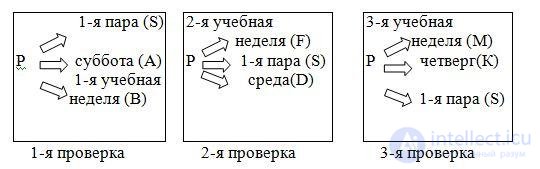
Conclusion: The first period (S) is the cause of poor attendance (P). The first check was during the first period, on Saturday, in the first week of classes. The second check was in the second week of classes, during the first period, on Wednesday. The third check was in the third week of classes, on Thursday, during the first period.
Conclusion: in all three cases of checking, the common circumstance is – the first period.
This message was obtained by the method of agreement of scientific induction, since here several cases are compared, in each of which the phenomenon under study occurs; at the same time all the cases are similar in only one respect and differ in all other circumstances – the first period was present everywhere, while the weeks of study and the days of the week changed.
2. Use inductive reasoning to answer the question: «Which of the well-known directors did not appear in his own films: N. Mikhalkov, G. Danelia, E. Ryazanov, A. Tarkovsky?» What kind of induction is this?
Induction is a form of logical inference from a particular position to a general one. In this case, it presumably means that one must consider particular cases (individual directors), and then draw a general conclusion.
Mikhalkov appeared in his own films ("A Slave of Love..." ["Svoy sredi chuzhikh..."], "Burnt by the Sun"), Danelia appeared ("I Walk Around Moscow," "Mimino"), Ryazanov appeared ("The Irony of Fate...", "The Garage," and others). Consequently, of the directors listed, the one who did not appear in his own pictures can only be Tarkovsky.

Comments