
Lecture
Logical form is the way in which the constituent parts of the content of a thought are connected, as distinct from that content itself — the result of abstraction from the content of the thought, that is, from which particular individuals, properties, relations, classes, situations, and the like are the subjects of the given thought. The procedure of replacing individual descriptive components of the linguistic context that expresses the given thought with variables (parameters) is regarded as the mechanism of such abstraction.
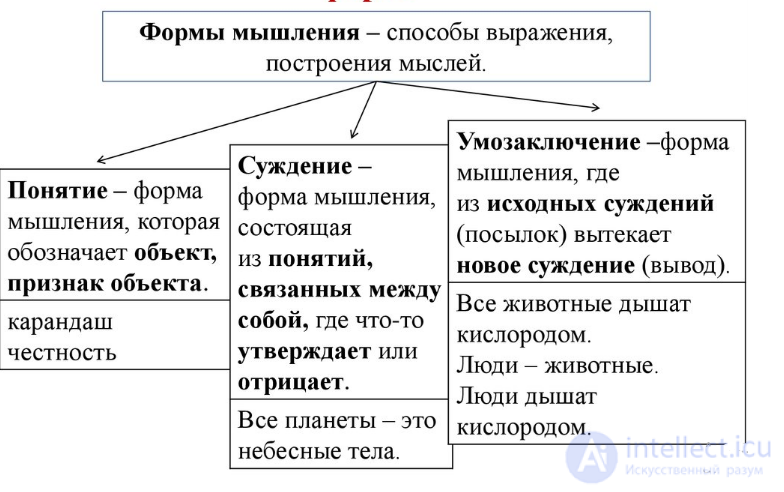
This intuitive notion of logical form receives serious refinement in modern logic (see Logic). It is held that the analysis of the form of conceptual constructs (concepts, judgments, inferences, and the like) cannot be carried out outside of language and depends substantially on the choice of linguistic means. It is assumed that mental constructs are adequately formulated as meaningful expressions of natural language. To fix their logical form, special artificial languages of logic are used which, firstly, must have a precise syntax, that is, a precisely specified alphabet and rules for forming complex expressions, and, secondly, must be based on a definite system of semantic categories with a clear division of the initial symbols into logical and non-logical ones, an indication of the types of possible values for various sorts of non-logical symbols, a fixing of the values of logical symbols, and a formulation of precise semantic rules for determining the values of complex expressions.
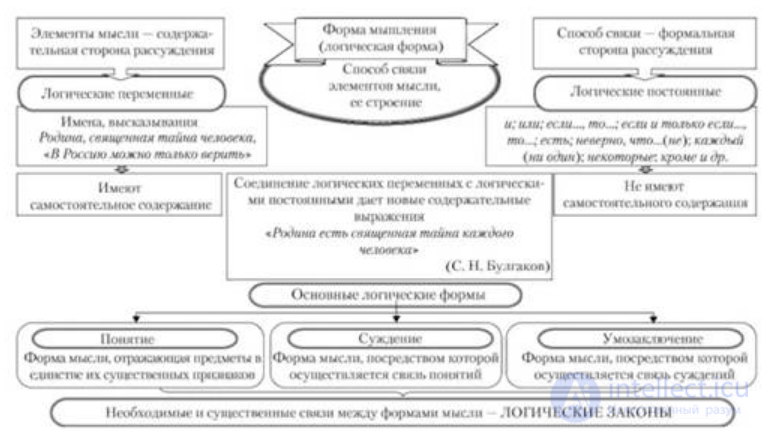
Fig. 1.3. The concept of the form of thinking (logical forms)
The procedure of identifying the logical form of a thought can be regarded as the process of translating the natural-language context expressing the thought into an artificial logical language — a formalized language. In this translation, descriptive terms, or entire simple statements within the original context, are replaced by non-logical symbols (parameters) of the artificial language belonging to the corresponding semantic categories, with identical expressions being replaced by identical symbols, and different ones — by different ones, and with the order and manner of connection of the descriptive components being reproduced in accordance with the syntactic rules of the logical language. The expression obtained as a result of this procedure is precisely what fixes the logical form of the thought. It cannot be regarded as devoid of content: it contains information expressed by logical terms, as well as information about the categories of the descriptive terms of the original context, about their identity and difference, and about the specifics of their combination.
Logical form should not be treated as something given once and for all, as an attribute inherent in a thought as such. Its study is largely determined by the categorial features of the artificial language, its expressive possibilities, and the accepted way of dividing complex expressions into components. The analysis of logical form can have varying degrees of depth. Thus, when expressing the form of natural-language contexts in the language of propositional logic (see Propositional logic), simple statements are replaced by parameters of the corresponding type — propositional variables, so that the internal structure of simple statements is ignored. The expressive resources of the languages of syllogistics (see Syllogistics) and predicate logic (see Predicate logic) make it possible to take internal structure into account; here it is not entire simple statements but the descriptive terms within them that undergo the substitution procedure. However, these languages are based on different systems of semantic categories (in ordinary syllogistics there is only one type of non-logical term — general terms, signs of classes, whereas predicate logic contains parameters for signs of individuals, properties, relations, and propositional functions), so there is a substantial difference between them in the character and depth of the reproduction of logical form. Thus, the form of the statement «All planets revolve around the Sun» can be expressed in syllogistic language by the formula S a P («Every S is P»), where the parameters S and P replace the general terms «planet» and «body revolving around the Sun», and the statement itself is regarded as attributive. In the language of predicate logic it is possible to convey the relational character of this statement by expressing its logical form by means of the formula ∀x (Q1 (x) ⊃ R2 (x, a)), where the parameter Q1 corresponds to the sign of the property «being a planet», R2 — to the sign of the relation «revolves around», and a — to the name «the Sun».
The refinement of the concept of logical form within the theory of semantic categories is contained, in particular, in the work of E. D. Smirnova, «Formalized Languages and Problems of Logical Semantics» (1982), in which a distinction is drawn between the concept of first-level logical form, which results from replacing the primitive signs within an expression with indices of the corresponding categories and which can be represented in the form of a graph, and second-level logical form, represented in the form of a generalized tree that contains information about the identity and difference of the descriptive components and about the meaning of the logical constants.
The concept of logical form is one of the most fundamental in logic, since the distinctive feature of its subject matter — the study of mental phenomena, cognitive procedures, and language from the point of view of their structure, their form. The definitions of such crucially important logical terms as «valid deductive inference», «logically true statement», and others rely substantially on the concept of logical form. The laws of logical theories (see Laws of logic) are nothing other than logical forms of natural-language statements that take the value «true» under any admissible interpretation of the descriptive symbols.
What are logical forms? Consider the following arguments:
1) If a = b, then a2 = b2. Therefore, if a2 ≠ b2, then a ≠ b.
2) If an electric current flows through a conductor, then an electromagnetic field forms around the conductor. Therefore, if no electromagnetic field forms around the conductor, then no electric current flows through it.
These arguments have different content, but they are united by a common construction scheme, or logical form.
Let X and Y – variables in place of which a specific value in the form of a declarative sentence can be substituted. The logical form of our two sentences is as follows:
If X, then Y
Therefore, if not Y, then not X
Logic is concerned above all with logical truths, or logical laws.
Such, for example, is the form considered above.
But, for instance, the form
If X, then Y
Therefore, if not X, then not Y
Is not a logical truth.
Example.
Substituting the sentence "a = b" for X, and the sentence "a2 = b2" for Y, we get:
If a = b, a2 = b2. Therefore, if a ≠ b, then a2 ≠ b2
But: 2 ≠-2, and 22 = (-2)2. Contradiction!
Determine which of the following sentences have the same logical form:
1) Ivanov won the chess tournament and became champion
2) It is not true that the capital of Belarus is not Minsk
3) If a quadrilateral is a parallelogram, then its diagonals bisect each other
4) It is not true that ergot does not contain poison
5) If a = b, then a2 = b2
6) My friend finished college and received an engineering degree
7) If the diagonals of a rectangle, on intersecting, do not bisect each other, then this quadrilateral is not a parallelogram
8) If a ≠ b, then a2 ≠ b2
The sentences with the same logical structure are
1-6
2-4
3-5
7-8
If the argument «If all men are mortal, and all Greeks – men, then all Greeks are mortal» is valid, are the following arguments valid? (the answers can be seen at the end of the test by clicking the "click here" button)
1) If all squares are similar, and all trapezoids – squares, then all trapezoids are similar.
2) If all dragons are cunning, and all lizards are dragons, then all lizards are cunning
3) If all glocky kuzdras are fierce, and all bokrs – glocky kuzdras, then all bokrs are fierce

Comments