
Lecture
Logical equivalence or equivalence (or equivalency) is a logical expression that is true when both simple logical expressions have the same truth value. This binary logical operation is usually denoted by the symbol ≡ or ↔.
Equivalence  is a shorthand notation for the expression
It is defined by the following truth table:
 |
 |
 |
|---|---|---|
| 0 | 0 | 1 |
| 1 | 0 | 0 |
| 0 | 1 | 0 |
| 1 | 1 | 1 |
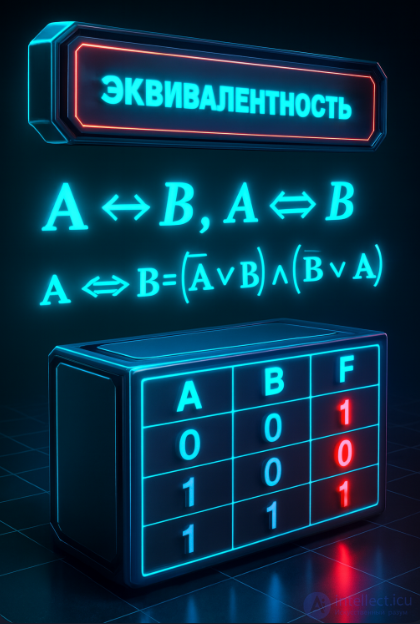
Thus, the statement A ≡ B means «A is the same as B», «A is equivalent to B», «A if and only if B».
Equivalence — the logical operation — should not be confused with the logical equivalence of statements, which is a binary relation. The connection between them is as follows:
Logical expressions A and B are equivalent if and only if the equivalence
The inverse of equivalence is exclusive «or».
Logical equality is a logical operator that compares two truth values, or, more generally, two formulas, in such a way that it returns the value «True» if both arguments have the same truth value, and «False» if they differ. In the case where the formulas contain free variables, we say that the two formulas are equal when their truth values are equal for all possible resolutions of the free variables. This corresponds to equality in Boolean algebra and to the logical biconditional in propositional calculus.
In various applications it is customary, though not always technically precise, to denote the operation of logical equality over logical operands x and y using any of the following forms:
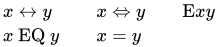
However, some logicians draw a clear distinction between the functional form, such as that shown in the left column, which they interpret as the application of a function to a pair of arguments (and thus simply an indication that the value of the compound expression depends on the values of the constituent expressions), and the equational form, such as that shown in the right column, which they interpret as an assertion that the arguments have equal values, in other words, that the functional value of the compound expression is true.
In mathematics, the sign «+» almost always denotes an operation satisfying the axioms given for addition in an algebraic structure known as a field. For Boolean algebra, this means that the logical operation denoted by «+» is not identical to inclusive disjunction, denoted by «∨», but is in fact equivalent to the logical inequality operator, denoted by «≠», or, equivalently, to exclusive disjunction, denoted by «XOR» or «⊕». Naturally, these differences in usage have over the years led to some communication failures between mathematicians and switching engineers. In any case, there exists the following set of corresponding forms for the symbols associated with logical inequality:
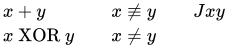
This explains why «EQ» is often called «XNOR» in the combinational logic of circuit design engineers, since it is the negation of the XOR operation; «NXOR» is a less common alternative. Another explanation, certainly of the complicated name «XNOR», is that it starts from the NOR operator «both false», to which is then added the exception «or both true».

Comments