
Lecture
The content of a concept is the totality of those properties that belong to all the objects designated by the given concept, and only to them.
For example, sclerosis is, as is well known, a hardening of some organs caused by the death of the elements specific to those organs and their replacement by connective tissue. These properties make up the content of the concept "sclerosis." They allow us, in any situation, to decide whether the changes that have occurred in an organ can be called sclerosis or not. The content of the concept "chair" consists of the properties of being a piece of furniture intended for sitting and of having legs, a seat and a back. These properties, relating to the function and structure of a chair, are possessed by every chair and by nothing else. If we remove one of the structural parts of a chair, say the back, we get the content of a different concept ("stool"). The content of the concept "table" includes the features of being a piece of furniture intended for sitting at, and of having legs and a top.
Besides content, or meaning, a concept also has an extension.
The extension of a concept — is the totality, or class, of those objects that possess the features included in the content of the concept.
For example, the extension of the concept "sclerosis" includes all cases of sclerotic change in organs, in particular sclerosis of the brain. The extension of the concept "chair" includes all chairs, and the extension of the concept "table" all tables. It is easy to notice that the extensions even of such simple concepts as "chair" and "table" are indefinite and blurred, and therefore these names themselves belong to the imprecise ones.
Concepts stand in various relations to one another. Between the extensions of any two concepts that it makes some sense to compare with each other, one and only one of the following relations holds: equivalence, intersection, subordination (two variants) and exclusion.
Equivalence — is a relation between concepts whose extensions coincide completely.
In other words, equivalent concepts refer to the same class of objects, but do so in different ways. For example, the concepts "square" and "equilateral rectangle" are equivalent: every square is an equilateral rectangle, and vice versa.
Equivalence means that the extensions of two concepts coincide, but not their contents. For example, the extensions of the concepts "son" and "grandson" coincide (every son is someone's grandson and every grandson is someone's son), but their contents differ.
The relations between the extensions of concepts can be represented geometrically and visually by means of circle diagrams. They are named after the eighteenth-century Russian mathematician L. Euler, "Euler circles." Each point of a circle represents one object included in the extension of the concept under consideration. Points outside the circle represent objects that do not fall under this concept.
Logical operations with concepts — and let us pay special attention to this — are often supplemented and reinforced by a special device called the method of Euler-Venn diagrams . These diagrams are sometimes called "circle diagrams." With this device one can visually depict the relations between the extensions of the concepts being compared. The famous mathematician L. Euler (1707-1783) was the first to apply this method systematically in logic, but circular depictions of the extensions of concepts were already used in the 6th century AD in the Athenian Neoplatonic school by the mathematician Philoponus .
The essence of this method is that the circle drawn conventionally includes the objects represented by some concept, and each of these objects is denoted inside this circle by a point . Such a circle may include another circle, of smaller diameter, and this means that the generic concept (the larger circle) includes the specific concept (the smaller circle).
Later the English logician John Venn (1834-1923) extended this method to all kinds of logical relations, and the depictions themselves came to be drawn not only as circles but also as, say, ellipses.
The extensions of a generic and a specific concept may either coincide with each other (see Fig. 1) or not coincide with each other (see Fig. 2). Illustrations here may be, respectively, the following statements: "Every person (A) has the right to citizenship (B) " (see Fig. 1) and "All investigators (A) are lawyers (B) " (see Fig. 2).
In cases where the extensions of two concepts coincide only partially, the relation between the extensions of such concepts is depicted by overlapping circles (see Fig. 3). For example : "Many participants in the Great Patriotic War (A) were awarded combat orders (B) ". On the diagram (see Fig. 3) this statement corresponds to the shaded part, which is common to the subject and the predicate of the judgment.
The cases given are cases of compatibility of concepts in extension. However, concepts may also be incompatible in extension. For example , in the statement "Minors (A) have no right to vote (B) ", A and B are incompatible. On a circle diagram this is shown as in Fig. 4. It is easy to see that both A and B may belong to a genus common to them (C) .
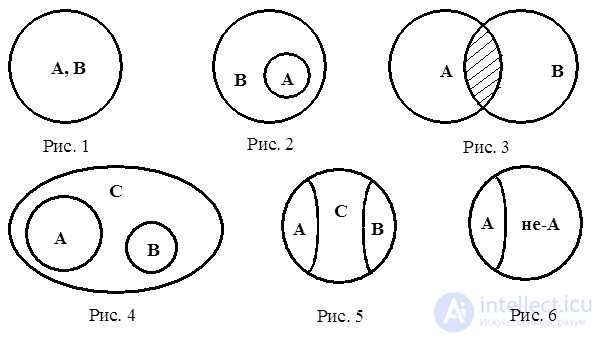
In cases where there are relations of contrariety between concepts, the relations between the extensions of such concepts are depicted by means of a single circle (see Fig. 5). For example : "Everything that has a beginning (A) also has an end (B) " (see Fig. 5). It can be seen that when there are contrary concepts there is also an intermediate concept (C – (A + B )). If there is no such "middle" part, then the given relation is considered a contradiction (see Fig. 6). For example : "No innocent person (A) should be classified as guilty (B) ".
Euler-Venn diagrams, by their visual graphic representation, not only make it easier to remember the structure of various combinations of thoughts but also help in solving a number of logical problems that arise in various fields of human activity .
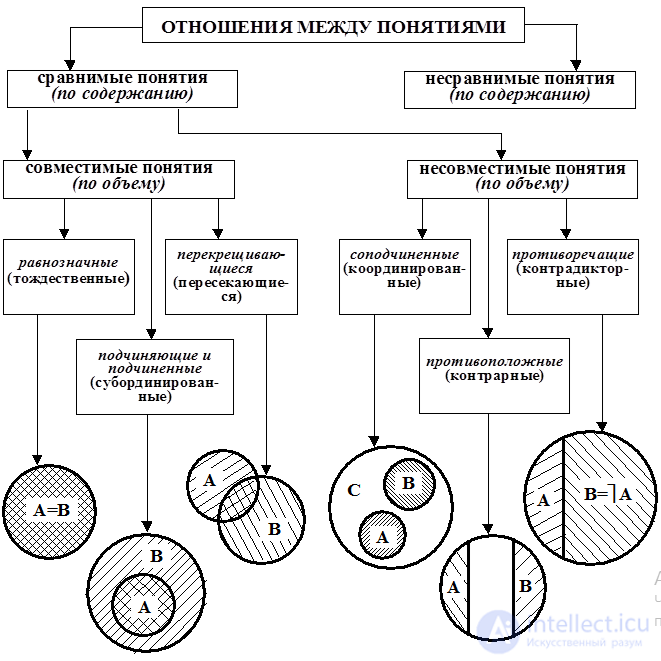
The relation between two equivalent concepts is depicted as two completely coinciding circles.
.
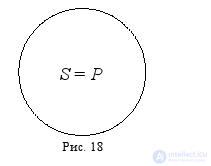
In the judgment "All squares are equilateral rectangles," the subject "squares" and the predicate "equilateral rectangles" stand in a relation of equivalence, because they are equivalent concepts (a square is necessarily an equilateral rectangle, S = P and an equilateral rectangle is necessarily a square) (Fig. 18).
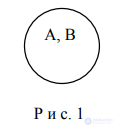
1. In the relation of equivalence (Fig. 1) stand concepts in which one and the same object is thought.
The extensions of these concepts coincide completely.
For example:
A – the largest city of Tatarstan,
B – the capital of Tatarstan.
2. In the relation of intersection (Fig. 2) stand concepts that have some common features, i.e. the extension of one of them partially falls within the extension of the other:
A – student; B – athlete.
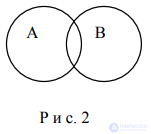
Intersection — is a relation between concepts whose extensions partially coincide.
In the judgment:
"Some writers are Americans," the subject "writers" and the predicate "Americans" stand in a relation of intersection, since they are intersecting concepts (a writer may or may not be an American, and an American may be a writer but may also not be one) (Fig. 19).
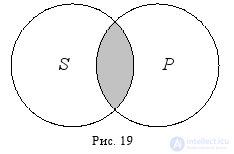
For example, the concepts "pilot" and "cosmonaut" intersect: some pilots are cosmonauts; some pilots are non-cosmonauts; some cosmonauts are non-pilots.
Subordination is a relation between concepts in which the extension of one is wholly included in the extension of the other.
In the judgment:
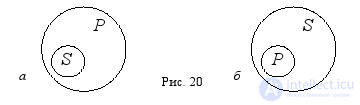
"All tigers are predators," the subject "tigers" and the predicate "predators" stand in a relation of subordination, because they are a species concept and a genus concept (a tiger is necessarily a predator, but a predator is not necessarily a tiger). Likewise in the judgment "Some predators are tigers," the subject "predators" and the predicate "tigers" stand in a relation of subordination, being a genus concept and a species concept. Thus, in the case of subordination, two variants of the relation between the subject and the predicate of a judgment are possible: the extension of the subject is wholly included in the extension of the predicate (Fig. 20, a), or vice versa (Fig. 20, b).
3. In the relation of subordination (Fig. 3) stand concepts one of which is wholly included in the extension of the other:
A – settlement;
B – city.
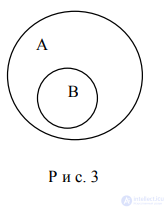
F i g. 3
The concept with the larger extension, A, is called the subordinating concept; the concept with the smaller extension, B, is called the subordinate concept. If general concepts stand in the relation of subordination, the subordinating concept is called the genus and the subordinate concept the species. The "genus" – "species" relation is widely used in the logical operations performed on concepts: generalization, limitation, definition, and division.
The concepts "triangle" and "right triangle," for example, stand in the relation of subordination: every right triangle is a triangle, but not every triangle is a right triangle.
The names "grandfather" and "grandson" stand in the same relation: every grandfather is somebody's grandson, but not every grandson is a grandfather. "Grandson" is the subordinating name, "grandfather" the subordinate one.
The subordinating concept is called the genus, and the subordinate one the species. The concept "triangle" is the genus for the species "right triangle," and the concept "grandson" is the genus for the species "grandfather."
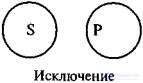
Exclusion is a relation between concepts whose extensions completely exclude each other.
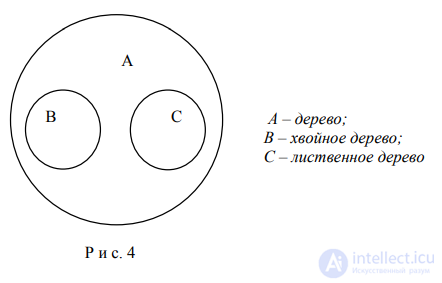
4. Two concepts stand in the relation of co-subordination to a third (Fig. 4) if they have no elements of extension in common and this third concept is subordinating for each of them: A – tree; B – coniferous tree; C – deciduous tree
The concepts "trapezoid" and "pentagon," "human being" and "planet," "white" and "red," and so on, exclude each other.
Two interesting kinds of exclusion can be distinguished:
Excluding extensions complement each other so that together they make up the whole extension of the genus of which they are species. Concepts that exclude each other in this way are called contradictory.
Contradictory concepts are, for example, "skillful" and "unskillful," "steadfast" and "unsteadfast," "beautiful" and "not beautiful," and so on. Also contradictory are the concepts "prime number" and "number that is not prime," which exhaust the extension of the generic concept "natural number," and the names "red" and "not red," which exhaust the extension of the generic concept "colored object," and so on.
Excluding concepts that together make up only part of the extension of the genus of which they are species are called contrary.
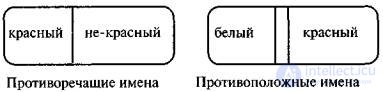
5. In the relation of contradiction (Fig. 5) stand concepts one of which contains certain attributes while the other denies those same attributes without replacing them with other attributes: A – black; B – not black
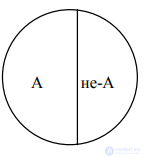
Fig. 5
6. In the relation of contrariety (Fig. 6) stand concepts one of which contains certain attributes while the other denies them by replacing them with excluding attributes: A – black; B – white.
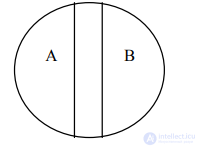
F i g. 6
Contrary concepts include, in particular, "prime number" and "even number," which do not exhaust the extension of the generic concept "natural number," the concepts "red" and "white," which do not exhaust the extension of the generic concept "colored object," and so on.
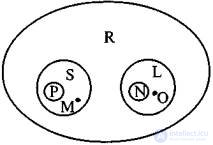
Circle diagrams can be used to represent simultaneously the extensional relations of more than two concepts. One example is the diagram in the figure, which represents the relations between the extensions of the concepts "planet" (B), "planet of the Solar System" (P), "Earth" (N), "satellite" (L), "artificial satellite" (M), "Moon" (O) and "celestial body" (R). According to this diagram there exist, in particular, celestial bodies that are neither planets nor their satellites; planets that do not belong to the Solar System; satellites that are not artificial, and so on. The extensions of singular names are represented by points.
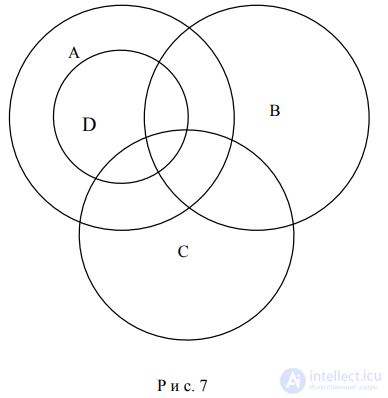
7. When depicting relations among more than two concepts, first the relations of each concept to each other are determined, and then a general diagram is drawn that displays these relations. For example, the relations between the extensions of the concepts A – "student," B – "volunteer," C – A B A not-A 7 "athlete," D – "EGPU student" can be depicted by the diagram shown in Fig. 7:
As a rule, all judgments are divided into three kinds:
1. Attributive judgments (from Lat. attributum – attribute) are judgments in which the predicate is some essential, inherent attribute of the subject. For example, the judgment "All sparrows are birds" is attributive, because its predicate is an inherent attribute of the subject: being a bird is the chief attribute of a sparrow, its attribute without which it would not be itself (if some object is not a bird, then it is necessarily not a sparrow either). It should be noted that in an attributive judgment it is not necessarily the predicate that is the attribute of the subject; the reverse may also hold – the subject may be the attribute of the predicate. For example, in the judgment "Some birds are sparrows" (as we see, compared with the example above, the subject and predicate have swapped places), the subject is an inherent attribute of the predicate. However, such judgments can always be reformulated so that the predicate becomes the attribute of the subject. Therefore, attributive judgments are usually those in which the predicate is an attribute of the subject.
2. Existential judgments (from Lat. existentia – existence) are judgments in which the predicate indicates the existence or non-existence of the subject. For example, the judgment "There are no perpetual motion machines" is existential, since its predicate "there are no" attests to the non-existence of the subject (more precisely, of the object designated by the subject).
3. Relational judgments (from Lat. relativus – relative) are judgments in which the predicate expresses some relation to the subject. For example, the judgment "Moscow was founded earlier than St. Petersburg" is relational, because its predicate "was founded earlier than St. Petersburg" indicates a temporal (age) relation of one city and its corresponding concept to another city and its corresponding concept, which is the subject of the judgment.
Thus, logic distinguishes six kinds of relations between concepts. To make them easier to remember, they are presented in Table 2.
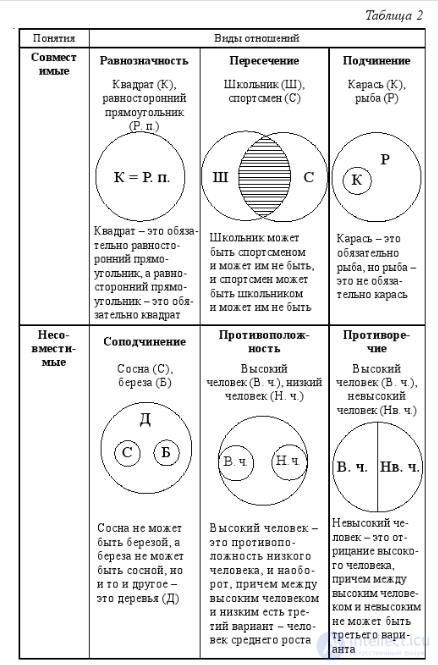
Any two comparable concepts are necessarily in one of the six indicated kinds of relation. For example, the concepts "writer" and "Russian citizen" stand in the relation of intersection, "writer" and "human being" – subordination, "Moscow" and "capital of Russia" – equivalence, "Moscow" and "St. Petersburg" – co-subordination, "wet road" and "dry road" – contrariety, "Antarctica" and "continent" – subordination, "Antarctica" and "Africa" – co-subordination, and so on. Note that if two concepts denote a part and a whole, for example "month" and "year," they stand in the relation of co-subordination, although it may seem that the relation between them is subordination, since a month is part of a year.
However, if the concepts "month" and "year" were subordinate, then we would have to assert that a month is necessarily a year, while a year is not necessarily a month (recall the relation of subordination in the example of the concepts "crucian carp" and "fish": a crucian carp is necessarily a fish, but a fish is not necessarily a crucian carp). A month is not a year, and a year is not a month, but both are a span of time; consequently the concepts "month" and "year," just like the concepts "book" and "page of a book," "automobile" and "wheel of an automobile," "molecule" and "atom," stand in the relation of co-subordination, since part and whole are not the same as species and genus.
As we already know, relations between concepts are depicted by Euler circle diagrams. So far we have depicted schematically the relations between two concepts, but this can also be done with a larger number of concepts.
For example, the relations between the concepts "boxer" (B), "Norwegian" (N) and "human being" (H) are depicted by the following Euler diagram (Fig. 7).
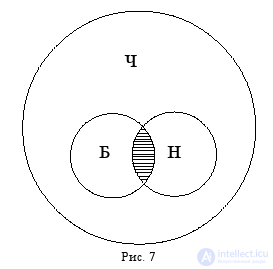
The relative position of the circles shows that the concepts "boxer" and "Norwegian" stand in the relation of intersection: a boxer may or may not be a Norwegian, and a Norwegian likewise may or may not be a boxer; while the concepts "boxer" and "human being," like the concepts "Norwegian" and "human being," stand in the relation of subordination: any boxer and any Norwegian is necessarily a human being, but a human being may be neither a boxer nor a Norwegian.
Let us consider the relations between the concepts "grandfather" (G), "father" (F), "man" (M), "human being" (H) with the help of an Euler diagram (Fig. 8).
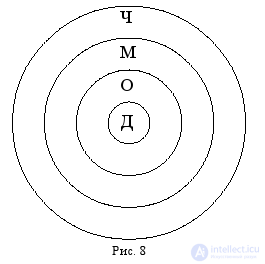
These four concepts stand in a relation of successive subordination: a grandfather is necessarily a father, but a father is not necessarily a grandfather; any father is necessarily a man, but not every man is a father; finally, a man is necessarily a human being, but not only a man can be a human being.
The relations between the concepts "predator" (D), "fish" (F), "shark" (S), "piranha" (P), "pike" (K), "living being" are depicted by the following Euler diagram (Fig. 9).
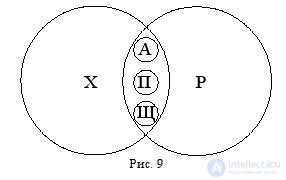
Try to comment on this diagram on your own, establishing all the kinds of relations between concepts shown on it.
Summing up all that has been said, we note that relations between concepts are relations between their extensions. This means that in order to establish relations between concepts, their extension must be sharp and their content, accordingly, clear, i.e. these concepts must be well defined.
Species and genus concepts are closely connected with each other by the logical operations of limitation and generalization.
Limitation of a concept is the logical operation of passing from a genus concept to a species concept by adding some attribute (or several attributes) to its content.
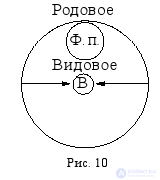
Let us recall the inverse relation between the extension and the content of a concept: the greater the extension, the smaller the content, and vice versa. Limitation of a concept, or the passage from a genus concept to a species concept, is a decrease of its extension and hence an increase of its content. That is why adding any attributes to the content of a concept automatically decreases its extension. For example, if we add to the content of the concept "physical instrument" (P.i.) the attribute "measures the voltage of an electric current," it turns into the concept "voltmeter" (V), which will be a species concept in relation to the original genus concept "physical instrument" (Fig. 10).
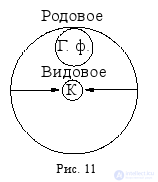
Likewise, if we add to the content of the concept "geometric figure" (G.f.) the attribute "has equal sides and right angles," it turns into the concept "square" (S), which will be a species concept in relation to the original genus concept "geometric figure" (Fig. 11).
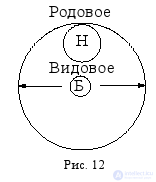
Generalization of a concept is the logical operation of passing from a species concept to a genus concept by removing some attribute (or several attributes) from its content. The content of a concept deprived of some attributes decreases, but at the same time the extension of the concept automatically increases, and it changes from a species concept into a genus concept, that is, it is generalized. For example, if we drop from the content of the concept "biology" (B) the attribute "studies various forms of life," it turns into the concept "science" (S), which will be a genus concept in relation to the original species concept "biology" (Fig. 12).
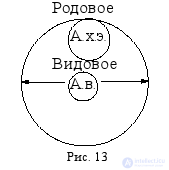
Likewise, if we drop from the content of the concept "hydrogen atom" (H.a.) the attribute "has one electron," it turns into the concept "atom of a chemical element" (A.c.e.), which will be a genus concept in relation to the original species concept "hydrogen atom" (Fig. 13).
Limitations and generalizations of concepts form logical chains in which each concept (except the first and the last) is a species concept in relation to one neighboring concept and a genus concept in relation to the other. For example, if we successively generalize the concept "Sun," we get the following chain: Sun → star →celestial body→ → physical body → form of matter. In this chain the concept "star" is a genus concept in relation to the concept "Sun," but a species concept in relation to the concept "celestial body"; likewise the concept "celestial body" is a genus concept in relation to the concept "star," but a species concept in relation to the concept "physical body," and so on. Movement along our chain from the concept "Sun" to the concept "form of matter" is a series of successive generalizations, and movement in the opposite direction is a series of limitations. If we depict the relations between the concepts of this chain on an Euler diagram, we get circles arranged one inside another: the smallest will denote the concept "Sun," and the largest "form of matter."
The limit of a chain of limitation of any concept will always be some singular concept (see Section 1.1), while the limit of a chain of generalization will, as a rule, be some broad, philosophical concept, for example: object of the universe, form of matter or form of being.
The most frequent errors made in limiting and generalizing concepts consist in naming, instead of a species for some genus, a part of some whole, and, instead of a genus for some species, a whole in relation to some part. For example, the concept "stem" is offered as a limitation of the concept "flower." Indeed, a stem is a part of a flower, but to limit a concept means to find not a part for a whole, but a species for a genus. Consequently, the correct limitation of the concept "flower" would be the concept "daisy," or "tulip," or "chrysanthemum," and so on. As a generalization of the concept "tree," the concept "forest" is often offered. Of course, a forest is a kind of whole in relation to the trees of which it consists, but to generalize a concept means to find not a whole for a part, but a genus for a species. Consequently, the correct generalization of the concept "tree" would be the concept "plant," or "object of flora," or "living organism," and so on.
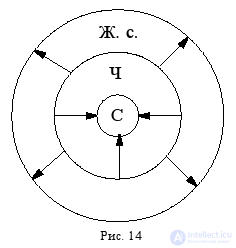
Thus, almost any concept (except singular and broad, philosophical ones) can be both limited and generalized. In other words, both a species concept and a genus concept can be found for it. For example, a limitation of the concept "human being" (H) would be the concept "athlete" (A) or "writer," or "man," or "young person," and so on, and its generalization would be the concept "living being" (L.b.) (Fig. 14).
EXAMPLES OF PROBLEM SOLUTIONS
E x a m p l e 1. Represent by means of an Euler circle diagram the relations between the following concepts:
Toy (A), wind-up toy (B), doll (C), wind-up car (D), pistol (E)
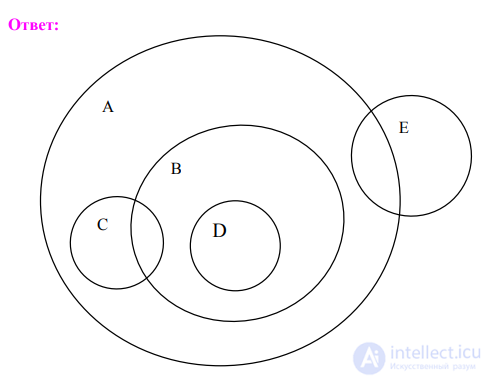
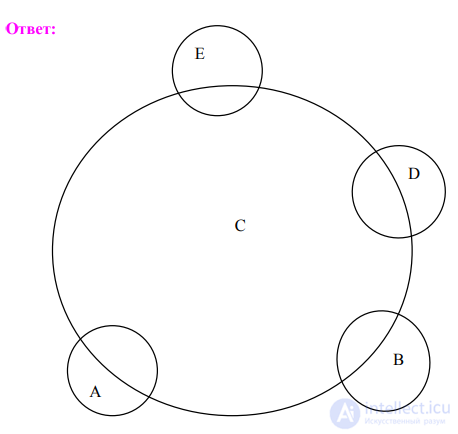
2. Represent by means of a circle diagram the relations between the following concepts: Lightning (A), arson (B), cause of a fire (C), fire (D), explosion
of an atomic bomb (E).
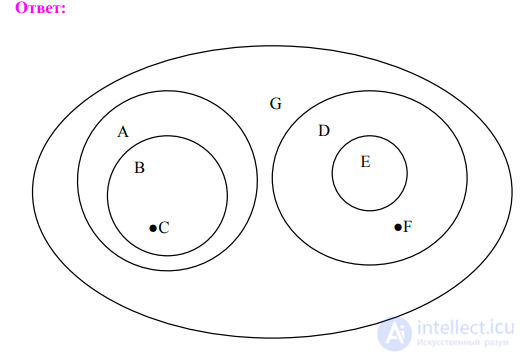
E x a m p l e 3. Represent by means of a circle diagram the relations between the following concepts: Planet (A), planet of the Solar System (B), Earth (C), satellite (D), artificial satellite (E), Moon (F), celestial body (G).
E x a m p l e 4. Find concepts whose relations would satisfy the given circle diagram:
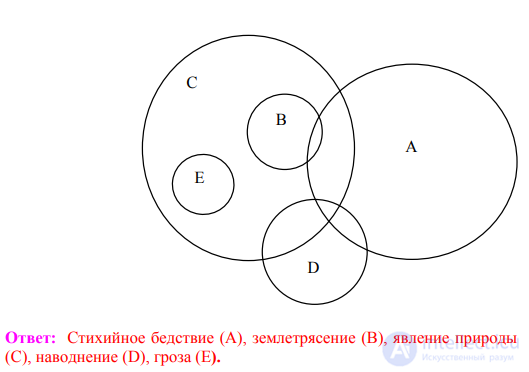
Answer: Natural disaster (A), earthquake (B), natural phenomenon (C), flood (D), thunderstorm (E).
E x a m p l e 5. Find concepts whose relations would satisfy the given circle diagram:
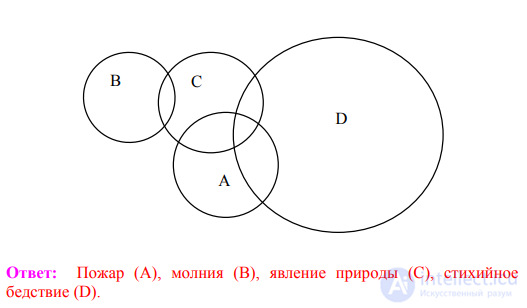
Answer: Fire (A), lightning (B), natural phenomenon (C), natural disaster (D).
1. What is limitation of a concept?
2. What is the logical operation of generalization of a concept?
3. How do limitations and generalizations of concepts form logical chains? What are the limits of chains of limitation and generalization?
4. What errors are often made in limiting and generalizing concepts? Demonstrate, using examples of your own choosing, that whole and part must not be confused with species and genus.
5. Can every concept be subjected to limitation or generalization? Which concepts do not lend themselves to these logical operations?
6. Choose any ten concepts and perform limitation and generalization on them, i.e. find both a species concept and a genus concept for each, illustrating these operations with Euler diagrams.
7. The judgment "There is no God" is:
8. An attributive judgment is:
9. The subject and predicate stand in the relation of intersection in the judgment:
10. A relational judgment is (choose one or several answers):
11 The term of a simple attributive judgment is undistributed if in this judgment:
12 The judgments "All predators are animals" and "Tigers are animals" stand in the relation of:
14. Relations between concepts are depicted by:
15 Division of a concept reveals its:

Comments