
Lecture
syllogism - a logical inference in which a third proposition (the conclusion) is derived from two given propositions (premises).
Conditional-categorical syllogism – a syllogism in which the major premise is a conditional proposition, and the minor premise is a categorical proposition.
Purely conditional syllogism – a syllogism in which both premises and the conclusion are conditional propositions
Equivalent-categorical syllogism – a syllogism in which the major premise is an equivalence (a distinguishing conditional), and the minor premise is a categorical proposition.
Inferences that contain conditional (implicative) propositions are called conditional. In thought and speech, the conditional-categorical syllogism is often used; its name indicates that its first premise is a conditional (implicative) proposition, while the second premise is a simple (categorical) one. For example:
If the runway is covered with ice, then aircraft cannot take off.
Today the runway is covered with ice.
Today aircraft cannot take off.

The conditional-categorical syllogism has two modes:
1. The affirming mode, in which the first premise is an implication consisting, as we already know, of two parts – the antecedent and the consequent, the second premise affirms the antecedent, and the conclusion affirms the consequent. For example:
If a substance is a metal, then it conducts electricity.
This substance is a metal.
This substance conducts electricity.
The form of the affirming mode of the conditional-categorical syllogism: ((a → b) ∧ a) → b, where (a → b) is the first premise in the form of an implication of the antecedent and the consequent; ((a → b) ∧ a) is the two premises of the syllogism in the form of a two-term conjunction consisting of the aforementioned implication and the affirmation of the antecedent; b is the conclusion of the syllogism that follows from the premises, in the form of an affirmation of the consequent.
2. The denying mode, in which the first premise is an implication of the antecedent and the consequent, the second premise denies the consequent, and the conclusion denies the antecedent.
For example:
If a substance is a metal, then it conducts electricity.
This substance does not conduct electricity.
This substance is not a metal.
The form of the denying mode of the conditional-categorical syllogism: ((a → b) ∧¬ b) → ¬ a, where (a → b) is the first premise in the form of an implication of the antecedent and the consequent; ((a → b) ∧ ¬b) is the two premises of the syllogism in the form of a two-term conjunction consisting of the aforementioned implication and the denial of the consequent; ¬ a is the conclusion of the syllogism that follows from the premises, in the form of a denial of the antecedent.
We must pay attention to the already familiar feature of the implicative proposition, which is that the antecedent and the consequent cannot be swapped. For example, the statement: «If a substance is a metal, then it conducts electricity» – is true, since all metals are conductors (from the fact that a substance is a metal, its conductivity necessarily follows). However, the statement: «If a substance conducts electricity, then it is a metal» – is false, since not all conductors are metals (from the fact that a substance conducts electricity, it does not follow that it is a metal). This feature of implication gives rise to two rules of the conditional-categorical syllogism:
1. One may affirm only from the antecedent to the consequent, i.e., in the second premise of the affirming mode, the antecedent of the implication (the first premise) must be affirmed, and the conclusion must affirm its consequent.
Otherwise, a false conclusion may follow from two true premises. For example:
If a word stands at the beginning of a sentence, it must be written with a capital letter.
The word «Moscow» must be written with a capital letter.
The word «Moscow» always stands at the beginning of a sentence.
In this syllogism, the second premise affirmed the consequent, and the conclusion affirmed the antecedent: ((a → b) ∧ b) → a. This affirmation from consequent to antecedent is the reason for the false conclusion despite true premises.
2. One may deny only from the consequent to the antecedent, i.e., in the second premise of the denying mode, the consequent of the implication (the first premise) must be denied, and the conclusion must deny its antecedent. Otherwise, a false conclusion may follow from two true premises. For example:
If a word stands at the beginning of a sentence, it must be written with a capital letter.
In this sentence, the word «Moscow» does not stand at the beginning.
In this sentence, the word «Moscow» need not be written with a capital letter.
In this syllogism, the second premise denies the antecedent, and the conclusion denies the consequent: ((a → b) ∧ ¬ a) → ¬ b. This denial from antecedent to consequent is the reason for the false conclusion despite true premises.
Recall that among compound propositions, besides implication: a → b, there is also equivalence: a b. Whereas an implication always distinguishes an antecedent and a consequent, an equivalence has neither, since it is a compound proposition both parts of which are identical (equivalent) to one another. If the first premise of a syllogism is not an implication but an equivalence, such a syllogism is called equivalent-categorical. For example:
If a number is even, then it is divisible by 2 without a remainder.
The number 16 is even.
The number 16 is divisible by 2 without a remainder.
The form of the mode of this syllogism: (ab) ∧ a) → b.
Since in the first premise of an equivalent-categorical syllogism neither an antecedent nor a consequent can be distinguished, the rules of the conditional-categorical syllogism discussed above do not apply to it (in an equivalent-categorical syllogism, both affirming and denying may be done in any way). Whereas in the conditional-categorical syllogism two modes are valid and two are invalid (see above), in the equivalent-categorical syllogism all four modes are valid:
((ab) ∧ a) → b;
((ab) ∧ b) → a;
((ab) ∧ ¬ a) → ¬ b;
((ab) ∧ ¬ b) → ¬ a.
The reader will have no difficulty finding examples for each of the four modes of the equivalent-categorical syllogism.
If both premises and the conclusion are conditional propositions, this is a purely conditional syllogism (a purely conditional inference). For example:
If a substance is a metal, then it conducts electricity.
If a substance conducts electricity, then it cannot be used as an insulator.
If a substance is a metal, then it cannot be used as an insulator.
The form of the mode of this syllogism: ((a → b) ∧ (b → c)) → (a → c).


Fig. The Law of Contraposition
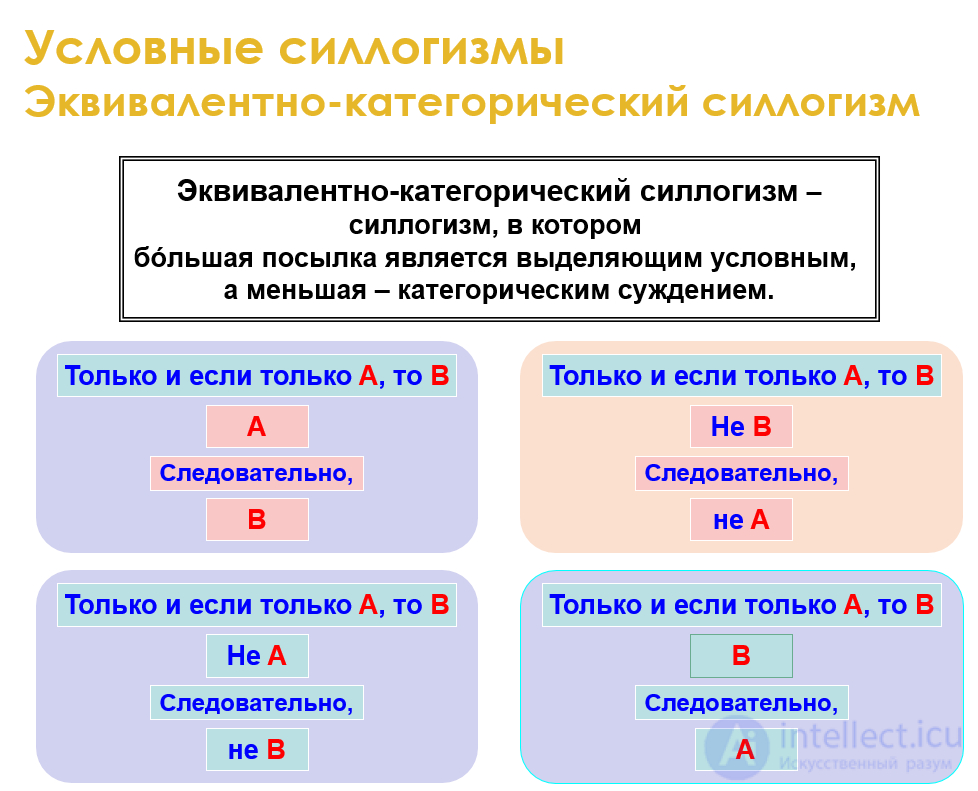
fig. Equivalent-categorical syllogism
1. What are conditional inferences?
2. What modes does the conditional-categorical syllogism have? Give three examples for each mode, representing their form using conditional logical notation.
3. What is called the «antecedent» in a conditional-categorical syllogism, and what is called the «consequent»? What are the rules of the conditional-categorical syllogism, and what errors arise when they are violated?
Come up with two examples for each error that arises from violating the corresponding rule.
4. What is an equivalent-categorical syllogism? How does it differ from a conditional-categorical one? Why does the conditional-categorical syllogism have only two valid modes, while the equivalent-categorical syllogism has four? Come up with one example for each mode of the equivalent-categorical syllogism.
5. How does a purely conditional syllogism differ from a conditional-categorical syllogism? Give two examples of a purely conditional syllogism.
6. Are there errors (and if so, which ones) in the following conditional-categorical syllogisms:
1) If an animal is a mammal, then it is a vertebrate.
Reptiles are not mammals.
Reptiles are not vertebrates.
2) If a person flatters, then they lie.
This person flatters.
This person lies.
3) If a geometric figure is a square, then all of its sides are equal.
An equilateral triangle is not a square.
An equilateral triangle's sides are not equal.
4) If a metal is lead, then it is heavier than water.
This metal is heavier than water.
This metal is lead.
5) If a celestial body is a planet of the Solar System, then it moves around the Sun.
Halley's Comet moves around the Sun.
Halley's Comet is a planet of the Solar System.

Comments