
Lecture
Syllogism categorical – a deductive inference in which
from two propositions having a subject-predicate form, a new proposition (the conclusion), also having a subject-predicate form, follows. Aristotle was the first to recognize the formal side of syllogisms, i.e., their independence from any particular content, and by introducing letter symbols to denote variables, Aristotle laid the foundations of the formal construction of logic.
Aristotle's syllogisms consist of two propositions connected by a common middle term, from which a third proposition follows, also having a subject-predicate form. In this case, the middle term is not included in the conclusion. Aristotle considered four types of propositions:
A (S,P) – universal affirmative: “all S are P”;
E (S,P) - universal negative: “no S is P” ;
I (S,P) - particular affirmative: “some S are P”;
O (S,P) – particular negative: “some S are not P”.
Here S – is a class of objects, and P - is a property.
A proposition containing a general property is called the major premise; a proposition containing a particular case - the minor premise; and the third proposition – the conclusion of the syllogism. Depending on the position of the minor premise, four figures of the syllogism are distinguished (where X takes the values A, E, I, O):
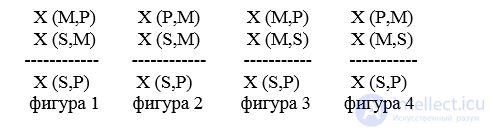
One figure corresponds to 64 moods, and in total there are 256 moods for the four figures. Of all the moods, only 19 are valid (those marked with * are valid for non-empty sets), having the following names:
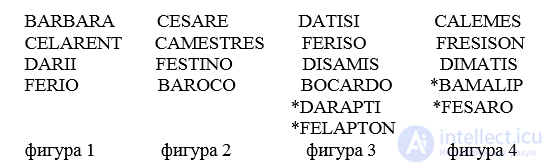
The vowels in the names of the syllogisms are the values of X. So that
the moods of the 1st figure: AAA, EAE, AII, EIO; the moods of the 2nd figure: EAE, AEE, EIO, AOO; the moods of the 3rd figure: AAI, IAI, AII, EAO, OAO, EIO; the moods of the 4th
figure: AAI, AEE, IAI, EAO, EIO.
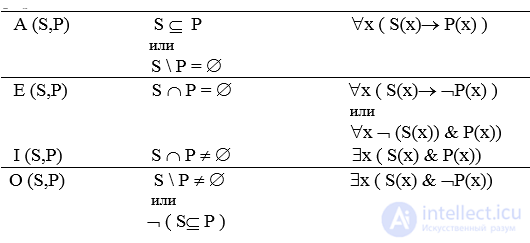
The truth of syllogisms can be proved using a set-theoretic interpretation, where P denotes the truth domain of the predicate P(x); then the propositions A, E, I receive the following interpretation:
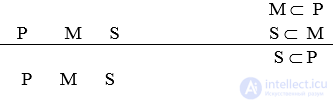
Every syllogistic inference can be depicted using three Euler circles (S, P, and M), and from the mutual position of the circles S and P relative to M one can visually infer the relation of S to P.
Thus the syllogism:
All people can be mistaken (MAP);
All scientists are people (SAM);
All scientists can be mistaken (SAP);
can be visually depicted as follows:
Another example:
People cannot change the objective laws of nature (MEP);
Scientists are people (SAM);
Scientists cannot repeal the objective laws of nature (SEP);
has the following set-theoretic representation:

Example of the proof of the mood BARBARA:
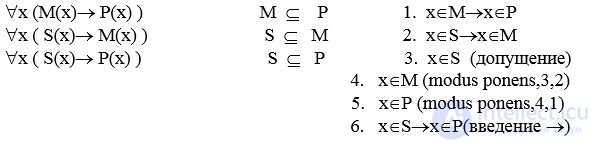
Aristotle developed rules for reducing some syllogisms to others (permutation of premises, reduction to the impossible, singling out part of one of the terms), which served as a prerequisite for the axiomatic construction of syllogistics.
Example of reducing the syllogism AAI:
All stars shine with their own light;
All stars are celestial bodies;
Some celestial bodies shine with their own light;
to the syllogism AII:
All stars shine with their own light;
Some celestial bodies are stars;
Some celestial bodies shine with their own light.
Exercise
1. Depict the moods using Euler circles and prove them by set-theoretic means.
2. Prove Aristotle's syllogisms using the inference rules of propositional calculus.
4. Draw conclusions using the rules of the syllogism:
4.1 All doctors have a general education. Some doctors are therapists.
4.2 None of A.P. Chekhov's works can be read in a single day. The story “The Grasshopper” is a work by A.P. Chekhov.
4.3. “Peter I … tore off the veil of mystery shrouding the tsar's person, and with disgust cast off the Byzantine hand-me-downs in which his predecessors had dressed. Peter I could not content himself with the pitiful role of a Christian Dalai Lama, decked out in brocade and precious stones, who was shown to the people from a distance when he solemnly proceeded from his palace to the Dormition Cathedral and from the Dormition Cathedral back to the palace. Peter I appears before his people as a simple mortal. Everyone sees how this tireless worker, dressed in a modest military-style coat, gives orders from morning till night and teaches how they are to be carried out: he is a blacksmith, a carpenter, an engineer, an architect, and a navigator. He is seen everywhere, without retinue – except perhaps with a single adjutant – towering over the crowd thanks to his height… Peter the Great was the first free personality in Russia and, if only for that reason, a crowned revolutionary” (Herzen A.I. On the Development of Revolutionary Ideas in Russia//Collected Works, Vol.3, p.388).
4.4. To Doctor Watson's question of how Holmes knew that he had been to the post office that morning and sent a telegram, the latter said the following: “…I know that you did not write any letters this morning, for I sat opposite you the whole morning. And in the open drawer of your desk I noticed a thick stack of postcards and a whole sheet of stamps. Why else would you go to the post office, if not to send a telegram? Eliminate everything that could not have taken place, and there remains a single fact, which is the truth” (Conan Doyle A. Collected Works).
4.5. Having carefully examined the room in which the crime had been committed, Sherlock Holmes said the following to Doctor Watson:
«It is not enough to have a good mind, the main thing is to use it well» R. Descartes
All people by nature desire to know
The syllogism (from Greek sillogismos - co-reckoning) is a classic topic of logic. The doctrine of the syllogism was set out by Aristotle (384 - 322 BC) in the «Analytics». In his research he relied on Democritus and Plato. According to Aristotle, a syllogism is a demonstrative inference in which the conclusion follows necessarily according to the laws of logic. In non-philosophical literature, the term «syllogism» is sometimes used to denote any demonstrative inference.
Aristotle divides inferences into types according to the method and character of obtaining the logical conclusion: «An inference is a discourse in which, certain things being supposed, something different from the things supposed results of necessity because these things are so. A demonstration exists when the inference is constructed from true and primary [premises] or from such whose knowledge derives from certain first and true [premises]. A dialectical inference, on the other hand, is one constructed from plausible [premises]. True and primary [premises] are those which are credible not through other [premises], but through themselves... . Plausible is that which appears correct to everyone or to the majority... . An eristic inference, on the other hand, proceeds from [premises] that seem plausible but in fact are not... .
Besides all the aforementioned kinds of inferences there are also paralogisms, which are constructed on the basis of what is peculiar to this or that science...: here one does not accept what seems correct to everyone» .
Aristotle invents the syllogism as a practical instrument, or «organon», for bringing demonstrative inferences into connection with one another. The Aristotelian syllogism consists of 3 propositions, two of them premises, and the third - the conclusion.
A syllogism is a deductive inference in which, from two propositions having a subject-predicate form (S - P), a new proposition (the conclusion) follows, also having a subject-predicate form (S - P). It should be added that the premises must be arranged, firstly, according to the logical square (A, E, I, O), and secondly, must have a middle term (M).
V.A. Svetlov, in «Practical Logic», adds the following to the characterization of the syllogism. All six terms must be part of a single inference. One of the premises contains the subject (S) of the conclusion and the excluded term (M), the other - the predicate (P) of the conclusion and the excluded term (M). The middle term (M) is precisely this excluded term - it is present in the premises but absent from the conclusion. Propositions in a syllogism are connected to one another by logical entailment and by the middle term . It is true that, in V.A. Svetlov, as in J. Łukasiewicz, the terms of the syllogism are denoted by the letters A, B, C, where B is the middle term. We find the generally accepted classification of syllogism terms closer to our own.
Finally, a syllogism is an inference by virtue of which, having recognized the truth of the premises, one cannot but agree with the truth of the conclusion, provided the corresponding rules of logical entailment are observed. Let us turn to the simplest characterization of the syllogism.
Let us return to our example.
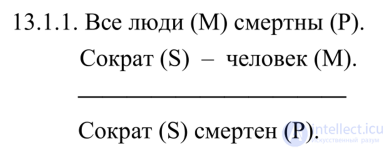
The premises stand above the line, and the conclusion - below the line. The three concepts (classes) in question are called the terms of the syllogism, whereby the subject of the conclusion (in our example - the concept «Socrates») is called the minor term, and the predicate («mortal») - the major term. The minor and major terms are called the extremes and are denoted by the corresponding symbols S and P. The term that occurs in the premises but is absent from the conclusion («man») is called the middle term and is denoted by the symbol M.
The premises of the syllogism are also given special names. The one that contains the major term (P) is called the major premise; the one that contains the minor term (S) is called the minor premise. The major premise always contains the terms P and M, the minor - the terms S and M, the conclusion - the terms S and P. In a syllogism, the named elements of the inference's structure are arranged in the following order: major premise, minor premise, conclusion. The conjunction of the premises can be regarded as the logical ground, and the conclusion - as the logical consequence: A ∧ A —> A (see the logical square). In a syllogism, i.e. in this inference, as in every logical inference, there are its own rules. They can be illustrated with the help of Euler circle diagrams.
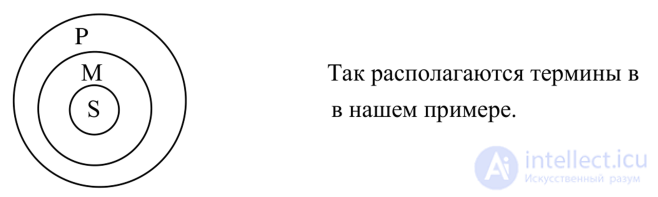
Fig. 1.1. Demonstrative syllogism in the mood Barbara (AAA). In other words, if every man is mortal, and Socrates is a man, then he too is mortal. But not the reverse: not every mortal is a man. This inference (logical conclusion) is constructed according to the first figure. It is precisely this arrangement of terms that occurs in the first figure.
However, such an arrangement of terms is by no means obligatory, and moods can be encountered in any syllogism (more on this in another section). Aristotle called such syllogisms dialectical, where the conclusion is plausible but not certain.
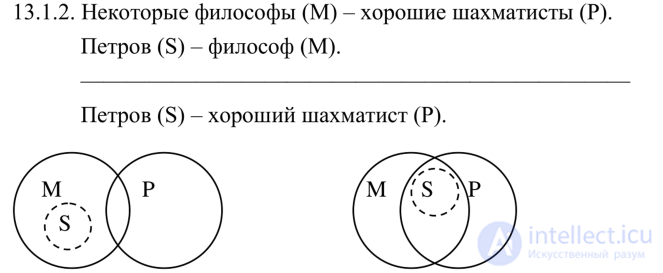
Fig. 1.2. Relation of terms in a non-demonstrative inference
This logical conclusion is plausible, for it allows of answers: either Petrov belongs to the class of «philosopher-chess players», or to the class of «philosophers who are not chess players»1. In other words, the logical conclusion that Petrov is a «good chess player» does not follow with necessity.
Aristotle in the «Analytics» describes the structure of the syllogism: «A premise is a discourse affirming or denying something of something. It is either universal, or particular, or indefinite. Universal I call [a premise] about what belongs to all or belongs to none, particular - about what does not belong to all, indefinite - about what belongs or does not belong without indication of whether it is universal or particular...
By term I mean that into which a premise is resolved, i.e., that which is predicated, and that of which it is predicated, with the addition of [the verb] «to be» or «not to be»; a syllogism, on the other hand, is a discourse in which, if something is suppo-
Euler circle diagrams are the simplest way of checking the truth of the conclusion in a syllogism.
sed, something different from what is posited results of necessity by virtue of the fact that what is posited is so. I call a syllogism perfect if it needs nothing else besides what has been assumed to reveal the necessity; imperfect, on the other hand, if it needs [for this] one or several things which, although necessary through the given terms, are not obtained through the [given] premises» .
According to Aristotle, the syllogism is presented in a form unfamiliar to the modern reader. First, Aristotle practically never used examples; instead of word-terms he used letter symbols. Second, the Aristotelian syllogism is recorded in the form of a conditional-categorical inference. Third, not a single syllogism is formulated by Aristotle as a conclusion with the word «therefore». Fourth, the fourth figure is not used by Aristotle. Sometimes Aristotle uses examples (living being - man - horse) for clarity, but very rarely. Inferences in the «Analytics» are most often described with the help of symbols. Fifth, the perfect syllogism is constructed according to the first figure (see example 13.1.1). Aristotle describes this inference thus: «If three terms are so related to one another that the last is contained wholly in the middle, and the middle is either contained wholly in the first or wholly excluded from it, then for these extreme terms there is necessarily a perfect syllogism» .
Syllogism 13.1.1 is treated in practically all logic textbooks as an example of an Aristotelian perfect syllogism. But Aristotle did not introduce singular terms («Socrates is a man») into the «Analytics». According to Aristotle, it would look different:
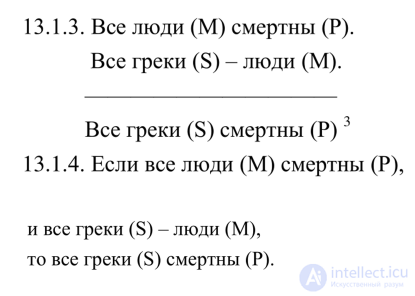
It is precisely in the form of an implication that the Aristotelian syllogism is recorded. Aristotle rarely uses word-terms; in the «Analytics» he more often includes symbols in the syllogism:
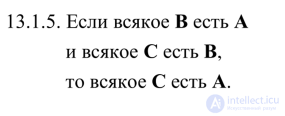
Finally, in the first premise Aristotle places the predicate in the position of the middle term, and in the second the subject in the position of the middle term:
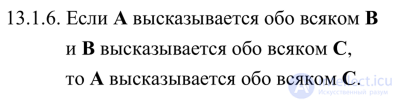
It is in this form that the Polish logician J. Łukasiewicz presents the Aristotelian syllogism .
The simple categorical syllogism is a deductive demonstrative inference in which, from two propositions having a subject-predicate form, a new proposition (the conclusion), also having a subject-predicate form, follows. In the simple categorical syllogism one distinguishes: 1) the premises, 2) the terms, 3) the conclusion.
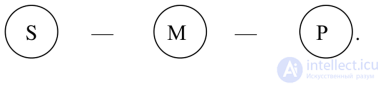
The terms S - M - P, where S (subject) - the minor term (the concept found in the second premise), M - the middle term (the concept occurring in both premises), P (predicate) - the major term (the concept found in the first premise). In any syllogism one can find a subject, a predicate, and a middle term.
The premises are propositions expressed in the form of sentences. One of them expresses the relation of the minor term (S) to the middle (M). It is called the «minor premise» and always occupies the second place. The other expresses the relation of the major term (P) to the middle (M). It is called the «major premise» and always occupies the first place. The conclusion of a syllogism always has the logical form S - P.
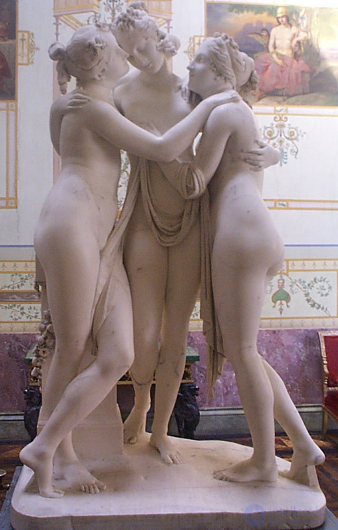
The Charites. 3rd century BC.
Matter is seen by everyone before them; content is found only by one who deals with it; form, however, remains a secret to most» (J.W. Goethe).
Form is that which is general and most essential in every reality (nature, society, thought). In the sphere of thought, form embodies the most general rules for constructing thoughts - deductive and inductive. The form of thought is also the linguistic structure of thought («concept - name», «proposition - statement», «inference - logical conclusion»).
For a correct understanding of the meaning of the concept «form», let us give an example from the theory of state and law. Every jurist knows well that states differ by national, territorial, and other characteristics (the organization of political power, state structure, the social management of the affairs of society, legal status, types of political regime, the presence in the state of constitutional rights and freedoms of man and citizen, etc.). In other words, there are not and cannot be two identical states.
Nevertheless, purely theoretically, in all the diversity of national and territorial state structures, only two forms of government can be distinguished - monarchy and republic. Monarchy and republic - are forms of state government. In turn, a monarchy can be of two kinds - absolute and parliamentary; a republic - presidential, parliamentary, mixed. To the logical characterization of the state let us add a definition of the form of the state - this is the organization of political power, including the form of government, the form of state structure, and the form of political regime.
Thus, form is the internal structure of every reality (including legal reality), and in theoretical terms - it is also an abstract-logical model of reality.
The sculptural model of the ancient Charites embodies the ancient understanding of the inner idea of the beauty of the female body - the radiant, benevolent, blossoming goodness of eternally young female nature.
Here, too, is presented the idea of a single form of beauty of the female body. In the sculptural composition there are 3 figures. According to ancient legend, the Charites (daughters of the great Zeus) were called: Aglaea («the radiant one»), Euphrosyne («the benevolent one»), Thalia («the blossoming one»). It is not by chance that they are depicted nude by the ancient sculptor. The ancient Master wanted thereby to emphasize that form is not an outer garment.
Despite the fact that there are three figures in the composition, in reality, if we look closely, we will find one figure - the «figure - form - idea» of feminine beauty. According to an even more ancient legend, Homer knew of only one daughter of Zeus - Charis. C h a r i s is the idea of eternal (universal) youth and beauty. She may have an infinite number of guises, but as a formal idea of eternal youth and beauty - she is one, represented by an unknown sculptor in the nude. Let us once again recall the words of the great J.W. Goethe: «Matter is seen by everyone before them...; form, however, remains a secret to most».
As paradoxical as it may sound, the figures and moods of the syllogism are universal and general formal structures of deductive inferences, consisting of two propositions having a subject-predicate form, whose logical conclusion is based on the relation of the two extreme terms (S and P) to the middle (M): S - M - P.
The figures of the syllogism are a distinctive form of the spirit and essence of the simple categorical syllogism. The figures and moods of the syllogism are the «bare» form of deductive demonstrative inferences:
Depending on the position of the middle term (M) in the premises, four figures of the syllogism are distinguished (3 - Aristotelian, 1 - Galenic). Together they represent one type of demonstrative inference - the simple categorical syllogism. The predicate is found in the major premise, the subject - in the minor premise. The middle term (M) - is in both premises. The diagrams show the arrangement of the subject, predicate, and middle term in syllogistic conclusions:
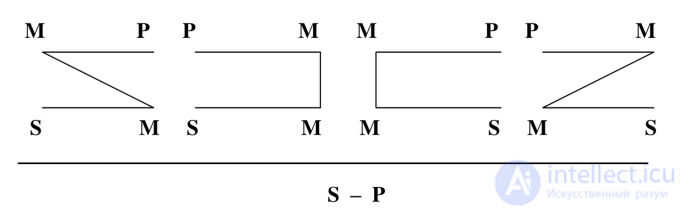
Fig. 2.1. Figures and Terms of the Syllogism
Below the line is the conclusion (S - P). The conclusion of a syllogism always has the form S - P .
Example of the 1st figure
Example of the 2nd figure
Example of the 3rd figure
Example of the 4th figure
tion of S with respect to M, and M with respect to P, or M with respect to both of them, or both of them with respect to M. This is the way figures of the syllogism are constructed.
Aristotle calls the first figure classical and often reduces inferences of the other two to the first. Aristotle believes that only according to the first figure does the conclusion follow with necessity: «If A is predicated of all B, and B of all C, then A is necessarily predicated of all C» . Syllogisms of the second and third figures are imperfect, since additional operations of reducing them to the first are necessary in order to achieve logical necessity of entailment.
In the first figure (with affirmative premises), the middle term expresses the cause. In other figures of the syllogism there is no such clarity. Logical conclusions according to the fourth figure are very rare. At the very least, it is very difficult to find examples. In textbooks it is, as a rule, not mentioned. Apparently also because the procedure of logical inference of the fourth figure is usually reduced to the first.
The ability to distinguish the figures of the syllogism has a purely practical significance. The fact is that each figure reflects different techniques of operating with premises. Thus, if it is required to prove the truth of a singular or particular proposition, the first figure is used, when a singular or particular case is subsumed under a general rule. If it is required to refute a singular affirmative proposition, the second figure of the syllogism can be used. To refute universal propositions, the third figure is used (N.I. Kondakov).
Since all inferences according to the figures of the syllogism can be reduced to the first, let us consider in full the operation of the first figure in thought. In the 1st figure, the two extreme terms (S and P) may mutually include or exclude one another through the mediation of a third. The conclusion takes on all possible (four) statements according to the logical square: A, E, I, O. These operations proceed as follows. Below, the arrangement of terms and premises in the first figure will be shown in circle diagrams.
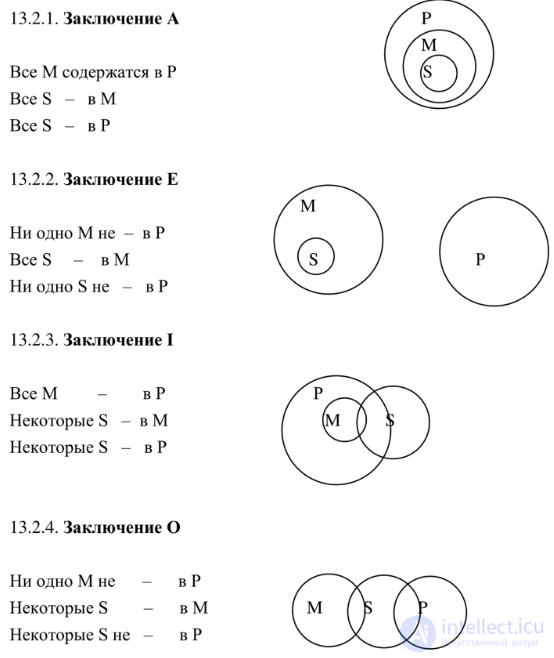
These four forms make up the moods of the first figure. If any proof can be reduced to these forms and if you accept its premises, then you must, if you wish to be consistent, admit the conclusion as well. Otherwise you will have to deny what is obvious and certain[10]. We see that if M lies wholly within P or wholly outside P, and S lies wholly or partly within M, then S lies wholly or partly within P or outside it.
But if we try to place the terms of the premises of the first figure in some other mutual relations, we find that nothing can be said about the position of S relative to P. If the major premise is not universal, i.e. if M does not lie wholly within P or wholly outside it, then no conclusion can be drawn, whatever the minor premise may be. Suppose, in this case, that the minor premise states: «All S are contained in M»; it is obvious that in this case it may be true both that «All S are contained in P» (A), and that «No S is contained in P» (E), and «Some S are contained in P» (I), and «Some S are not contained in P» (O)[11]:
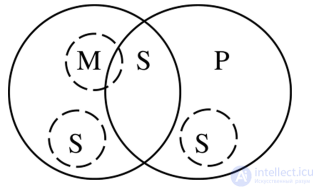
In other words, the position of S is indeterminate. As a result, the logical conclusion does not follow with necessity. And finally, if the minor premise in the first figure is not affirmative, the probability of the conclusion increases several times over.
The moods of the simple categorical syllogism are varieties of the syllogism, differing from one another by the qualitative and quantitative characteristics of the premises and conclusion that make them up.
Each figure has its own moods (or forms), the application of which gives a true conclusion[12].
The total number of combinations of propositions, distinguished by quantity and quality (A - E - I - O), in the premises and conclusion of a syllogism for each figure is equal to 64. If we also take into account the peculiarities of the arrangement of terms in the figures, then theoretically one can speak of 256 moods of the syllogism. However, only a small part of them forms the basis of correct demonstrative inferences. Some combinations do not occur at all (for example, two negative premises, when a conclusion is in principle impossible). Other combinations are impossible due to the special rules of the figures, etc. As a result, 19 moods remain, which are customarily called correct. The remaining moods are incorrect (they cannot serve as the basis of demonstrative conclusions). But the «Dictionary of Logic» nevertheless gives a different figure - 24[13]. The difference lies in the so-called «weakened» moods, in which we obtain a conclusion of type I and O, although we could obtain propositions A and E respectively. So, there are 19 correct moods in the syllogism:
moods of the 1st figure: AAA, EAE, AII, EIO;
moods of the 2nd figure: EAE, AEE, EIO, AOO;
moods of the 3rd figure: AAI, IAI, AII, EAO, OAO, EIO;
moods of the 4th figure: AAI, AEE, IAI, EAO, EIO.
In medieval universities, graphic diagrams of the moods of the syllogism were compiled. Sometimes, for a better memorization of the forms of the syllogism, poems were composed (logical statements in verse were easier to remember). In the 13th century, the «logical square of Boethius» was widespread in universities specifically for memorizing the moods of the syllogism. One version of the recording of the moods took the following form:
Barbara, Celarent, Darii, Ferio;
Cesare, Camestres, Festino, Baroco;
Darapti, Disamis, Datisi, Felapton, Bocardo, Ferison;
Bramantip, Camenes, Dimaris, Fesapo, Fresison.
The first vowel indicates the quantity and quality of the major premise. The second - the quantity and quality of the minor premise. The third - the quantity and quality of the conclusion.
The initial consonants B, C, D, F indicate the mood of the first figure to which it can be reduced. Thus the syllogism «Baroco» of the second figure can be brought to the syllogism «Barbara», «Disamis» of the third figure - to «Darii» of the first, etc.
The consonant letters S, P, M, C indicate the possibility of logical operations: a) S means that the proposition denoted by the vowel after which it stands is subject to simple conversion («conversio simplex»).
2
Thus, «Festino» is converted, i.e. the subject replaces the predicate without a change of quantity, into the mood «Ferio» of the first figure; b) P means that the proposition denoted by the vowel after which this letter stands must be converted by limitation («per accidens»); c) M means that the premises are mutually convertible, the major becomes the minor and vice versa; d) C means reduction to the impossible, demonstrating that if the conclusion is denied, a self-contradiction arises in the sense that the premises, or one of them, are also denied.
1) «Tell me, friend Hugh,» said the old knight, addressing the tavern keeper, «are you familiar with the syllogism where the first premise runs thus: «Every eagle can fly», and the second thus: «Some pigs cannot fly»?» - Ha-ha-ha! You evidently take me for a complete fool. Every snot-nosed boy in our village knows the conclusion of this syllogism, which runs as follows:
2. All cats love fish. No elephant loves fish.
3. No bird is a dog. All dachshunds are dogs.
4. Some cats are striped. Some dogs are prone to biting.
5. All butterflies can fly. Some animals are butterflies.
6. No giraffe eats fish. No giraffe is blue.
7. Some mice are white. All mice have whiskers.
8. All hedgehogs are prickly. Some hedgehogs do not live in the forest.
9. All tigers are predators. All tigers are fluffy.
10. No penguin lives in Africa. Some birds are penguins.
11. Some cats are ginger. Some cats are striped.

Comments