
Lecture
Causality is a philosophical and physical concept; the causal interdependence of events in time. A determination in which the influence of one object (the cause) produces a corresponding expected change in another object (the effect). It is one of the forms of relation characterized by genetic connection and necessity. The mechanistic picture of the world and the concepts of determinism (Laplace, Spinoza) were built on this concept.
The term causality (Lat. causalis) is sometimes used as a synonym. Causality plays a crucial methodological role in scientific and everyday cognition. In control theory, causality characterizes the causal interdependence and inertia of processes in controlled objects and systems.
A causal relation between phenomena x and y is a relation between them by virtue of which the existence of x conditions the existence of y. In such a case we say that «x causally entails y» and write this statement in the form «x => y», where x is called the cause, and y — the effect, or action, of this cause.
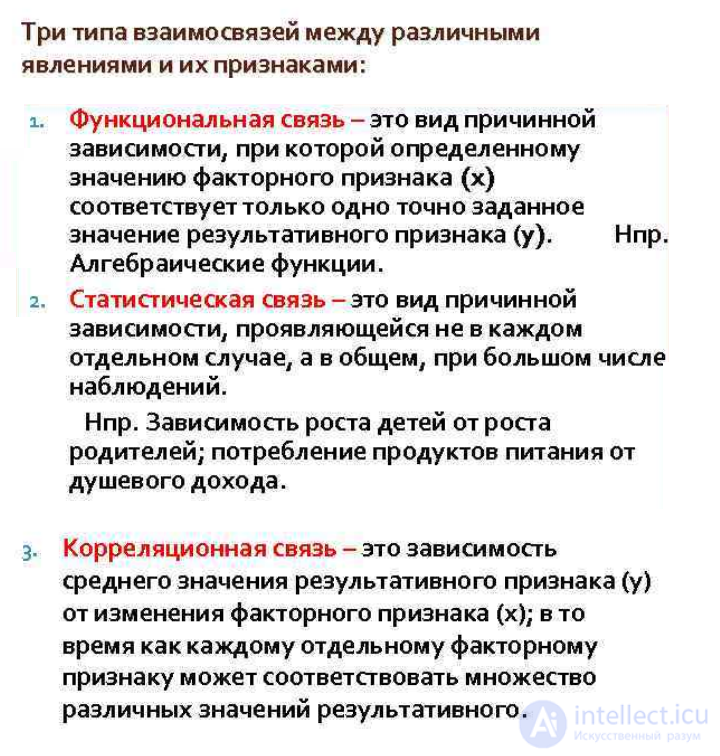
Causality is an internal relation between phenomena, their connection, in which one is always followed by another.
A cause is a phenomenon that gives rise to another phenomenon.
- A cause can only be established on the basis of reasoning.
Methods of establishing causal dependence (canons):
Causality is the subject of Immanuel Kant's third antinomy:
Logic considers four methods of establishing causal relations. They were first put forward by the 17th-century English philosopher Francis Bacon, and were comprehensively developed by the 19th-century English logician and philosopher John Stuart Mill.
The method of agreement is built according to the following scheme:
Under conditions ABC, phenomenon x occurs. Under conditions ADE, phenomenon x occurs. Under conditions AFG, phenomenon x occurs.
Presumably, condition A is the cause of phenomenon x.
Before us are three situations in which conditions A, B, C, D, E, F, G act, one of which (A) recurs in each. This recurring condition is the only thing these situations have in common. Next, one should note that phenomenon x occurs in all the situations. From this a probable conclusion can be drawn that condition A is the cause of phenomenon x (one of the conditions keeps recurring, and the phenomenon keeps occurring along with it, which gives grounds to link the first and the second by a cause-and-effect relationship). For example, suppose one needs to establish which food product causes an allergic reaction in a person. Assume that over the course of three days an allergic reaction occurred consistently. On the first day the person ate foods A, B, C, on the second day – foods A, D, E, on the third day – foods A, F, G, i.e. over the three days only food A was eaten repeatedly, and it is most likely the cause of the allergy.
The method of difference is built as follows:
Under conditions ABCD, phenomenon x occurs.
Under conditions BCD, phenomenon x does not occur.
Presumably, condition A is the cause of phenomenon x.
As we can see, the two situations differ from one another in only one respect: in the first, condition A is present, while in the second it is absent.
Moreover, in the first situation phenomenon x occurs, while in the second it does not. On this basis one can suppose that condition A is indeed the cause of phenomenon x. For example, in air a metal ball falls to the ground sooner than a feather dropped simultaneously with it from the same height, i.e. the ball moves toward the ground with greater acceleration than the feather. However, if this experiment is carried out in a vacuum (all conditions being the same except for the presence of air), then both the ball and the feather will fall to the ground at the same time, i.e. with the same acceleration. Seeing that the difference in acceleration of falling bodies occurs in air but not in a vacuum, one can conclude that air resistance is most likely the cause of different bodies falling with different acceleration.
The method of concomitant variation is built as follows:
Under conditions A BCD, phenomenon x . 1 1 occurs. Under conditions A BCD, phenomenon x . 2 2 occurs. Under conditions A BCD, phenomenon x . n 3 3 occurs. Presumably, condition A is the cause of phenomenon x.
A change in one of the conditions (with the other conditions remaining unchanged) is accompanied by a change in the occurring phenomenon, by virtue of which it can be asserted that this condition and the given phenomenon are linked by a cause-and-effect relationship. For example, when the speed of motion is doubled, the distance traveled also doubles; if the speed increases threefold, the distance traveled also becomes three times greater. Consequently, an increase in speed is the cause of an increase in the distance traveled (naturally, over the same period of time).
The method of residues is built as follows:
Under conditions ABC, phenomenon xyz occurs. It is known that part y of phenomenon xyz is caused by condition B. It is known that part z of phenomenon xyz is caused by condition C. Presumably, condition A is the cause of phenomenon x.
In this case the occurring phenomenon is broken down into its constituent parts, and the causal connection of each of them, except one, with some condition is known. If only one part of the resulting phenomenon and only one condition out of the set of conditions producing it remain, then it can be asserted that the remaining condition is the cause of the remaining part of the phenomenon under consideration. For example, the author's manuscript was read by editors A., B., C., who made notes in it with ballpoint pens. It is known that editor B. corrected the manuscript in blue ink (y), and editor C. – in red ink (z). However, the manuscript also contains notes made in green ink (x). One can conclude that they were most likely left by editor A.
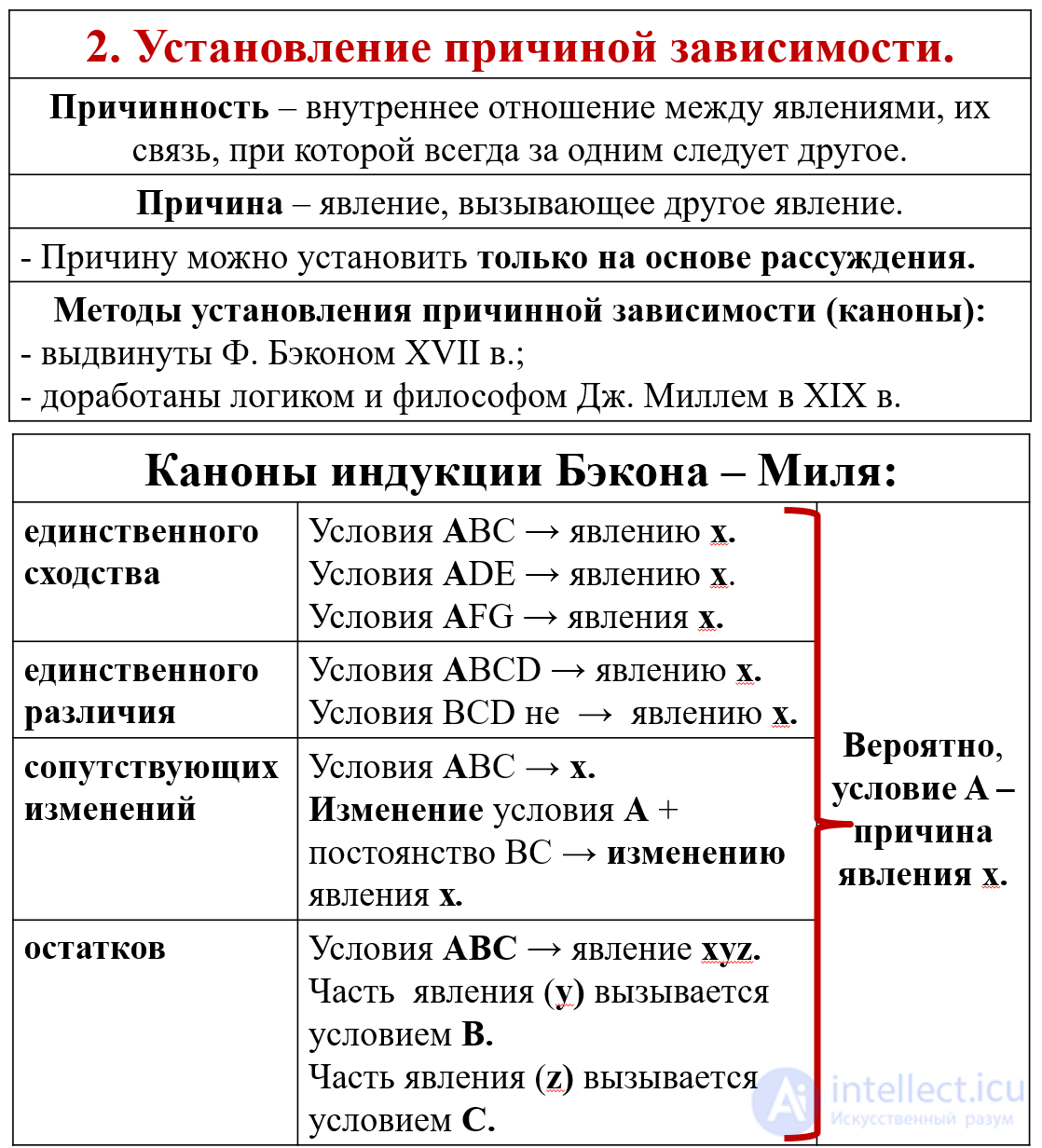
Fig. The canons of induction of Bacon – Mill:
1. What is the method of agreement? Come up with an example of using this method.
2. According to what scheme is the method of difference constructed? Come up with an example of using this method.
3. How is a causal connection established using the method of concomitant variation? Come up with an example of using this method.
4. How are the causes of occurring phenomena discovered using the method of residues? Come up with an example of using this method.
5. How are the methods of establishing causal connections usually applied in scientific and everyday thinking? Consider why the conclusions obtained by means of these methods remain only more or less probable?
6. Determine by which methods of establishing causal connections the conclusions in the following situations were obtained:
1) Observing the motion of the planet Uranus, 19th-century astronomers noticed that it deviates somewhat from its orbit. It was established that Uranus deviates by amounts a, b, c, and these deviations are caused by the influence of the neighboring planets A, B, C. However, it was also noticed that in its motion Uranus deviates not only by amounts a, b, c, but also by an amount d. From this a tentative conclusion was drawn that there exists, beyond the orbit of Uranus, a still-unknown planet causing this deviation. The French scientist Urbain Jean Joseph Le Verrier calculated the position of this planet, and the German scientist Johann Gottfried Galle found it in the celestial sphere using a telescope he had constructed. Thus, in the 19th century, the planet Neptune was discovered.
2) The leaves of a plant that grew in a cellar are not green in color. The leaves of the same plant, grown under normal conditions, are green. There is no light in the cellar. Under normal conditions the plant grows in sunlight. Consequently, it is the cause of the green color of plants.
3) Even in ancient times it was noticed that the periodicity of sea tides and the change in their height correspond to changes in the position of the Moon. The highest tides occur on the days of new moons and full moons, the lowest – on the so-called days of quadrature (when the directions from the Earth to the Moon and to the Sun form a right angle). On the basis of these observations it was concluded that sea tides are caused by the action of the Moon.
4) The effect of small doses of alcohol on the accuracy of rifle shooting at 250 m, prone, with ten cartridges, without a time limit, was studied. When the shooters were sober, 86% of the bullets hit the targets, and 14% of the bullets hit the shields. After consuming alcohol, 20% of the bullets were sent into the targets, 34% into the shields, and 46% of the bullets did not even hit the shields. Consequently, the consumption of alcohol is the cause of the decrease in shooting accuracy.

Comments