
Lecture
Logical connection (logical relationship) is a relation or link between two or more concepts, facts, or statements that rests on logical laws and rules. It indicates how one statement or concept depends on another, or how they interact with each other. Logical connection– the dependency of two scheduled operations, or of an operation and a key project event. A logical connection reflects the impossibility of performing one operation if the operation preceding it has not been completed. The following types of relationships exist: finish–start, start–start, finish–finish, start–finish.
A logical connection can be expressed in various ways, including:
Implication: a relation of cause and effect, where one statement is the logical consequence of another. For example, "If it is raining today, the streets may be wet."
Conjunction: the logical "and," indicating that both statements are true. For example, "The sun is shining, and the birds are singing."
Disjunction: the logical "or," indicating that at least one of the statements is true. For example, "You can choose red or blue."
Negation: indicates the opposite or the absence of a logical connection between statements. For example, "This is not true."
Logical connection plays an important role in reasoning, argumentation, mathematics, and programming, helping to build consistent and coherent logical thinking and conclusions.
It is widely used in logic, proofs, and programming, just as the cause-and-effect relationship is widely used in philosophy.
Logical connection has practical significance and is applied in many fields. Some of them are listed below:
Problem solving: Logical connection plays an important role in analyzing and solving problems. It helps identify the causes of a problem, determine possible solutions, evaluate their effectiveness, and choose the most logical and well-founded solution.
Scientific research: In scientific research, logical connection is used to build hypotheses, formulate assumptions, develop methodology, and analyze the data obtained. It helps substantiate conclusions and establish a logical sequence in the research process.
Critical thinking: Logical connection is an important component of critical thinking. It helps analyze information, evaluate evidence, identify flaws in argumentation, and draw well-founded conclusions.
Mathematics and logic: In mathematics and logic, logical connection is a fundamental principle. It is used to prove theorems, develop mathematical models, solve problems, and develop formal systems.
Pedagogy and education: Logical connection is of great importance in pedagogy and education. It helps develop students' logical thinking, their ability to analyze and draw conclusions, solve problems, and make well-founded decisions.
Jurisprudence and law: In law, logical connection is used to analyze legislation, formulate legal arguments and conclusions, and develop legal documents and evidence.
Information technology: In programming and software development, logical connection is applied to build algorithms, conditional statements, logical expressions, and condition checks.
In general, logical connection has broad application in various fields where analysis, reasoning, decision-making, and the development of logically substantiated conclusions are required.
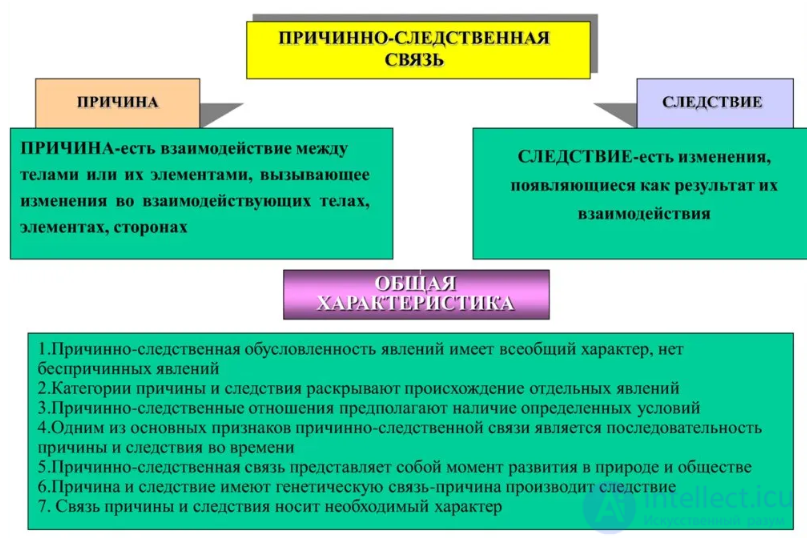
A cause-and-effect relationship is a connection between an event (the cause) and a second event (the effect), where the effect is the direct result of the cause.
Causality — a philosophical and physical concept; the causal interdependence of events in time. A determination in which the influence of one object (the cause) produces a corresponding expected change in another object (the effect). One of the forms of relation, characterized by genetic origin and necessity. Its concept underlay the mechanistic worldview and the concepts of determinism (Laplace, Spinoza).
A cause (Latin causa) is that without which there would be no effect. The relationship between a cause and an effect is called a cause-and-effect relationship.
The term causality (Latin causalis) is sometimes used as a synonym. Causality plays a crucial methodological role in scientific and everyday cognition. In control theory, causality characterizes the causal interdependence and inertia of processes in controlled objects and systems.
Logical connection and cause-and-effect relationship are two different concepts with different characteristics. Here are their differences:
Logical connection:
Example of a logical connection: If Alexey is tall, and all tall people can reach items on the top shelf, then Alexey can reach items on the top shelf.
example of a logical connection: If the website intellect.icu has words, and all people can read words, then I too will be able to read intellect.icu
Cause-and-effect relationship:
In general, logical connection is associated with logical relations and rules, while a cause-and-effect relationship refers to the link between the cause and effect of events. Logical connection is used for argumentation and proof, whereas a cause-and-effect relationship denotes the relation between a cause and its result.
Despite the differences between logical connection and cause-and-effect relationship, they also share common aspects:
In the end, logical connection and cause-and-effect relationship share common features in that both express dependency and sequence, require logical reasoning, and can be used in analysis and argumentation. However, they differ in that logical connection is based on logical laws and rules, while a cause-and-effect relationship is tied to the cause and effect of events.
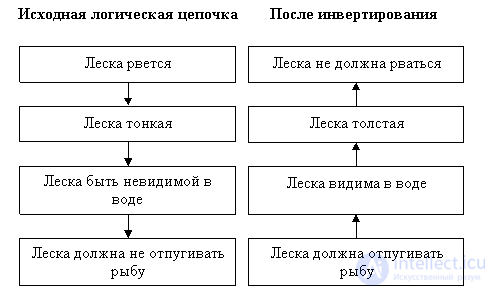
Transformation of cause-and-effect chains
if an inversion operation is applied to a cause-and-effect chain (i.e., all judgments are changed to their opposites and the direction of the arrows is reversed), a new cause-and-effect chain is obtained. Moreover, after such an operation, the transformed second cause-and-effect chain becomes a continuation of the first.
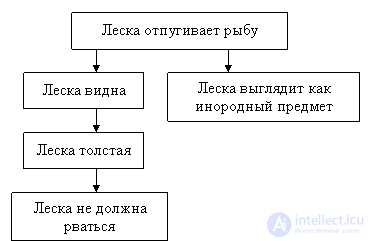
In literature and text theory, the concept of "logical connection" refers to the way in which elements of a text or ideas are linked to one another in order to create a logically consistent and coherent work.
Logical connection in literature and text theory means that the ideas, plotlines, characters, and events in a text must be linked and consistent. It ensures the logical integrity and readability of the work.
Logical connection in a text can be expressed in various ways:
Logical connection in literature and text theory is an important aspect of creating a quality work that will be logical, understandable, and coherent for the reader.

Example exercise for reinforcing the material
Establish the logical connection between the paragraphs of the essay.
Option 1
Option 2
Answer options
In psychology and pedagogy, logical connection refers to the ability to establish and understand links, logical relations, and sequences between ideas, concepts, facts, or events.
In psychology, logical connection is related to cognitive processes such as thinking, perception, analysis, and reasoning. Logical connection includes the ability to recognize and understand cause-and-effect relations, identify common features and differences, analyze and synthesize information, and draw logical conclusions. It helps people organize and structure information in their thinking.
In pedagogy, logical connection is important for the education and development of students. It is related to the development of logical thinking, the ability to analyze, reason, and draw conclusions based on logical relations. In pedagogy, emphasis is placed on developing students' ability to establish links between various facts, ideas, and concepts, as well as to apply logical principles and rules in solving tasks and problems.
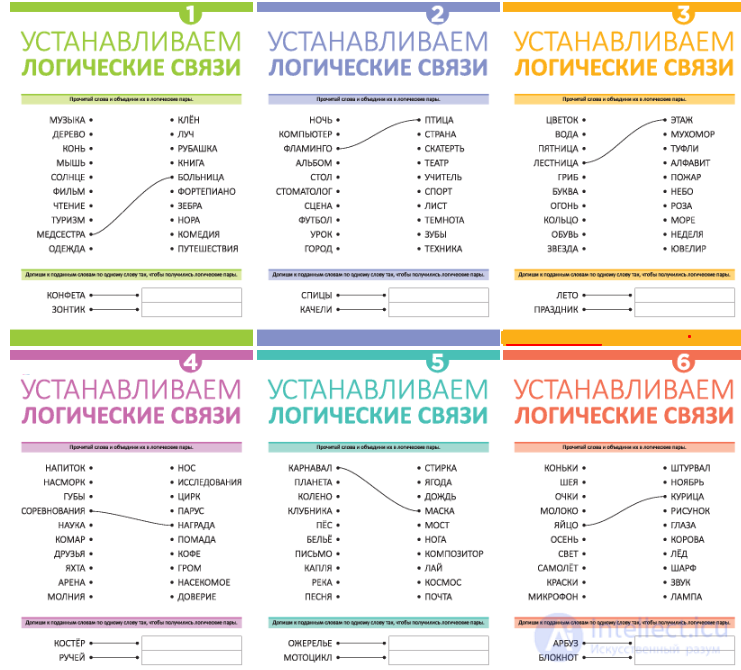
Logical connection in psychology and pedagogy helps develop analytical thinking, critical thinking, problem solving, and the capacity for abstract thought. It contributes to the formation of logical competence and the ability to adapt to new situations and tasks that require analysis and reasoning. For example, to develop logical thinking, children are given cards for establishing links in logical pairs.
Example exercise for reinforcing the material
In mathematics, logical connection refers to the way in which mathematical statements, facts, and theorems are linked and follow from one another on the basis of logical laws and rules.
Logical connection in mathematics ensures the coherence and rigor of mathematical proofs. It makes it possible to establish a sequence of steps and logical links between them in order to reach a final conclusion or solution.
Examples of logical connection in mathematics:
Implication: a logical relation of cause and effect. If statement A implies statement B (denoted A ⇒ B), this means that the truth of statement A entails the truth of statement B. This is a fundamental logical connection in mathematics and is used to prove theorems and derive logical consequences.
Quantifiers: logical operators that link variables and predicates in mathematical statements. The "for all" quantifier (∀) and the "there exists" quantifier (∃) make it possible to formulate statements that depend on all elements of a certain set, or on the existence of an element satisfying certain conditions.
Proofs: the logical connection in mathematical proofs is based on the use of logical laws, such as the laws of logic (the law of excluded middle, the law of double negation, etc.), as well as on the use of previously proven facts, definitions, and axioms.
Logical connection in mathematics helps build rigorous and reliable arguments, formulate and prove theorems, solve mathematical problems, and develop mathematical models. It provides the foundation for the development of mathematical logic and the formalization of mathematical systems.
Logical relations is a proof method used in the semantics of a programming language to show that two denotational semantics are equivalent (English: to denote — whence «denotational»).
To describe the process, let us denote the two semantics by [[−]]i , where  . For each type A , there exists a certain associated relation ∼
 between [[A]]1 and [[A]]2 . This relation is defined in such a way that for every program phrase M , the two denotations are related:[[M]]1∼[[M]]2 . Another property of this relation is that related denotations for basic types are in some sense equivalent, usually equal. Thus, it is concluded that both denotations demonstrate equivalent behavior on the basic terms and are therefore equivalent.
Denotational semantics (English: denotational semantics) assigns to expressions in a program actual mathematical objects, that is, the expressions denote (English: to denote — whence «denotational») their values. The most important, including pioneering, results in the construction of denotational semantics were obtained in the works of D. Scott (Dana Scott) and C. Strachey (Christopher Strachey) in the late 1960s — early 1970s. Scott was the first to construct a model of λ-calculus based on the notion of a complete partially ordered set. To do this, he used functions that are continuous on such a set.
In the context of databases, a logical connection refers to the link or relationship between tables that determines how the data in those tables relate to one another. Logical connection is one of the basic principles of database design and organization.
In databases, logical connection ensures data integrity and links information from different tables to establish relationships and dependencies between them. It allows data to be structured and stored efficiently, and also makes it possible to perform join, selection, and modification operations on data based on their relationships. A relationship is established between two common fields (columns) of two tables.
Relationships that can exist between the records of two tables:
Logical connection in databases helps ensure the structuring of data, prevent duplication of information, and ensure the integrity of the database. It also makes it possible to perform complex queries, analyze data, and create related views of information. There are various notations for recording these relationships; physically, these relationships are provided by normalizing tables, adding keys, and constraining fields.
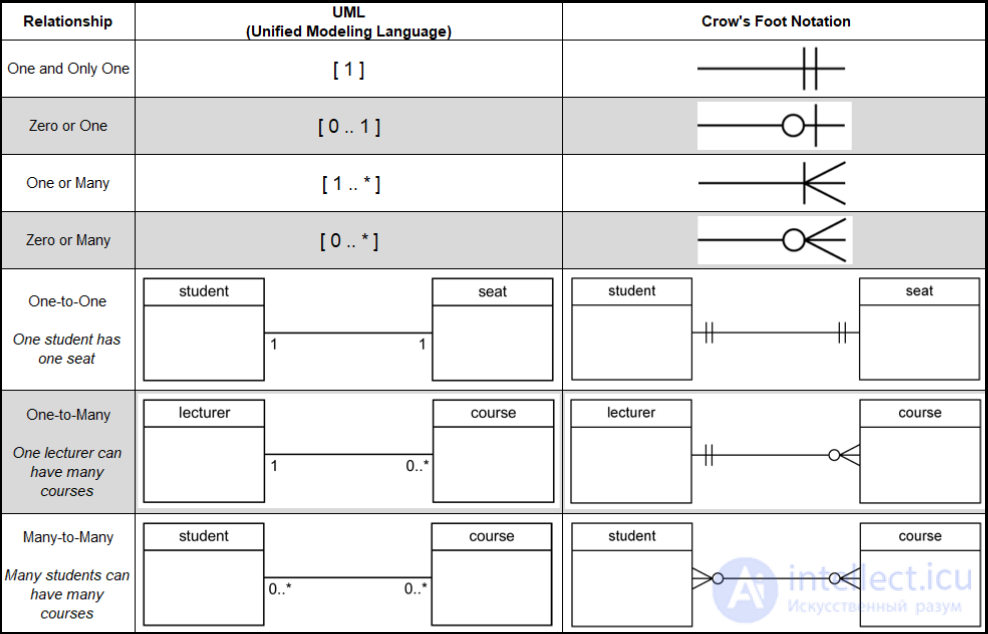
In databases, logical relationships are provided using key fields (or key columns) and links between tables. They define the relationships between data in different tables and ensure the integrity and consistency of the data.
Here are some of the basic steps typically taken to create logical relationships in a database:
It is important to note that the process of creating and configuring logical relationships may differ depending on the specific database management system (DBMS) and the chosen data model (for example, the relational data model). However, the principles of relationships and ensuring data integrity are common to most databases.
Logical connection is the way in which elements, ideas, or facts are linked to one another on the basis of logical laws and rules. It plays an important role in various fields, such as literature, text theory, psychology, pedagogy, and mathematics.
In literature and text theory, logical connection ensures the logical integrity and coherence of a work, the harmonious development of the plot, and the logical organization of ideas. It makes it possible to establish cause-and-effect relationships, highlight common themes and ideas, and logically structure the text.
In psychology and pedagogy, logical connection helps develop cognitive processes such as thinking, analysis, and reasoning. It fosters the development of logical thinking, the ability to establish links between ideas and facts, and the application of logical principles in problem solving.
In mathematics, logical connection is fundamental to constructing mathematical proofs and deriving logical consequences. It makes it possible to establish links between mathematical statements and apply logical operators, such as implication and quantifiers.
What is common to all these fields is that logical connection provides structure, sequence, and logical integrity to information. It helps organize thoughts, draw well-founded conclusions, make decisions, and reach logical conclusions. Logical connection plays an important role in developing analytical thinking, critical thinking, and the ability to reason logically.
In sum, logical connection is an integral part of various fields of knowledge and contributes to a logical, consistent, and coherent presentation of information. It helps us build logically sound arguments, solve problems, and improve our thinking.

Comments