The test on the discipline «Logic and Theory of Argumentation» was developed to assess the knowledge of journalism faculty students, and their theoretical and practical training in this course. The purpose of the test is interim monitoring of students’ knowledge. The number of questions in the test – 100. Test completion time – 25 minutes. Type of tasks – closed-type tasks. The difficulty level of the tasks and their content fully comply with the State Educational Standard (GOS) requirements for the course. Grading system: - for a correct answer (regardless of the type of task and topic) – 2 points; - for an incorrect answer – 0 points.
Topic «Concept»
1. Logic is:
- the science of inferences and proofs;
- the science of the rules of thinking;
- * the science of the forms and laws of thinking;
- the science of the forms and laws of cognition.
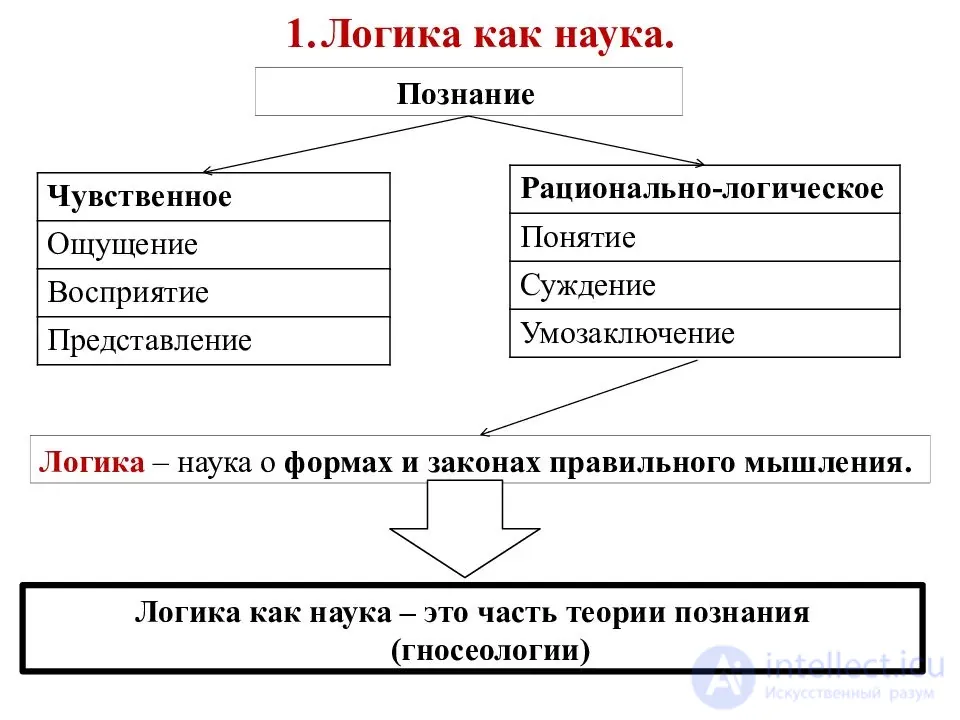
2. The creator of logic is considered to be the ancient Greek philosopher:
- Anaximenes;
- Anaxagoras;
- Antisthenes;
- * Aristotle;
3. Why is it necessary to study logic:
- to win any argument;
- * to reason with proof, and not make logical errors;
- to avoid unpleasant discussions and not to argue with superior authorities.
4. A concept is:
- a word or phrase;
- * a form of thinking;
- a true thesis;
- a certain object.
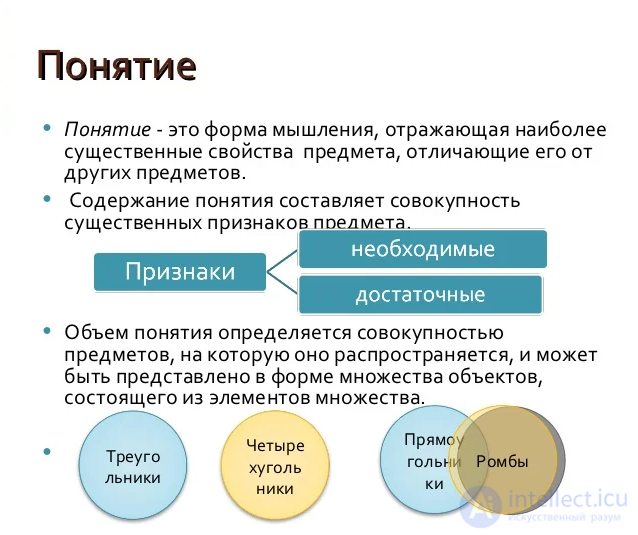
5. The concepts «spring day» and «sunny day» are in the relation of:
- subordination;
- coordination;
- opposition;
- * intersection;
6. A singular concept is:
- Zmey Gorynych;
- a Harvard student;
- Desert;
- * Aristotle.
7. Any concept has:
- magnitude;
- * extension;
- size;
- shape.
8. Determine the correctness of the following definition; if it is incorrect, indicate which rule of definition is violated «Life is the sum of vital functions»:
- the definition must be precise and clear;
- the rule of proportionality: too broad a definition;
- the rule of proportionality: too narrow a definition;
- * the definition is circular.
9. The concepts «measurement» and «weighing» are in the relation of:
- equivalence;
- * subordination;
- intersection;
- coordination.
10. Check the correctness of the division of the concept: in an incorrect division determine which rules are violated «School subjects are divided into compulsory and optional»:
- the rule of proportionality is violated;
- the rule is violated: a division must have a single basis:
- * dichotomy;
- the rule of continuity of division is violated,
11. Determine the type of the following concept «A philosophical work of Socrates»:
- general;
- * empty;
- singular.
12. Any concept is expressed in the form of:
- a simple sentence;
- a complex sentence;
- * a word or a phrase;
- connected text.
13. The content of a concept is:
- the totality of all objects that it covers;
- * the most important attributes of the object that it expresses;
- the word or phrase in which it is expressed;
- the object that it denotes.
14. The extension of a concept is the totality of:
- * objects covered by this concept;
- all words or phrases that can express it;
- all meanings that can be put into it;
- the most important attributes of the object that it denotes;
15. «The Sun» is a concept:
- * singular;
- null;
- general;
- astronomical.
16. The concepts «black raven» and «black square» are in the relation of:
- equivalence;
- subordination;
- intersection;
- * coordination.
17. «Stupidity» is a concept:
- concrete;
- * abstract;
- negative;
- psychological.
18. Which attributes are essential for the concept «human being»?
- white skin color;
- curly hair;
- * the presence of consciousness;
- the ability to laugh and make others laugh.
19. «Slob» is a concept:
- * positive;
- negative;
- neutral;
- empty;
- collective.
20. A concept that is greater in extension is called:
- a species concept;
- * a genus concept;
- null;
- general;
21. The concepts «star» and «constellation» are in the relations of:
- subordination;
- intersection;
- exclusion;
- * coordination.
22. Relations between concepts are depicted by:
- * Euler circle diagrams;
- Boyler circle diagrams;
- Pager circle diagrams;
- Aristotle circle diagrams.
23. Determine the type of relation between the concepts «law», «morality»?
- subordination;
- intersection;
- exclusion;
- * coordination.
24. The definition «Existentialism is a 20th-century philosophical movement that examines various existential questions and problems», is:
- ambiguous;
- * circular;
- narrow;
- philosophical.
25. Determine the type of relation between the concepts «bribery», «embezzlement»?
- subordination;
- intersection;
- exclusion;
- * coordination.
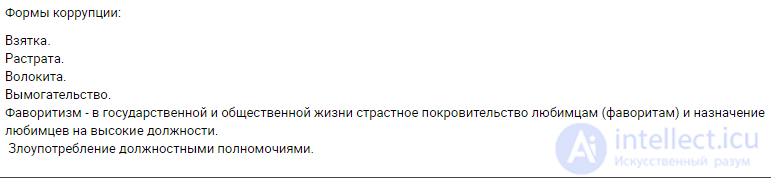
26. A possible result of limitation for the concept «crime rate» is the concept:
- crime;
- grave crime;
- apartment theft;
- * high crime rate;
- criminal community;
- criminality.
27. Division of a concept reveals its:
- content;
- form;
- meaning;
- * extension.
28. The definition «Logic is not parapsychology and not palmistry»:
- incorrect (disproportionate);
- incorrect (ambiguous);
- * incorrect (only negative);
- incorrect (contains a circle).
29. Find the concept:
- * a first-year student at Harvard.
- I am a student at Harvard.
- this student studies at Harvard.
- there are excellent students in our group.
30. the mental combination of an object’s attributes into a single whole:
- comparison;
- generalization;
- * synthesis;
- analysis.
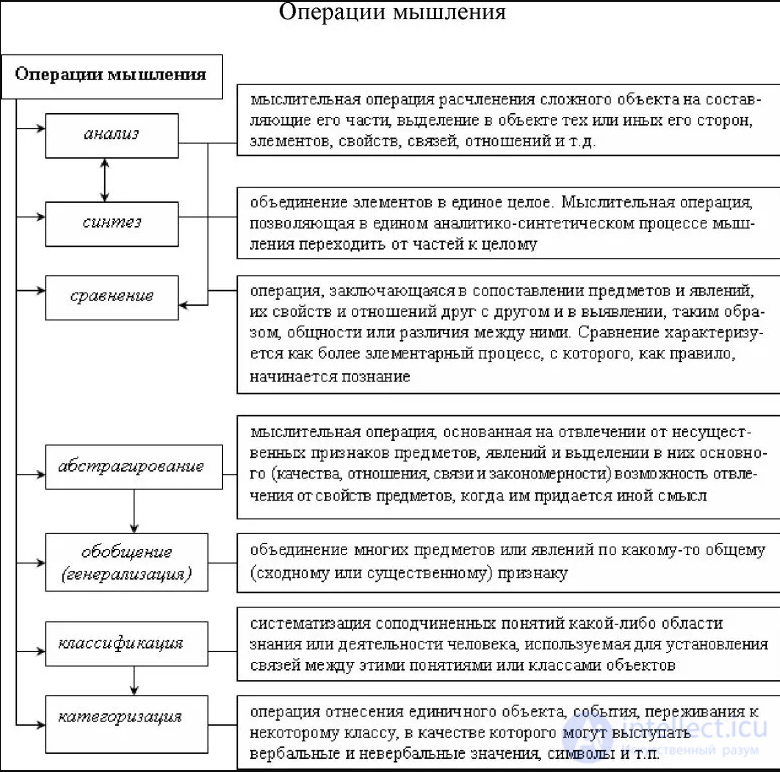
31. Determine the correctness of the following definition; if it is incorrect, indicate which rule of definition is violated«A diplomat is a person who remembers a lady’s birthday but does not remember her age»:
- * the definition must be precise and clear;
- the rule of proportionality: too broad a definition;
- the rule of proportionality: too narrow a definition;
- the definition is circular.
32. find the correct variant of generalization of the concept:
- * flower – plant;
- flower – stem;
- flower – bouquet of flowers;
- flower – tulip.
33. Name the most important logical characteristics of a concept:
- quality and quantity;
- truth and falsity;
- * content and extension;
- affirmative and negative.
34. In the division «People are men, women, athletes, and dancers», an error was made:
- a leap in division;
- quadrupling of terms;
- * substitution of the basis;
- hasty generalization.
35. Choose the correct variant of the logical operation of limitation of the concept «society»:
- * primitive society;
- a collection of people;
- the result of human activity;
- a company.
36. The mental division of an object of thought into its elements?
- abstraction;
- synthesis;
- generalization;
- comparison;
- * analysis
37. the definition «Money is what people die for, and what chickens don’t peck»:
- incorrect (too narrow);
- incorrect (too broad);
- incorrect (contains a circle);
- * incorrect (a haphazard definition)
38. A possible result of limitation for the concept «pencil» will be the concept:
- writing implement;
- stationery item;
- wooden object;
- * broken pencil;
- a man-made product.
39. The limit of the logical chain of limitation of any concept will always be some:
- null concept;
- concrete concept;
- non-collective concept;
- * singular concept;
40. Which of the listed names is empty in meaning?
- the President of France;
- the President of the USA;
- the President of Russia;
- * the President of Great Britain.
41.Choose the correct variant of the logical operation of generalization of the concept «newspaper»:
- periodical publication;
- weekly newspaper;
- the official organ of the Russian Government «Rossiyskaya Gazeta»;
- * mass medium.
42.What relation do the extensions of the names «student» and «athlete» have:
- subordination;
- coincidence;
- * intersection;
- Exclusion.
43. concepts in which what is reflected is not the object, event, or thought itself, but their attributes, which are thought of independently from their bearer, these are:
- Proper;
- Positive;
- * Abstract;
- Null (empty).
44. Incompatible concepts cannot be in the relation of:
- * subordination;
- coordination;
- opposition;
- contradiction.
45. Euler diagrams are:
- diagrams in the shape of squares;
- * circle diagrams;
- mathematical diagrams;
- tables.
46. Find the correct variant of limitation of the concept «Capital»:
- * Kyiv – the capital of Kievan Rus;
- Kyiv– a city;
- capital – the capital of Kievan Rus;
- Kyiv – a district of Kyiv.
Tests on the topic «Judgment»
47. A judgment is:
- a sentence;
- a generalized concept;
- * a form of thinking;
- a law of thinking.
48. A judgment is expressed in the form of:
- * a declarative sentence;
- an interrogative sentence;
- an imperative sentence;
- a phrase.
49. The structure of a simple judgment does not include:
- the subject of the judgment;
- the predicate of the judgment;
- the quantifier;
- * a syllogism.
50. True or false can be:
- a concept;
- * a judgment;
- a term;
- a quantifier.
51. The following judgment is not an implication:
- if it rains, the excursion will not take place;
- * there’s elderberry in the garden, and an uncle in Kyiv;
- sow the wind – reap the whirlwind;
- smoking is harmful to health.
52. The subject matter of a judgment is called:
- meaning;
- * subject;
- copula;
- predicate.
53. Two contradictory judgments about two different objects cannot be:
- simultaneously true;
- simultaneously false;
- one – true, the other – false;
- * neither true nor false, each of them.
54. The judgment «All people are not monkeys», is a judgment of the type:
- universal negative;
- particular affirmative;
- * universal affirmative;
- particular negative.
55. The compound judgment «If it rained in the morning, then it cleared up by noon», is:
- a conjunction;
- an equivalence;
- * an implication;
- an existential judgment.
56. The judgment «God does not exist», is:
- relational;
- * existential;
- attributive;
- religious;
- incorrect.
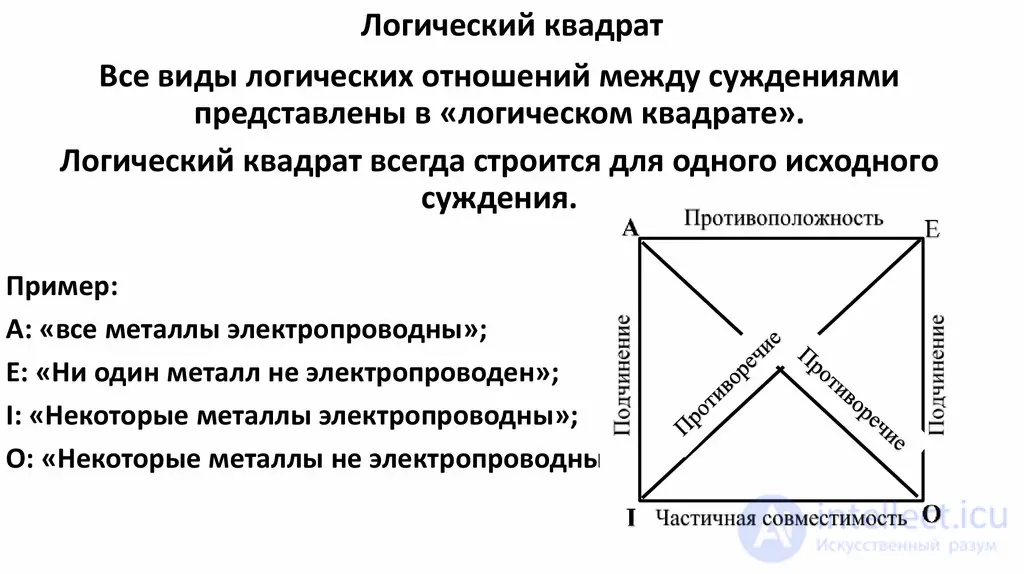
57.Which relation in the square of opposition reflects the statement «Of two judgments, one must be true, and the other – false»:
- * contradiction;
- contrariety;
- subordination;
- subcontrariety.
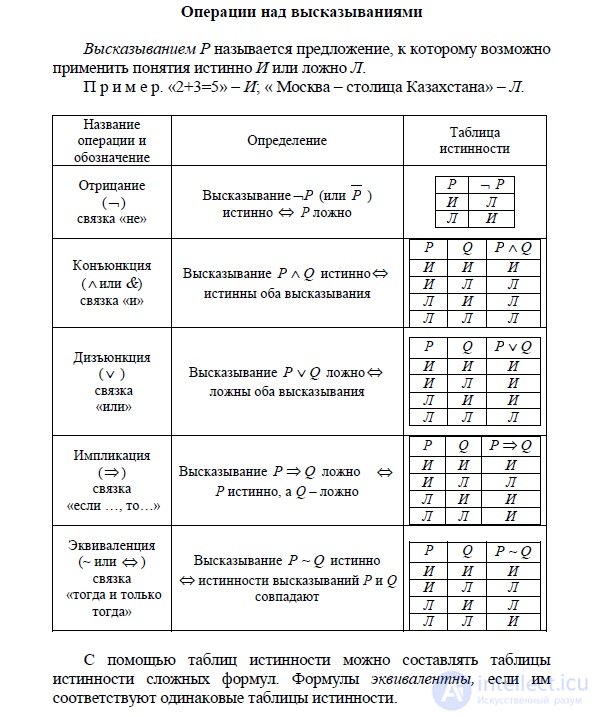
58. In modern formal logic the symbol «&» is named:
- implication;
- negation;
- disjunction;
- * conjunction.
59.In modern formal logic the symbol «↔» is named:
- negation;
- * equivalence;
- conjunction;
- implication.
60. Which relation in the square of opposition reflects the statement «Two judgments can be simultaneously true, but cannot be simultaneously false»:
- subordination;
- contradiction;
- * subcontrariety;
- Contrariety
61. In modern formal logic the symbol «→» is named:.
- disjunction;
- conjunction;
- * implication;
- negation.
62. How many concepts are linked in a simple judgment and what are they:
- quantifier and copula;
- * subject, predicate, quantifier, copula;
- subject and predicate;
- subject, predicate, and copula.
63. The compound judgment «Sow the wind – reap the whirlwind», is:
- * an implication;
- a conjunction;
- a disjunction;
- equivalence
64.Determine whether the following sentence expresses a judgment? «Farewell, free element!»:
65. Name the most important characteristics of a judgment:
- positive and negative;
- * truth and falsity;
- declarative and interrogative;
- immediate and mediated.
66. Determine the type of modality in the following judgment «It is unknown what transport will be like in a hundred years»:
- alethic;
- * epistemic;
- deontic;
- axiological
67. Name the main forms of abstract thinking:
- * concepts, judgments, and inferences;
- sensation, perception, representation;
- definiteness, consistency, non-contradiction;
- statements, sayings, quotations.
68. The attributive judgment is:
- Kyiv was founded earlier than Moscow.
- eternal laws of the world exist.
- miracles do not happen.
- * a human being is a rational living creature.
69. The compound judgment «Midnight is already approaching, and still Herman is not here», is:
- a disjunction;
- an equivalence;
- * a conjunction;
- an implication.
70. Which relation in the square of opposition reflects the statement «Both judgments cannot be simultaneously true, but can be false»:
- subordination;
- contradiction:
- * contrariety;
- subcontrariety.
71. Find the judgment:
- a passed exam;
- a failed exam in logic;
- * we passed the exam;
- the hardest exam of my life.
72. Conjunction is the name of the logical operation expressed in language by the conjunction:
- * «and»;
- «or»;
- «if…, then…»;
- «if, and only if…, then…».
73. Determine the type of modality in the following judgment «Smoking is not allowed on university premises»:
- alethic;
- epistemic;
- * deontic;
- axiological
74. The attributive judgment is:
- Kyiv was founded earlier than Moscow;
- * a human being is a rational living creature;
- miracles do not happen.
75. Determine the type of modality in the following judgment «Columbus was convinced that he had reached China»:
- alethic;
- * epistemic;
- deontic;
- axiological
76. Which relation in the square of opposition reflects the statement: «Two judgments can be simultaneously true, but cannot be simultaneously false»:
- subordination;
- contradiction;
- * subcontrariety;
- contrariety
77. Determine the type of modal judgment «It is possible that life exists on Mars»:
- deontic;
- * alethic;
- epistemic;
- axiological.
78. Determine the type of the simple judgments: «There is no story more woeful in the world Than that of Romeo and Juliet» (Shakespeare)
- attributive;
- * relational;
- existential.
79. Find the judgment:
- an equilateral triangle.
- * it is cold outside.
- the first president of the USA.
- a broken pencil.
80. A general concept is not:
- * dry water.
- a Muscovite.
- an engine.
- a deep lake.
81. In modern formal logic the symbol «↔» is named:
- negation;
- * equivalence;
- conjunction;
- implication.
82. Which types does the judgment «Being determines consciousness» belong to?
- singular judgment;
- attributive judgment;
- judgment of existence;
- * judgment of relation;
- affirmative judgment.
83. The compound judgment is:
- only a specialist can solve some of the problems in this textbook;
- * he is an educated person, and it is not true that he has a poor memory;
- all transactions that do not comply with the requirements of the law are invalid;
- a woman, beautiful, still young, beautifully dressed, with a pleasant smile, bent over the water.
84. A strict disjunction is the following judgment:
- he is engaged in painting, or music, or literature.
- Nelli and Katya are friends, or simply live nearby.
- if a number is odd, then it is divisible by two.
- * Ivan is either the son, or the grandson, of Pyotr Vasilyevich.
85. determine the type of judgment «Nothing exists without a cause»:
- * existential;
- relational;
- attributive.
86. Determine the type of modality in the following judgment: «Probably, gold was one of the first equivalents of money».
- deontic;
- alethic;
- * epistemic;
- axiological;
- temporal.
87. What is a law of thinking?
- a law of pure and correct thought;
- an internal connection between statements that recur often and definitely;
- * an internal, essential, stable, necessary, recurring connection between
- the elements of thought and the thoughts themselves;
- an objective, internal connection between statements, as well as between the structural elements of statements.
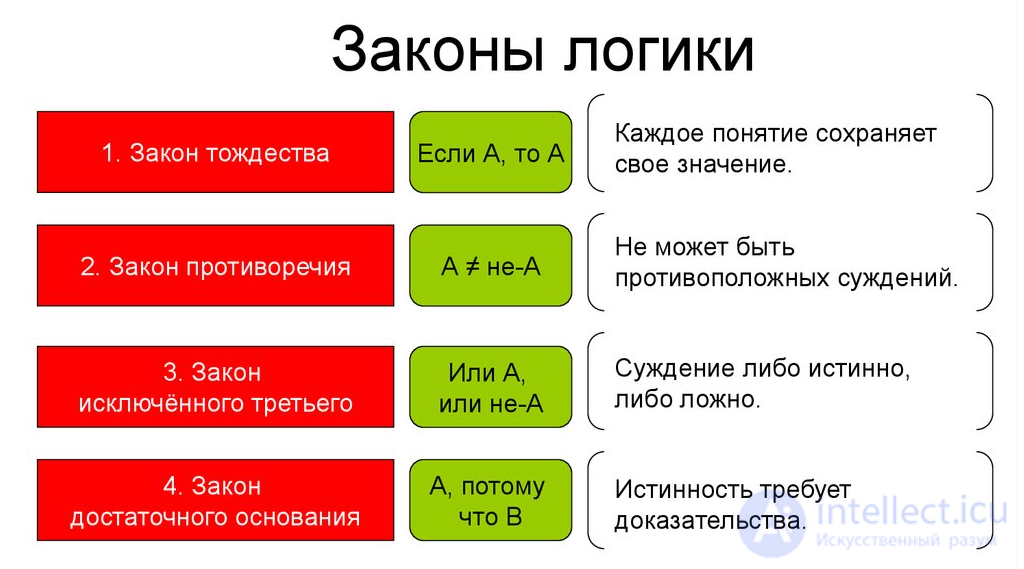
88. Which formal-logical law can be written as follows: «A is A»
- the law of excluded middle;
- the law of (non-)contradiction;
- * the law of identity;
- the law of sufficient reason.
89. Which formal-logical law can be written as follows? «Either A is B, or A is not B».
- the law of identity;
- the law of sufficient reason;
- * the law of excluded middle;
- the law of (non-)contradiction.
90. A necessary, essential, stable, recurring connection between thoughts is:
- a scientific hypothesis;
- an initial premise;
- * a law of thinking;
- a law of nature.
91. Which formal-logical law can be written as follows?
- «A cannot at the same time be B and not B»
- the law of sufficient reason
- the law of identity;
- the law of excluded middle;
- * the law of (non-)contradiction.
92. Every thought is recognized as true if it has sufficient reason:
- * the law of sufficient reason;
- the law of excluded middle;
- the law of non-contradiction;
- the law of identity
93. By whom was the law of sufficient reason formulated:
- Hegel;
- Aristotle;
- * Leibniz;
- Bacon.
94. Every thought, in the process of reasoning, is identical to itself:
- the law of sufficient reason;
- the law of excluded middle;
- the law of non-contradiction;
- * the law of identity
95. determine the modality of the judgment: «It is necessary to measure everything that is measurable, and to make measurable what is not» (G. Galileo):
- deontic;
- alethic;
- epistemic;
- axiological.
96. Determine the type of modal judgment: «A person is indifferent to state property»:
- deontic;
- alethic;
- epistemic;
- axiological.
97. The sign above the stairs in the metro in the form of a crossed-out figure of a person is:
- a sign – index;
- a sign – icon;
- a sign – symbol;
- *a combination of a sign – icon and a sign – symbol.
98. The following judgment is not modal:
- cats never make friends with mice.
- * some people have never been to the sea.
- no rabbit is a predatory animal.
- sometimes people say foolish things.
99. The type of compound judgment «What is actual is rational, and what is rational is actual» (Hegel) is:
- disjunction;
- equivalence;
- conjunction;
- implication.
100. To which type of compound judgment does the reasoning «Thinking what you say and saying what you think are not at all the same thing» belong:
- implication;
- conjunction;
- disjunction;
- equivalence
See also
- [[b5646]]
- [[b9563]]
- [[b9796]]
- [[b9797]]
- [[b9798]]
- [[b5645]]
- [[b5643]]
- [[b5647]]
- [[b834]]
- [[b835]]
- [[b836]]
- [[b5647]]
- [[b9494]]
- [[b5645]]
See also
- 100 interesting logic tasks with answers and comments
- Logic Tests and Answers on Sorites, Mood, Reasoning, Enthymeme, Epicheirema, Polysyllogisms and Syllogisms
- Logic Tests with Answers, Part 1
- Logic Tests with Answers, Part 2
- Logic Tests with Answers, Part 3
- 100 logic tests with answers
- 6.3 Other laws of logic. The law of identity The law of contraposition The laws of de Morgan Modus ponens and modus tollens. Approving-denying and denying-approving modes. Constructive and destructive dilemmas. Law of Clavia
- Glossary of Logic Terms
- Judgment is an abstract thought.
- Inference is an abstract thought in which the conclusion is derived from the premise
- A concept is an abstract thought that distinguishes an object as a system of all its essential properties.
- Glossary of Logic Terms
- Logic as a Science: Its History, Concepts, Laws and Functions. What Is the Value of Logic? What Does Logic Teach?
- 100 logic tests with answers


Comments