You get a bonus - 1 coin for daily activity. Now you have 1 coin

Logic Tests with Answers, Part 1

Lecture


Logic tests with answers

1. Abstraction is:

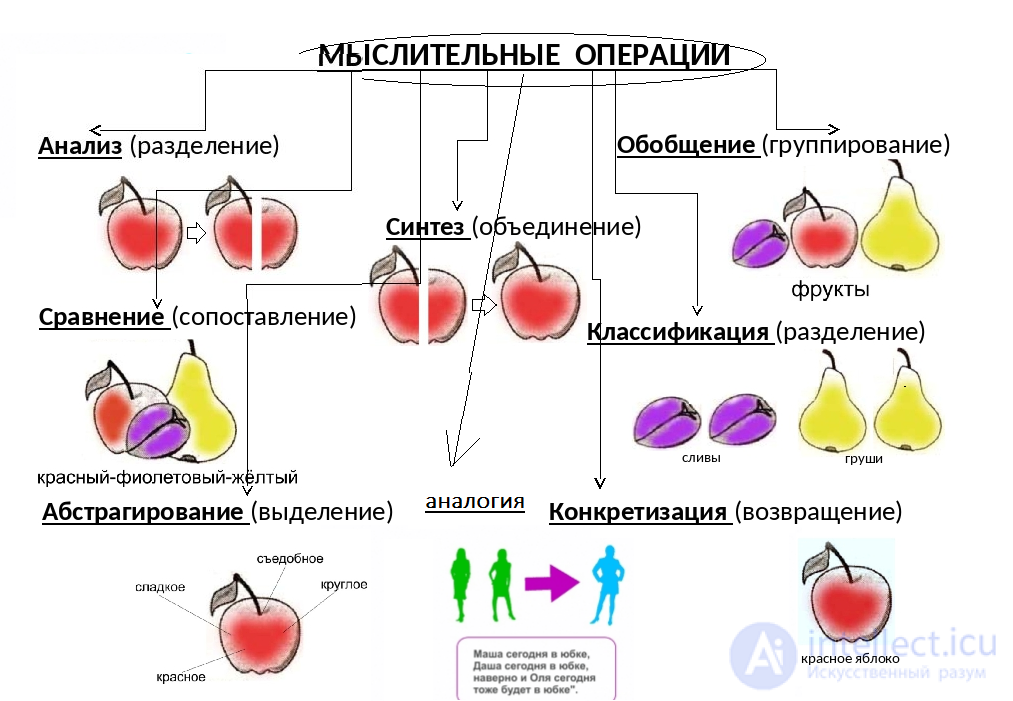
  • 1) a logical method of forming concepts
  • 2) a law of logic
  • 3) a similarity between concepts

answer: at the bottom of the page, or figure it out yourself
Logic Tests with Answers, Part 1
2. Analogy is:

  • 1) a rule of induction
  • 2) an error in a syllogism
  • 3) a law of logic
  • 4) a compound proposition
  • 5) a type of inference

answer: at the bottom of the page, or think it through yourself

3. In the joke: - Do you have color TVs? - Yes. - Then give me a yellow one - the following is violated:

  • 1) the law of contradiction
  • 2) the law of ambiguity
  • 3) the law of the joke
  • 4) the law of identity
  • 5) the law of excluded middle

answer: at the bottom of the page, or work it out yourself
Logic Tests with Answers, Part 1

4. In the division «People are men, women, athletes, and dancers» the following error was made:

  • 1) a jump in division
  • 2) quadruplication of terms
  • 3) ambiguity
  • 4) substitution of the basis
  • 5) hasty generalization

answer: at the bottom of the page


5. At the beginning of its formation, logic existed as part of:

  • 1) philosophy
  • 2) art
  • 3) ideology
  • 4) mathematics
  • 5) political science

answer: at the bottom of the page


6. A possible result of generalizing the concept «car wheel» would be the concept

  • 1) automobile
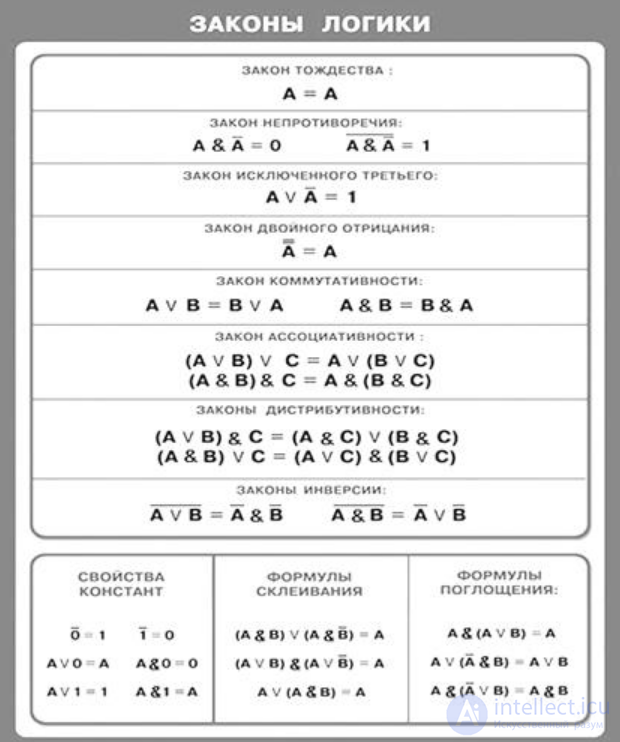
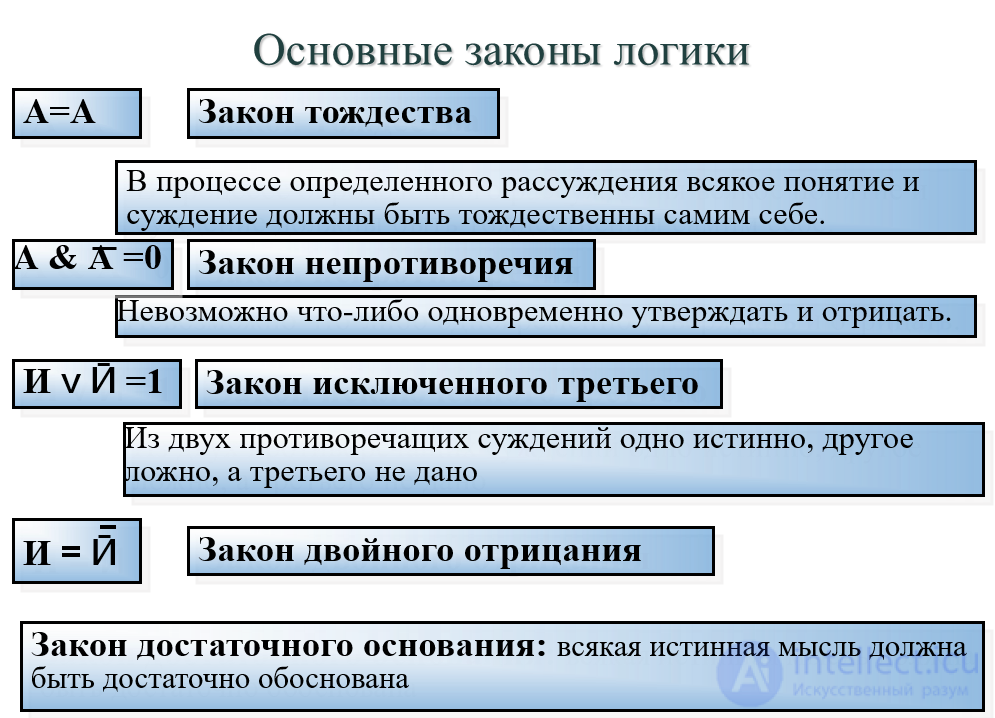
  • 2) means of transportation
  • 3) a huge wheel
  • 4) a man-made product

answer: at the bottom of the page


7. A possible result of limiting the concept «pencil» would be the concept:

  • 1) writing instrument
  • 2) stationery item
  • 3) wooden object
  • 4) a broken pencil
  • 5) a man-made product

answer: at the bottom of the page


8. In the syllogism below, check the correctness of the conclusion; if the conclusion is incorrect, determine which rule of the syllogism has been violated: All secretaries are engaged in useful work.Some birds are secretaries.____________________ Therefore, some birds are engaged in useful work -

  • 1) if one of the premises of the proposition is particular, then the conclusion must also be particular
  • 2) the conclusion is correct
  • 3) the middle term in one of the premises is not distributed
  • 4) no conclusion can be drawn from two particular propositions
  • 5) incorrect: the syllogism has more than 3 terms

answer: at the bottom of the page


9. In the syllogism below, check the correctness of the conclusion; if the conclusion is incorrect, determine which rule of the syllogism has been violated: Not all of A.P. Chekhov's works can be read in one day. «The Darling» – is a work by Chekhov.______________________ Therefore, «The Darling» cannot be read in one day -

  • 1) the conclusion is correct
  • 2) incorrect: the syllogism has 4 terms
  • 3) the middle term is not distributed in the premises
  • 4) to obtain a negative conclusion, the premise must also be negative
  • 5) no conclusion can be drawn from two negative propositions
  • 6) terms not taken in their full extent in the premises cannot be taken in their full extent in the conclusion

answer: at the bottom of the page


10. In the syllogism below, check the correctness of the conclusion; if the conclusion is incorrect, determine which rule of the syllogism has been violated: Some religions do not permit polygamy. All religions sanctify marriage.______________________________ Therefore, some religions sanctify polygamy -

  • 1) the conclusion is correct
  • 2) a syllogism should have no more than 3 terms
  • 3) no conclusion whatsoever can be drawn from two negative propositions
  • 4) the middle term is not distributed in the premises
  • 5) incorrect: if a premise is negative, the conclusion must also be negative

answer: at the bottom of the page


11. In the syllogism below, check the correctness of the conclusion; if the conclusion is incorrect, determine which rule of the syllogism has been violated: Spouses must support each other financially. M. and N. support each other.___________________ Therefore, M. and N. are spouses -

  • 1) the conclusion is correct
  • 2) the conclusion is incorrect: the middle term is not distributed in the premises
  • 3) a syllogism should have three terms
  • 4) terms not taken in their full extent in the premises cannot be taken in their full extent in the conclusion either
  • 5) no conclusion can be drawn from two particular propositions

answer: at the bottom of the page


12. A logical error is possible in the process of reasoning because:

  • 1) human thinking itself is a poorly studied area
  • 2) a person in principle cannot know the world
  • 3) the subject intentionally or unintentionally violates the rules of thinking

answer: at the bottom of the page


13. In the reasoning: «When working on a lathe, the workpiece and the cutting tool heat up from friction, and the faster the chuck of the lathe rotates, the stronger their heating; therefore, the speed of rotation of the chuck is the cause of the degree of heating of the workpiece and the tool» - the conclusion was obtained by:

  • 1) the method of agreement
  • 2) the method of difference
  • 3) the method of concomitant variation
  • 4) the method of conducted observation
  • 5) the method of conducted experiment

answer: at the bottom of the page


14. In the syllogism: Ancient Romans were politicians, orators, or writers. Cicero was a politician.____________________________________ Cicero was neither an orator nor a writer - an error has been made:

  • 1) quadruplication of terms
  • 2) substitution of the basis
  • 3) hasty generalization
  • 4) non-strict (inclusive) disjunction
  • 5) violation of conjunction

answer: at the bottom of the page


15. In the syllogism: Laws are eternal principles of nature. Universal military conscription is a law ___________________. Universal military conscription is an eternal principle of nature - an error has been made:

  • 1) substitution of the basis
  • 2) quadruplication of terms
  • 3) hasty generalization
  • 4) non-strict (inclusive) disjunction
  • 5) tautology

answer: at the bottom of the page


16. In the inference:Vasya Sidorov is a failing student, Petya Smirnov is a failing student, Sasha Ivanov is a failing student, Vasya Sidorov, Petya Smirnov, Sasha Ivanov are students of class 6 «B», All students of class 6 «B» are failing students - an error has been made:

  • 1) popular induction
  • 2) incomplete induction
  • 3) violation of induction
  • 4) non-strict induction
  • 5) none of the above

answer: at the bottom of the page


17. Choose the correct variant of the logical operation of generalization for the concept “electron”:

  • 1) conductor
  • 2) atom
  • 3) molecule
  • 4) elementary particle

answer: at the bottom of the page


18. Choose the correct variant of the logical operation of conversion for the following proposition: «All economic laws are objective»

  • 1) all objective laws are economic
  • 2) some objective laws are economic
  • 3) cannot be converted
  • 4) some economic laws are objective

answer: at the bottom of the page

19. Choose the correct variant of the logical operation of limitation for the concept «society»:

  • 1) primitive society
  • 2) a collection of people
  • 3) an association of people
  • 4) the result of people's activity
  • 5) a campaign

answer: at the bottom of the page


20. Choose the correct variant of the logical operation of obversion for the following proposition: «No court verdict should be unfounded» -

  • 1) all court verdicts should be well-founded
  • 2) all court verdicts should be unfounded
  • 3) no court verdict should be well-founded
  • 4) all court verdicts should not be well-founded

answer: at the bottom of the page


21. Choose the correct variant of the logical operation of contraposition of the predicate for the following proposition: «Some doctors are neurologists» -

  • 1) all neurologists are doctors
  • 2) some non-neurologists are doctors
  • 3) cannot be transformed
  • 4) no neurologist is a non-doctor

answer: at the bottom of the page


22. Inferential knowledge (knowledge derived from premises) is studied by:

  • 1) mathematical logic
  • 2) formal logic
  • 3) dialectical logic
  • 4) symbolic logic

answer: at the bottom of the page


23. The statement: «Human concepts are not static, but eternally move and pass into one another; without this they would not reflect living life» - belongs to:

  • 1) Socrates
  • 2) Aristotle
  • 3) V.I. Lenin
  • 4) F. Bacon
  • 5) G.W. Leibniz

answer: at the bottom of the page


24. Determine whether the requirement of the law of sufficient reason is violated here: All students study economics. Semyonov studies economics. Therefore he is a student.

  • 1) yes
  • 2) no

answer: at the bottom of the page


25. G.W. Leibniz considered the main function of logic to be:

  • 1) factologization
  • 2) calculus
  • 3) argumentation
  • 4) proof

answer: at the bottom of the page


26. «Stupidity» - is a concept that is:

  • 1) concrete
  • 2) abstracted
  • 3) abstract
  • 4) negative

answer: at the bottom of the page


27. The following diagram:
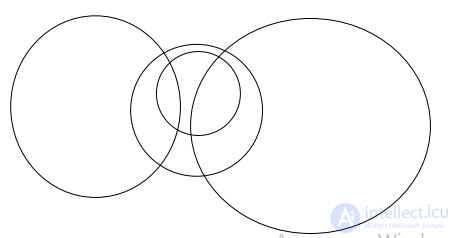
Logic Tests with Answers, Part 1
- corresponds to the following group of concepts:
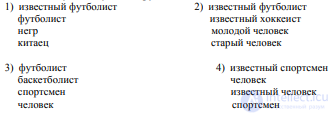
Logic Tests with Answers, Part 1
28. Two concepts, the extension of one of which is fully contained within the extension of the other, but does not coincide with it, are in:

  • 1) a relation of intersection
  • 2) a relation of equivalence
  • 3) a relation of subordination

answer: at the bottom of the page


29. Two contrary propositions about two different objects:

  • 1) must be simultaneously true
  • 2) must be simultaneously false
  • 3) must be one true, the other false
  • 4) can be of any truth value whatsoever

answer: at the bottom of the page


30. Two contradictory propositions about two different objects cannot be:

  • 1) simultaneously true
  • 2) simultaneously false
  • 3) one true, the other false
  • 4) each neither true nor false

answer: at the bottom of the page


31. Deductive inferences are called:

  • 1) alogisms
  • 2) syllogisms
  • 3) sophisms
  • 4) paradoxes
  • 5) logicisms

answer: at the bottom of the page


32. The following is a deductive inference:

  • 1) All people are mortal ,Socrates is a person, Socrates is mortal
  • 2) Copper conducts electricity, Iron conducts electricity, Copper and iron are metals, Metals conduct electricity,

answer: at the bottom of the page


33. Division of a concept, in which its extension is fully divided into two subsets, which are the extensions of contradictory concepts, is called ……..Write the answer:

  • dichotomous
  • Apotomic

answer: at the bottom of the page


34. Division of a concept reveals its:

  • 1) content
  • 2) form
  • 3) meaning
  • 4) significance
  • 5) extension

answer: at the bottom of the page


35. Demonstration is:

  • 1) a type of induction
  • 2) an operation with a concept
  • 3) a rule of the syllogism
  • 4) a part of proof
  • 5) a form of thought

answer: at the bottom of the page


36. A discussion, as a rule, should always begin:

  • 1) with an agreement not to insult one another
  • 2) with defining the goal of the dispute
  • 3) with presenting facts and arguments
  • 4) with defining the concepts
  • 5) with clarifying the thesis of the dispute

answer: at the bottom of the page


37. Proof, as a logical operation, has the following structure:

  • 1) thesis, arguments, demonstration
  • 2) premise, conclusion, inference

answer: at the bottom of the page


38. If flattery, bluff, and slander are combined into a single whole, the result is:

  • 1) concealment
  • 2) disinformation
  • 3) sophism
  • 4) falsification
  • answer: at the bottom of the page


39. If the proposition «All people have studied logic» is false, then the proposition «All people have not studied logic» is:

  • 1) true
  • 2) false
  • 3) incorrect
  • 4) truthful
  • 5) indeterminate in truth value

answer: at the bottom of the page


40. The law of logic of Aristotle that played a negative role in the development of dialectical thinking:

  • 1) the law of identity
  • 2) the law of contradiction
  • 3) the law of excluded middle
  • 4) the law of sufficient reason

answer: at the bottom of the page

Logic Tests with Answers, Part 1


41. The law of logic symbolically represented as follows: «It is not the case that A and not-A» -

  • 1) the law of identity
  • 2) the law of contradiction
  • 3) the law of excluded middle
  • 4) the law of sufficient reason

answer: at the bottom of the page


42. The law of logic symbolically represented by the formula: «A is A» -

  • 1) the law of identity
  • 2) the law of contradiction
  • 3) the law of excluded middle
  • 4) the law of sufficient reason

answer: at the bottom of the page


43. The law of logic symbolically represented by the formula: «A is either B or not B» -

  • 1) the law of identity
  • 2) the law of contradiction
  • 3) the law of excluded middle
  • 4) the law of sufficient reason

answer: at the bottom of the page


44. The law of logic symbolically represented by the formula: «If there is B, then there is its condition A» -

  • 1) the law of identity
  • 2) the law of contradiction
  • 3) the law of excluded middle
  • 4) the law of sufficient reason

answer: at the bottom of the page


45. The law of logic formulated by the German logician G.W. Leibniz:

  • 1) the law of identity
  • 2) the law of contradiction
  • 3) the law of excluded middle
  • 4) the law of sufficient reason

answer: at the bottom of the page


46. The law of logic most often applied in proofs and argumentation:

  • 1) the law of identity
  • 2) the law of (non-)contradiction
  • 3) the law of excluded middle
  • 4) the law of sufficient reason

answer: at the bottom of the page


47. The law of identity states that:

  • 1) any concept or thesis must be proved only by true premises
  • 2) any concept or thesis must not change in the course of reasoning
  • 3) any concept or thesis can be either true or false
  • 4) any concept or thesis must not contradict itself

answer: at the bottom of the page


48.The laws of logic are:

  1. 1) a necessity really present in the world
  2. 2) a person's habitual thought about what is important in the world
  3. 3) mental reflections of necessary connections in the world
  4. 4) rules, formulas of logical reasoning

answer: at the bottom of the page


49. The laws of thought in classical (formal) logic were named formal laws because:

  • 1) they draw attention to the forms in which mental operations take place
  • 2) they are aimed at revealing the regularities of thinking
  • 3) they are directed at the content of thinking

answer: at the bottom of the page


50. The significance of the law of sufficient reason lies in the fact that no inference arises:

  • 1) without preliminary premises
  • 2) without a certain set of conditions
  • 3) without definitions agreed upon in advance

answer: at the bottom of the page


51. The significance of the law of excluded middle is shown in the fact that if the first proposition is true, then:

  • 1) the other, opposite proposition is necessarily false
  • 2) the other, opposite proposition is either true or false
  • 3) the other, opposite proposition is true in one case, false in another

answer: at the bottom of the page


52. The significance of the law of contradiction is shown in the fact that if the thesis:

  • 1) is stipulated, then no dispute will arise
  • 2) is true, then it is true in every respect
  • 3) is defined, then it does not change in the course of reasoning

answer: at the bottom of the page


53. The significance of the law of identity is shown in the fact that concepts and theses must be:

  • 1) unambiguous and stipulated
  • 2) known and accessible to everyone
  • 3) defined and unchanging throughout the reasoning

answer: at the bottom of the page


54. A famous logician who believed that "logic is medicine for the mind":

  • 1) Aristotle
  • 2) G.W. Leibniz
  • 3) B. Russell
  • 4) E. Tschirnhaus
  • 5) A.N. Kolmogorov

answer: at the bottom of the page


55. Of the Russians listed, the greatest contribution to the development of logic was made by:

  • 1) V.S. Solovyov;
  • 2) N.A. Berdyaev;
  • 3) P.S. Poretsky
  • 4) V.I. Lenin
  • 5) G.V. Plekhanov

answer: at the bottom of the page


56. Induction is:

  • 1) a compound proposition
  • 2) a logical connective
  • 3) a type of inference
  • 4) a type of deduction
  • 3) a law of logic

answer: at the bottom of the page


57. The truth of a thought is:

  • 1) the logical correctness of a thought
  • 2) the correspondence of a thought to objective reality
  • 3) the plausibility of a thought

answer: at the bottom of the page


58. What can be true or false is:

  • 1) a concept
  • 2) a proposition
  • 3) a term
  • 4) a quantifier

answer: at the bottom of the page


59. According to F. Bacon, various «idols» lead to logical errors. Indicate which «idols» refer to errors made due to the ambiguity of the concepts used (for example, the Russian word «kosa» at once means a tool, a sandbar, and a girl's braided hair):

  • 1) «idols of the tribe»
  • 2) «idols of the cave»
  • 3) «idols of the marketplace»
  • 4) «idols of the theater»

answer: at the bottom of the page


60. Errors in the premises include:

  • 1) substitution of the thesis
  • 2) excessive proof
  • 3) false premise
  • 4) quadruplication of the term
  • 5) errors in defining concepts

answer: at the bottom of the page


61. Logic became an independent science:

  • 1) in the 6th – 5th centuries BC
  • 2) in the 4th century BC
  • 3) in the 1st – 2nd centuries AD
  • 4) in the 3rd – 5th centuries AD

answer: at the bottom of the page


62. Logic is a science:

  • 1) about the ability to conduct a discussion, an argument
  • 2) about the rational cognition of the world
  • 3) about the unity of the empirical and theoretical levels of knowledge
  • 4) about the laws and forms of correct thinking

answer: at the bottom of the page


63. Logic is:

  • 1) a theory of reasoning
  • 2) a theory of correct reasoning
  • 3) a science of artificial languages

answer: at the bottom of the page


64. Logic should not have the function(s):

  • 1) explanatory
  • 2) critical
  • 3) educational
  • 4) illusory-compensatory
  • 5) cultural

answer: at the bottom of the page


65. The logician who claimed that «the highest form of inference is inductive inference»:

  • 1) Aristotle
  • 2) F. Bacon
  • 3) R. Descartes
  • 4) G.W. Leibniz
  • 5) I. Kant

answer: at the bottom of the page


66. The logician who believed that «logic is the most important way of verifying the truth of acquired knowledge»:

  • 1) Aristotle
  • 2) F. Bacon
  • 3) R. Descartes
  • 4) G.W. Leibniz
  • 5) I. Kant

answer: at the bottom of the page


67. The logician who formulated the following paradox: A. Medicine for the sick is a good. B. The more good, the better._______________. Conclusion: Medicine should be used as much as possible -

  • 1) Socrates
  • 2) Aristotle
  • 3) F. Bacon
  • 4) J. Buridan
  • 5) G.W. Leibniz
  • 6) I. Kant

answer: at the bottom of the page


68. The logician who formulated the following paradox: A. A donkey wanted to eat.B. The donkey stood between two completely identical and equidistant bundles of hay and, given equal motives, could not decide which
bundle to eat first.___________________________________________________. Result: The donkey died of hunger -

  • 1) Socrates
  • 2) Aristotle
  • 3) F. Bacon
  • 4) J. Buridan
  • 5) G.W. Leibniz
  • 6) I. Kant

answer: at the bottom of the page


69. The logician who asserted that «a proposition is the highest form of thought»:

  • 1) Aristotle;
  • 2) F. Bacon;
  • 3) R. Descartes;
  • 4) G.W. Leibniz;
  • 5) I. Kant

answer: at the bottom of the page

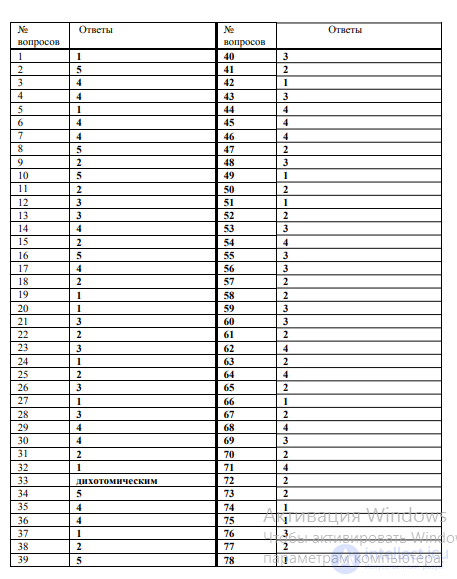
Answers to the test

Logic Tests with Answers, Part 1

See also

  • [[b5646]]
  • [[b9563]]
  • [[b9796]]
  • [[b9797]]
  • [[b9798]]
  • [[b5645]]
  • [[b5643]]
  • [[b5647]]
  • [[b834]]
  • [[b835]]
  • [[b836]]
  • [[b5626]]

See also

created: 2020-11-28
updated: 2026-03-09
911


Was this answer useful?
Choose a quick rating so we can improve the next answer for you.
How satisfied are you?


Comments

To leave a comment

If you have any suggestion, idea, thanks or comment, feel free to write. We really value feedback and are glad to hear your opinion.
To reply

Lectures and tutorial on "Logics"

Terms: Logics