
Lecture
Causality (also called causation or cause and effect) is the influence by which one event, process, state, or object (a cause) contributes to the production of another event, process, state, or object (an effect), where the cause is partly responsible for the effect, and the effect is partly dependent on the cause. In general, a process has many causes, which are also said to be causal factors for it, and all lie in its past. An effect can in turn be a cause of, or causal factor for, many other effects, which all lie in its future. Some authors hold that causality is metaphysically prior to the notions of time and space.
Causality is an abstraction that indicates how the world progresses, a concept so fundamental that it is more suited to explaining other notions of progression than to being explained by other, more fundamental ones. The concept is similar to the notions of free will and efficacy. For this reason, intuition may be required in order to grasp it. Accordingly, causality is implicit in the logic and structure of ordinary language.
In English studies of Aristotelian philosophy, the word "cause" is used as a specialized technical term, the translation of Aristotle's term αἰτία, by which Aristotle meant "explanation" or an "answer to a 'why' question." Aristotle distinguished four kinds of answers, or "causes": material, formal, efficient, and final. In this sense, a "cause" is an explanation of an explanation, and failing to recognize that different kinds of "cause" are being discussed can lead to fruitless argument. Of Aristotle's four modes of explanation, the one most relevant to the concerns of this article is the "efficient" one.
David Hume, arguing against rationalism, held that pure reason alone cannot prove the reality of efficient causation; instead, he appealed to custom and mental habit, observing that all human knowledge derives solely from experience.
The topic of causality remains central in contemporary philosophy.
CAUSE AND EFFECT – philosophical categories expressing one of the forms of the universal connection of phenomena. A cause (Latin: causa) is usually conceived as a phenomenon whose action produces, determines, or brings about another phenomenon; the latter is called the effect. Causality, according to Aristotle, is unthinkable without purposiveness.
Post hoc, non est propter hoc (post hoc, non est propter hoc) — after this does not mean because of this
(After this, therefore because of this) -A logical fallacy in which a temporal sequence of events is mistaken for a causal dependency.
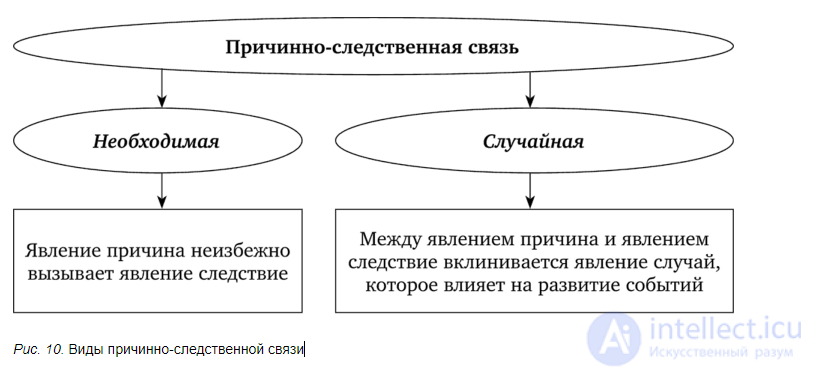
Fig. 10. Types of causal relationship
The nature of cause and effect is a subject known as metaphysics. Kant held that time and space were concepts prior to human understanding of the progress or evolution of the world, and he also acknowledged the priority of causality. But he lacked the insight, which came later with the knowledge of Minkowski geometry and special relativity, that the concept of causality can be used as a preliminary foundation for constructing notions of time and space.
The general metaphysical question about cause and effect is which entity can be a cause, and which can be an effect.
One view on this question is that cause and effect are entities of the same kind, and the causal relation is an asymmetric relation between them. In other words, grammatically it makes sense to say either «A is the cause, and B is the effect», or «B is the cause, and A is the effect», although in fact only one of these two can be true. From this point of view, one opinion offered as a metaphysical principle in process philosophy is that every cause and every effect is, respectively, some process, event, becoming, or occurrence. For example, «his tripping over the step was the cause, and his broken ankle was the effect». Another view is that causes and effects are «states of affairs», with the precise nature of these entities defined less strictly than in process philosophy.
Another, more classical view on this question holds that a cause and its effect can be different kinds of entities. For example, in Aristotle's efficient-causal explanation, an action can be a cause, and a persisting object can be its effect. For instance, the procreative acts of his parents can be regarded as the efficient cause, with Socrates as the effect, and Socrates regarded as a persisting object, called in the philosophical tradition a «substance», as distinct from an action.
Since causality is a subtle metaphysical notion, considerable intellectual effort, together with a demonstration of evidence, is required to establish knowledge of it in particular empirical circumstances. According to David Hume, the human mind cannot directly perceive causal connections. On this basis, the scholar drew a distinction between the regularity view of causality and the counterfactual view. According to the counterfactual view, X causes Y if and only if, without X, Y would not exist. Hume interpreted the latter as an ontological view, i.e., as a description of the nature of causality, but, given the limitations of the human mind, advised using the former (roughly, that X causes Y if and only if the two events are spatiotemporally conjoined, and X precedes Y) as an epistemological definition of causality. To distinguish causal from non-causal relations, one must have an epistemological concept of causality. The contemporary philosophical literature on causality can be divided into five broad approaches. These include (mentioned above) regularity, probabilistic, counterfactual, mechanistic, and manipulability views. These five approaches can be shown to be reductive, i.e., they define causality in terms of relations of other kinds. Read this way, they define causality in terms of, respectively, empirical regularities (constant conjunctions of events), changes in conditional probabilities, counterfactual conditionals, mechanisms underlying causal relations, and invariance under intervention.
Causality has the properties of precedence and contiguity. These are topological and are constituent parts of the geometry of space-time. These properties, developed by Alfred Robb, make it possible to derive the notions of time and space. Max Jammer writes: «Einstein's postulate ... opens the way to the direct construction of the causal topology ... of Minkowski space». Causal efficacy does not propagate faster than light.
Thus, the concept of causality is metaphysically prior to the notions of time and space. From a practical standpoint, this is because the use of the causal relation is necessary for interpreting empirical experiments. The interpretation of experiments is in turn necessary for establishing physical and geometric notions of time and space.
A deterministic worldview holds that the history of the universe can be exhaustively represented as a progression of events following one another in a causal sequence. The incompatibilist version of this holds that there is no such thing as «free will». Compatibilism, on the other hand, holds that determinism is compatible with free will, or is even required by it.
Sometimes causes can be divided into two types: necessary and sufficient. A third type of causation, which by itself requires neither necessity nor sufficiency but contributes to the effect, is called a «contributory cause».
Necessary causes
If x is a necessary cause of y, then the presence of y necessarily implies the prior occurrence of x. However, the presence of x does not imply that y will occur.
Sufficient causes
If x is a sufficient cause of y, then the presence of x necessarily implies the subsequent occurrence of y. However, another cause z may alternatively cause y. Thus, the presence of y does not imply the prior occurrence of x.
Contributory causes
For a given effect, in a single case, a factor that is a contributory cause is one of several contributory causes; it is implied that all of them contribute. For a given effect there is, in general, no implication that a contributory cause is necessary, although it may be so. In general, a factor that is a contributory cause is insufficient, because by definition it is accompanied by other causes that would not count as causes if it alone were sufficient. For a given effect, a factor that in some cases is a contributory cause might in other cases be sufficient, but in those other cases it would not simply be a contributing factor.
J. L. Mackie argues that ordinary talk of «cause» in fact refers to INUS conditions (an Insufficient but Non-redundant part of a condition which is itself Unnecessary but Sufficient for the occurrence of the effect). An example is a short circuit as a cause of a house fire. Consider the conjunction of events: a short circuit, the proximity of flammable materials, and the absence of firefighters. Together they are not necessary but are sufficient for the house to burn down (since many other conjunctions of events could certainly have led to the house burning down, for example, firing a flamethrower in the presence of oxygen, etc.). Within this conjunction, the short circuit is insufficient (since the short circuit by itself would not have caused the fire), but it is not redundant (since without it, other things being equal, the fire would not have occurred) — a part of a condition that is itself unnecessary but sufficient for the occurrence of the effect. So, the short circuit is an INUS condition for the occurrence of the house fire.
Conditional statements are not statements of causal relation. An important distinction is that statements of causality require that the antecedent precede or coincide with the consequent in time, whereas conditional statements do not require this temporal ordering. Confusion commonly arises because many different statements in English can be expressed using the «If ..., then ...» form (and, perhaps, because this form is far more often used to assert causation). However, these two kinds of statements are different.
For example, all of the following statements are true under the interpretation of «If ..., then ...» as a material conditional:
The first is true because both the antecedent and the consequent are true. The second is true in sentential logic and vacuous for natural language, regardless of the subsequent statement, because the antecedent is false.
The ordinary indicative conditional has somewhat more structure than the material conditional. For example, although the first is the closest match, neither of the two preceding statements seems true under an ordinary indicative reading. But the sentence:
intuitively seems true, although in this hypothetical situation there is no direct causal connection between Shakespeare not writing "Macbeth" and someone else actually writing it.
Another kind of conditional, the counterfactual conditional, has a stronger connection to causality, but even counterfactual statements are not all instances of causation. Consider the following two statements:
In the first case, it would not be correct to say that A being a triangle caused it to have three sides, since the relation between triangularity and three-sidedness is one of definition. The property of having three sides in fact defines the state of A as a triangle. Nevertheless, even under a counterfactual interpretation, the first statement is true. An early version of Aristotle's "four causes" theory is described as recognizing an "essential cause." In this version of the theory, the fact that a closed polygon has three sides is called the "essential cause" of its being a triangle. Such a use of the word "cause" has, of course, long since become obsolete. Nevertheless, within ordinary language it can be said that a triangle has three sides.
A full understanding of the concept of conditionals is important for understanding the literature on causality. In everyday language, loose conditional statements are used quite often, and they must be interpreted carefully.
Questionable-cause fallacies, also known as causal fallacies, non-causa pro causa (Latin for "non-cause for cause") or false cause, are informal fallacies in which a cause is incorrectly identified.
Counterfactual theories define causation in terms of counterfactual relations. These theories can often be regarded as "floating" their account of causation on top of an account of the logic of counterfactual conditionals. This approach can be traced back to David Hume's definition of a causal relation as one "where, if the first object had not been, the second never had existed." A more fully developed analysis of causation in terms of counterfactual conditionals did not appear until the 20th century, after the development of possible-world semantics for evaluating counterfactual conditionals. In his 1973 paper «Causation», David Lewis proposed the following definition of the notion of causal dependence:
Event E causally depends on C if and only if: (i) if C had occurred, E would have occurred, and (ii) if C had not occurred, E would not have occurred.
Causation is defined as a chain of causal dependence. That is, C causes E if and only if there exists a sequence of events C, D1, D2, ... Dk, E, such that each event in the sequence depends on the previous one. This chain can be called a mechanism.
Note that the analysis does not claim to explain how we make causal judgments or how we reason about causation, but rather to give a metaphysical account of what it means for there to be a causal connection between a given pair of events. If it is correct, the analysis can explain certain features of causation. Knowing that causation is a matter of counterfactual dependence, we can reflect on the nature of counterfactual dependence in order to explain the nature of causal connection. For example, in his paper «Counterfactual Dependence and Time's Arrow», Lewis attempted to explain the directionality of counterfactual dependence in time in terms of the semantics of the counterfactual conditional. If this theory is correct, it may serve to explain a fundamental part of our experience, namely that we can causally influence only the future, not the past.
The interpretation of causation as a deterministic relation would require that if A causes B, then A must always be followed by B. In this sense, war does not cause death, and smoking does not cause cancer or emphysema. As a result, many turn to the notion of probabilistic causation. Informally, A («the person is a smoker») probabilistically causes B («the person has now or will at some point in the future have cancer»), if the information that A occurred increases the probability of B occurring. Formally, P{B|A} ≥ P{B}, where P{B|A} is the conditional probability that B will occur given the information that A occurred, and P{B} is the probability that B will occur without knowing whether A occurred or not. This intuitive condition is not suitable as a definition of probabilistic causation, however, because it is too general and therefore does not match our intuitive notion of cause and effect. For example, if A denotes the event "the person smokes," B denotes the event "the person has now or will have cancer at some point in the future," and C denotes the event "the person has now or will have emphysema at some point in the future," then the following three relations hold: P{B|A} ≥ P{B}, P{C|A} ≥ P{C}, and P{B|C} ≥ P{B}. The last relation states that knowing that a person has emphysema increases the probability that they will get cancer. The reason for this is that having the information that a person has emphysema increases the probability that the person smokes, which in turn indirectly increases the probability that the person will get cancer. However, we do not want to conclude that emphysema causes cancer. Thus, we need additional conditions, such as a temporal relation between A and B and a rational account of the underlying mechanism. This latter requirement is difficult to quantify, so different authors prefer somewhat different definitions.
When experimental interventions are impossible or unethical, the derivation of causal relationships from observational studies must rest on certain qualitative theoretical assumptions, for example, that symptoms do not cause diseases, which are usually expressed as missing arrows in causal diagrams such as Bayesian networks or path diagrams. The theory underlying these derivations rests on the distinction between conditional probabilities, as in P(cancer|smoking), and interventional probabilities, as in P(cancer|do(smoking)). The former reads: "the probability of finding cancer in a person known to smoke, who began doing so, not compelled by the experimenter, at an unspecified time in the past," while the latter reads: "the probability of finding cancer in a person whom the experimenter forced to smoke at a specific time in the past." The former represents a statistical notion that can be estimated by observation with negligible intervention by the experimenter, whereas the latter represents a causal notion that is estimated in an experiment with an important, controlled, randomized intervention. It is characteristic of quantum phenomena that observations defined by incompatible variables always involve important experimenter intervention, which is quantitatively described by the observer effect. In classical thermodynamics, processes are initiated by interventions called thermodynamic operations. In other fields of science, such as astronomy, the experimenter can often observe with negligible intervention. 

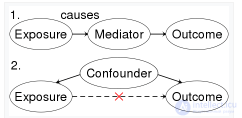
The theory of "causal calculus" (also known as do-calculus, Judea Pearl's causal calculus, or the calculus of actions) makes it possible to derive interventional probabilities from conditional probabilities in causal Bayesian networks with unmeasured variables. One very practical result of this theory is the characterization of confounding variables, namely, a sufficient set of variables which, if adjusted for, would yield the correct causal effect between the variables of interest. It can be shown that a sufficient set for estimating the causal effect of X on Y is any set of non-descendants of X that is d-separated from Y after removing all arrows emanating from X. This criterion, called the "backdoor" criterion, gives a mathematical definition of "confounding" and helps researchers identify available sets of variables worth measuring. 


While inferences in causal calculus rely on the structure of the causal graph, parts of the causal structure can, under certain assumptions, be learned from statistical data. The basic idea goes back to Sewall Wright's 1921 work on path analysis. Rebane and Pearl (1987) developed a "recovery" algorithm that rests on Wright's distinction among three possible types of causal substructures allowed in a directed acyclic graph (DAG):



Type 1 and Type 2 represent the same statistical dependencies (i.e., X and Z are independent given Y) and are therefore indistinguishable within purely cross-sectional data. Type 3, however, can be uniquely identified, since X and Z are marginally independent while all other pairs are dependent. Thus, although the skeletons (graphs stripped of arrows) of these three triplets are identical, the direction of the arrows is partially identifiable. The same distinction applies when X and Z have common ancestors, except that one must first condition on those ancestors. Algorithms have been developed to systematically determine the skeleton of the underlying graph and then orient all arrows whose direction is dictated by the observed conditional dependencies. 
Alternative structure-learning methods search among the set of possible causal structures over the variables and remove those that are strongly inconsistent with the observed correlations. In general, this leaves a set of possible causal relations, which should then be tested by analyzing time-series data or, preferably, by designing appropriately controlled experiments. Unlike Bayesian networks, path analysis (and its generalization, structural equation modeling) is better suited to estimating a known causal effect or testing a causal model than to generating causal hypotheses.
For non-experimental data, causal direction can often be inferred if information about time is available. This is because (according to many, though not all, theories) causes must precede their effects in time. This may be determined, for example, by means of statistical time-series models, or by a statistical test based on the idea of Granger causality, or by direct experimental manipulation. The use of temporal data may allow statistical tests of a pre-existing theory of causal connection. For example, our degree of confidence in the direction and nature of a causal relationship is much greater when it is supported by cross-correlations, ARIMA models, or cross-spectral analysis using vector time-series data than by cross-sectional data.
Nobel laureate Herbert A. Simon and philosopher Nicholas Rescher argue that the asymmetry of the causal relation is not tied to the asymmetry of any implication that runs counter to it. Rather, causation is not a relation between the values of variables, but a function of one variable (the cause) with respect to another (the effect). Thus, given a system of equations and a set of variables entering into these equations, we can introduce an asymmetric relation among individual equations and variables that fully corresponds to our common-sense notion of causal order. The system of equations must possess certain properties; most importantly, if some values are chosen arbitrarily, the remaining values will be uniquely determined through a sequential unfolding that is entirely causal. They postulate that the inherent serialization of such a system of equations can correctly capture causal relations in all empirical domains, including physics and economics.
Some theorists equate causation with manipulability. According to these theories, x causes y only if one can change x in order to change y. This fits with common notions of causation, since we often ask causal questions in order to change some feature of the world. For example, we are interested in learning the causes of crime so that we can find ways to reduce it.
These theories have been criticized for two main reasons. First, theorists complain that these accounts are circular. Attempting to reduce causal claims to manipulation requires that manipulation be simpler than causal interaction. But describing manipulation in non-causal terms presents a substantial difficulty.
The second criticism concerns a worry about anthropocentrism. To many people it seems that causation is some relation existing in the world that we can harness for our own purposes. If causation is identified with our manipulation, this intuition is lost. In this sense, human beings become central to the interactions of the world.
Some attempts to defend manipulation theories are recent accounts that do not claim to reduce causation to manipulation. These accounts use manipulation as a sign or indicator of causal connection, without asserting that manipulation is more fundamental than causation.
Some theorists are interested in the distinction between causal and non-causal processes (Russell 1948; Salmon 1984). These theorists often want to distinguish process from pseudo-process. For example, a ball moving through the air (a process) is contrasted with the movement of its shadow (a pseudo-process). The former is causal in nature, while the latter is not.
Salmon (1984) argues that causal processes can be identified by their ability to transmit changes across space and time. A mark made on the ball (say, with a pen) travels with it as the ball flies through the air. A change made to the shadow (insofar as this is possible), on the other hand, will not be transmitted by the shadow as it moves.
These theorists argue that the important concept for understanding causation is not causal relations or causal interactions, but rather the definition of causal processes. The former notions can then be defined in terms of causal processes.
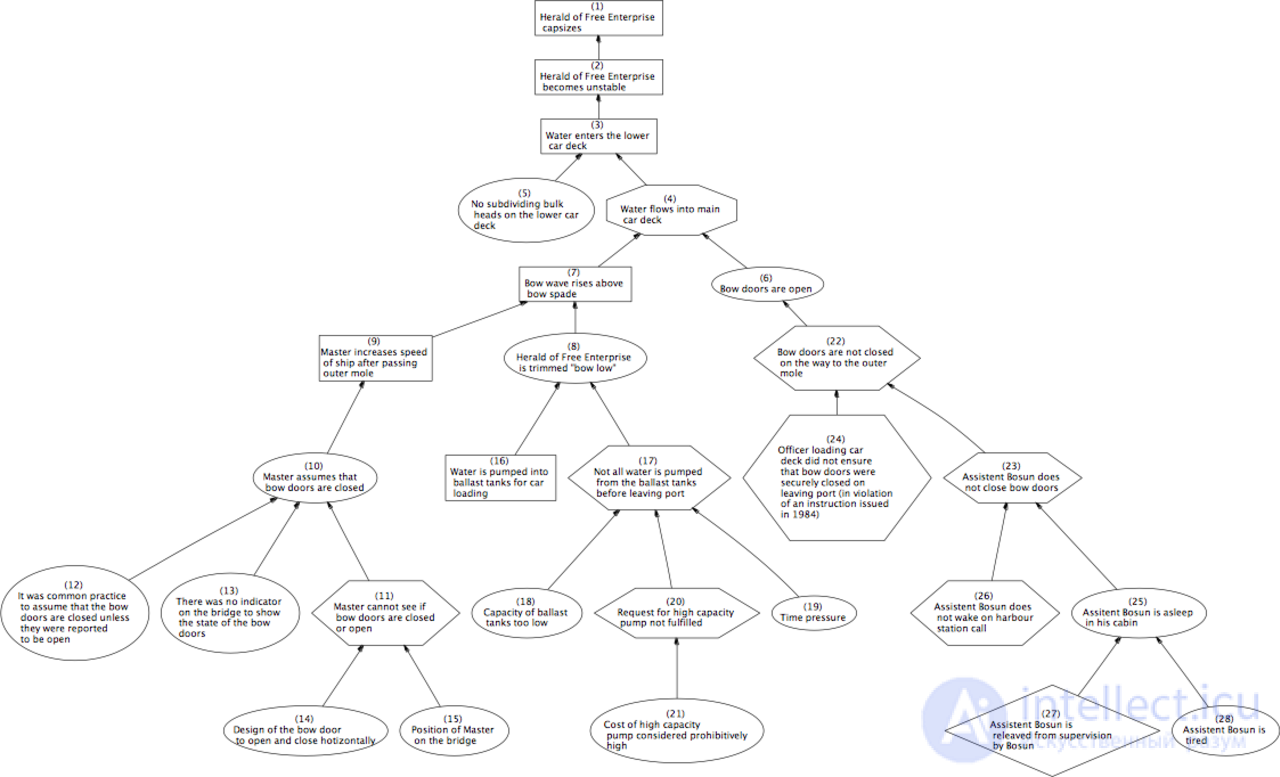
A subgroup of process theories is the mechanistic view of causation. It holds that causal relations supervene on mechanisms. Although the notion of mechanism is understood in various ways, the definition proposed by a group of philosophers known as the "New Mechanists" dominates the literature.
The doctrine of criminal law has come to reflect various theories of causation in the commission of a crime. The theories of equivalence and adequacy of the causal link in the commission of a crime became the most widespread in the 19th century and the early 20th century. Other theories are also known: the theory of multiple factors, the theory of the dominant cause, and the theory of the possibility and actuality of the causal link.
The theory of the equivalence of causes, otherwise known as the theory of the necessary condition (conditio sine qua non). A causal link exists in all situations (including casuistic ones) if the act is a necessary condition for the occurrence of the consequence. Regardless of how far or close the conditions for the occurrence of the consequences were, they may all equally be causes of the crime committed, if they were required for that criminal consequence to occur (M. Buri, E. Belling, F. Liszt, and others). According to the theory of equivalence, a person is guilty of causing the victim's death if, for example, they inflicted a finger wound on the victim, from which the victim died as a result of blood loss, because the victim suffered from hemophilia.
The idea underlying the theory of the necessary condition was further developed by P. P. Pustoroslev, N. D. Sergeyevsky, T. V. Tsereteli, and other Russian/Soviet researchers.
The theory of adequacy (adequate cause). Only those acts that in principle (and not merely in a particular case) are capable of entailing the corresponding criminal consequences can be the cause of socially dangerous consequences (J. Kries, M. Rümelin, and others). According to the theory of adequacy, death resulting, for example, from a light blow is not typical; a fatal outcome does not correspond to a light blow and is not adequate to it. For example, the guilty party lightly struck the victim on the head, but the victim had recently suffered a brain illness, so a light blow was enough to cause death; however, such a blow cannot be recognized as the adequate cause of the victim's death.
Thus, the causal link between a socially dangerous act and the consequence that has occurred represents a real, necessary, internally lawful connection between them, which exists objectively and does not depend on the influence of extraneous forces.
It is possible to distinguish between a causally necessary and a causally accidental link between a socially dangerous act and the resulting consequence, as well as other kinds of causal link, for example, depending on the number and quality of the socially dangerous consequences that occurred.
The doctrine of criminal law has come to establish various theories of causation in the commission of a crime, in particular: the equivalence of causes; adequacy (adequate cause); the multiplicity of factors; the dominant cause; and the possibility and actuality of the causal link.
For the scientific investigation of efficient causality, cause and effect are best regarded as temporary transient processes.
Within the conceptual framework of the scientific method, an investigator establishes several distinct and contrasting temporary transient material processes having the structure of experiments, and records the possible material responses, generally designed to determine causality in the physical world. For instance, one might wish to know whether a high intake of carrots causes bubonic plague in humans. The amount of carrot consumed is a process that varies from case to case. The occurrence or non-occurrence of subsequent bubonic plague is recorded. To establish a causal relationship, the experiment must meet certain criteria, of which only one example is given here. For instance, instances of the supposed cause must be arranged so as to occur at a time when the supposed effect is comparatively unlikely in the absence of the hypothesized cause; such improbability must be established by empirical evidence. Mere observation of a correlation is not sufficient to establish a causal relationship. In nearly all cases, the establishment of a causal relationship rests on the repetition of experiments and on probabilistic reasoning. Causality is rarely established more firmly than as more or less probable. For establishing causality, it is most convenient if the contrasting material states of affairs match exactly, except for a single variable factor, possibly measured by a real number.
One should be careful when using the word "cause" in physics. Strictly speaking, both the hypothetical cause and the hypothetical effect are temporary transient processes. For example, force is a useful concept for explaining acceleration, but force by itself is not a cause. More is required. For instance, a temporary transient process might be characterized by a particular change in force at a particular time. Such a process can be regarded as a cause. Causality is not implied from the outset in the equations of motion, but is postulated as an additional constraint that must be satisfied (i.e., the cause always precedes its effect). This constraint has mathematical consequences, such as the Kramers-Kronig relations.
Causality is one of the most fundamental and important concepts in physics. Causal efficacy cannot "propagate" faster than light. Otherwise, reference coordinate systems could be constructed (using the Lorentz transformation of special relativity) in which an observer would see the effect precede its cause (i.e., the postulate of causality would be violated).
Causal notions appear in the context of the flow of mass-energy. Any real process has causal efficacy, which can propagate no faster than light. By contrast, an abstraction has no causal efficacy. Its mathematical expression does not propagate in the ordinary sense of the word, although it may refer to virtual or nominal "velocities" with a magnitude greater than that of light. For example, wave packets are mathematical objects that have a group velocity and a phase velocity. The energy of a wave packet propagates at the group velocity (under normal conditions); since energy has causal efficacy, the group velocity cannot be higher than the speed of light. The phase of a wave packet moves at the phase velocity; since the phase is not causal, the phase velocity of a wave packet may be higher than the speed of light.
Causal notions are important in general relativity to the extent that the existence of an arrow of time requires that the pseudo-Riemannian manifold of the universe be orientable, so that "future" and "past" are globally definable quantities.
A causal system is a system with an output and internal states that depends only on current and previous input values. A system that has some dependence on input values from the future (in addition to possible past or current input values) is called an acausal system, while a system that depends solely on future input values is an anticausal system. For example, acausal filters can only exist as post-processing filters, because such filters can extract future values from a memory buffer or file.
Austin Bradford Hill drew on the work of Hume and Popper and proposed, in his paper «The Environment and Disease: Association or Causation?», that aspects of association such as strength, consistency, specificity, and temporality be taken into account when attempting to distinguish causal from non-causal connections in an epidemiological situation. (See the Bradford Hill criteria.) He did note, however, that temporality is the only necessary criterion among these aspects. Directed acyclic graphs (DAGs) are increasingly being used in epidemiology to clarify causal reasoning.
Psychologists take an empirical approach to causation, investigating how humans and non-human animals detect or infer causal connections from sensory information, prior experience, and innate knowledge.
Attribution
Attribution theory is a theory concerned with how people explain individual instances of causation. Attribution can be external (attributing causality to an external agent or force — asserting that some outside thing caused the event) or internal (attributing causality to factors within the person — taking personal responsibility or accountability for one's actions and asserting that the person bears direct responsibility for the event). Taken even further with respect to causation, the type of attribution a person makes influences their future behavior.
The intention behind a cause or effect can be covered by the subject of agency. See accident; blame; intention; and responsibility.
Causal powers
While David Hume argued that causes are inferred from non-causal observations, Immanuel Kant claimed that people have innate assumptions about causes. In the field of psychology, Patricia Cheng attempted to reconcile the Humean and Kantian views. According to her power PC theory, people filter their observations of events through an intuition that allows causes to generate (or prevent) their effects, thereby revealing specific causal relationships.
Causation and salience
Our view of causation depends on what we consider to be the relevant events. Another way of looking at the statement "Lightning causes thunder" is to regard both the lightning and the thunder as two perceptions of the same event, namely, an electrical discharge that we perceive first visually and then aurally.
Naming and causation
David Sobel and Alison Gopnik of the psychology department at the University of California, Berkeley, developed a device known as a blicket detector, which would activate when an object was placed on it. Their research shows that "even young children readily and quickly learn about the novel causal power of an object and spontaneously use that information to categorize and name the object."
Perception of launching events
Some researchers, such as Anjan Chatterjee of the University of Pennsylvania and Jonathan Fugelsang of the University of Waterloo, use neuroscientific methods to investigate the neural and psychological underpinnings of causal launching events, in which one object causes another object to move. Both temporal and spatial factors can be manipulated.
See Causal thinking (Psychology) for further information.
Statistics and economics usually employ pre-existing data or experimental data to infer causation by means of regression methods. The bulk of statistical methods make substantial use of regression analysis. Typically, a linear relationship such as

is postulated, in which there is the i-th observation of the dependent variable (presumed to be caused by the independent variable), for j = 1, ..., k there is the i-th observation on the j-th independent variable (hypothesized to be a causal variable), and there is the disturbance term for the i-th observation (containing the combined effects of all other causal variables, which must not correlate with the included independent variables). If there is reason to believe that none of the xj's is caused by y, then estimates of the coefficients are obtained. If the null hypothesis is rejected, then the alternative hypothesis — that the coefficient is nonzero and, equivalently, that xj causes y — cannot be rejected. On the other hand, if the null hypothesis cannot be rejected, then, correspondingly, the hypothesis that there is no causal effect of xj on y cannot be rejected. Here the notion of causation is one of contributory causation, as discussed above: if the true value of the coefficient is nonzero, a change in xj will result in a change in y, unless some other causal variable(s) included in the regression, or implicitly contained in the disturbance term, change in such a way as to exactly offset its effect; thus a change in xj is not sufficient to change y. Furthermore, a change in xj is not necessary to change y, since a change in y may be caused by something implicit in the disturbance term (or by some other causal explanatory variable included in the model). 


The above-mentioned way of testing for causation requires a belief that there is no reverse causation, in which y could be a cause of xj. This belief can be established in one of several ways. First, the variable may be a non-economic variable: for example, if it is postulated that the amount of rainfall will affect the futures price y of some agricultural commodity, it is impossible that the futures price could actually affect the amount of rainfall (assuming cloud seeding is never attempted). Second, the instrumental variables method can be used to eliminate any reverse causation by introducing the role of other variables (instruments) that are known not to be affected by the dependent variable. Third, one can invoke the principle that effects cannot precede their causes, by including on the right-hand side of the regression only variables that precede the dependent variable in time; this principle is applied, for example, in testing for Granger causality and in its multivariate analog, vector autoregression, both of which control for lagged values of the dependent variable when testing for the causal effects of lagged independent variables.
Regression analysis controls for other relevant variables by including them as regressors (independent variables). This helps avoid false inferences of causation due to the presence of a third, underlying variable that influences both the potentially causal variable and the potentially caused variable: its effect on the potentially caused variable is captured by directly including it in the regression, so that this effect will not be mistaken for an indirect effect through the potentially causal variable of interest. Given the procedures described above, a spurious (as opposed to causal) correlation can be probabilistically ruled out if the data samples are large and if the regression results pass cross-validation tests showing that the correlations hold even for data that was not used in the regression. To assert with certainty that a common cause is absent, and that the regression represents the true causal structure, is, in principle, impossible.
Beyond building statistical models of observational and experimental data, economists use axiomatic (mathematical) models to derive and represent causal mechanisms. Microeconomics is dominated by highly abstract theoretical models that isolate and idealize a single mechanism. In macroeconomics, economists use broad mathematical models calibrated to historical data. A subgroup of calibrated models, dynamic stochastic general equilibrium (DSGE) models, are used to represent (in simplified form) the entire economy and to model changes in fiscal and monetary policy.
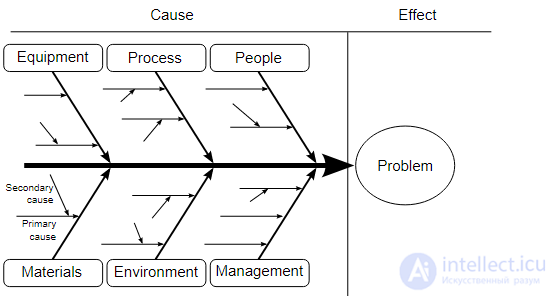
For quality control in manufacturing, Kaoru Ishikawa developed in the 1960s a causal diagram known as the Ishikawa diagram or the "fishbone" diagram. The scheme divides causes, for instance, into the six main categories shown here. These categories are then subdivided. Ishikawa's method identifies "causes" during brainstorming sessions carried out among the various groups involved in the production process. These groups can then be labeled as categories on the diagrams. The use of these diagrams has spread beyond quality control, and they are used in other areas of management, as well as in design and engineering. Ishikawa diagrams have been criticized for failing to distinguish between necessary conditions and sufficient conditions. It appears that Ishikawa himself was not even aware of this distinction.
When discussing history, events are sometimes treated as though they were in some way agents that can then cause other historical events. Thus, a combination of crop failures, the hardships of the peasantry, high taxes, the lack of popular representation, and royal ineptitude are among the causes of the French Revolution. This is to some extent a Platonic and Hegelian view, which reifies causes as ontological entities. In Aristotelian terminology, this usage approximates to the case of an efficient cause.
Some philosophers of history, such as Arthur Danto, have argued that "explanations in history and elsewhere" describe "not merely an event — what happens — but a change." Like many practicing historians, they treat causes as intersecting actions and sets of actions that bring about "large-scale changes," in Danto's words: deciding "what elements persist through the change" is "fairly straightforward" when dealing with an individual's "change of attitude," but "it is considerably more complicated and metaphysically challenging when we are concerned with such a change as, say, the collapse of feudalism or the rise of nationalism."
Much of the historical debate about causes centers on the relationship between communicative and other actions, between singular and repeated actions, and between actions, structures of action or a group, and institutional contexts and broader sets of conditions. John Gaddis drew a distinction between exceptional and general causes (following Marc Bloch), and between "routine" and "distinctive links" in causal chains: "in explaining what happened at Hiroshima on August 6, 1945, we assign greater weight to the fact that President Truman ordered the atomic bomb dropped than to the decision of the U.S. Air Force to carry out his orders." He also pointed to the difference between immediate, intermediate, and distant causes. For his part, Christopher Lloyd puts forward four "general concepts of causation" used in history: "a metaphysical idealist concept, which holds that the phenomena of the universe are products or emanations of an omnipotent being or such a final cause"; "an empirical (or Humean) concept of regularity, which rests on the idea of causation as a matter of constant conjunctions of events"; "a functional/teleological/consequentialist concept," which "is directed toward the attainment of a goal, such that ends are causes"; and "a realist, structurist, and dispositional approach, which regards structures of relations and inherent dispositions as the causes of phenomena."
Under law and judicial practice, legal grounds must be demonstrated in order to hold a defendant liable for a crime or a tort (that is, a civil wrong such as negligence or trespass). It must be proven that a causal link, or "sufficient causal connection," ties the defendant's actions to the criminal event or damage in question. Causation is also an important legal element that must be proven in order to satisfy the criteria for applying remedies under international trade law.
Note the concept of divine providence in Abrahamic theology, which represents the belief that God set all events in motion at the dawn of time; He is both the determiner of, and the cause of, all things. This is thus an attempt to reconcile the apparent incompatibility between determinism and the existence of an omnipotent god.
The literature of the Vedic period (c. 1750–500 BCE) has karmic origins. Karma is the belief, held by Sanatana Dharma and the major religions descended from it, that a person's actions have a positive or negative effect on their current and/or future life. Various philosophical schools (darshanas) describe this subject differently. The doctrine of satkaryavada holds that the effect is in some way connected to the cause. Thus, the effect is a real or apparent modification of the cause. The doctrine of asatkaryavada holds that the effect is not connected to the cause but is a new occurrence. See Nyaya for some details of the theory of causation in the Nyaya school. In the Brahma-samhita, Brahma describes Krishna as the primal cause of all causes.
The Bhagavad Gita 18.14 identifies five causes of any action (knowing which, actions may be undertaken): the body,
продолжение следует...
Часть 1 Cause and Effect - Causality in Logic, Philosophy, and Criminal Law
Часть 2 See Also - Cause and Effect - Causality in Logic,

Comments