
Lecture
Argumentation (from Lat"argumentum"-"basis") - is the justification of the acceptability and correctness of particular statements or intentions of action. By an argument (Lat. argumentum, from the verb arguo – to show, to clarify, to prove – a reason, a proof, an inference) we shall call a fragment of an utterance containing the justification of a thought whose acceptability appears doubtful.
To justify means to reduce a thought that is doubtful or disputable for the audience to an acceptable one. A thought may be considered acceptable if the audience finds it true or plausible, correct from the standpoint of some norm or other, or preferable from the standpoint of its own (rather than the orator’s – the speaker’s) values, goals, or interests.
The problems of argumentation have been most thoroughly worked out in logic. Naturally, an orator must take into account the achievements of this discipline. Moreover, the concepts of logical and rhetorical argumentation differ from one another. Logical argumentation is merely a special case of rhetorical argumentation. Let us recall that for Aristotle logos is only one of the modes of persuasion, alongside ethos and pathos. Accordingly, only those means of persuasion that appeal to reason belong to the domain of logic. If an orator concentrates on logos alone, he unjustifiably deprives himself of the possibility of using other means of influence (in some cases more effective ones).
Sometimes argumentation is regarded not simply as a procedure of justification but also as the totality of arguments adduced in support of particular theses. Such a conception corresponds more closely to the second division of rhetoric, "Disposition." There argumentation already appears as a definite part of the orator’s speech.
In the structure of argumentation the following components are distinguished:. Thesis (from Greek"thesis"-"position") - a statement which the orator attempts to convince the audience of
. Arguments are statements by means of which the orator substantiates the thesis
. Form (scheme) is the way in which the arguments and the thesis are connected
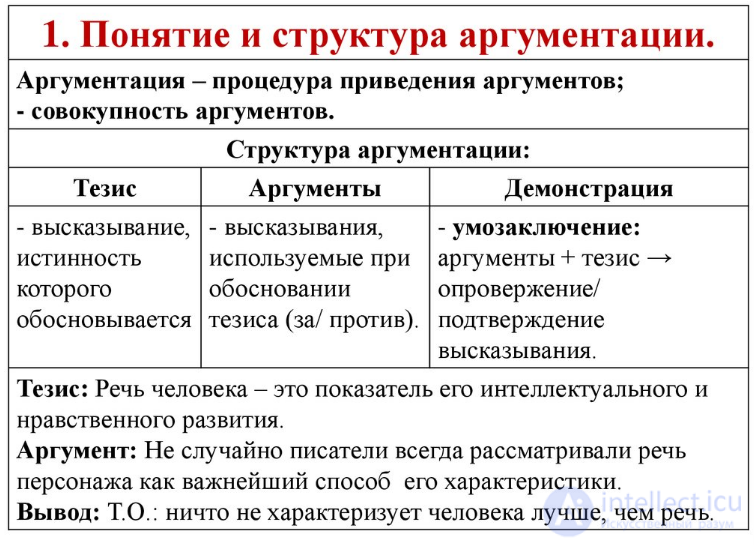
There are many classifications of argumentation. Let us dwell on those that are important for oratorical activity
1). Depending on the method of justification, the following are distinguished:
o empirical argumentation;
o theoretical argumentation
2). Depending on the form (scheme), the following are distinguished:
o symptomatic argumentation;
o causal argumentation;
o argumentation by analogy
3). Depending on the procedure of justification, the following are distinguished:
o direct argumentation;
o indirect argumentation
Regarding the first classification, it should be emphasized that as early as Aristotle the means of persuasion were divided into non-technical and technical:
"By non-technical means of persuasion I mean those which have not been invented by us but existed previously [without us]; to these belong: witnesses, testimony, evidence given under torture, written contracts, and the like; by technical, on the other hand, [I call] those which can be created by us through method and by our own resources, so that the former class of proofs can only be used, while the others must [first] be found"1.
Today these concepts can be defined as follows:
. Empirical argumentation is the justification of a thesis by direct appeal to reality
Its arguments are experiments, observations, experience, and so on.
. Theoretical argumentation is the justification of a thesis grounded in considerations
The arguments here are other well-known propositions to which the orator appeals. In fact, in oratorical practice one often encounters cases in which argumentation combines both an appeal to experience and theoretical considerations
Let us consider an example of argumentation that has a fairly long history:
"All men are mortal
. Socrates is a man
. Therefore,. Socrates is mortal"
The first two statements in this example are the arguments, and the last is the thesis. Of course, in oratorical speeches it is hardly possible to find argumentation in exactly this form. Even this example would more likely take the form:
"Socrates is mortal, since he is a man"
Aristotle called reasoning of this kind enthymemes
For understanding the peculiarities of argumentation in rhetoric, the examples given above are instructive in this respect, that theses in oratorical speeches very often come before the arguments: the orator first formulates the thesis that he needs to justify. To do this, he seeks out arguments that would help influence the audience. In logic, however, everything happens the other way around. In the course of reasoning, a person derives from existing knowledge (the premises, the arguments) new knowledge (conclusions, propositions).
Empirical argumentation, as its definition might suggest, should not be linked exclusively with the natural sciences. In oratorical practice, such argumentation takes the form of using facts as examples. Aristotle wrote that examples and enthymemes are the common means of persuasion:
"Examples should be used in those cases where there are no enthymemes available for proof, since in order to persuade one needs [some] proof; but when [enthymemes] are available, examples should be used as corroborating evidence..."
It is in this sense that the use of examples is regarded as empirical argumentation
. Examples are statements about individual facts (from Lat. done, accomplished) serving as arguments to confirm a general thesis
Most often such arguments are used by the orator to justify the intentions of action that he expects from the audience, when specific situations from the lives of well-known people, and the like, are cited. In that case, parables and fables may serve as examples — cases in which we cannot appeal to observable facts. Nevertheless, such arguments are likewise meant to confirm general theses. In justifying particular actions, they influence listeners quite effectively.
As is well known,. Jesus taught the people in parables. For example:
"Behold, a sower went out to sow. And as he sowed, some seeds fell by the wayside, and the birds came and devoured them. Others fell on stony ground, where there was not much soil, and they sprang up quickly because the earth had no depth; but when the sun rose they were scorched, and having no root, they withered away. Others fell among thorns, and the thorns grew up and choked them. But others fell on good ground and yielded fruit: some a hundredfold, some sixty, some thirty. He who has ears to hear, let him hear!"...
The second classification gives the orator the opportunity, on the one hand, to competently analyze the argumentation of other people, and on the other hand, to correctly use argumentative schemes himself when constructing a speech
The distinction of different types of argumentation in this classification is based on what kind of relation is taken as the basis of the connection between the arguments and the thesis. In the literature on logic, with respect to the form of argumentation, a distinction is made between deductive and non-deductive argumentation, depending on the type of reasoning by which the argumentation unfolds. Most likely, symptomatic argumentation can be correlated with deductive argumentation, causal argumentation with non-deductive argumentation grounded in inductive reasoning, and argumentation by analogy with non-deductive argumentation based on reasoning by analogy.
In rhetoric it is appropriate to use the terms symptomatic, causal, and analogical types of argumentation1.
. Symptomatic argumentation is the justification of a thesis by adducing in the arguments certain features of that which is postulated in the thesis
The general scheme of symptomatic argumentation looks as follows:. A is acceptable for. B, because: 1). C is acceptable for. B and 2). C is characteristic of. A
The example given above"Socrates is mortal, since he is a man" is an example of symptomatic argumentation:. Mortality (A) is characteristic of. Socrates (B) because:
1). Socrates (B) is a man (C) and
2). For all people (C) mortality (A) is characteristic
Symptomatic argumentation can be regarded as a further development of the topoi of the first group, associated with the essence of the subject of the speech. Thus, from propositions of a general character, on the basis of the presence of certain features in the subject, the orator derives a thesis of a particular character.
. Causal argumentation is the justification of a thesis by adducing a cause-and-effect relationship between the arguments and the thesis
The general scheme of causal argumentation looks as follows:. A is acceptable for. B, because: 1). A is acceptable for. C and 2). C leads to. B
It is precisely according to this scheme that the argumentation of. Ch.-L. Montesquieu unfolds:
"In countries of temperate climate you will find peoples inconstant in their conduct, and even in their vices and virtues, since the insufficiently determinate qualities of this climate are not capable of giving them stability".
1). Temperate climate (A) has insufficiently determinate qualities (C) and
2). Insufficiently determinate qualities of the climate (C) lead to instability in the conduct of a people (B)
Causal argumentation can be regarded as a further development of the topoi of the third group, associated with the causes and consequences of the existence of the subject
argumentation by analogy is the justification of a thesis by adducing a resemblance between what is said in the arguments and what is said in the thesis
The general scheme of argumentation by analogy looks as follows:. A is acceptable for. B, because: 1). A is acceptable for. C and 2). C is comparable to. B
It is precisely according to this scheme that the argumentation in one of the maxims of. Jean de. La Bruyère unfolds:
"We look upon a learned woman as upon a fine sword: it is carefully finished, elegantly polished, covered with delicate engraving. This ornament is shown to connoisseurs, but it is not taken along either to war or to the hunt, for it is as unfit for real use as a manège horse, however excellently trained".
In this example there are two instances of argumentation by analogy:
I. Neither in war nor in the hunt is (A) needed — a learned woman (B) because:
1). Neither in war nor in the hunt is (A) needed — a fine sword (C) and
2). An expensive sword (C) resembles a learned woman (B)
II. Unfit for real use (A) — a learned woman (B) because:
1). Unfit for real use (A) — a manège horse (C) and
2). A manège horse (C) resembles a learned woman (B). Let us consider one more example — an excerpt from the treatise of. C. S. Lewis, "The Problem of Pain":
"The Christian teaching about suffering explains, in my view, a striking feature of our world. God does not give us the rest and happiness that we so long for; instead He is very generous with joy, laughter, and recreation. We know little rest, but we do know merriment, and even delight. And it is understandable why. A settled sense of well-being would turn the heart toward the temporal, drawing it away from God. Rare joys of love, a beautiful landscape, music, conversation, bathing, or a game do not have such an effect. The Father sustains us along the way, yet watches closely that we do not mistake a roadside inn for our true home".
In this fragment the thesis is a compound statement: "God does not give us the rest and happiness that we so long for; instead He is very generous with joy, laughter, and recreation." Each simple assertion that enters into the thesis is justified separately. In doing so,. C. S. Lewis does not adduce some of the arguments, but they can be reconstructed from the context.
Let us try to identify the arguments by which the statement "God does not give us rest and happiness" is justified:
1st argument:. Rest and happiness, as a settled sense of well-being, turn a person’s heart toward the temporal, drawing it away from. God
The basis of this justification is a symptomatic argumentative scheme:
God does not give a person (B) rest and happiness (A) because:
1). Rest and happiness (A) draw a person’s heart away from. God (C) and
2). God does not give a person (B) that which draws his heart away from Him (C)
The justification of the second statement from the thesis "God is very generous with joy, laughter, and recreation" is likewise based on a symptomatic argumentative scheme. Try to reconstruct it yourself
As regards the third classification, it should be emphasized that these types of argumentation are quite widely applied in various spheres of people’s activity. Therefore the ability to construct them will be useful for an orator
. Direct argumentation is a type of argumentation in the course of which arguments are adduced that directly justify the thesis
The examples considered above, of. Ch.-L. Montesquieu,. Jean de. La Bruyère, and. C. S. Lewis, are examples of direct argumentation
. Indirect argumentation is a type of argumentation in the course of which the thesis is justified indirectly, by establishing the unacceptability of the antithesis (a statement that is the negation of the thesis), or by establishing the unacceptability of propositions competing with the thesis.
Indirect argumentation is of two kinds:
At the basis of apagogic argumentation lies reasoning according to the scheme "proof by contradiction" (recall some of the theorem proofs from the course "Geometry"). Thought in such reasoning moves from the formulation of the antithesis, through the derivation from it of contradictory arguments (two statements, one of which negates the other), to the unacceptability of the antithesis and the correctness of the thesis itself.
At the basis of disjunctive argumentation considerations are laid out according to such a scheme. First, propositions that compete with the thesis are formulated, along with the thesis itself. Then the untenability of the propositions competing with the thesis is shown. Thereby the acceptability of the thesis itself is indirectly asserted. In order for the thesis in such argumentation to have a reliable character, it is necessary at the first stage to take into account all the possibilities. Disjunctive argumentation is a further development of the topos "a review of alternatives." In this case, the orator, as noted above, sets out before the audience various points of view on the subject of the speech, and then shows their untenability, except for the one that represents the orator’s thesis. The use of disjunctive argumentation is quite effective with a prepared audience.
Let us consider an example:
"Should open-ended questions (questions with an extended answer) be used in a test, or not? For three years a model providing for their use was being developed in Ukraine. The situation with open-ended questions resembles the case of a "suitcase without a handle" – hard to carry, yet a pity to throw away. The experiments with open-ended questions continued for three years. There is no end to the matter in sight: one would very much like to keep creative tasks in the tests, but how is one to check them, how to grade them, how to ensure uniformity of grading? Open-ended questions were abandoned (understanding as test items only those whose answers a computer can check), and efforts were concentrated instead on improving the formats and content of test items.
In 2006, in the Ukrainian model of. ET (external testing –. Ed.) it is proposed to use only closed-ended questions, and only computerized processing of the test results is envisaged (scanning followed by scoring)" (S. Rakov, "Testing of 2006 Graduates").
In this fragment, indirect apagogic argumentation is employed. The use of only closed-ended questions in tests (the thesis) is justified through the adducing of arguments that show the unacceptability of open-ended questions. Thus, in this case, the proposition about using open-ended questions in tests is the antithesis to the proposition about using only closed-ended questions in tests.
Rules of argumentation (thesis, arguments, and demonstration)
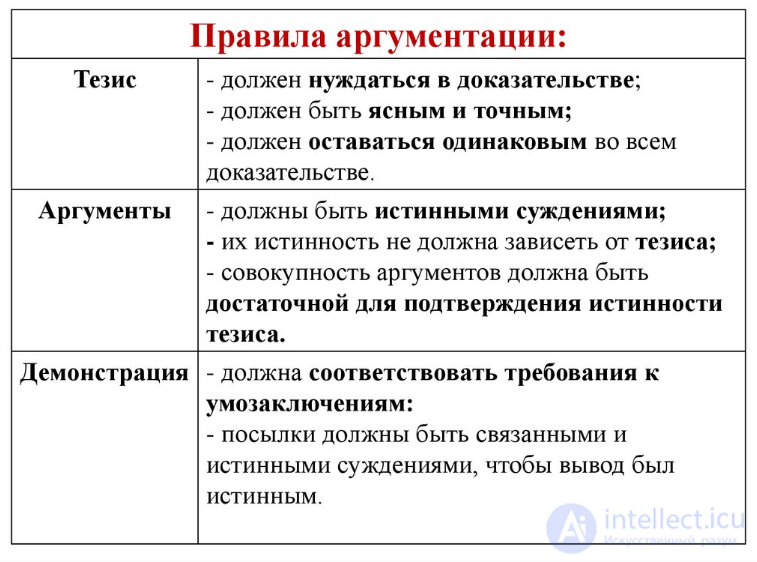
A rhetorical argument consists of: (1) a proposition, and (2) a justification. Let us consider an example:
(1) "But can truth actually be found? – One must think that it can, since the mind cannot live without it, and it, it seems, does live, and of course does not wish to admit itself to be deprived of life" .
Justification – a set of reasons, formulations of thoughts, by means of which the orator seeks to make the proposition acceptable to the audience: ... if the mind cannot live without truth, and it, it seems, does live, and of course does not wish to admit itself to be deprived of life.
The proposition of an argument – a formulation of a thought that is advanced by the orator but appears doubtful to the audience: But can truth actually be found? – One must think that it can
From the point of view of structure and content, a rhetorical argument includes three components: the scheme, the topos, and the reduction.
The scheme represents the logical form of this particular argument. The construction of the scheme obeys the rules of logic, and the scheme is a kind of logical skeleton of the argument, which makes it possible not only to judge the structure of a complex thought, but also to determine its correctness.
A commonplace, or topos, is a proposition that is recognized as true or correct and on the basis of which a particular justification appears convincing. The topos is contained in, or implied by, the premises of the argument. The first topos of the argument cited above is: the mind lives by truth. This proposition is not proved and does not follow from anywhere, but appears self-evident to the audience to which Saint Philaret is addressing himself.
Argumentation may be dogmatic or dialectical. Dogmatic argumentation proceeds from propositions that are accepted as postulates and considered self-evident and universal; such are the initial principles of a scientific theory. Dialectical argumentation proceeds from premises that are convincing to the audience and are drawn from a variety of sources. Dialectical argumentation is in principle intended for a particular audience.
Rhetorical argumentation is for the most part dialectical . This means, first, that the proposition of a rhetorical argument constitutes a thought (a thesis), to which another thought (a counter-thesis) may be opposed. The counter-thesis, however, does not always logically exclude the thesis.
Thesis: A performed a heroic act; counter-thesis: A violated military discipline. The premises justifying the counter-thesis are also not always the negation of the premises supporting the thesis, and may be perfectly compatible with them. If an audience is inclined to consider every property owner a dishonest person, then an argument such as the following will be convincing to it: A committed arson of insured property because he wanted to obtain the insurance payout. Here the following premises would be implied: every property owner is ready to commit a crime for profit; A is a property owner; a fire destroyed A’s property, which was insured for a large sum; therefore, and so on.
But the opposite proposition can be justified not by a premise opposite in meaning (not every property owner is ready to commit a crime for profit), but by a different, no less convincing premise, for example: A did not commit the arson, because at that time he was in another place.
Second, the orator first puts forward a proposition or thesis, and only then looks for premises that support it. The most difficult and, it would seem, the most interesting questions not only of rhetoric but also of philosophy are: where do we get the premises for justifying the propositions we put forward? which premises, and why, do we prefer? in what way and in what words do we formulate them?
The reduction of an argument is the operation of reducing a proposition to one or several judgments (premises) connected in a definite way. At the logico-conceptual level, reduction is included in the scheme of the argument. At the verbal level, which is the most significant, reduction constitutes the totality of linguistic means that ensure the audience’s understanding and interpretation of the argument in accordance with the orator’s intention. Reduction comprises the verbal series and the introduction to the argument (the convention).
By means of the verbal series, the sender of the utterance creates a chain of words or word combinations linking the terms of the proposition with the terms of the premises, creates a verbal image of the subject of the thought and the modality in which the utterance is assessed, whereby the lexico-syntactic unity of the argument is achieved.
The words in example (1) are selected and combined with one another so as to create a single semantic image of the subject and to lend the thought special persuasiveness.
First, the meanings of some words (life, lives, mind) in the context of the phrase are included in the meanings of others (truth) this is not a logical but a lexical reduction – the operation of bringing the meanings of the words contained in the proposition into line with the meanings of the words contained in the premises.
Second, in example (1) the very syntactic structure and division of the phrase is formed by the combination of several figures of speech. The proposition contains a figure of dialogism (question-and-answer), combined with a figure of framing ("можно … можно", i.e. "can" ... "can"), which introduces the figure of ploce (differentiation)
Third, all these figures create an image of dialogical relations: the question is posed as if on behalf of the audience, and the answer is given in a markedly impersonal form, as if on behalf of the norm of thinking ("one must think"); further, the modal parenthetical words "it seems" and "of course" clearly belong to the speaker, who appeals to the listener’s judgment and agreement. In such a construction of the phrase, images of "society," "the audience," and "the speaker" emerge, which jointly reveal the truth of the reasoning, and this is what creates the persuasive pathos of the phrase.
Fourth, for understanding the content and meaning of a particular argument, the semantics of the key words in the lexical chain from the proposition (the conclusion) to the major premise is extremely important. Indeed, what does "truth" mean in the context of this speech by Saint Philaret? "Truth" and "life" here direct the recipient not only to the ordinary meaning of the word, but also to the Gospel context: the Word became flesh and dwelt among us, full of grace and truth, and we beheld His glory as of the only-begotten of the Father [John 1:14]. The word "truth" means not only the correspondence of an utterance to reality: the expression "to find truth" means, in the first place, "to find Truth as such," that is, God, and in the second place – "to find every scientific, philosophical, legal, and so on truth, insofar as it is a particular expression of absolute truth." This philosophico-theological multiplicity of meaning of the word in context refers to a certain authority, the natural reason of man, which in turn is confirmed by the context of Holy Scripture [Rom. 1:20-24]. Thus, the justifying premise in example (1) appeals to man’s natural reason and to Holy Scripture as the authority confirming its acceptability, and not merely to the fact of the logical liar’s paradox arising from the judgment "Truth cannot be found."
The introduction to the argument, or its conventional component, as part of the reduction, constitutes a metalinguistic construction needed for assessing the argument itself or for formulating the conditions of its acceptability. The introduction to the argument is presented in examples (3), (4), and (5), where the conditions of acceptability of the justification are established and substantiated, in particular the evidentiary significance of the premises. Thus, in example (3) the advocate asserts that the controversy pertains to the status of establishment, and that the matter concerns the presence or absence of the fact of the arson of the storeroom, rather than the legal characterization of the accused’s act, and this proposition is specially substantiated and subsequently repeated. The examples also contain recurring assessments of the arguments adduced ("Hence one possible conclusion <…>. This conclusion is as clear as day"). In example (5) the introductory part of the argument is expressed even more clearly and appears as a sequence of questions and answers: the unknown person is prompted to accept the convention after the confessor explains the logical technique of justification (reduction to absurdity).
Thus, the reasons of an argument are connected with the proposition and with one another by means of the scheme – the construction of an inference whose conclusion (the judgment contained in the proposition) follows from the premises – judgments underlying the reasons; the verbal series – the words, lexico-semantic and syntactic connections that fix the meaning of the utterance; and the topos, which is contained at the basis of the argument. The verbal series of an argument is always individual; its structure is determined by the style and the purposive orientation of the utterance. The scheme of an argument is individual, but is constructed according to the norms of logic. The topos of an argument, by definition, is a generally accepted judgment. Therefore it is evidently possible to construct a typology of the verbal series of arguments .
The classification of rhetorical arguments gives a picture of the so-called "field of argumentation": it makes it possible to represent and evaluate the possible moves in the justification of a thought and to establish which speech-and-thought devices, and in what proportion, are used in a particular verbal culture. Rhetorical argumentation can be constructed in various ways and on various grounds. But in considering the types of rhetorical arguments, that is, in presenting the picture of public argumentation, one must bear in mind that the proposition put forward by the orator is not necessarily regarded as true or false. Moreover, the very truth of the proposition put forward, even if it can in principle be true or false, is often pushed into the background when a decision is made or an evaluation of the subject of the speech is given. Therefore the propositions of arguments of one class, for example, arguments to authority, may be regarded as true or false, as constructive or unconstructive, as ethically or practically acceptable or unacceptable: an authoritative source may assert that the Earth revolves around the Sun, or that one should act in such-and-such a way, but all of this will equally be an argument to authority.
In real rhetorical argumentation, the construction of the verbal series is of decisive importance: the audience of oratorical speech, homiletics, publicistic writing, the mass media, and even philosophical prose, is far from always able to reconstruct, let alone analyze, the scheme of an argument, or to identify the source of its premises – convincing are the words. Therefore rhetoric has been and remains a philological, rather than a psychological or philosophical, discipline. But it also follows from this that the contemporary development of rhetorical prose urgently demands philological rhetorical criticism, whose task is precisely to clarify the actual structure of public argumentation .
As noted above, knowledge of the structure and types of argumentation gives the orator the opportunity to see "weak points" and competently criticize the propositions of other people. Indeed, oratorical speech is not born in a vacuum. There exist other opinions regarding the subject under investigation, and the orator must convince the audience of the correctness of precisely his own position. Even if these thoughts are not explicitly expressed, the orator can formulate them, introduce them into his speech, and show their untenability.
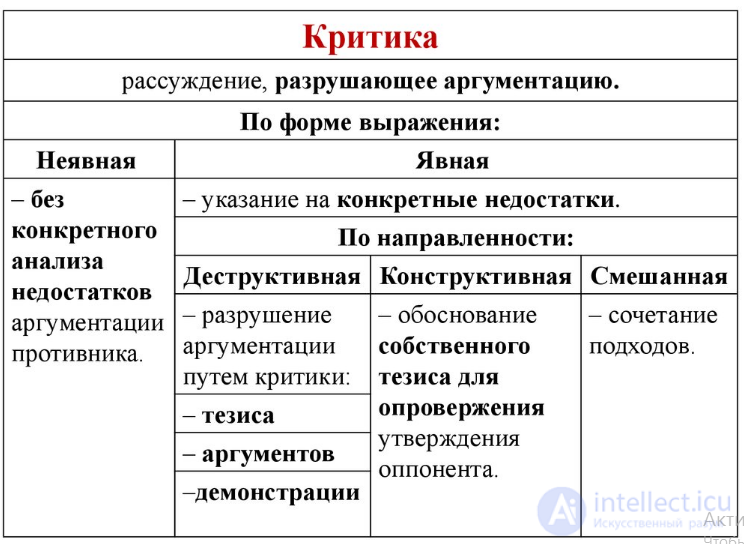
Today the term "criticism" (from Greek – the art of distinguishing) has several meanings. For example, this term is used to denote statements that contain a negative evaluation of the thoughts or actions of certain people, or that reveal shortcomings in the thoughts or deeds of other people.
Within the framework of this conception of rhetoric, which is taught in this manual, the concept of "criticism" can be defined as follows:
. Criticism is the justification of the unacceptability of a particular argumentation
In the literature on logic, the more commonly used term for such processes is "refutation." However, in oratorical activity such a procedure is almost never encountered. The reason is that refutation is the justification, by logical means (predominantly in the form of deductive reasoning), of the falsity of a thesis with the help of true arguments
The construction of criticism presupposes the presence of a particular argumentation. Depending on which structural component the criticism is directed at, the following types of it are distinguished:
o criticism of the thesis;
o criticism of the arguments;
o criticism of the form
. Criticism of the thesis is a type of criticism directed at the orator’s justification of the unacceptability of the statement that was defended by another person
As a rule, for criticism of the thesis the following are chosen:
o the path of "reduction to absurdity" or
o the path of justifying the antithesis
The first path involves deriving from the thesis such consequences as contradict generally recognized propositions or facts
The second path essentially involves the orator constructing argumentation in favor of his own thesis, when it is the antithesis to the proposition put forward by the other person
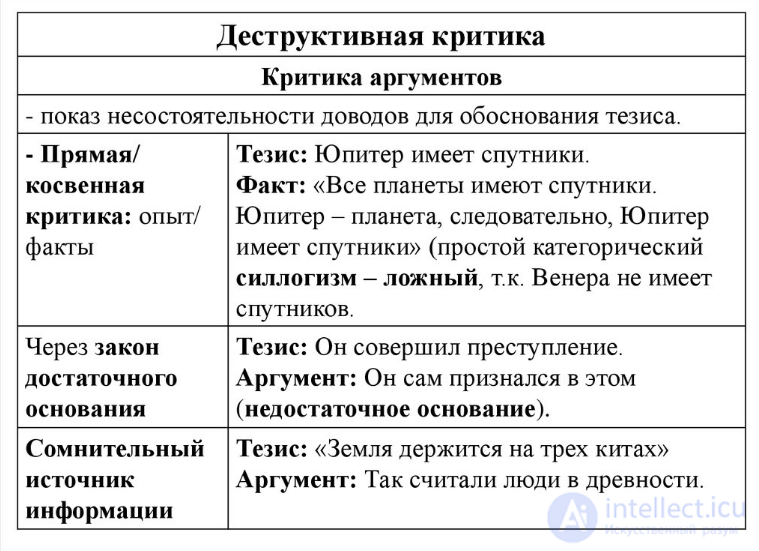
. Criticism of the arguments is a type of criticism directed at the orator’s justification of the unacceptability of those arguments that the other person used in support of his thesis
For example, the orator may show that the consequences of the arguments adduced are unacceptable, or demonstrate a well-founded objection to the initial propositions of the other person
It is often thought that criticism of the arguments is sufficient for the thesis to be recognized as unacceptable. In fact, this is not quite so. By means of such a procedure the thesis is recognized only as unsubstantiated, and the other person retains the possibility of finding more weighty arguments in its favor.
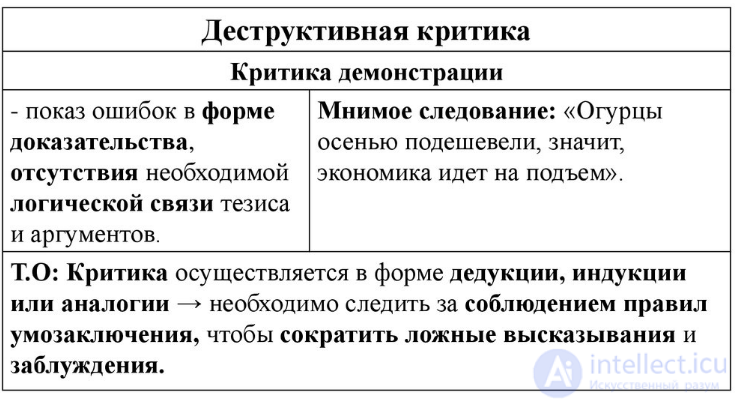
. Criticism of the form is a type of criticism directed at the orator’s justification of the absence of a connection between the arguments and the thesis of the other person
The presence of such a connection is ensured by compliance with the rules that logic has established for particular types of reasoning
Criticism of the thesis is the strongest type of criticism, for only in this case is the thesis recognized as unacceptable, even though arguments have not yet been adduced in its support. Other types of criticism (criticism of the arguments and criticism of the form) merely disrupt the process of argumentation
Let us consider an example:
"Is it worth electing new, unknown politicians to parliament? The representatives of this bloc consider this their advantage. But if we reason this way, then next year we will have to re-elect these ones too: after all, they will no longer be new politicians. Nowhere in the world are parliamentarians changed like gloves!".
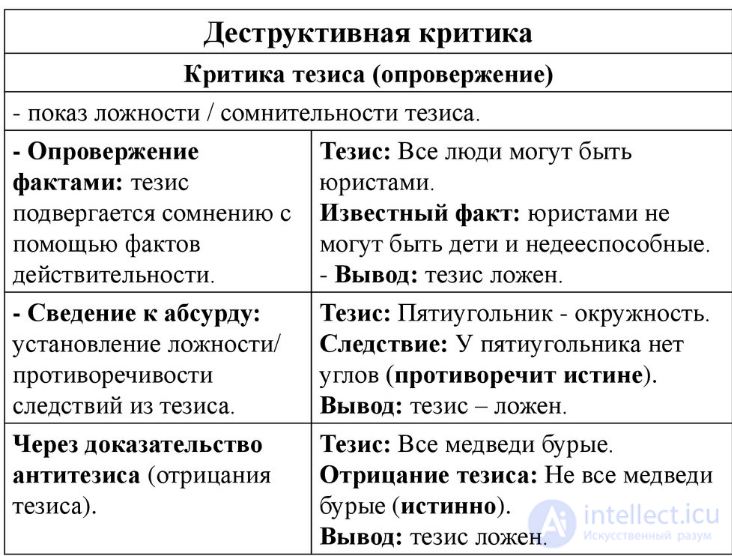
In this campaign leaflet there is an attempt at criticism of the thesis ("New, unknown politicians should be elected to parliament") by way of "reduction to absurdity." From it a consequence is derived ("Next year these politicians too will have to be re-elected"), which is inconsistent with the "generally accepted" experience of political activity ("Nowhere in the world are parliamentarians changed like gloves!").
Try to evaluate for yourself the level of persuasiveness of such criticism

Comments