You get a bonus - 1 coin for daily activity. Now you have 1 coin

Logic Tests with Answers, Part 3

Lecture


150. The subject of a judgment is called:

  • 1) an essence
  • 2) a meaning
  • 3) a subject
  • 4) a syllogism
  • 5) a copula
  • 6) a predicate


151. A feature of an object is everything in which objects:

  • 1) resemble one another
  • 2) differ from one another
  • 3) resemble one another, or in which they all differ from one another


152. When defining concepts it is necessary to correlate the concepts:

  • 1) singular and general
  • 2) formal and substantive
  • 3) concrete and abstract
  • 4) specific and generic


153. In reasoning it is necessary to think in terms of:

  • 1) possible or neutral
  • 2) falsification or delusion
  • 3) true or false
  • 4) truth or falsehood


154. Check the correctness of the division of the concept; in the incorrect division determine which rules are violated: «Periodicals are divided into newspapers and magazines».

  • 1) the rule of continuity of division is violated
  • 2) the rule of proportionality is violated
  • 3) the rule that the basis must be essential is violated
  • 4) the rule that a division must have a single basis is violated
  • 5) correct
  • 5) the rule that the members of a division must mutually exclude one another is violated


155. Check the correctness of the division of the concept; in the incorrect division determine which rules are violated: «School subjects are divided into compulsory and optional»

  • 1) the rule that the basis must be essential is violated
  • 2) the rule of proportionality is violated
  • 3) the rule that a division must have a single basis is violated
  • 4) dichotomy
  • 5) the rule of continuity of division is violated
  • 6) the rule that the members of a division must mutually exclude one another is violated


156. The contraposition of the predicate for the judgment «All sparrows are birds» will be the judgment:

  • 1) some birds are sparrows
  • 2) all non-birds are not sparrows
  • 3) all sparrows are not non-birds
  • 4) some birds are not sparrows


157. The most severe degree of mental deficiency, with an almost complete absence of speech and thought, is called:

  • 1) foolishness
  • 2) idiocy
  • 3) dullness
  • 4) debility
  • 5) imbecility


158. The connection between the subject and predicate of the conclusion in a simple syllogism is carried out by:

  • 1) the major term
  • 2) the greater term
  • 3) the minor term
  • 4) the middle term
  • 5) the lesser term


159. Semantics studies:

  • 1) purely structural properties of sign systems, the rules of their formation and transformation
  • 2) the relation of sign systems to the objects they denote (theory of reference) and to the content expressed (theory of sense)
  • 3) the relation between sign systems and those who perceive, interpret, and use the messages contained in them

160. Syllogism: If every angle of a triangle equals 60o, the triangle is equilateral. In triangle ABC every angle equals 60o.____________ Triangle ABC is equilateral - is:

  • 1) simple categorical
  • 2) disjunctive-categorical
  • 3) conditional-categorical
  • 4) equivalent-categorical
  • 5) conditional-disjunctive


161. Syllogism: If I idle away the whole semester, I will have to strain myself during the exam session or I will be expelled from the institute. I do not want to strain myself during the exam session or to be expelled.____ I will not idle away the semester - is:

  • 1) a simple constructive dilemma
  • 2) a complex constructive dilemma
  • 3) a simple destructive dilemma
  • 4) a complex destructive dilemma


162. A system of signs serving as a means of human communication and mental activity is called ……..Enter the answer:

  • speech
  • language
  • communication


163. The words: «If our premises are true and if we correctly apply the laws of thought to them, then the result must correspond to reality…» - belong to:

  • 1) F. Bacon
  • 2) R. Descartes
  • 3) I. Kant
  • 4) G.W. Leibniz
  • 5) F. Engels
  • 6) V.I. Lenin


164. The complex judgment «Sow the wind – reap the whirlwind» is:

  • 1) an implication
  • 2) a sublimation
  • 3) a conjunction
  • 4) a disjunction
  • 5) an isostension


165. The complex judgment «Midnight is drawing near, and Herman is still not here» is:

  • 1) a disjunction
  • 2) an equivalence
  • 3) an abstinence
  • 4) a conjunction
  • 5) an implication


166. The totality of essential features of an object or class of homogeneous objects that is conceived in a given concept - this is:

  • 1) the extension of the concept
  • 2) the content (intension) of the concept
  • 3) a class or set


167. An abridged syllogism in which one of the premises or the conclusion is omitted (but implicitly assumed) is called ……..Enter the answer:

  • an enthymeme
  • a morpheme
  • an ethinome


168. A sophism differs from a paralogism in:

  • 1) contradictoriness
  • 2) pseudo-scientific character
  • 3) deliberateness
  • 4) mysteriousness


169. Sophism: «What you have not lost, you have. You have not lost horns. Therefore, you are horned» - is called …Enter the answer:

  • horned
  • hornish
  • hornate

170. A sophism - is:

  • 1) a rule of induction
  • 2) a complex judgment
  • 3) a type of deduction
  • 4) a law of thought
  • 5) none of the above


171. The subject and predicate in the judgment «All pines are not birches» are in a relation of:

  • 1) intersection
  • 2) equivalence
  • 3) compatibility
  • 4) incompatibility
  • 5) contrariety
  • 6) contradiction


172. The judgment will be identical if the concept singled out in this judgment is replaced by the concept given in brackets: Any state that pursues a peace-loving policy deserves respect (country) -

  • 1) yes
  • 2) no


173. The judgment «All people are not monkeys» is a judgment of the type:

  • 1) A
  • 2) B
  • 3) C
  • 4) D
  • 5) E


174. A judgment is expressed in the form of:

  • 1) a declarative sentence
  • 2) an interrogative sentence
  • 3) an imperative sentence
  • 4) a phrase


175. The judgment from which a new judgment is derived in an inference is called ……..Enter the answer:

  • a premise
  • a conclusion


176. The judgment «Some students are excellent students» is:

  • 1) universal affirmative
  • 2) universal negative
  • 3) particular affirmative
  • 4) particular negative


177. A judgment - is:

  • 1) any statement of a person
  • 2) inferred knowledge from some premises
  • 3) a form of statement in which something is affirmed or denied
  • 4) a system of concepts about the features of objects or phenomena


178. A judgment - is:

  • 1) a sentence
  • 2) an unfinished thought
  • 3) a generalized concept
  • 4) a form of thought
  • 5) a law of thought

179. The judgments «All predators are animals» and «Tigers are animals» are in the relation of:

  • 1) partial coincidence
  • 2) intersection
  • 3) subordination
  • 4) unambiguity
  • 5) equivalence


180. The essential difference between formal-logical laws and the laws of nature lies in the fact that:

  • 1) the laws of nature are objective, while the laws of logic are subjective
  • 2) the laws of nature are in principle not violated, while the laws of thought are violated
  • 3) the laws of nature act by themselves, while logical laws depend on people


181. The diagram reflecting the relation of subordination between concepts:
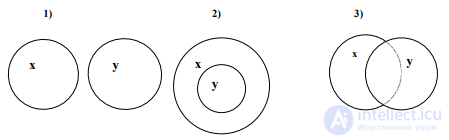
  • 1) 1
  • 2) 2
  • 3) 3


Logic Tests with Answers, Part 3


182. The thesis on logical errors: «He who proves too much proves nothing» - was formulated by:

  • 1) Aristotle;
  • 2) F. Bacon;
  • 3) R. Descartes;
  • 4) G.W. Leibniz;
  • 5) I. Kant.
  • 6) J. Buridan


183. Traditional logic is:

  • 1) symbolic
  • 2) Aristotelian
  • 3) mathematical
  • 4) modern


184. Indicate the correspondence between the names of the formal-logical laws and their formulations:
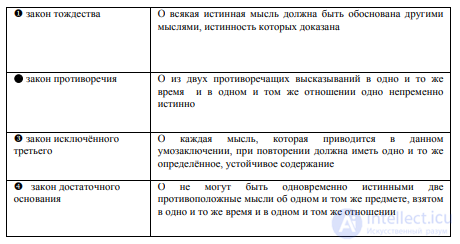
Logic Tests with Answers, Part 3


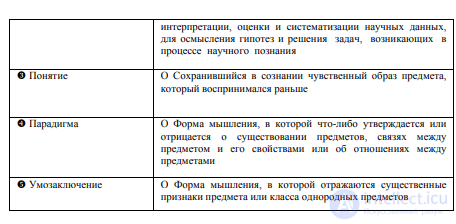
185. Indicate the correspondence between concepts and their definitions:
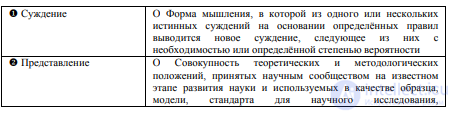
Logic Tests with Answers, Part 3

Logic Tests with Answers, Part 3
X Judgment O A form of thought in which, from one or more true judgments, on the basis of certain rules,
a new judgment is derived, following from them with necessity or a certain degree of probability
Y Representation O A body of theoretical and methodological positions accepted by the scientific community at a known
stage in the development of science and used as a sample, model, standard for scientific research,
X law of identity O every true thought must be substantiated by other thoughts whose truth has been proven
Y law of contradiction O of two contradictory statements, at one and the same time and in one and the same respect, one is necessarily true
Z law of the excluded middle


O every thought that is used in a given inference must, upon repetition, have one and the same
definite, stable content
[ law of sufficient
reason
O two opposite thoughts about one and the same subject, taken at one and the same time and in one and
the same respect, cannot both be true

interpretation, evaluation and systematization of scientific data,
for making sense of hypotheses and solving problems arising in
the process of scientific cognition
Z Concept O A sensory image of an object preserved in consciousness,
which was perceived earlier
[ Paradigm O A form of thought in which something is affirmed or
denied about the existence of objects, connections between
an object and its properties, or relations between
objects
\ Inference O A form of thought in which the essential
features of an object or class of homogeneous objects are reflected


186. Eubulides's inference: A. I am a liar. B. I am telling the truth.________________ Conclusion: I am simultaneously telling the truth and lying - which he used in disputes, is called:

  • 1) an error
  • 2) a paradox
  • 3) a sophism
  • 4) a trick


187. An inference by analogy whose conclusion carries a reliable character is called ……..Enter the answer:

  • strict analogy


188. An inference - is:

  • 1) a law of thought
  • 2) a complex judgment
  • 3) a form of thought
  • 4) a true conclusion
  • 5) a false concept


189. An inference - is:

  • 1) a logical conclusion about something
  • 2) a system of judgments with something
  • 3) any judgment of a person
  • 4) a new judgment following from other judgments


190. A deliberately erroneous line of reasoning presented as true:

  • 1) a paralogism
  • 2) a sophism
  • 3) a paradox


191. Determine the correctness of the following definition; if it is incorrect, which rule of definition is violated: «Life is the sum of vital functions»

  • 1) a definition must be precise, clear
  • 2) rule of proportionality: definition too broad
  • 3) rule of proportionality: definition too narrow
  • 4) correct
  • 5) the definition is circular


192. Determine the correctness of the following definition; if it is incorrect, which rule of definition is violated: «A concern is a form of monopolistic association»

  • 1) correct
  • 2) the definition is circular
  • 3) rule of proportionality: definition too narrow
  • 4) a definition must be precise, clear
  • 5) rule of proportionality: definition too broad
  • 6) a definition must not be negative


193. «Participant of the Great Patriotic War of 1941 – 1945» - this is:

  • 1) a collective concept
  • 2) a registering concept
  • 3) a non-registering concept


194. Formal logic appeared:

  • 1) in the Middle Ages
  • 2) in antiquity
  • 3) in the Modern era
  • 4) in the Renaissance


195. Formal errors in thinking are:

  • 1) sophisms
  • 2) prejudices
  • 3) paralogisms
  • 4) stylistic
  • 5) orthographic


196. The form of thought in which the essential features of an object or class of homogeneous objects are reflected:

  • 1) judgment
  • 2) concept
  • 3) inference
  • 4) syllogism


197. The formula reflecting the essence of a judgment:

  • 1) A is B
  • 2) S is P
  • 3) A = B
  • 4) S = P


198. Forms of abstract thought:

  • 1) representation
  • 2) concept
  • 3) judgment
  • 4) disjunction
  • 5) inference


199. Forms of sensory cognition:

  • 1) emotions
  • 2) sensations
  • 3) perceptions
  • 4) affects
  • 5) representations


200. The function of logic is, first and foremost, the possibility of teaching a person:

  • 1) to think and reason correctly
  • 2) not to err in reasoning
  • 3) to debate, to argue
  • 4) to mislead another person


201. Most often, people commit at the beginning of their reasoning:

  • 1) errors in theses
  • 2) errors in premises
  • 3) errors in argumentation


202. A person who applies knowledge of logic to achieve good is called:

  • 1) «the devil's advocate»
  • 2) «God's advocate»
  • 3) «the advocate of truth»
  • 4) «the advocate of lies»


203. The element of a judgment indicating which part of the extension of the concept that functions as the subject of this judgment is being discussed is called …….. Enter the answer:

  • a quantifier number


204. An epicheirema - is:

  • 1) a type of complex judgment
  • 2) a variety of inference
  • 3) a branch of induction
  • 4) a law of deduction
  • 5) a rule of the syllogism


205. Eristic is connected with such a form of reasoning as a dispute. Indicate the type of dispute aimed at reaching agreement, and not at «destroying» the opponent:

  • 1) discussion
  • 2) polemic
  • 3) disputation
  • 4) dialogue


206. Eristic - is:

  • 1) the doctrine of correct thinking
  • 2) the doctrine of the rules of discussion
  • 3) the doctrine of the laws of logic
  • 4) the doctrine of paradoxes

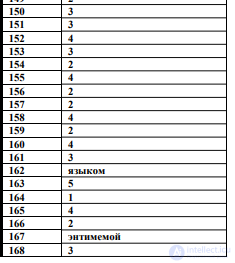
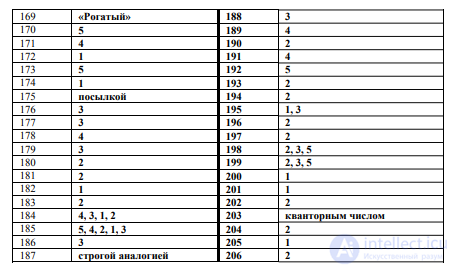
Answers to the tests

Logic Tests with Answers, Part 3

Logic Tests with Answers, Part 3

See also

  • [[b5646]]
  • [[b9563]]
  • [[b9796]]
  • [[b9797]]
  • [[b9798]]
  • [[b5645]]
  • [[b5643]]
  • [[b5647]]
  • [[b834]]
  • [[b835]]
  • [[b836]]
  • [[b6955]]

See also

created: 2020-11-28
updated: 2026-03-10
384


Was this answer useful?
Choose a quick rating so we can improve the next answer for you.
How satisfied are you?


Comments

To leave a comment

If you have any suggestion, idea, thanks or comment, feel free to write. We really value feedback and are glad to hear your opinion.
To reply

Lectures and tutorial on "Logics"

Terms: Logics