
Lecture
Buddhism arose in the northeastern part of India (the territory of the modern state of Bihar), where the ancient states (Magadha, Kosala, Vaishali) in which the Buddha preached were located, and where Buddhism gained significant spread from the very beginning of its existence. It is usually held that, on the one hand, the positions of the Vedic religion and its associated varna (caste) system, which ensured the privileged position of the Brahmin (priestly) varna, were weaker here than in other parts of India (that is, the northeast of India was, as it were, a «weak link» of Brahmanism), while on the other hand, it was precisely here that a vigorous process of state-building was underway, presupposing the ascendancy of another «noble» estate – the kshatriya varna (warriors and secular rulers, i.e. kings). It was precisely as a teaching in opposition to Brahmanism, relying above all on the secular power of kings, that Buddhism arose. It is important to note here that, again, Buddhism contributed to the creation in India of powerful state formations such as the empire of Ashoka. Much later, already in the 5th century CE, the great Buddhist philosopher Vasubandhu, expounding the cosmogonic myth in his «Treasury of Abhidharma» (Abhidharmakosha), says almost nothing about the Brahmins, but
describes in great detail the origin of royal power (proposing one of the oldest versions of the contract theory) and of the warrior estate.
In Buddhism's reliance not so much on the kshatriya estate as on royal power as such, a significant danger was concealed, one that manifested itself fully during the so-called decline of Buddhism in India, which led to the practically complete disappearance of Buddhism in its homeland (7th–13th centuries). In fact, there was no decline as such. In the monastery-universities (Nalanda, Vikramashila) monastic scholarship continued to flourish, the most refined treatises on logic and epistemology were written, disputations were won, and tantric yogi-mahasiddhas («great accomplished ones») gathered for their mystical feasts and gave themselves over to contemplation
in forests and at cemeteries. It was simply that kings gradually ceased to support Buddhism, returning, for reasons not entirely clear, to the fold of Brahmanical orthodoxy – Hinduism. With the cessation of royal support, Buddhism disappeared as well. Where, however, kings retained their devotion to the Buddha's Teaching (Dharma), the flourishing of Buddhism continued. This was the case, for example, in the Bengali state of the Palas, whose kings continued to patronize Buddhism right up until Bengal fell under the rule of Muslim conquerors. Thus, in India Buddhism was a «royal religion», which did not prevent it from simultaneously being a form of ancient Indian free thought, since it was the priestly estate of the Brahmins in India that bore the mantle of religious and, more broadly, ideological orthodoxy and orthopraxy. And even
in the latest period of its existence in India, Buddhism did not lose this spirit of free thought.
The middle of the first millennium BCE was, in India, a time of crisis for the ancient Vedic religion, whose custodians and zealots were the Brahmins. It is unsurprising, then, that the «weak link» of Brahmanism – the states of northeastern India – became the support and stronghold of alternative religious movements, to which Buddhism belonged. The emergence of these alternative teachings, in turn, was closely connected with the disillusionment of part of ancient Indian society with the Vedic religion, with its ritualism and formal piety, as well as with certain contradictions and conflicts between the Brahmins (the priesthood) and the kshatriyas (who embodied the principles of secular power among the ancient Indian kings).
The old Vedic religion of sacrifices and rituals was undergoing an acute crisis, which expressed itself in the appearance of new, unorthodox ascetic movements of the so-called shramanas – ascetics, strivers, and wandering philosophers who rejected the authority of the Brahmins and the sacred Vedas and set themselves the goal of an independent search for truth through the practice of philosophy and yoga (the psycho-practice of transforming consciousness). One such shramana (or, in Pali, samana) was the Buddha Shakyamuni, the historical founder of Buddhism.
The shramanas and shramana movements played an enormous role in the history of Indian philosophy and culture. Above all, it is from them that the tradition derives
of free philosophical disputation and of philosophy as the logical-discursive substantiation and derivation of one or another theoretical proposition.
In India itself, ancient Buddhist literature has not survived, if one does not count the rock inscriptions of Ashoka, which are the very first document known to scholarship that mentions the Buddha and his teaching – the dharma. They were created in the 3rd century BCE. The Buddhist literature known today took shape over the course of many centuries, not only in India but also in the countries into which Buddhism penetrated. It is quite extensive. Thus, the Tibetan collections of canonical works, the Kangyur and the Tengyur, contain 4,566 texts. Various schools
and traditions of Buddhism still dispute among themselves over many works – whether or not they should be classed as sacred literature unconditionally worthy of trust. Some consider the Pali texts more reliable, others the Sanskrit texts. However, all Buddhists agree in recognizing as the most important source of information about early Buddhism those religious works that were written down by the beginning of our era in the Pali language in Ceylon and are known under the name of the Tipitaka (Tripitaka) – the «three baskets». A complete set of these works in early manuscripts has not been found.
In the last century, the work of collecting what had survived in the monasteries of Ceylon, Burma, Siam, and Nepal, as well as (in translations into the respective languages) in Tibet, China, Mongolia, and Japan, began. In 1871, the Fifth Buddhist Council was convened in Mandalay (Burma), at which 2,400 monks, experts in the canon,
– by collating various manuscripts and translations, produced a refined text of the Tipitaka, which was then carved onto 729 specially made marble slabs. For each slab a separate miniature, pointed-roof white shrine was built. Standing in orderly rows, these shrines formed the Kuthodaw temple complex – a whole distinctive little town-library, a repository of the canon. Thanks to Kuthodaw, and to another, very similar temple complex, Sandamuni, which contains commentaries on the Tipitaka, Mandalay became one of the most revered places for Buddhists the world over.
In the late 19th and early 20th centuries, many of the texts making up the Tipitaka were translated into European languages and published, becoming accessible to a wide circle of researchers.
The Tipitaka includes works of the most varied content and form. These include collections of rules of monastic conduct, various religious-didactic tales, religious-philosophical treatises, and versified sayings. Analysis of the texts has made it possible to establish an approximate time of their composition.
The oldest part of the canon is considered to be the Vinaya Pitaka, or «basket of discipline». In Kuthodaw it occupies 111 marble slabs. The five books that make it up set out the rules of conduct and way of life of Buddhist monks and laypeople, the conditions for admission to and expulsion from the monastic community, and the details of the community's organizational structure and its history. Although the formulations of all these rules and requirements are attributed to the Buddha Shakyamuni, specialists believe that most of the works making up the Vinaya Pitaka took shape no earlier than the 3rd century BCE, that is, at most two centuries before their initial written fixation. The Patimokkha is the oldest and central text of the Vinaya Pitaka. It is the oldest part of the entire canon. Its content is a list of transgressions committed by monks and the punishments imposed for them. Next comes the two-book Suttavibhanga – commentaries on the Patimokkha.
The next book is called the Khandhaka, divided into two parts – the Mahavagga and the Cullavagga. The first part represents the history of the development of the Buddhist monastic community, beginning with the legendary moment of Gautama's attainment of enlightenment. It describes in detail the main ceremonies and festivals of the community, the rules of conduct for monks during the day, and the gathering of the community for the rainy season. The Cullavagga is a continuation of the Mahavagga. It focuses mainly on the punishments imposed on monks for various transgressions. It also speaks of those who renounced monastic life and describes the first two Buddhist councils.
The Parivara sets out mnemonic devices that facilitate the memorization of the numerous rules and prohibitions.
The second part of the Tipitaka is the Sutta Pitaka, or «basket of discourses». This is the most extensive part of the canon. It is allotted 410 slabs in Kuthodaw. It consists of five collections that set out the ideology of Buddhism in the form of parables and discourses, which are likewise attributed to the Buddha or his closest disciples. The Khuddaka Nikaya collection includes 15 books, some of which enjoy particular renown. Among them is the Dhammapada, which conveys the most important questions of doctrine in concise verse form. The Suttanipata contains verses of ethical content, and so on. Especially interesting are the Theragatha and Therigatha, or the hymns of monks and nuns – likewise one of the oldest works in the entire canon. Also important for the study of early Buddhism is the Jataka collection, which includes stories of the Buddha's rebirths. They have the character of moral admonitions proceeding from the Buddha himself. Modern scholarship has established that these are, at their core, not original Buddhist compositions but works of Indian folklore adapted for the visual preaching of Buddhism. They are important as a source of information on the conditions of social life in ancient India.
Finally, the third part of the canon is the Abhidhamma Pitaka, or «basket of the explanation of the teaching (law)». It occupies 208 slabs in Kuthodaw. It comprises seven books of a religious-philosophical character, devoted to the exposition and development of thoughts attributed to the Buddha. This is the latest part of the canon. Many schools and traditions of Buddhism do not recognize it as a primary source and do not include it in the canon.
The «Diamond Sutra» is one of the principal works of the Buddhist canon in its Mahayana version (Mahayana – the «great vehicle» – the name of one of the main schools of Buddhism, widespread to the north of India). The canon of Buddhists of all schools consists of three parts: the Vinaya (monastic rules), the Sutra (the sayings of the Buddha Shakyamuni addressed to his disciples), and the Abhidharma (philosophical texts). Each of these parts is very
large in volume. Thus, in the Tibetan Buddhist canon the sutras occupy 44 volumes.
The Mahayana canon differs from the sacred books of the Hinayana («lesser vehicle», southern Buddhism) in its original esoteric character. Mahayana tradition holds that when the disciples of the deceased Shakyamuni in the city of Rajagriha (the capital of the ancient Indian kingdom of Magadha) were forming the Hinayana canon, the bodhisattvas Vajrapani, Maitreya, and Manjushri gathered on Mount Vimalasvabhava near Rajagriha. At their heavenly council they recorded the Buddha's teaching more fully than ordinary people could have done.
As for the specific Mahayana texts, they have come down to us in a later redaction. In seeking their oldest versions we often turn to the Tibetan heritage. But Buddhism spread widely in Tibet only in the 7th century, and many Mahayana texts go back to other primary sources, above all Sanskrit and Chinese ones. This applies also to the «Diamond Sutra», which acquired its canonical form among Chinese Buddhists in the 4th century CE. Its author (or editor) is said to be Kumarajiva (343–413) – the first Indian Buddhist to acquaint the Chinese with the teaching of Mahayana, and who also gave completeness and coherence to the system of doctrine of this Buddhist school as a whole. Minor changes were made to the text of the sutra later as well.
In the full Sanskrit title of the «Diamond Sutra» (Vajracchedika Prajnaparamita Sutra) the main goal facing the Buddhist is reflected – the attainment of nirvana. An important prerequisite for attaining this goal is the acquisition of the six «perfections» («paramitas»): perfection in generosity, morality, righteous diligence, patience, meditative practice, and in the intuitive wisdom which in Sanskrit is called «prajna».
The text of the «Diamond Sutra» has not changed in 17 centuries, but what was comprehensible then is now perceived with difficulty. It should be remembered that the content of the «Diamond Sutra» is immeasurably deep. The word and the meaning to which it points are not one and the same thing. The semantic meaning is like a multifaceted crystal, to which many words pertain. Each word points to one facet of the crystal, but not to the crystal itself. At the same time, a facet of the crystal's surface belongs to the crystal, so the word does point to the crystal. In the 6th century the text of the «Sutra» was divided into 32 sections (paragraphs). The Sutra, which represents, as it were, an objectification of the awakened consciousness of the text's author and a means of engendering the same in the reader, is filled with paradoxical statements that, as it were, test the reader's understanding of the text (for one who has understood, the paradox turns out to be only apparent).
The popularity of the «Vajracchedika» is explained in large part by its conciseness combined with the fullness of the content and expression of the Prajnaparamita doctrine. This doctrine («prajna paramita» – the intuitive «wisdom that carries one across to the other shore of existence») began to take shape in India at the turn of our era and turned out to be closely connected with the philosophy of the Madhyamaka school (Shunyavada), which in a certain sense represents a systematized and rationalized Prajnaparamita teaching.
The «Vajracchedika Prajnaparamita Sutra», known in Europe as the «Diamond Sutra», belongs among the most revered Buddhist texts of the Far Eastern tradition.
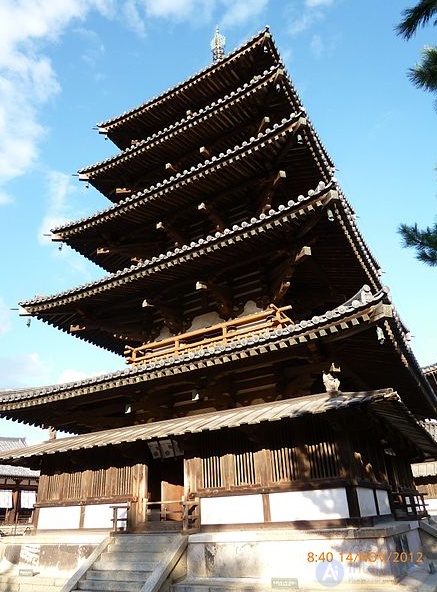
The pagoda of the temple at Horyu-ji, the oldest wooden structure in Japan
A call to fearlessness resounds in the Tibetan «Book of the Great Liberation», which in form is a complex set of instructions and prayers with which a lama guides the dying and the dead. The main task of the lama reading the book is to show the dying person that all the images that arise before him are «manifestations» or «reflections» of his own consciousness. The images of the «Book of the Dead» are, as a rule, ambiguous; they can be understood only through additional descriptions that are contradictory from the standpoint of everyday logic. For instance, the «emptiness» into which the dying person is immersed is inseparable from luminosity, from «primordial radiance» as the foundation of being. One of the peculiarities of the ritual is considered to be that the person listens to the lama's instructions while in an invisible body. The instructions of the Tibetan lamas are striking in the precision of their description of the borderline states of human existence, and anyone will be convinced of this. Anyone who has experienced them.
The «Book of the Great Liberation» belongs to the so-called «hidden treasure texts». According to tradition, they were composed by the teacher Padmasambhava in the 8th century, then concealed in secret caves and discovered later, in the era of the flourishing of Tibetan Buddhism.
The deities described in the «Book of the Dead» are perceived in the Buddhist tradition as embodiments of various energetic manifestations. The «Book of the Dead» describes, and interprets in its own particular way, the life experience of human beings. Chögyam Trungpa called it the «Book of Space», which encompasses both life and death. Indeed, the bardo – the intermediate state – can occur not only after death but also in life situations, for example, during illness and trauma. The comprehension and experiencing of these states is meant to give an understanding of life and death, and to overcome stress and fear.
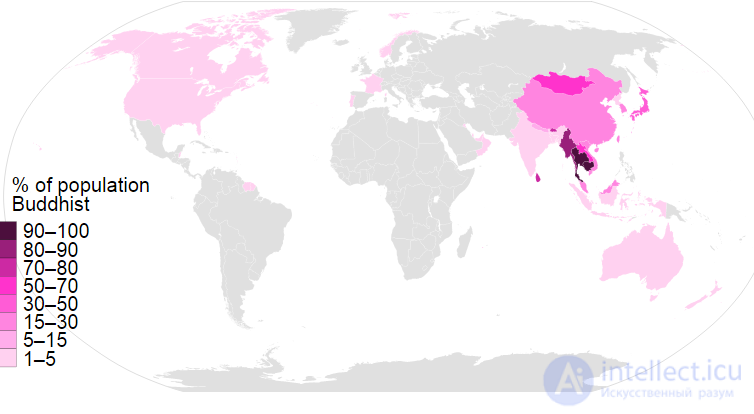
Percentage of Buddhist population in the countries of the world according to Pew Research Center data (2010)
Comparison of Buddhism and Hinduism

At present it is completely impossible to reconstruct a scholarly biography of the Buddha. Simple excision of mythological plots and elements of a folkloric character is entirely ineffective, and modern scholarship clearly lacks the material for a genuine biographical reconstruction. Therefore, we shall not even attempt this hopeless task here, and shall instead present not a biography but a fully traditional life-account of the Buddha, based on a synthesis of a number of Buddhist hagiographic texts (such as Ashvaghosha's «Life of the Buddha» – 1st century CE, or the Mahayana «Lalitavistara»).
Over the course of hundreds and hundreds of lives, the Bodhisattva (bodhi – awakening, enlightenment; sattva – being; here – the future Buddha) performed countless deeds of love and compassion, gradually accumulating merit and drawing closer to the state of the sage who has known the truth and emerged from the agonizing wheel of the alternation of births and deaths – the Buddha. And now the time of his final birth arrived. The Bodhisattva was dwelling at that time in the Tushita heaven and surveyed the earth in search of the most auspicious place for his final birth, since he had already reached such a level of spiritual development that he could choose. And his gaze came to rest on a small state of the Shakya people in the northeastern part of India (the territory of modern Nepal), ruled by the wise king Shuddhodana of an ancient royal lineage. And the Bodhisattva, who could even have simply appeared in the world without entering a mother's womb, decided to choose the family of the Shakya king for his birth, so that afterward people, feeling deep respect for the venerable lineage of the Shakya kings, would place greater trust in the Buddha's preaching, seeing in him a scion of an ancient and glorious family.
That night the king's wife, Queen Mahamaya, had a dream: a white elephant with six tusks entered her side, and she understood that she had conceived a great man. Buddhism teaches that the Buddha's conception was entirely natural, and that the vision of the white elephant was merely a sign of the conception of a great personage.
Shortly before the birth, the queen, accompanied by her retinue, set out, in accordance with custom, for her parents' house. On the way, as they were passing through a grove of sal trees called Lumbini, the queen felt the pangs of labor, took hold of a branch of a tree, and gave birth to a son, who emerged from her womb through her side. The infant immediately stood on his feet and took seven steps, proclaiming himself a being surpassing both men and gods.
This wondrous birth proved fatal, and Mahamaya soon died. Her son, however, did not forget the mother he had never known: after his own Awakening he ascended to the Tushita heaven, where Mahamaya had been reborn, told her that he had become the Buddha, the conqueror of suffering, and preached to her the Abhidharma – the Buddhist philosophical teaching. But for now the future Buddha is still an infant, and he is brought to his father's palace in the city of Kapilavastu (near the modern capital of Nepal, Kathmandu), the center of the land of the Shakyas.
The king summoned the astrologer Asita to see the infant, and he discovered on the child's body thirty-two marks of a great man (the sign of a wheel between the eyebrows, as well as on the palms and soles of the feet, an ushnisha – a protuberance on the crown of the head, webbing between the fingers, and so on). On the basis of these signs Asita declared that the newborn would become either a great sovereign, ruler of the entire world (a chakravartin), or a saint who had known the truth – a Buddha. The boy was then named Siddhartha Gautama. Gautama is his family name; the word «Siddhartha» may be translated as «He Who Has Fully Achieved His Goal.»
The king, of course, wished for his son to become a great sovereign. He therefore resolved to arrange his son's life so that nothing could lead him toward philosophical reflection or musings on the meaning of life. The prince was settled in luxury and comfort in a magnificent palace, shut off from the outside world. The boy grew up, invariably surpassing all his peers in learning and sport. From childhood, however, he showed a tendency toward reflection, and once, sitting beneath a rose bush, he spontaneously sank into a state of yogic trance (samadhi) of such intensity that its power even halted one of the deities flying nearby. The prince was gentle by nature, which at first even turned his betrothed – Princess Yashodhara – against him, for she considered such gentleness unbefitting a kshatriya and incompatible with martial valor. Only after Siddhartha demonstrated his martial skill to Yashodhara did she agree to become his wife; a son, Rahula, was born to them. It seemed that the plan of the father-king would surely come to pass. So it continued until the prince turned twenty-nine and one day went out hunting. That hunt changed his whole life.
While hunting, the prince was struck for the first time by the sight of the suffering that fills life. He sees a plowed field where birds are pecking worms out of the clods of earth, and is astonished that some living beings can live only at the cost of others' deaths. But the most important events for Siddhartha's spiritual transformation prove to be four encounters: the prince sees a funeral procession and understands that all people, and he himself, are mortal, and that neither wealth nor noble birth can protect one from death. He notices a leper and for the first time realizes that disease lies in wait for every mortal. The prince looks upon a beggar asking for alms and understands the fleeting, illusory nature of wealth and noble birth. And then Siddhartha comes upon a sage absorbed in contemplation. Looking at him, the prince realizes that the path of inner reflection and self-knowledge is the only path to understanding the causes of suffering and the means of deliverance from it. It is said that the gods themselves, who likewise dwell within the wheel of birth and death and long for deliverance, sent these people to meet the prince, in order to inspire him to set out on the path of knowledge and liberation.
After this memorable hunt the prince could no longer live quietly in his splendid palace. And so one night he leaves the palace on his beloved horse Kanthaka, accompanied by a single servant. At the edge of the forest he bade farewell to the servant and the horse, and with his sword – which he took up for the last time in his life – cut off, as a sign of renunciation of worldly life, his long «honey-colored» hair. Having done this, he entered the forest. Thus began a period of apprenticeship, asceticism, and spiritual searching.
Siddhartha joined various shramana groups, quickly mastering everything their teachers taught. The most famous of the future Buddha's teachers were Udraka Ramaputra and Arada Kalama. They preached a doctrine close to Samkhya – one of the orthodox Brahmanical schools, which nevertheless arose within the shramana milieu – and also taught yogic practices of spiritual exercise, including breathing exercises requiring prolonged breath retention accompanied by excruciating sensations. According to the teaching of Samkhya, the world is the result of a false identification of spirit (purusha) with matter (prakriti). Complete separation of spirit from matter is liberation (kaivalya) and deliverance from all suffering. Siddhartha very quickly attained everything his teachers taught, and they even invited him to become their successor. But the former prince refused: he himself had not found what he sought, and the answers he received by practicing his teachers' methods did not satisfy him.
It should be noted that the shramana philosophers (parivrajakas, «wanderers») preached the most diverse doctrines. Here is some information about them found in Pali Buddhist texts (the names are given here in their Pali, rather than Sanskrit, form): Purana Kassapa preached the futility of actions; Makkhali Gosala (head of the well-known Ajivika school) maintained strict determinism and fatalism; Ajita Kesakambali upheld a doctrine close to materialism; Pakudha Kaccayana spoke of the eternity of seven substances; Sanjaya Belatthiputta was an adherent of complete agnosticism, and Nigantha Nataputta professed skeptical views.
Siddhartha listened attentively to all of them, but became no one's follower. He gave himself over to severe asceticism and mortification of the flesh. He himself later said that he had reached such a degree of emaciation that, touching his stomach, he could feel his spine with his finger. But asceticism did not bring him closer to enlightenment, and the truth remained as far from him as it had been when he lived in the royal palace at Kapilavastu.
Siddhartha then decided to renounce the extreme of asceticism and accepted a modest but nourishing meal (rice porridge with milk) from the hands of a girl who lived nearby. The five ascetics who had practiced together with Siddhartha considered him a renegade and abandoned him, leaving him in complete solitude. The former prince then sat down in the posture of contemplation beneath a banyan tree, which came to be known in the Buddhist tradition as the «Tree of Awakening» (bodhi), and vowed that he would not leave that spot until he had attained his goal and known the truth, after which he entered a state of deep concentration, absorbed in contemplation.
Sensing the approach of Siddhartha's victory over the world of death and birth, the evil demon Mara attacked him with his demonic hosts, and when Siddhartha showed no fear, tried to tempt him with the beautiful forms of his daughters. But Siddhartha remained unshaken, and Mara withdrew. Meanwhile Siddhartha sank ever deeper into contemplation, and the Four Noble Truths concerning suffering, the cause of suffering, the cessation of suffering, and the path leading to the cessation of suffering were revealed to him. His concentration deepened still further, and he grasped the universal principle of dependent origination. Finally Siddhartha's mind reached the fourth level of concentration, and before him shone the light of the unshakable peace of nirvana, the Great Liberation. Here Siddhartha entered the state of trance (samadhi) of Oceanic Reflection, in which his consciousness became like the boundless surface of the world ocean in a state of complete calm, when the mirror-smooth surface of the motionless waters reflects within itself all phenomena. At that moment Siddhartha Gautama, prince of the Shakya clan, disappeared, and the Buddha – the Awakened One, the Enlightened One – appeared in the world (the Sanskrit root buddh is the same as in the Russian words «budit», «probuzhdat'sya» – «to awaken», which is entirely unsurprising, since Russian, like Sanskrit, along with Latin, German, Lithuanian, and many other Slavic, Germanic, Romance, and similar
languages, belongs to the Indo-European language family). And he was no longer a prince and heir to the throne; strictly speaking, he was no longer even a human being, for human beings are born and die, while the Buddha abides beyond both life and death. And his names and titles from then on were – Buddha Shakyamuni (the Awakened Sage of the Shakya clan), Tathagata (Thus Come or Thus Gone), Bhagavan (the Blessed One, the Blissful One; literally – «endowed with a blessed portion»), Sugata (the Rightly Gone), Jina (the Victor), Lokajyeshtha (the One Honored by the World). And the whole universe rejoiced, the gods showered the Buddha with heavenly flowers, a wondrous fragrance spread throughout the world, and the earth trembled at the appearance of the Victor. But the Buddha himself remained for seven more days in a state of samadhi, savoring the bliss of liberation. On the eighth day he emerged from his trance, and Mara at once approached him with a final temptation. He proposed that the Buddha remain there, beneath the Bodhi Tree, and enjoy the bliss he had attained, going nowhere and preaching the truth to no one. But the Buddha immediately rejected this temptation and set out for one of the religious centers of India – Benares (Varanasi), located not far from Vajrasana (Vajrasana (Skt.) – the Seat of Diamond Indestructibility, an epithet for the place of Awakening; today Bodh Gaya, in the state of Bihar). Arriving there, he made his way to the nearby Deer Park (Sarnath), where he delivered his first sermon – the Sermon on Turning the Wheel of the Teaching (Dharma). The Buddha's first listeners were the five ascetics who had earlier abandoned the renegade Gautama in contempt. Even now they at first did not wish to listen to the Buddha, but his transformed appearance so astonished them that they nevertheless decided to hear him out, and having heard him, they came to believe, thus becoming the first Buddhist monks, the first members of the sangha – the Buddhist monastic community. Thus the new religion at once acquired its Three Jewels (Triratna), the three objects of veneration, by taking refuge in which a person may be considered a Buddhist – the Buddha, the Dharma (his Teaching), and the Sangha (the monastic Community).
Besides the ascetics, the Buddha was also heeded by two gazelles, whose images on either side of the eight-spoked (the eight spokes of the Wheel symbolize the eight stages of the Buddhist Noble Path) Wheel of the Teaching (dharmachakra) became a symbol of Buddhism and Buddhist preaching; this image can be seen on the roofs of many Buddhist temples, including the St. Petersburg Datsan.
Siddhartha Gautama left the palace at the age of twenty-nine and became the Buddha at thirty-five. After that he preached his teaching for another forty-five years in various states of northeastern India. The wealthy merchant Anathapindada gave the sangha a grove near the city of Shravasti, capital of the state of Kosala. There the Buddha and his monks often stayed when they came to Kosala. The sangha grew rapidly, and, if the sutras are to be believed, its numbers reached 12,500. Among the first monks the most outstanding disciples of the Buddha stood out: Ananda, Mahakashyapa («the Standard-Bearer of the Dharma»), Mahamaudgalyayana, Subhuti, and others. A community of nuns was also established. Thus, besides monks (bhikshu), there also appeared nuns (bhikshuni). The Buddha did not forget his own family either. He visited the land of the Shakyas and was joyfully welcomed by his father, by Princess Yashodhara, and by the people of the country. After conversations with the Buddha, his son Rahula and Yashodhara took monastic vows. The Buddha's father, Shuddhodana, thus left without heirs, made the Buddha promise that he would never again admit into the community an only son in a family without his parents' consent. The Buddha promised this, and since then this custom has been faithfully observed in Buddhist countries, especially in the Far East. Not everything, however, went smoothly. The Buddha's fame aroused the envy of his cousin Devadatta, who had always envied the prince's successes even before, and who, after Siddhartha's departure into asceticism, even tried to seduce Yashodhara. At first Devadatta tried to destroy the Buddha, first setting a maddened elephant upon him (which, however, knelt before the Buddha), then hurling a huge boulder at him. When these attempts failed, Devadatta pretended to become a follower of the Buddha and took monastic vows, actually seeking to split the sangha from within (he accused the Buddha of insufficiently strict asceticism, opposed the creation of a community of nuns, and in every way obstructed all his brother's undertakings). But all his schemes were in vain, and in the end he was disgracefully expelled from the community. The entire literature of the jatakas (didactic narratives about the previous lives of the Bodhisattva – the future Buddha) is full of stories about how Devadatta was at enmity with the Bodhisattva even in their past lives).
Time passed. The Buddha grew old, and the day of his departure into final nirvana drew near. This took place in the town of Kushinagara, on the bank of the river Hiranyavati, not far from Benares. Having taken leave of his disciples and given them his final instruction to rely only on their own strength, to «be lamps unto themselves,» and to labor diligently for the sake of liberation, the Buddha lay down in the lion's posture (on his right side, head to the south and face to the east, with his right hand placed beneath his head) and sank into contemplation. First he attained the fourth level of concentration, then the eighth, then returned to the fourth and from it entered the great and eternal nirvana without remainder. His last life had ended; there would be no more new births and no more new deaths. The potter's wheel of karma stopped turning, and the body, the last objectification of the former attachment to profane existence, ceased to live. Henceforth the Buddha was no longer in the world, and the world was no longer for the Buddha. He entered a state that can be neither described nor represented. One can only say that in it there was no place for suffering, which was replaced by supreme bliss.
In Buddhism the word «Dharma» has at least two meanings: «teaching» and the «path» pointed out by the Buddha, the latter being the more important. The teaching merely sets forth what is to be realized through personal experience. The power of the Dharma lies in the practice of putting it into effect in each person's life. It also lies in the very
sound of the Dharma, in the energy of the Buddha's word when ritually pronounced. The word of the Buddha, like the name of the Buddha (for example, Amitabha), is «charged» with his merits and possesses power even as a mere sound, regardless of the word's meaning.
The core of the Dharma is the Four Noble Truths:
These truths are not simple theories, not the product of philosophical speculation; nor were they given from above in divine revelation. They were realized by the Buddha experientially, through moral discipline and meditation – rigorous self-analysis. They are more the conclusions of a physician than the arguments of a metaphysician or the visions of a mystic. The physician has experienced the illness (suffering), determined its cause experimentally (desire), then found a remedy for it (the cessation of desire), and taken the medicine (the path) by which he finally overcame the illness. Buddhism employs a psychological approach to reality, describing the world in terms of a profound analysis of personal experience. Starting from the presence of physical and mental suffering, it seeks deliverance from this undesirable state not through action upon the surrounding natural environment or upon human society, but through the investigation of the sufferer's feelings and thoughts. The fact of suffering must be recognized; the cause of suffering must be abandoned; the cessation of suffering must be realized, and the path leading to the cessation of suffering must be traversed.
A man named Malunkyaputta once put to the Buddha several abstract questions: «Is the world eternal or not eternal? Are soul and body identical or not identical?» and so on – saying that if the Buddha gave a satisfactory answer to these questions, he, Malunkyaputta, would become his disciple. The Buddha replied that Malunkyaputta was like a man wounded by a poisoned arrow who, before allowing others to begin treating him, insisted on asking the name of the man who had shot the arrow, what village, caste, and family he was from, and so on. The meaning of the Buddha's answer is that the wounded man's questions, like philosophizing about life in general, divert attention from the essential matter: suffering exists; it has a cause; it can be eliminated. The Dharma is not general reasoning about life, but a practical and personal discipline by means of which one can grasp the cause of suffering and the way to remove it.
The Second Noble Truth is the truth of the cause of suffering. This cause is craving, desire, attachment to life in the broadest sense – the will to live, as A. Schopenhauer, who was drawn to Buddhism and other Indian teachings, would have put it. Here craving is understood by Buddhism in the broadest possible sense, for this concept also includes aversion as the reverse side of craving, craving with the opposite sign. At the basis of life lies attraction to the pleasant and aversion to the unpleasant, expressed in corresponding reactions and motivations, resting on a fundamental
delusion, or ignorance (avidya), expressed in a failure to understand that the essence of existence is suffering. Craving gives rise to suffering; if there were no cravings and no thirst for life, there would be no suffering. And this thirst pervades the whole of nature. It is, as it were, the very core of the vital activity of every living being. And this life is governed by the law of karma.
The teaching on karma is the doctrinal core of Buddhism. The word «karma» itself may be translated as «deed,» «action» (and in no way as «fate» or «destiny,» as is sometimes thought); in Chinese, «karma» is translated by the word «ye,» which in the modern language even has the meaning of «occupation,» «specialty,» or «profession.» In Vedic times, karma was understood to mean not just any action, but only a ritually significant one (for example, the performance of some rite) that yielded the desired result, or «fruit» (phala). Gradually the meaning of this concept broadened, and it came to signify any action, or act, in the broadest sense of the word – a physical act (deed, action), a verbal act (word, utterance), and a mental and volitional act (thought, intention, desire). Incidentally, this very triad «body, speech, thought» is extremely ancient and is attested not only in Indian but also in early Iranian texts (the gathas of the Avesta, the sacred text of the Zoroastrians – the Mazdeans), which points to its deep Indo-European roots.
Thus karma is an action which necessarily has a consequence, or result. The totality of all actions performed in a lifetime, or more precisely the overall energy of these actions, likewise bears its fruit: it determines the necessity of the next birth, a new life, whose character is determined by the karma (that is, the character of the actions performed) of the deceased. Accordingly, karma may be wholesome or unwholesome, that is, leading to good or bad forms of birth. Properly speaking, karma determines, in a new birth, what existentialist philosophers call «thrownness»: the country in which a person will be born (if a human form of birth is indeed obtained); the family of birth; sex and other genetic characteristics (for example, congenital illnesses); the basic traits of character; psychological inclinations, and the like. In this life a person again performs actions leading him toward a new birth, and so on, and so on. This cycle of births and deaths is called, in the religions of India (not only in Buddhism), samsara (cycle, whirling round), whose chief characteristic is suffering, arising from cravings and desires. Therefore all the religions of India (Buddhism, Hinduism, Jainism, and even, in part, Sikhism) set as their goal liberation, that is, escape from the cycle of samsara and the attainment of freedom from the suffering and the state of suffering to which samsaric existence condemns every living being. Samsara has no beginning, that is, no being has ever had an absolutely first life; it has existed in samsara from time without beginning. Consequently, samsaric existence is also fraught with the repetition of situations and roles, with the tormenting monotony of the cyclical reproduction of one and the same content.
The doctrine of karma and samsara arose already in the pre-Buddhist period within late Vedic Brahmanism (apparently no later than the 8th–7th centuries BCE), but it was Buddhism that elaborated it in detail, articulated it clearly, made it a form-shaping part of its teaching, and, already in finished form, once again «transmitted» it to Hinduism. However, there are certain differences between the Buddhist and Hindu understanding of karma. Thus, in the theistic currents of Hinduism it is held that the consequences of karma are determined by God, who distributes recompense for various deeds. But Buddhism is not a theistic teaching; there is no place in it for the concept of God, and therefore karma is understood by Buddhists not as some retribution or recompense on the part of God or gods, but as an absolutely objective basic law of existence, as inexorable as the laws of nature, and operating just as impersonally and automatically. In essence, the law of karma is simply the result of extending the notion of the universality of cause-and-effect relations into the sphere of ethics, morality, and psychology.
Besides the human form, Buddhism recognizes five further possible forms of existence: birth as a deity (deva), a warlike titan (asura) – these two forms of birth, like the human one, are considered «fortunate» – as well as an animal, a hungry ghost (preta), and a denizen of hell – unfortunate forms of birth. It is worth reiterating that no idea of spiritual evolution is built into this scheme: after dying as a deity one may be reborn as a human, then fall into hell, then be born as an animal, then again as a human, then fall into hell once more, and so on.
Here it must be noted that only a human being (according to some Buddhist thinkers – also deities and asuras) is capable of generating karma and thus being responsible for his actions: other living beings merely reap the fruits of good or bad deeds committed by them in previous human births. Therefore, for example, animals suffer in a certain sense innocently, and their human karmic «predecessor» is to blame for their sufferings. Here the Buddhist position converges to a significant degree with the reflections on the innocent suffering of dumb creatures voiced by the elder Zosima in F.M. Dostoevsky’s novel «The Brothers Karamazov».
Buddhist texts constantly emphasize that the human form of birth is especially favorable: only the human being occupies a middle position among living beings: he is not so immersed in illusory bliss as the gods, yet not so tormented as the denizens of hell; moreover, unlike animals, the human being is also endowed with developed intellect. And this middle, central position affords the human being a unique opportunity: only a human is capable of attaining liberation from the cycle of samsara, only a human is capable of stepping out of the round of births and deaths and attaining the eternal, blissful repose of nirvana.
Buddhist texts constantly say that the human body is a rare treasure, and obtaining it is a great fortune, since only a human being is capable of attaining liberation, and it is therefore in the highest degree unwise to let slip so rare an opportunity. Tsongkhapa (Tsongkhava), the famous Tibetan religious reformer of the turn of the 14th–15th centuries, compares the probability of obtaining a human body to the probability that a turtle swimming in the depths of the world ocean, surfacing, would immediately put its head through the hole of the single wooden ring someone had thrown into the ocean. And so the best thing a person can do, Buddhism teaches, is to set out on the path of liberation – of himself alone (as Hinayana teaches) or of all living beings (according to the teaching of Mahayana).
The doctrine of karma as a causal connection finds its deepened development in the theory known as «pratītya-samutpāda» (dependent origination). This theory is extremely important, since later (especially within the philosophical school of Madhyamaka) it essentially became the foundational methodological principle of Buddhist thought.
In Tibetan thangkas (religious paintings, icons) this doctrine receives an extremely visual embodiment, organically combined with the teaching on karma and forms of birth. Paintings of this kind are called bhavacakra (the «wheel of existence») and represent the following. Imagine three concentric circles. In the central (smallest) circle three animals are depicted: a pig, a snake, and a rooster. They seem to have seized each other’s tails and set off running in a circle (like a squirrel in a wheel), setting the entire «wheel of existence» in motion. The animals depicted are ignorance (moha), anger (raga), and passion (dvesha) – the three basic afflictions (kleshas) that lie, as it were, at the foundation of samsaric existence (in the texts envy and pride are sometimes added to them).
The larger circle outside this one is divided into five sectors corresponding to the five worlds of birth of living beings (usually the gods and titans are depicted in one and the same sector); it contains scenes from the life of each type of being.
And, finally, the last, narrow circle, forming as it were the rim of the wheel, is divided into twelve segments corresponding to the twelve nidanas of the chain of dependent origination. Each nidana corresponds to a symbolic image. For example, ignorance is symbolized by the image of a man whose eye has been struck by an arrow, formations – samskaras – by the figure of a potter shaping pots on his potter’s wheel, consciousness – by a monkey leaping from branch to branch (consciousness is unstable and inclined to jump from one object to another), name and form – by two people floating in one boat, the six bases of perception – by a house with six windows, the contact of the sense organs with their objects – by a couple engaged in intercourse, and so on.
All of this «wheel of existence» is held in its paws, as if embracing it, by a fearsome monster symbolizing suffering as the chief property of samsaric existence. Outside the wheel, in the upper corner of the picture, the Buddha (or a monk) is usually depicted, pointing a finger at a radiant circle beside him – a symbol of nirvana, a state free from suffering.
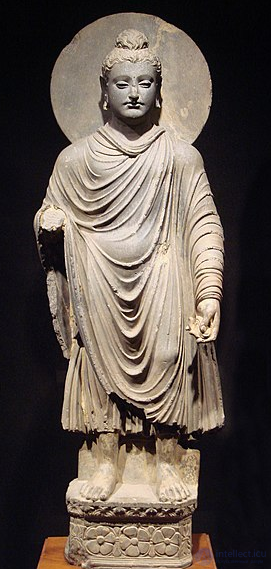
Standing Buddha. One of the earliest known images of Buddha Shakyamuni, 1st—2nd century CE. Greco-Buddhist art, Gandhara (Tokyo National Museum)
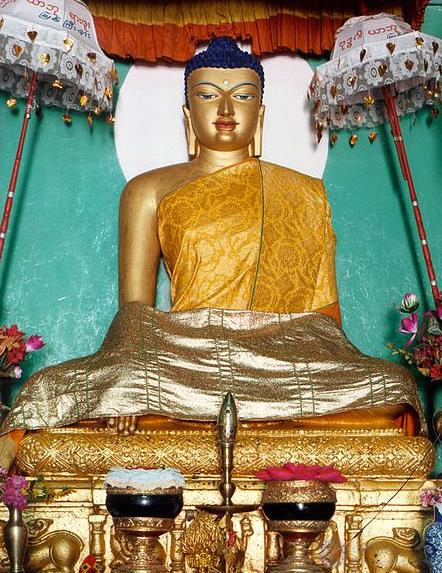
Statue of Siddhartha Gautama in Bodh Gaya, India. Bodh Gaya is traditionally considered the place of his enlightenment
And now we can move directly to the Third Noble Truth.
The Third Noble Truth is the truth of the cessation of suffering, i.e., of nirvana (a synonym is nirodha, cessation). Like a physician giving a patient a favorable prognosis, the Buddha asserts that although suffering pervades all levels of samsaric existence, there nevertheless exists a state in which suffering is no more, and that this state is attainable. This is nirvana.
The very word «nirvana» (Pali: nibbana) goes back to the Sanskrit root «nir» with the meaning «extinguishing», «dying down» (for example, the extinguishing of a lamp or the subsiding of the sea’s agitation). On this basis, nineteenth-century Buddhologists often built their theory of nirvana as the complete cessation of life, a kind of total dying, after which they accused Buddhism of pessimism. However, Buddhist texts quite clearly indicate that it is by no means being that is extinguished or dies down. One of the most widespread images used in the texts to explain the idea of nirvana is as follows: just as a lamp ceases to burn when the oil feeding the flame runs out, or just as the surface of the sea ceases to be agitated when the wind that raises the waves subsides, so too all sufferings cease when all the afflictions (kleshas) and cravings that feed suffering run out. That is, it is precisely passions, attachments, and defilements that are extinguished, and not being at all. With the disappearance of the cause of suffering, suffering itself disappears too.
So what, then, is nirvana? The Buddha himself never gave a direct answer to this question and tried to remain silent when the question was nonetheless asked. Here the Buddha turns out to be a direct forerunner of the famous twentieth-century philosopher L. Wittgenstein, who proclaimed that whereof one cannot speak, thereof one must be silent. Already in the early Upanishads – Brahmanical texts of a philosophical character – it was said that one can speak of the Absolute (Brahman) only
in negative terms: «neti, neti» («not this, not this»), since the Absolute is transcendent to our experience, incomprehensible to thought, and inexpressible in words
and concepts. The nirvana that the Buddha teaches is neither God nor an impersonal Absolute
and his silence is not apophatic theology. Nirvana is not a substance (Buddhism does not recognize substances at all), but a state, a state of freedom and a special extra-personal, or supra-personal, fullness of being. But this state is also absolutely transcendent to the whole of our samsaric experience,
in which there is nothing resembling nirvana. Therefore it is even psychologically more correct to say nothing about nirvana than to compare it to something known to us, for otherwise we would immediately construct «our own» nirvana, create some mental image of nirvana, a wholly inadequate representation of it, and become attached to this representation, thereby making nirvana itself an object of attachment and a source of suffering. That is why the Buddha confined himself to the most general characteristics of nirvana as a state free from suffering, or as a state of supreme bliss (paramam sukham). Later Buddhists would work out many different conceptions of nirvana, but the recognition of its non-sign-like, non-semiotic nature would remain in Buddhism forever. For now, therefore, let us likewise confine ourselves to the brief outline given here.
But how, then, is liberation, nirvana, to be attained? This is what the Fourth Noble Truth speaks of – the truth of the path (marga) leading to the cessation of suffering – i.e., of the Noble Eightfold Path (ārya aṣṭāṅga mārga).
The entire Buddhist path is divided into three great stages: the stage of wisdom (prajna), the stage of morality, or the observance of vows (shila), and the stage of concentration (samadhi), i.e., psychopractice. The first stage includes two steps, the others – three each, eight steps in all.
I. The Stage of Wisdom
1. Right View. At this stage a person must assimilate and master the Four Noble Truths and the other basic tenets of Buddhism, internally live through them, and make them the basis of the motivations of his actions and of his entire conduct.
2. Right Resolve. Now the person must resolve once and for all to set out on the path leading to liberation, guided by the principles of the Buddhist teaching.
II. The Stage of Morality
1. Right Speech. A Buddhist must avoid in every way lying, slander, false testimony, abuse, and the spreading of rumors and gossip that feed enmity.
2. Right Conduct. Lay Buddhists undertake a minimal number of vows conducive to the accumulation of good karma. They are as follows:
Monks and nuns have far more vows (several hundred). They are described in detail in the section «Vinaya» of the Buddhist Tripitaka (particularly important is the text entitled «Pratimoksha»/«Patimokkha»). The vows of monks orient their life no longer toward the improvement of karma, but toward its complete exhaustion and the attainment of nirvana.
3. Right Livelihood. This is the same right conduct, but taken as it were in its social dimension. A Buddhist (whether monk or layperson) must abstain from engaging in any form of activity incompatible with right conduct. He must abstain, for example, from trading in living beings, people and animals, from trading in weapons (at the same time Buddhism does not forbid laypeople to serve in the army, since the army is regarded as a means of protecting living beings in the event of aggression, whereas the arms trade provokes conflicts and creates preconditions for them), from distributing alcohol and drugs, from engaging in prostitution and any profession connected with deception (fortune-telling, divination, casting horoscopes, and the like).
III. The Stage of Concentration
1. Right Effort. This stage and all its steps are intended mainly for monks and consist in constant engagement in Buddhist yoga. The Sanskrit word «yoga» is formed from the root «yuj» – to bind together, to yoke, to join. Therefore the word «yoga» is related to the Russian word «igo» and the English word «yoke» – «yoke», «bondage». The word «yoga», thus, means concentration, focusing, the binding of all one’s forces into a single bundle in order to achieve a goal. In India this word has from ancient times been used to designate various highly complex systems of psychophysical training («psychopractice», «psychotechnique») aimed at changing consciousness and passing from a profane, worldly, samsaric state into the sacred state of «immortality and freedom». Yoga in the narrow sense of the word is one of the orthodox Brahmanical religious-philosophical systems (darshanas), created by the rishi (sage) Patanjali in the 4th–5th centuries CE. Yoga in the broad sense is any form of psychopractice directed toward the attainment of liberation from samsara (nirvana, moksha, mukti, kaivalya); in this sense one may speak of Buddhist yoga, Jain yoga, Hindu yoga, and so on. Yoga was practiced, as a rule, by hermit ascetics and members of various religious monastic communities. «Right resolve» is spoken of here in the sense of developing an orientation toward deepened and tradition-appropriate engagement in yogic contemplation for passing into nirvana.
2. Right Mindfulness. Holistic and all-encompassing control over all
продолжение следует...
Часть 1 5. Buddhism: history, concept and features, and the Amidism and Nichiren schools
Часть 2 4. Distinctive Features of the Buddhist Teaching on the Gods,
Часть 3 7. Amidism and Nichiren. Features of Buddhism in China and

Comments