
Lecture
Logic inverter — (Lat. inverto — to turn, to reverse)(Lat. inverto — to turn, to reverse) — a computing-machine element that performs certain signal transformations. Two main types of inverters are distinguished: analog and digital.
The term inverter (or invertor) can mean:
Negation (inversion, from Lat. inversio — turnover, logical «NOT») in logic is a unary operation on propositions whose result is a proposition «opposite» to the original one. It is denoted by the sign ¬ placed before, or by an overline — above, the proposition.
In both classical and intuitionistic logic, «double negation»  follows from the proposition }
 , that is, the following tautology holds:
  .
.
The converse statement  is true in classical logic (the law of double negation), but does not hold in intuitionistic logic. That is, negating the negation of a given statement cannot serve as an intuitionistic proof, unlike in classical logic. This difference between the two logical systems is usually considered the principal one.
|
 |
|---|---|
| 0 | 1 |
| 1 | 0 |
The mnemonic rule for negation is as follows: the output will be
| Definition |  |
|---|---|
| Truth table |  |
| Logic gate |  |
| Normal forms | |
| Disjunctive | |
| Conjunctive | |
| Zhegalkin polynomial |  |
| Membership in pre-complete classes | |
| Preserves 0 | No |
| Preserves 1 | No |
| Monotonic | No |
| Linear | Yes |
| Self-dual | Yes |
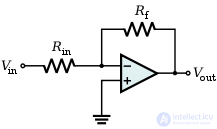

An inverter in analog computers is an analog functional block in which the output quantity  and the input quantity
  are related by:
 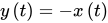 . It is used in structural-type analog computers when, in implementing the structural diagram of a model, the sign of a function or quantity must be reversed.
A summing block can be used as an inverter, in which  and
and  , and the output voltage is determined by:[clarify]
 .
.

An inverter in digital computers is a logic element that performs the logical negation operation — inversion. Inverters are usually built using active components that simultaneously amplify and shape the output signal. Together with other logic elements, they are used as a component part of devices performing a specific logical function.
A distinction is made between potential (level) inverters and pulse inverters.
In potential inverters, a high input voltage level is converted to a low level, and vice versa.
In pulse inverters, at the moment a signal is applied to the input, a signal of opposite polarity appears at the output. Alternatively, when pulses of a clock train are applied, a signal appears at the output only in the absence of a signal at the input.

Comments