
Lecture
In direct-current circuit theory, Norton's Theorem (also known as the Mayer–Norton Theorem) is a simplification that can be applied to networks consisting of linear time-invariant resistances, voltage sources and current sources. At a pair of network terminals, it can be replaced with a current source and a single resistor connected in parallel.
For alternating current (AC), the theorem applies to reactance as well as resistance.
The Norton equivalent circuit is used to represent any network of linear sources and impedances at a given frequency.
Norton's theorem and its dual, Thevenin's theorem, are widely used to simplify circuit analysis and to study the initial and steady-state conditions of a circuit.
Norton's theorem was independently derived in 1926 by Siemens & Halske researcher Hans Ferdinand Mayer (1895–1980) and Bell Labs engineer Edward Lawry Norton (1898–1983).
To find the equivalent, the Norton current IN is calculated as the current flowing at the terminals under a short circuit (zero resistance between A and B). This is IN. The Norton resistance RN is determined by calculating the output voltage that arises when there is no resistance at the terminals; equivalently, it is the resistance between the terminals when all (independent) voltage sources are shorted and independent current sources are opened. This is equivalent to computing the Thevenin resistance.
When dependent sources are present, a more general method must be used. The voltage at the terminals is calculated for a test current of 1 A applied to the terminals. This voltage, divided by the 1 A current, gives the Norton impedance R_N. This method must be used if the circuit contains dependent sources, but it can be used in all cases, even when there are no dependent sources.
Online emulation of Norton's theorem
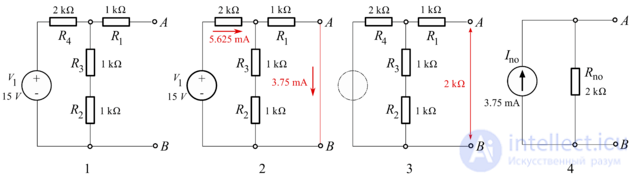
In this example, the total current Itotal is given by:

Then the current through the load, using the current divider rule:


And the equivalent resistance, looking into the circuit, is:

Thus, the equivalent circuit is a 3.75 mA current source connected in parallel with a 2 kΩ resistor.
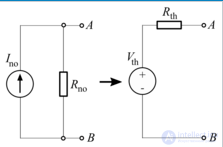
The Norton equivalent circuit is related to the Thevenin equivalent by the equations:



The passive equivalent of the "Norton theorem" circuit in queueing theory is called the Chandy–Herzog–Woo theorem. In a reversible queueing system, it is often possible to replace an uninteresting subset of queues with a single (FCFS or PS) queue with an appropriately chosen service rate.

Comments