
Lecture
Electromechanics — a branch of electrical engineering that studies the general principles of electromechanical energy conversion and their practical application to the design and operation of electrical machines.
Electromechanics - a fundamental science studying electromechanical energy conversion. The technical application of electromechanics is based on deep knowledge of physics and mathematics, electrical and electronic engineering, mechanics and materials science, cybernetics and computer engineering, and is clearly manifested in such complex and environmentally clean electromechanical converters as electrical machines .
Electromechanics is a generalized theory of the forces acting in an electromagnetic field and of the problems associated with the manifestation of these forces. The breadth of this concept also makes it quite indeterminate: besides electrical machines and electric drives, which naturally belong to electromechanics, it also includes electroacoustics, magnetic hydro- and aerodynamics, and much more
The subject of electromechanics is the control of operating modes and the regulation of the parameters of the reversible conversion of electrical energy into mechanical energy and of mechanical energy — into electrical energy, including the generation and transformation of electrical energy.
Electromechanics as a science addresses the creation and improvement of power and information devices for the mutual conversion of electrical and mechanical energy, and of electrical, contact and contactless apparatus for switching electrical circuits and controlling energy flows .
According to the all-Russian classifier of fields of study, electromechanics is a specialty of higher professional education, training in which is carried out within the direction 140600 — «Electrical Engineering, Electromechanics and Electrical Technologies» .
One of the first works on electromechanics is a work devoted to the theory and design of the windings of DC electrical machines, which was published in 1891 by the Swiss scientist Engelbert Arnold .
In the first three decades of the 20th century, the theory of steady-state operating modes of electrical machines was developed in the works of E. Arnold, A. Blondel, M. Vidmar, L. Dreyfus, M. P. Kostenko, K. A. Krug, and V. A. Tolvinsky.
In 1895, A. Blondel proposed the two-reaction method for the analysis of synchronous machines.
In 1929, R. Park[en], using the two-reaction method, derived the differential equations of the synchronous machine that bear his name.
In 1938—1942, G. Kron created a generalized theory of electrical machines (the differential equations of an idealized generalized electrical machine) and developed methods of tensor and matrix analysis of electrical circuits and machines.
In 1963, I. P. Kopylov proposed a mathematical model of a generalized electromechanical converter for a non-sinusoidal magnetic field in the air gap, applicable to symmetric and asymmetric electrical machines with any number of stator and rotor winding phases and taking into account the nonlinearity of the variation of their parameters.
The history of the development of electromechanics shows the existence of two extreme approaches to the theory of electromechanical energy conversion: one based on field theory and one based on the theory of electric circuits. Field theory is developed on the basis of Maxwell's equations, while circuit theory is developed on the basis of Kirchhoff's equations.
Knowledge of the history of the development of electromechanics is necessary for a deep understanding of the ideas and patterns that determine the future of electrical engineering science and its practical application. The history of electromechanics convincingly shows how scientific discoveries and theoretical research give rise to new engineering solutions, while practical achievements ensure the further development of theory.
In the development of modern electronics, electromechanical devices were widely used as part of complex systems, including electric typewriters, teletypes, very early television systems, and the earliest electromechanical digital computing machines.
The development of electromechanics leads to the creation of new electromechanical converters with a liquid or gaseous rotor, electrical machines with unusual geometry, and unusual applications.
Academician A. G. Iosifyan gave a general definition of electromechanics: «Electromechanics — the science of the motion and interaction of material inertial macroscopic and microscopic bodies associated with electric and magnetic fields» . Given that the action of a force is required to set a body at rest into motion, the definition given by A. G. Iosifyan can be reduced to the following form: «Electromechanics — the generalized doctrine of the forces acting in an electromagnetic field and of the problems associated with the manifestation of these forces»[10].
The following definition is found in foreign sources: «Electromechanics — a technology dealing with issues related to electromechanical components, devices, equipment, systems or processes»[11], where electromechanical components are understood to mean electrical machines.
Electromechanics lies somewhere between the theory of electromagnetic phenomena and mechanics. General phenomena - the motion of particles and bodies - are determined not only by the interaction of forces of mechanical origin, but also by electromagnetic forces. This is because the motion of these particles and bodies occurs in a region of space occupied by an electromagnetic field, and the moving bodies themselves carry electric charges or currents.
Thus, the electromagnetic force turns out to be a function of mechanical quantities - the velocity and position of the body in space. Therefore, it is not possible to «separate» the system of equations describing the state of an EMC (electromechanical converter) into purely electrical or mechanical parts. The most general approach to solving problems in electromechanics consists in considering a body that carries a current or charge in an electromagnetic field. This can be done using the fundamental equations of electrodynamics - Maxwell's equations of the electromagnetic field. However, the need to determine boundary conditions when solving these equations makes this approach quite complex even in the simplest cases.
Therefore, it is better to proceed from the possibility of representing any EMC as a «set» of electrical and magnetic circuits with lumped parameters. This is made permissible as a result of the «low» speeds at which physical processes proceed and the «low» frequencies at which quantities change. This makes it possible to formulate the dynamic equations of motion based on parameters determined from the calculation of static (quasi-static) fields.
As a rule, the laws of electromechanics refer to the following laws of electrodynamics, necessary for analyzing processes and designing electromechanical converters[12].
1. Faraday's law of electromagnetic induction:
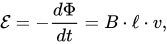
where  — EMF,
  — magnetic flux,
  — magnetic flux density at a given point of the field,
  — active length of the conductor within a uniform magnetic field of flux density , located in a plane perpendicular to the direction of the magnetic field lines,
  — velocity of the conductor in a plane normal to , in a direction perpendicular to .
2. The total current law for a magnetic circuit (Maxwell's 1st equation in integral form):
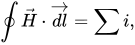
where  — magnetic field strength vector,
  — elementary displacement along some path in the magnetic field,
  — the value of the total current enclosed by the integration contour.
3. The law of electromagnetic forces (Ampere's law).

Professor I. P. Kopylov of the Moscow Power Engineering Institute (MEI) formulated three general laws of electromechanics[13]:
1st law: Electromechanical energy conversion cannot occur without losses; its efficiency is always less than 100%.
2nd law: All electric machines are reversible; the same machine can operate both as a motor and as a generator.
3rd law: Electromechanical energy conversion is carried out by fields that are stationary relative to one another. The rotor can rotate at the same speed as the field (in synchronous machines) or at a different speed (in asynchronous machines), but in steady-state operation the stator and rotor fields are stationary relative to each other.
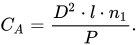
1.The fundamental equation of an electric machine[14] — an equation relating the rotor diameter and rotor length to the motor power and the number of revolutions per minute:

where  — rotor diameter,
  — rotor length,
  — synchronous rotor speed in rpm (equal to the rotation speed of the first harmonic of the stator winding MMF),
  — power of the electric machine in kW,
  — power factor,
  — winding factor, accounting for the effect of the winding distribution in the slots and the effect of winding pitch shortening,
  — amplitude of the normal component of magnetic flux density in the machine's air gap,
  — the «linear current loading», equal to the number of ampere-conductors per 1 running centimeter of stator circumference length. The right-hand side of the fundamental equation for a given (known) type of machine varies within comparatively narrow limits and is called the «machine constant» or Arnold's constant
2.Voltage balance equations of the windings of an electric machine — equations set up for the winding circuits based on Kirchhoff's second law
For an induction machine with a squirrel-cage rotor, the voltage balance equations have the form[15]:


where  — stator phase voltage,
  and
and  — stator and rotor phase currents,
  and
and  — stator and rotor winding resistances,
  and
and  — stator and rotor leakage reactances,
  and
and  — EMFs induced in the stator and rotor windings by the resultant magnetic flux of the stator and rotor fields.
3.Equation of Electromagnetic Torque
The equation of electromagnetic torque of an induction machine has the form[16]:

where  — is the number of phases of the stator winding,
  — is the number of pole pairs,
  — is the RMS value of the stator voltage,
  — is the stator current frequency,
  — is the rotor active resistance referred to the stator, — is the active resistance of the stator phase winding,
  — is the short-circuit reactance, approximately equal to the sum of the stator leakage inductance and the rotor leakage inductance referred to the stator
  .
.
The equation of electromagnetic torque of a synchronous machine[15] :

where  — is the EMF induced in the stator winding by the rotor flux,
  — is the load angle (the phase-shift angle between the EMF and the stator voltage),
  — are the direct-axis and quadrature-axis synchronous reactances of the stator winding.
In accordance with the GOST standard that defines the content of training for university graduates in the specialty "Electromechanics," electromechanics addresses the following topics:
Textbooks on electromechanics contain topics such as[12]:

Comments