
Lecture
In electronics, derating is operating a device at a power below its rated maximum power in order to extend its service life. Typical examples include operation below the maximum rated power, current, or voltage.
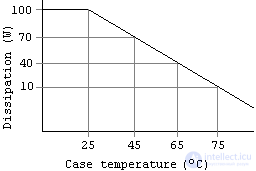
Derating curve of a hypothetical power device.
Power semiconductor devices typically have a maximum dissipated power specified at a case temperature of 25 °C (77 °F). The device's datasheet also provides a derating curve, which shows how much power the device will dissipate without damage at any given case temperature, and this must be taken into account when designing a system.
As can be seen from the derating curve image for a hypothetical bipolar transistor, the device (rated at 100 W at 25 °C (77 °F)) should not dissipate more than 40 W if the ambient temperature is such that the temperature at which the device's case stabilizes (after heat is removed) is 65 °C (149 °F). This final case temperature is a function of the thermal resistance between the device's case and the heat sink, as well as between the heat sink and the environment (this includes the heat transfer rating per watt of the heat sink — lower values imply better cooling performance).
At high temperatures, the voltage rating of some capacitors decreases, since the softened dielectric (for example, a polymer) softens further under the effect of heat, and its breakdown strength decreases. Derating curves for such capacitors are given in the specifications.
Derating can also provide a safety margin for transient voltages or currents (surges) exceeding normal operating values, or extend service life. For example, the service life of electrolytic capacitors increases significantly when they are operated at temperatures below the maximum permissible ones.
Connectors also have a maximum operating current, which depends on the ambient temperature. Since the power loss in a connector increases quadratically with increasing current, the permissible current does not decrease linearly with ambient temperature, unlike in the graph above.
Computers often use heat sinks or fans to maximize the dissipation of heat generated by, for example, the main processor. This prevents the system from exceeding its performance limit due to cooling.
All dimmers use heat conduction and convection to cool electronic components. Similarly, power wiring (for example, household wiring) that is not surrounded by an air gap (for example, inside a conduit) must have a current-limiting device (for example, a circuit breaker or fuse) adjusted so that a lower current passes through this circuit. Derating is the reduction of the maximum power (load) that a device can reliably withstand when fins/side sections are removed.

Comments