
Lecture 5 min.
Classical dance is the foundation of choreographic art. It underlies the training of nearly every style of stage dance. The system of classical dance took shape over several centuries and absorbed the finest achievements of the European ballet school.
The main feature of classical dance is its strict sequence of instruction, which develops the performer's muscular strength, endurance, flexibility, coordination, musicality and artistry.
The primary language of classical dance is French terminology, which is used in every country of the world.
The origins of classical dance go back to the Renaissance. Dance first existed as a courtly art in Italy and France. A major contribution to the development of ballet was made by the French king Louis XIV, who founded the first Royal Academy of Dance in 1661.
The system of teaching classical dance took shape in the eighteenth–nineteenth centuries. A significant contribution was made by well-known ballet masters:
A special place belongs to the method of A. Y. Vaganova, which became the foundation of the Russian school of classical ballet.
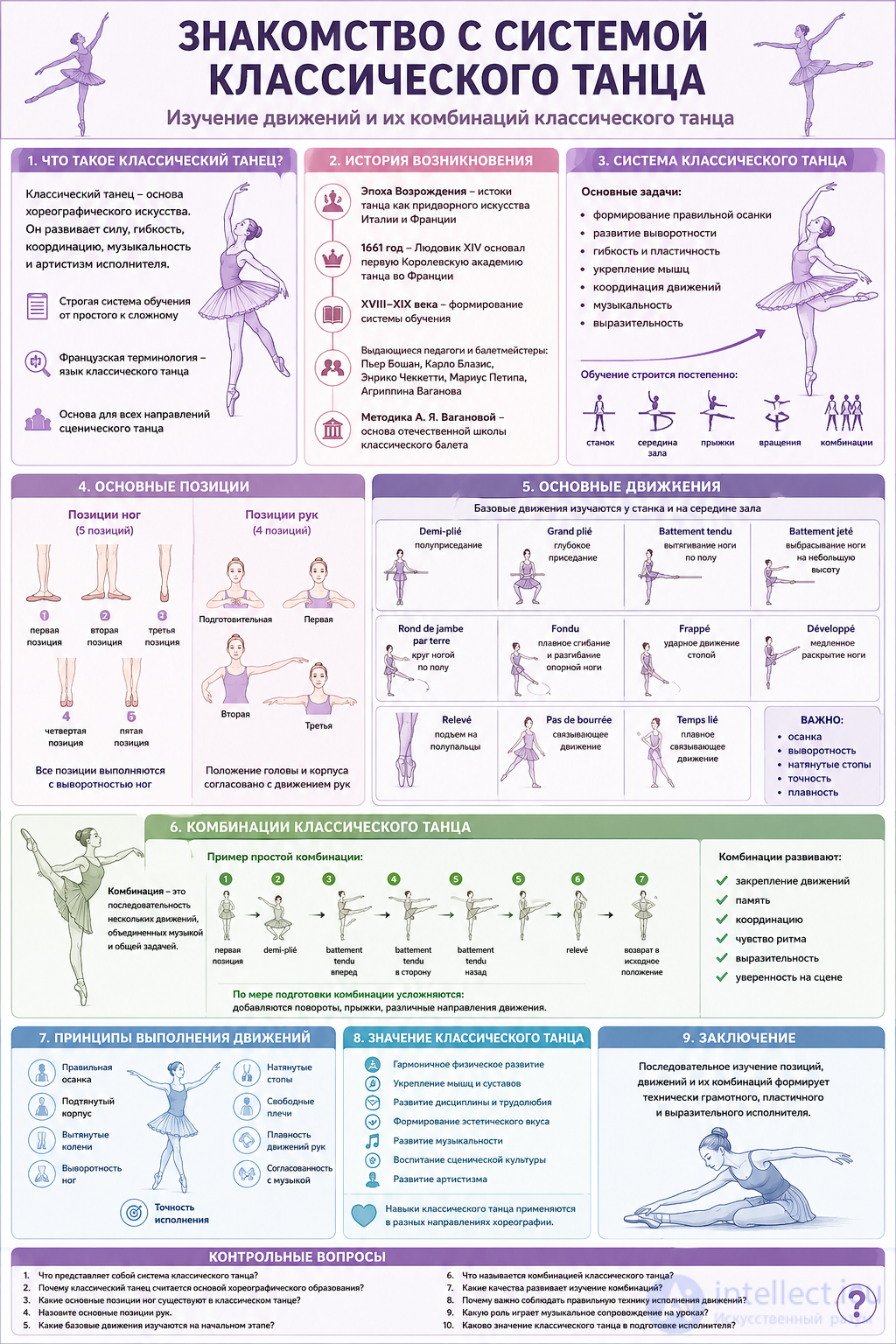
The system of classical dance is a logically structured sequence for mastering exercises from simple to complex.
The main objectives of the system are:
Training is built up gradually and includes work at the barre, exercises in the centre, jumps, turns and stage combinations.
Training begins with learning the basic positions.
There are five basic positions:
All the positions are based on the principle of leg turnout.
The main ones are:
The position of the head and torso is always coordinated with the movement of the arms.
Each movement has a specific technique of execution and a French name.
At the initial stage the following elements are studied:
Demi-plié — a half bend of the knees.
Grand plié — a full bend of the knees.
Battement tendu — stretching the leg along the floor.
Battement jeté — throwing the leg to a small height.
Rond de jambe par terre — a circle traced by the leg along the floor.
Fondu — a smooth bending and straightening of the supporting leg.
Frappé — a striking movement of the foot.
Développé — a slow unfolding of the leg.
Relevé — rising onto demi-pointe.
Pas de bourrée — a linking movement.
Temps lié — a smooth linking movement.
All exercises are performed first at the barre, then in the centre.
A combination is a sequence of several movements united by musical accompaniment and a common task.
Combinations make it possible to:
An example of a simple combination:
As training progresses, the combinations become more complex and include turns, jumps and various directions of movement.
When performing the exercises, the following rules must be observed:
Observing these requirements ensures safety in class and shapes a beautiful performing technique.
Classical dance is the foundation of a dancer's professional training.
It contributes to:
The skills of classical dance are successfully applied in folk, contemporary, variety and sport dance.
The system of classical dance is a coherent teaching methodology, tested by many years of practice in world ballet art. The sequential study of positions, basic movements and their combinations makes it possible to form a technically proficient, plastic and expressive performer. Regular training develops physical qualities, a sense of rhythm, artistic taste and stage culture, providing a solid foundation for the dancer's further professional growth.
Sign in and the lectures you have studied will be marked in this list.
Choose a course
Comments