Before every classical dance class it is important to prepare the body for exertion. One of the most effective ways of doing this is floor-barre training.
The word «parterre» in choreography means performing exercises on the floor. This reduces the load on the spine and joints, and allows the muscles to work in a more isolated and safer way.
Floor-barre training helps to gradually warm up the body and prepare the muscles and ligaments for the more complex movements at the barre and in the centre of the room.
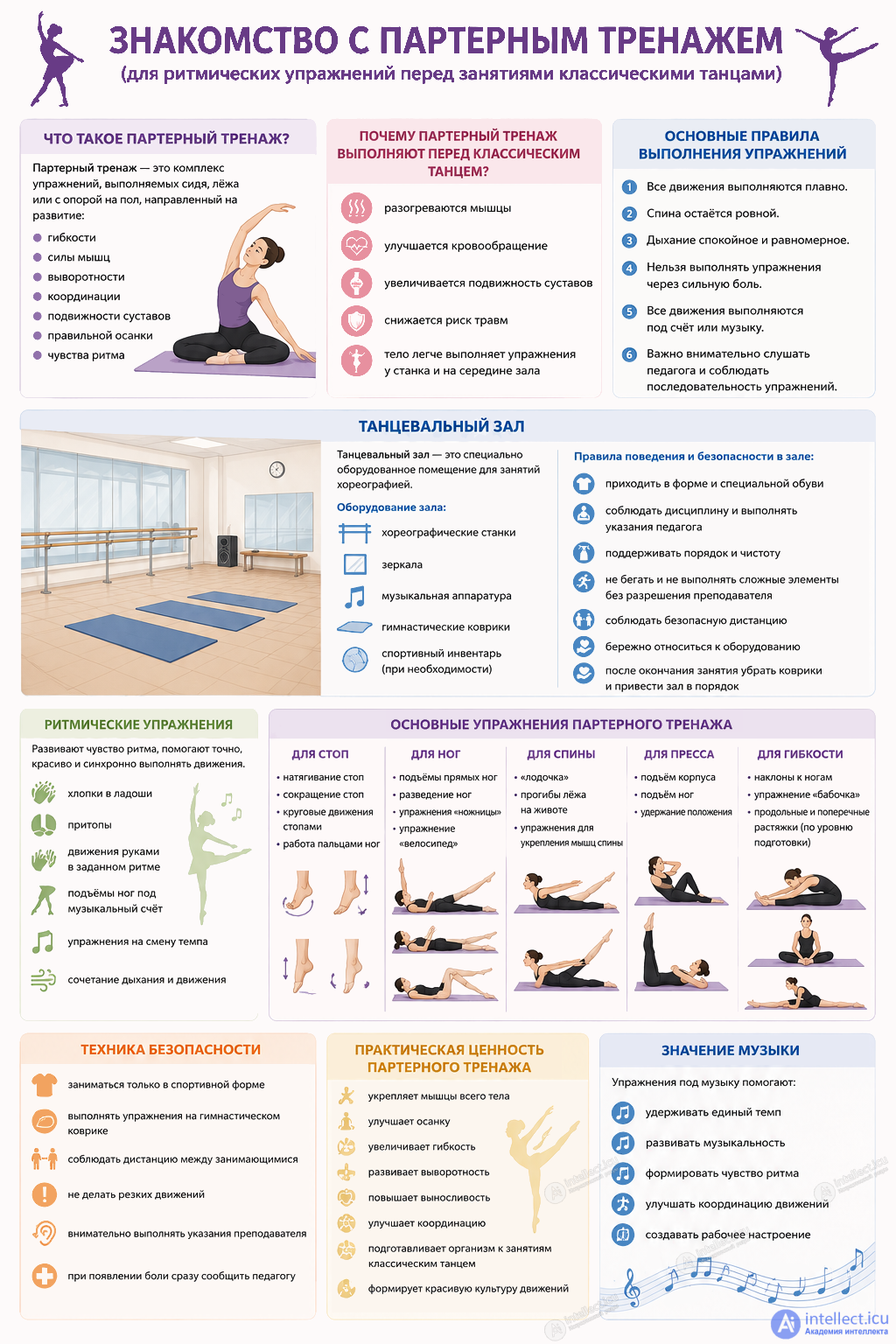
The dance studio
The dance studio is a specially equipped room intended for choreography classes, rehearsals and the training of dancers. The safety of the students, the quality of the exercises performed and the comfort of the class all depend on how the dance studio is organised.
Before the start of a lesson it is necessary to make sure the studio is ready for work. The room should be clean, well ventilated, sufficiently lit and kept at a comfortable air temperature (18–22 °C). The floor should be even, non-slip and springy, so as to reduce the load on the joints and spine. Gymnastic mats or special exercise mats are recommended for floor-barre training.
A dance studio usually contains:
- choreographic barres for classical dance classes;
- mirrors for checking the correctness of movements and posture;
- music equipment for accompanying the classes;
- gymnastic mats for performing exercises on the floor;
- where necessary — sports equipment (elastic bands, gymnastic balls, stretching blocks and so on).
During classes in the dance studio, rules of conduct and safety must be observed:
- arrive for class in the prescribed uniform and special dance footwear;
- maintain discipline and follow the teacher’s instructions attentively;
- keep order and cleanliness in the studio;
- do not run or perform complex elements without the teacher’s permission;
- keep a safe distance between students;
- treat the equipment and props with care;
- after the class ends, put away the mats and tidy the work area.
A properly organised dance studio creates favourable conditions for learning, helps students concentrate on performing the exercises, fosters the development of performing culture and ensures the safe mastery of the elements of classical dance and floor-barre training.
What is floor-barre training?
Floor-barre training is a set of exercises performed sitting, lying down or supported on the floor, aimed at developing:
- flexibility;
- muscle strength;
- turnout;
- coordination;
- joint mobility;
- correct posture;
- a sense of rhythm.
These exercises form the basis of the physical training of a dancer of any age.
Why is floor-barre training performed before classical dance?
While performing the exercises:
- the muscles warm up;
- blood circulation improves;
- joint mobility increases;
- the risk of injury is reduced;
- correct movement technique is formed.
A prepared body performs the exercises of the classical barre work more easily.
Basic rules for performing the exercises
During floor-barre training a number of rules must be observed.
- All movements are performed smoothly.
- The back stays straight.
- Breathing is calm and even.
- Exercises must not be performed through severe pain.
- All movements are performed to a count or to music.
- It is important to listen attentively to the teacher and follow the sequence of exercises.
Rhythmic exercises
A special place is given to the development of the sense of rhythm.
Rhythm helps the dancer:
- feel the music;
- perform movements precisely;
- move in time with the group;
- correctly distribute the strength and tempo of the performance.
During floor-barre training the following may be used:
- clapping hands;
- foot stamps;
- arm movements to a set rhythm;
- raising the legs to a musical count;
- exercises for changing tempo;
- combining breathing and movement.
The basic exercises of floor-barre training
The set usually includes:
For the feet
- pointing (stretching) the feet;
- flexing the feet;
- circular movements of the feet;
- working the toes.
For the legs
- raising the straight legs;
- opening the legs;
- the «scissors» exercise;
- the «bicycle» exercise.
For the back
- the «boat»;
- back extensions lying on the stomach;
- exercises for strengthening the back muscles.
For the abdomen
- raising the torso;
- raising the legs;
- holding a position.
For flexibility
- bending toward the legs;
- the «butterfly» exercise;
- longitudinal and lateral stretches (according to the level of training).
The importance of music
It is best for all exercises to be performed to music.
Musical accompaniment helps to:
- maintain a uniform tempo;
- develop musicality;
- form a sense of rhythm;
- improve the coordination of movements;
- create a working mood.
Beginners usually use music of a moderate tempo with a clear rhythmic pattern.
Safety technique
During classes the following requirements must be observed:
- train only in proper sportswear;
- perform the exercises on a gymnastic mat;
- keep a distance between those training;
- do not make sudden movements;
- follow the teacher’s instructions attentively;
- report any pain to the teacher immediately.
The practical value of floor-barre training
Regular classes make it possible to:
- strengthen the muscles of the whole body;
- improve posture;
- increase flexibility;
- develop turnout;
- increase endurance;
- improve coordination;
- prepare the body for classical dance classes;
- form a beautiful culture of movement.
Conclusion
Floor-barre training is an important part of every dancer’s preparation. It helps safely develop the physical qualities needed for classical dance and makes movements more precise, beautiful and free. Regularly performing these exercises helps strengthen health, develop discipline and build professional skills.
Conclusion: floor-barre training — is not merely a warm-up but an important stage in a dancer’s preparation, one that develops strength, flexibility, musicality and coordination and helps in performing the exercises of classical dance well.
Questions for reviewing the material
- What is meant by floor-barre training?
- Why is floor-barre training performed before a classical dance lesson?
- What physical qualities does floor-barre training develop?
- Why is it important to perform the exercises to music?
- What rules must be observed during classes?
- What exercises make up the floor-barre training set?
- What role does the sense of rhythm play in choreography?


Comments