
Studying the Basic Rhythmic, Training and Group-Order Exercises (For Training Sessions Before Classical Dance Lessons)

Lecture 10 min.


Rhythmic and group-order exercises are an important part of preparing students for classical dance classes. They foster the development of musicality, a sense of rhythm, coordination of movement, discipline, spatial orientation and the ability to work as part of a group. Performing these exercises prepares the body for physical exertion, focuses the students’ attention and creates a working atmosphere in the class.

Before starting classical dance classes it is important gradually to activate the work of the muscles, ligaments and joints, and also to bring the respiratory and cardiovascular systems to a state of readiness. This is precisely why group-order exercises are an obligatory element of the organisational part of the class.

Aims of the classes

The main aims of performing rhythmic and group-order exercises are:

  • developing a sense of musical rhythm;
  • forming correct posture;
  • improving the coordination of movements;
  • developing attention, memory and speed of reaction;
  • cultivating discipline and organisation;
  • preparing the body to perform the more complex exercises of classical dance.

The importance of rhythmic exercises

Rhythmic exercises help students learn to perceive the musical accompaniment and to identify the tempo, metre and character of the music. Performing movements in keeping with the musical pattern forms musicality — one of the most important qualities of a dancer.

While performing the exercises, students develop the ability to coordinate the movements of the arms, legs, torso and head with the musical accompaniment. This is especially important for successfully mastering the exercises at the barre and in the centre of the room.

Regular classes foster the development of:

  • a sense of tempo;
  • a sense of rhythm;
  • motor memory;
  • plasticity;
  • expressiveness of movement;
  • concentration of attention.

The main types of rhythmic exercises

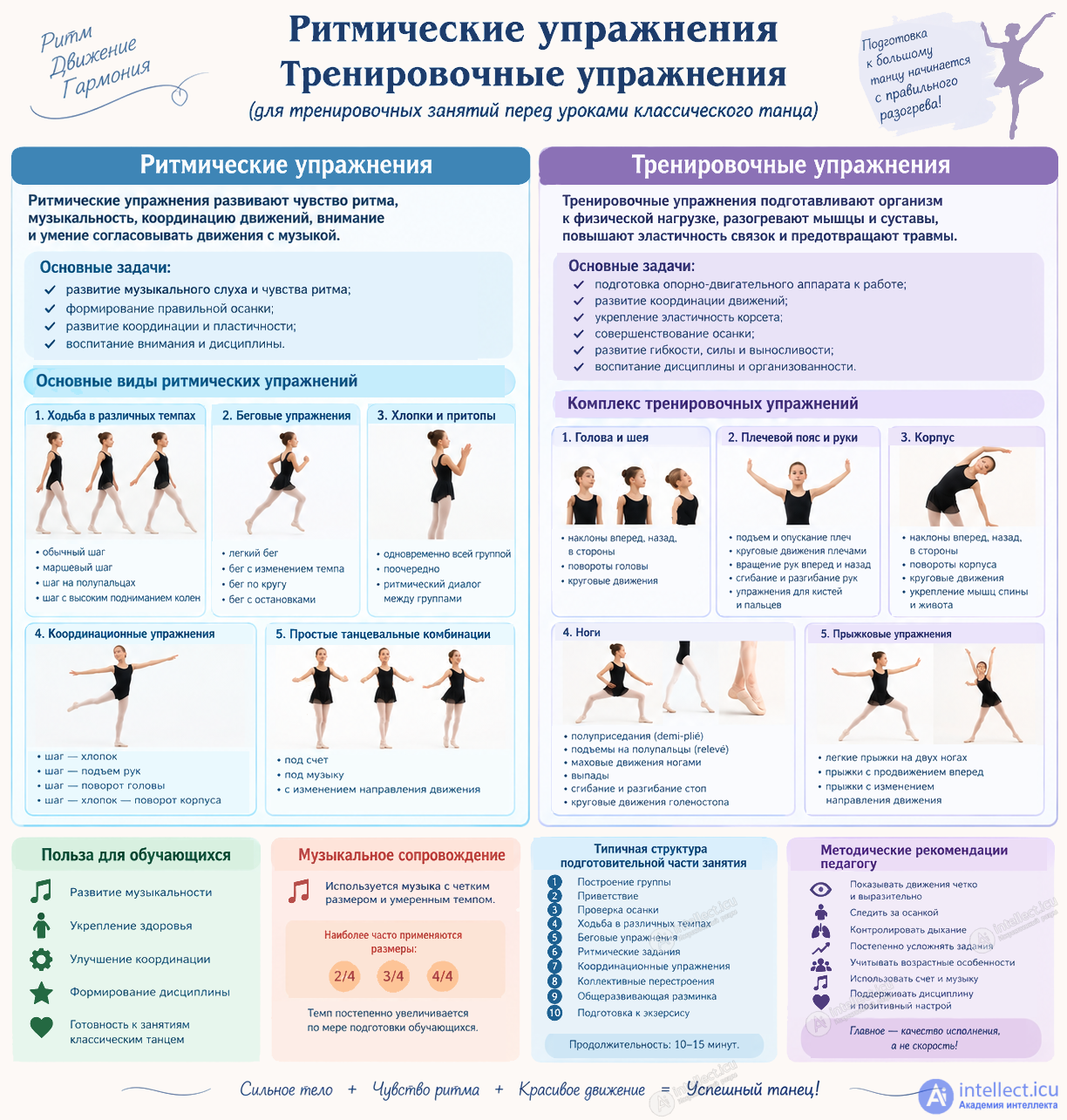
Rhythmic exercises are one of the most important means of preparing students for classical dance classes. Their main task is to develop a sense of rhythm, musicality, coordination of movement, attention and the ability to coordinate movements with the musical accompaniment. The regular performance of rhythmic exercises fosters the formation of correct posture, improves motor memory and develops plasticity.

While performing rhythmic exercises, students learn to distinguish the tempo, character and dynamics of the music, to respond promptly to changes in the musical accompaniment, and to perform movements in a synchronised and expressive manner. Particular attention is paid to the precision of the movements and to how well they correspond to the musical metre.

The main rhythmic exercises include:

  • Clapping the hands in the time signatures 2/4, 3/4 and 4/4, with accents on different beats of the bar.
  • Combining rhythmic clapping with various kinds of:
    • • dance movements;
    • • jumps;
    • • movements of the arms, head and torso.
  • walking at various tempos (slow, moderate, fast);
  • marching to musical accompaniment;
  • running with changes of tempo and direction of movement;
  • clapping and stamping to a set rhythm;
  • exercises for reproducing rhythmic patterns;
  • combining steps with arm movements;
  • exercises for stopping movement on a musical cue;
  • performing simple dance combinations to a count and to music.

The gradual increase in the complexity of the exercises fosters the development of a sense of musical form, the ability to find one’s bearings in space and to interact with the other members of the group.

The most widespread exercises include:

1. Walking at various tempos

Performed to musical accompaniment.

Variants:

  • ordinary step;
  • marching step;
  • step on demi-pointe;
  • step with the knees raised high;
  • step with a change in direction of movement.

These exercises develop a sense of tempo and help organise the group.

2. Running exercises

Used to activate the work of the muscles.

They include:

  • light running;
  • running with changes of tempo;
  • running in a circle;
  • running with stops on a musical cue.

3. Clapping and stamping

Students clap their hands and stamp their feet to a set rhythm.

The exercises may be performed:

  • by the whole group at the same time;
  • in turn;
  • in the form of a rhythmic dialogue between groups.

4. Coordination exercises

These involve combining various movements of the arms and legs.

For example:

  • step — clap;
  • step — raise the arms;
  • step — turn of the head;
  • step — clap — turn of the torso.

These exercises develop the ability to perform several movements at once.
Studying the Basic Rhythmic, Training and Group-Order Exercises (For Training Sessions Before Classical Dance Lessons)

The main training exercises

Training exercises are performed in the preparatory part of the class and are aimed at gradually preparing the body for physical exertion before the exercises of classical dance. They help warm up the muscles and joints, increase the elasticity of the ligaments, improve blood circulation and prevent injury.

The main tasks of the training exercises are:

  • preparing the musculoskeletal system for work;
  • developing the coordination of movements;
  • strengthening the muscular corset;
  • improving correct posture;
  • developing flexibility, strength and endurance;
  • cultivating discipline and organisation.

  • Developing correct carriage of the torso, legs, arms and head.
  • Positions of the legs used in ballroom dance (I, II, III, VI).
  • Positions of the arms (preparatory, I, II, III).
  • Demi-plié (half-bending of the knees in the I, II, III and VI positions of the legs).
  • Grand plié (a full bending of the knees in the I and III positions).
  • Battement tendu (sliding the leg along the floor in the I and III positions, to the front, to the side and to the back).
  • Battement tendu from demi-plié (sliding the leg along the floor with a half-bend of the knees in the I and III positions, to the front, to the side and to the back).
  • Battement tendu jeté (in the I and III positions – en croix).
  • Battement tendu jeté with a flexed foot in the air (in the I and III positions – en croix).
  • Grand battement jeté (large throws of the leg in the I and III positions – en croix).
  • Relevé (a rise onto demi-pointe in the I, II, III and VI positions).
  • Various kinds of port de bras (transfers of the arms).

The set of training exercises usually includes:

Exercises for the head and neck:

  • tilting the head forward, backward and to the sides;
  • smooth turns of the head;
  • circular movements at a slow tempo.

Exercises for the shoulder girdle and arms:

  • raising and lowering the shoulders;
  • circular movements of the shoulders;
  • rotating the arms forward and backward;
  • bending and straightening the arms;
  • exercises for the hands and fingers.

Exercises for the torso:

  • bending forward, backward and to the sides;
  • turns of the torso;
  • circular movements of the torso;
  • exercises for strengthening the muscles of the back and abdomen.

Exercises for the legs:

  • half-bends of the knees (demi-plié);
  • rises onto demi-pointe (relevé);
  • swinging movements of the legs;
  • lunges;
  • bending and straightening the feet;
  • circular movements of the ankle joint.

Jumping exercises:

  • light jumps on two legs;
  • jumps travelling forward;
  • jumps with a change in direction of movement.

All training exercises are performed in sequence — from the simple to the more complex, with a gradual increase in the amplitude and tempo of the movements. Particular attention is paid to correct breathing, maintaining a beautiful posture and the precision with which each element is performed.

Group-order exercises

Group-order exercises are aimed at cultivating organisation, discipline and the ability to work as an ensemble.

The main group-order exercises

  • Entering the studio with a dance step.
  • Position of the arms.
  • Forming up, re-forming and moving about the dance studio in different directions.
  • A simple step forward, backward and to the side.
  • Dance step.
  • Skipping steps.

Main tasks:

  • quickly forming up the group;
  • keeping the correct distance;
  • orientation in space;
  • synchronisation of movements;
  • carrying out the teacher’s commands.

The main types of formation

The following formations are used in class:

  • a single line;
  • two lines;
  • a column of one;
  • a column of two;
  • a circle;
  • a semicircle;
  • a diagonal;
  • a chequerboard order.

Each type of formation has practical significance in preparing for dance compositions.

Re-forming

Various methods of re-forming are used during class:

  • from a column into a circle;
  • from a circle into lines;
  • changing places;
  • re-forming along diagonals;
  • moving into pairs;
  • moving in a circle with a change of direction.

Exercises of this kind develop spatial thinking and attention.

General developmental exercises

Before a classical dance lesson it is recommended to include exercises for:

  • warming up the neck;
  • the shoulder joints;
  • the hands;
  • the spine;
  • the hip joints;
  • the knee joints;
  • the ankle.

All movements are performed smoothly, without sudden jerks.

Musical accompaniment

For conducting rhythmic exercises, music with a clear time signature and a moderate tempo is chosen.

The time signatures most often used are:

  • 2/4;
  • 3/4;
  • 4/4.

The tempo increases gradually as the students are prepared for the main part of the lesson.

The musical accompaniment must correspond to the students’ age and level of training.

Methodological recommendations for the teacher

While conducting the exercises the teacher should:

  • demonstrate the movements clearly and expressively;
  • watch the students’ posture;
  • monitor their breathing;
  • gradually make the tasks more complex;
  • take the children’s age-related characteristics into account;
  • use a spoken count and musical accompaniment;
  • maintain discipline and a positive emotional mood.

Particular attention is paid to the quality of performance rather than to the speed with which the exercises are done.

The typical structure of the preparatory part of the class

  1. Forming up the group.
  2. Greeting.
  3. Checking posture.
  4. Walking at various tempos.
  5. Running exercises.
  6. Rhythmic tasks.
  7. Coordination exercises.
  8. Group re-formations.
  9. General developmental warm-up.
  10. Preparation for the classical dance exercises.

The preparatory part usually lasts 10–15 minutes.

Conclusion

Rhythmic and group-order exercises are one of the most important components in preparing students for classical dance classes. They foster harmonious physical development and shape musicality, discipline, a sense of the group and confident spatial orientation.

The systematic performance of these exercises considerably eases the mastery of classical dance technique, raises the quality of movement performance and fosters the cultivation of the students’ aesthetic culture. A well-organised preparatory part of the class creates the necessary conditions for successful learning, helps avoid injury and ensures the effective performance of the dance exercises that follow.

The systematic performance of rhythmic and training exercises fosters the students’ all-round physical development, shapes a culture of movement and musicality, and creates the necessary foundation for successfully mastering the technique of classical dance.

Comments

To leave a comment

If you have any suggestion, idea, thanks or comment, feel free to write. We really value feedback and are glad to hear your opinion.
To reply

Lectures and tutorial on "choreographic creativity BASICS OF DANCE COMPOSITION AND STAGE"

Terms: choreographic creativity BASICS OF DANCE COMPOSITION AND STAGE

Sign in and the lectures you have studied will be marked in this list.

Choose a course