
Lecture 5 min.
Classical dance is the foundation of professional choreographic education. It is what shapes a dancer's performing culture, developing physical qualities, musicality, artistic thinking and stage mastery. Whatever specialization a performer later pursues — character dance, contemporary dance or variety dance — command of the classical school remains an obligatory basis of professional training.
Building professional foundations is a lengthy pedagogical process aimed at developing the technical, artistic and personal qualities of the future artist. The refinement of performance skills continues throughout a dancer's entire creative career and demands constant, systematic work.
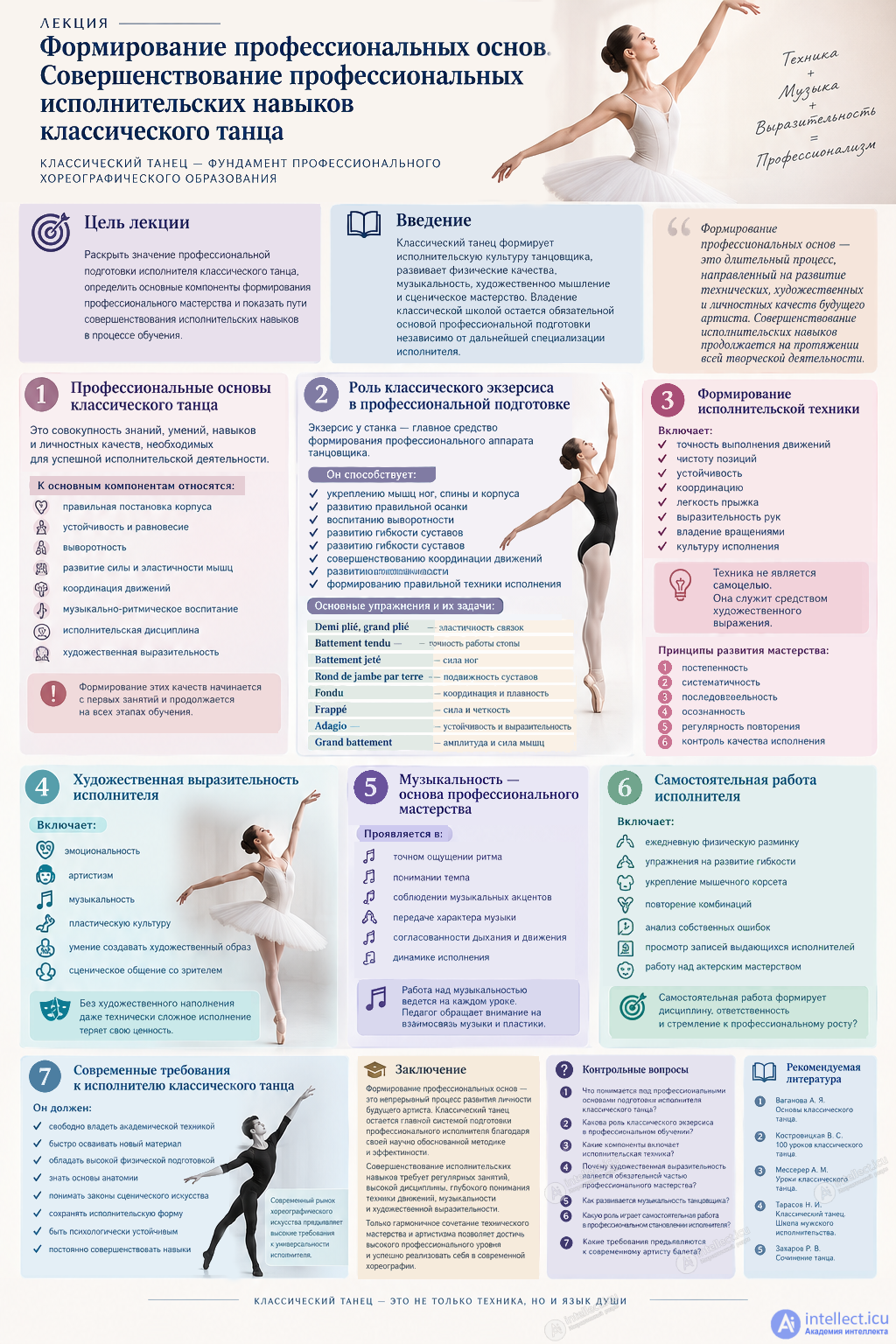
The professional foundations are the sum of the knowledge, abilities, skills and personal qualities needed for successful performance.
These include:
The development of these qualities begins with the very first classical-exercise classes and continues at every stage of professional training.
The systematic nature of training is of special importance. Every new movement is built on technical skills already formed. Gaps in mastering the basic elements therefore inevitably affect the quality of subsequent training.
Exercise at the barre is the principal means of shaping a dancer's professional apparatus.
It contributes to:
Each exercise has a specific pedagogical purpose.
Demi plié and grand plié develop the elasticity of the ligaments and joints.
Battement tendu builds precision in the work of the foot.
Battement jeté develops strength in the legs.
Rond de jambe par terre improves mobility of the hip joints.
Fondu develops coordination and smoothness of movement.
Frappé promotes the development of strength and sharpness.
Adagio cultivates stability, control of the body and expressiveness.
Grand battement increases the amplitude of movement and muscular strength.
Thus the exercise represents a logically structured system for the professional training of the dancer.
Performance technique includes:
High technique is impossible without constant training.
The basic principles of developing performance mastery are:
It must be remembered that technique is never an end in itself. It serves as a means of artistic expression.
Today's ballet artist must possess not only high technique but also a developed stage culture.
Expressiveness includes:
Every movement must carry inner content.
The performer is obliged to understand the dramaturgy of the work, the particular qualities of the musical material, and the style of the choreography being performed.
Without artistic content, even technically difficult performance loses its value.
Musicality is one of the most important components of performance training.
It is expressed in:
Work on musicality is carried out at every class in classical dance.
The teacher continually draws students' attention to the relationship between music and movement.
A high professional level is impossible without independent preparation.
It includes:
Independent work builds discipline, responsibility and a drive toward professional growth.
Today's professional dancer must possess a broad range of competencies.
They must:
The contemporary market for choreographic art places high demands on the versatility of the performer.
Building professional foundations is a continuous process in the development of the future artist's personality. Classical dance remains the principal system for training the professional performer thanks to its scientifically grounded methodology, consistency and effectiveness.
The refinement of performance skills demands regular practice, high discipline, a deep understanding of movement technique, musicality and artistic expressiveness. Only a harmonious combination of technical mastery and artistry allows a performer to reach a high professional level and to fulfil themselves successfully in contemporary choreography.
Sign in and the lectures you have studied will be marked in this list.
Choose a course
Comments