
Lecture 4 min.
Dance is one of the most ancient art forms, helping people express their feelings, emotions, and mood through movement. Contemporary dance is highly popular among children, teenagers, and adults thanks to its dynamism, variety of styles, and the opportunity it offers for self-expression.
Contemporary dance is based on the natural movements of the human body, a sense of rhythm, musicality, and the ability to coordinate body movement. Becoming familiar with the elements of contemporary dance promotes the development of physical qualities, creative abilities, and self-confidence.
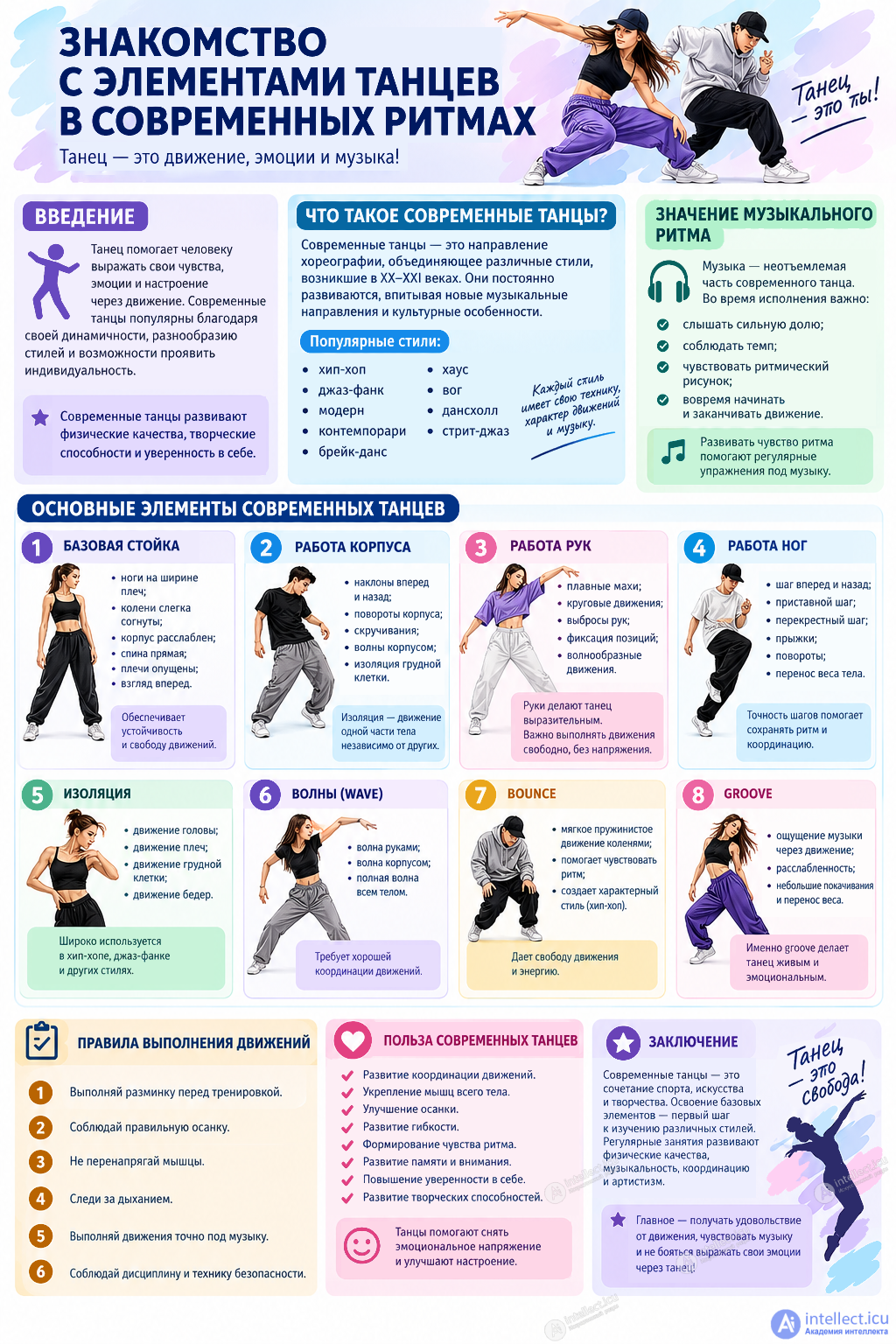
Contemporary dance is a branch of choreography that brings together various styles that emerged in the 20th–21st centuries. It is constantly evolving, absorbing new musical trends and the cultural features of different countries.
The best-known contemporary styles are:
Each style has its own technique, character of movement, and musical accompaniment.
Any dance begins with the correct starting position.
Basic requirements:
This stance provides stability and freedom of movement.
The body plays an important role in almost all contemporary styles.
Basic movements:
Isolation means moving one part of the body independently of the rest.
The arms help make the dance expressive.
Basic elements:
It is important to perform the movements freely, without unnecessary tension.
In contemporary dance, a great deal of attention is paid to step technique.
Basic movements:
Precise execution of the steps helps maintain rhythm and coordination.
Isolation is the ability to move a single part of the body independently of the others.
For example:
This element is widely used in hip-hop, jazz-funk, and other contemporary styles.
A wave is a smooth movement that passes through various parts of the body.
There are:
Good coordination of movement is essential for a beautiful execution.
Bounce is a soft, springy movement of the knees characteristic of hip-hop.
It helps:
Groove is the sense of music expressed through the natural movement of the body.
The performer moves in a relaxed manner, emphasising the musical rhythm with small swaying movements and shifts of weight.
It is groove that makes a dance lively and emotional.
Contemporary dance is impossible to imagine without music.
While performing, it is necessary to:
A sense of rhythm is developed through regular exercises performed to musical accompaniment.
The following rules must be observed during classes:
Regular contemporary dance classes contribute to:
In addition to physical development, dance helps relieve emotional tension and improves mood.
Contemporary dance is a combination of sport, art, and creativity. Mastering the basic elements is the first step toward learning various dance styles. Regular practice helps develop physical qualities, musicality, coordination, and artistry. The most important thing in contemporary dance is to enjoy movement, feel the music, and not be afraid to express your emotions through dance.
Sign in and the lectures you have studied will be marked in this list.
Choose a course
Comments