
Lecture 6 min.
Classical dance is an art built on the harmonious union of music and movement. No movement exists on its own — it is born, develops and comes to an end in accordance with the musical form. It is music that determines the character of the performance, the tempo, the dynamics, the emotional coloring and the duration of each movement.
The musical breakdown is a system for distributing individual movements and their combinations across musical beats, measures, musical phrases and periods. It is one of the most important means of developing musicality, coordination, a sense of rhythm and a dancer's performing culture.
A correct musical breakdown helps the performer execute movements freely, logically and expressively, and helps the teacher organize the learning process rationally.
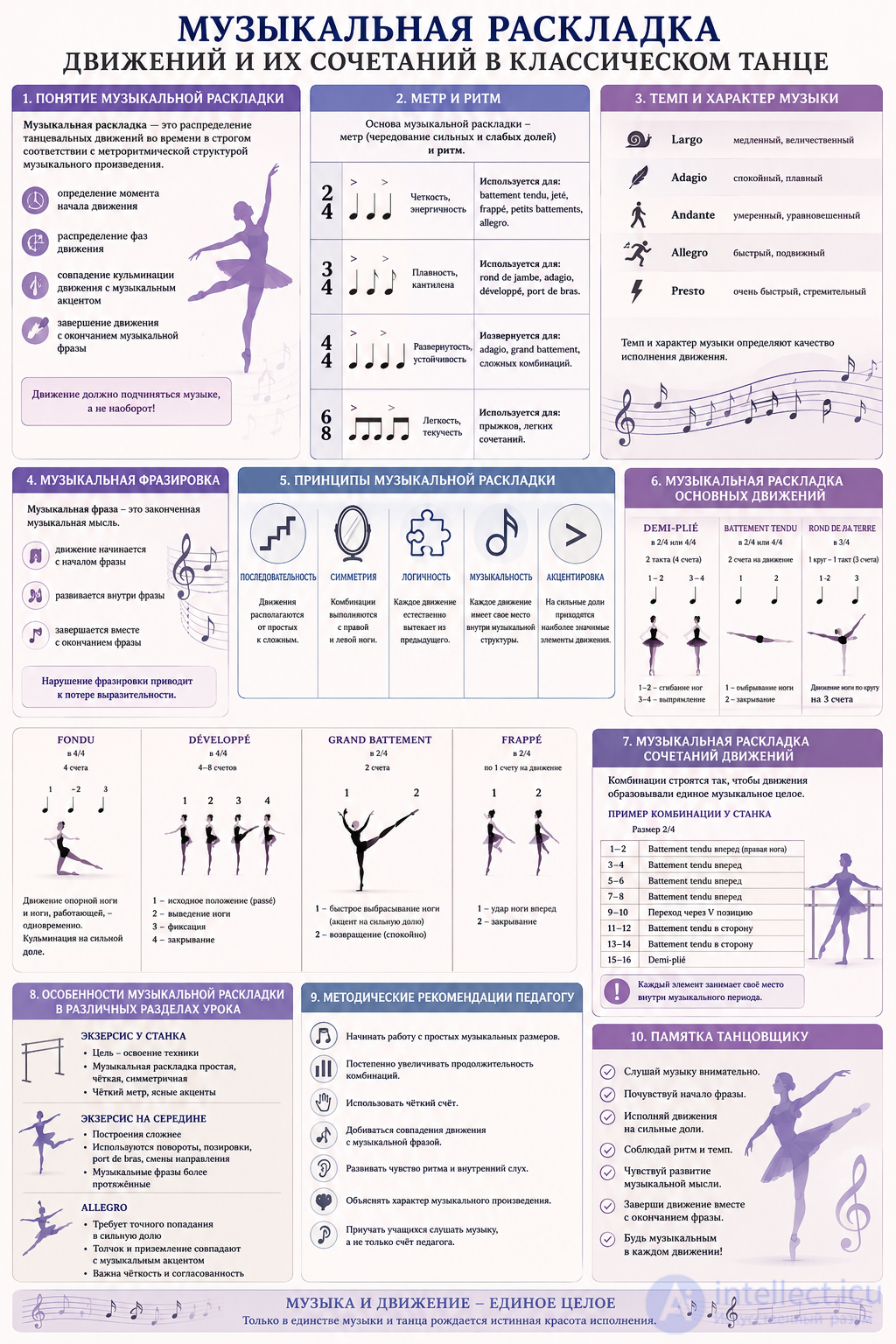
The musical breakdown is the distribution of dance movements in time in strict accordance with the metro-rhythmic structure of the musical work.
It includes:
The musical breakdown is built with regard to:
Meter and rhythm are the foundation of the musical breakdown.
Meter is the regular alternation of strong and weak beats.
The most common time signatures used in a classical dance class are:
Each time signature determines the specific character of how the movements are performed.
Used for:
Distinguished by clarity, energy and sharply defined accents.
Characteristic of:
Allows for smoothness, cantilena and expressiveness of movement.
Used when building:
Allows movements to be performed in a more expansive, unfolded manner.
Gives movements:
Tempo determines the speed at which a movement is performed.
The following are distinguished:
One and the same movement can take on an entirely different character depending on the tempo of its execution.
For example:
Battement tendu
A musical phrase is a complete musical thought.
A movement should:
A violation of phrasing leads to a loss of artistic expressiveness.
The teacher must train students to feel the beginning, development and conclusion of a musical thought.
The following principles are observed when composing combinations:
Sequence
Movements are arranged from simple to complex.
Symmetry
Combinations must always be performed on both the right and the left leg.
Logic
Each subsequent movement follows naturally from the one before it.
Musicality
Each movement has its own place within the musical structure.
Accentuation
The strong beats carry the most significant elements of the movement.
Usually performed over two or four measures.
1st measure — bending the legs.
2nd measure — straightening.
At a slow tempo the movement may take up eight counts.
A breakdown option:
Or:
Performed predominantly in 2/4 time.
Each opening and closing coincides with a separate beat.
Most often performed in 3/4 time.
A full circle may take:
It all depends on the students' level of training.
Performed smoothly.
The movement of the working leg and the supporting leg happens simultaneously.
The culmination coincides with the strong beat of the measure.
The breakdown is most often:
4–8 counts may be allotted for the execution of the movement.
More often performed in 2/4 time.
The accent falls on the fast throw of the leg.
The return is performed more calmly.
Combinations are built so that the movements form a single musical whole.
For example:
Battement tendu
4 times to the front
4 times to the side
4 times to the back
Transition through fifth position
Concluding demi-plié
The entire combination may take up eight or sixteen measures.
In this case, each element has a strictly defined place within the musical period.
The main task is mastering technique.
The musical breakdown is simple, clear and symmetrical.
The musical structures become more complex.
The following are used:
The musical breakdown requires:
When teaching the musical breakdown, the teacher should:
Special attention is given to developing an inner musical ear, which allows movements to be performed without constant external counting.
The musical breakdown of movements is one of the most important components of the methodology of teaching classical dance. It ensures the unity of music and movement and fosters the development of musicality, a sense of rhythm, performing expressiveness and technical proficiency in the dancer.
The ability to correctly distribute movements within the musical structure makes it possible to create complete choreographic combinations, helps shape artistic taste, and is the foundation of a ballet artist's professional mastery. A command of the principles of musical breakdown is necessary for both the performer and the teacher-choreographer, since it is through music that the artistic meaning of classical dance is revealed.
Sign in and the lectures you have studied will be marked in this list.
Choose a course
Comments