Turns (pirouettes, tours) are one of the most important elements of classical dance. They require a high degree of coordination of movement, stability, muscular strength, a sense of balance and musicality. High-quality execution of turns is impossible without the correct placement of the torso, head, arms and legs, and without an understanding of the principles of maintaining the body's axis.
In classical dance, turns are performed at different tempos, in different directions and from different starting positions, which considerably complicates the technique of their execution and requires gradual mastery.
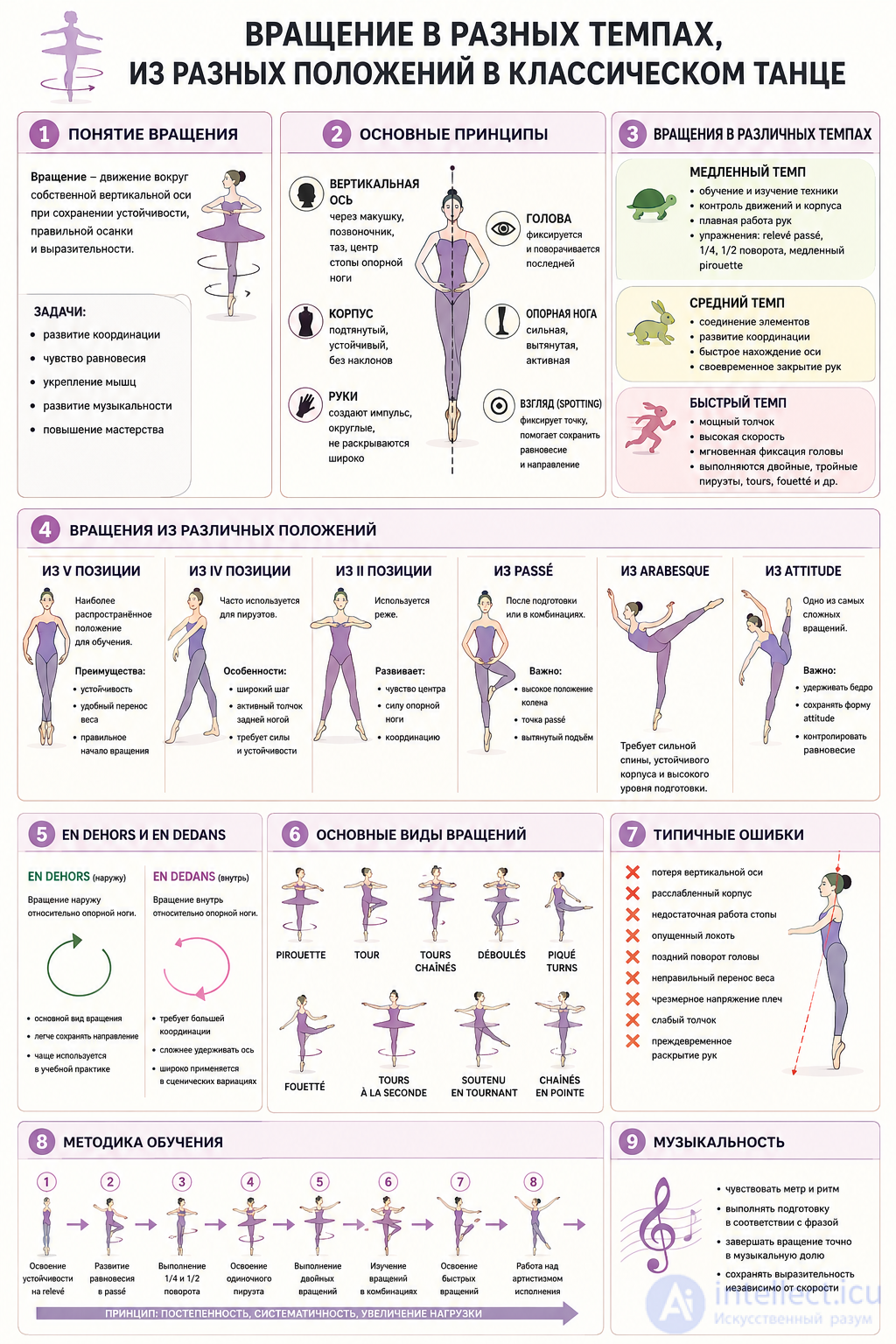
1. The Concept of Turning in Classical Dance
A turn is the movement of the performer around their own vertical axis while maintaining stability, correct posture and expressiveness.
The main objectives of turning are:
- developing coordination;
- perfecting the sense of balance;
- strengthening the muscular system;
- developing musicality;
- raising the level of performing skill.
The foundation of any turn is:
- a correct axis of the body;
- a strong supporting leg;
- a lifted torso;
- active work of the arms;
- a precise fixation of the gaze (spotting).
2. Basic Principles of Executing Turns
When performing a turn the following rules must be observed:
The Vertical Axis
The axis of the body must pass through:
- the crown of the head;
- the spine;
- the pelvis;
- the center of the supporting foot.
Any deviation of the torso leads to a loss of balance.
Work of the Torso
The torso must be:
- lifted;
- stable;
- free of any lean forward or back.
Work of the Head
The head completes the turn last.
Fixing the gaze helps to:
- avoid dizziness;
- maintain direction;
- improve stability.
Work of the Arms
The arms create the impulse for the turn.
During the turn they:
- do not open too wide;
- keep a rounded shape;
- hold the center of gravity.
3. Turns at Different Tempos
Tempo has a significant influence on the technique of executing a turn.
Slow Tempo
Used:
- at the initial stage of training;
- for studying the technique;
- for developing stability.
Features:
- a slow transfer of weight;
- a conscious placement of the legs;
- control of the torso;
- smooth work of the arms.
Typical exercises:
- relevé passé;
- a quarter turn;
- a half turn;
- a slow pirouette.
Moderate Tempo
Allows for:
- linking elements together;
- developing coordination;
- forming automatism of movement.
The performer must:
- find the axis quickly;
- maintain balance;
- close the arms in good time.
Fast Tempo
Used in concert practice.
Features:
- a powerful push-off;
- a high speed of rotation;
- an instantaneous fixation of the head;
- precise work of the torso.
At a fast tempo the following are performed:
- double pirouettes;
- triple pirouettes;
- tours en dehors;
- tours en dedans;
- fouetté;
- tours à la seconde.
4. Turns from Different Positions
The technique of execution depends on the starting position.
From Fifth Position
The most common variant used in training.
Used for:
- the first pirouettes;
- tours en dehors;
- tours en dedans.
Advantages:
- a stable position;
- a convenient transfer of weight;
- a correct start to the turn.
From Fourth Position
Most often applied for the execution of single and double pirouettes.
Features:
- a wide step;
- a correct distribution of weight;
- an active push-off with the back leg.
Requires good leg strength and stability of the torso.
From Second Position
Used considerably less often.
Develops:
- a sense of the center;
- the strength of the supporting leg;
- coordination.
From the Passé Position
Performed both after a preparation and within combinations.
It is important to maintain:
- a high position of the knee;
- the passé point;
- a stretched instep.
From Arabesque
Used predominantly in the senior classes.
Requires:
- a strong back;
- a stable torso;
- a high level of training.
From Attitude
One of the most difficult turns.
It is necessary to:
- hold the position of the thigh;
- maintain the shape of the attitude;
- control the balance.
5. Turns En Dehors and En Dedans
En Dehors
The turn is performed outward relative to the supporting leg.
Features:
- considered the basic type of turn;
- easier to maintain direction;
- more often used in classroom practice.
En Dedans
The turn is performed inward.
Features:
- requires a higher degree of coordination;
- harder to hold the axis;
- widely applied in stage variations.
6. The Most Common Types of Turns
The basic turns of classical dance include:
- pirouette;
- tour;
- tours chaînés;
- déboulés;
- piqué turns;
- fouetté;
- tours à la seconde;
- soutenu en tournant;
- chaînés en pointe.
Each type requires its own technique of preparation and execution.
7. Typical Mistakes
The most frequently encountered are:
- loss of the vertical axis;
- a relaxed torso;
- insufficient work of the foot;
- a dropped elbow;
- a late turn of the head;
- an incorrect transfer of weight;
- excessive tension in the shoulders;
- a weak push-off;
- a premature opening of the arms.
8. Teaching Method
The sequence of training is built on the principle of gradual increase in difficulty:
- Mastering stability in relevé.
- Developing balance in passé.
- Performing a quarter and a half turn.
- Mastering a single pirouette.
- Performing double turns.
- Studying turns within combinations.
- Mastering fast turns.
- Working on artistry of performance.
It is important to observe the principle of consistency and a gradual increase in load.
9. Musicality in the Execution of Turns
The execution of turns is closely tied to the musical accompaniment.
The dancer must:
- feel the meter and rhythm;
- perform the preparation in accordance with the musical phrase;
- complete the turn precisely on the musical beat;
- maintain expressiveness regardless of the speed of execution.
Musicality makes a turn not only technically precise but also artistically expressive.
Conclusion
Turns in classical dance are one of the most complex technical elements, uniting physical preparation, coordination, a sense of balance and musicality. Mastering turns at different tempos and from different starting positions fosters the development of a dancer's performing skill, confidence and stage expressiveness. Consistent study of the technique, constant work on stability, precision of movement and artistic image make it possible to reach a high level of performance and to use turns freely as an expressive means of classical dance.


Comments